

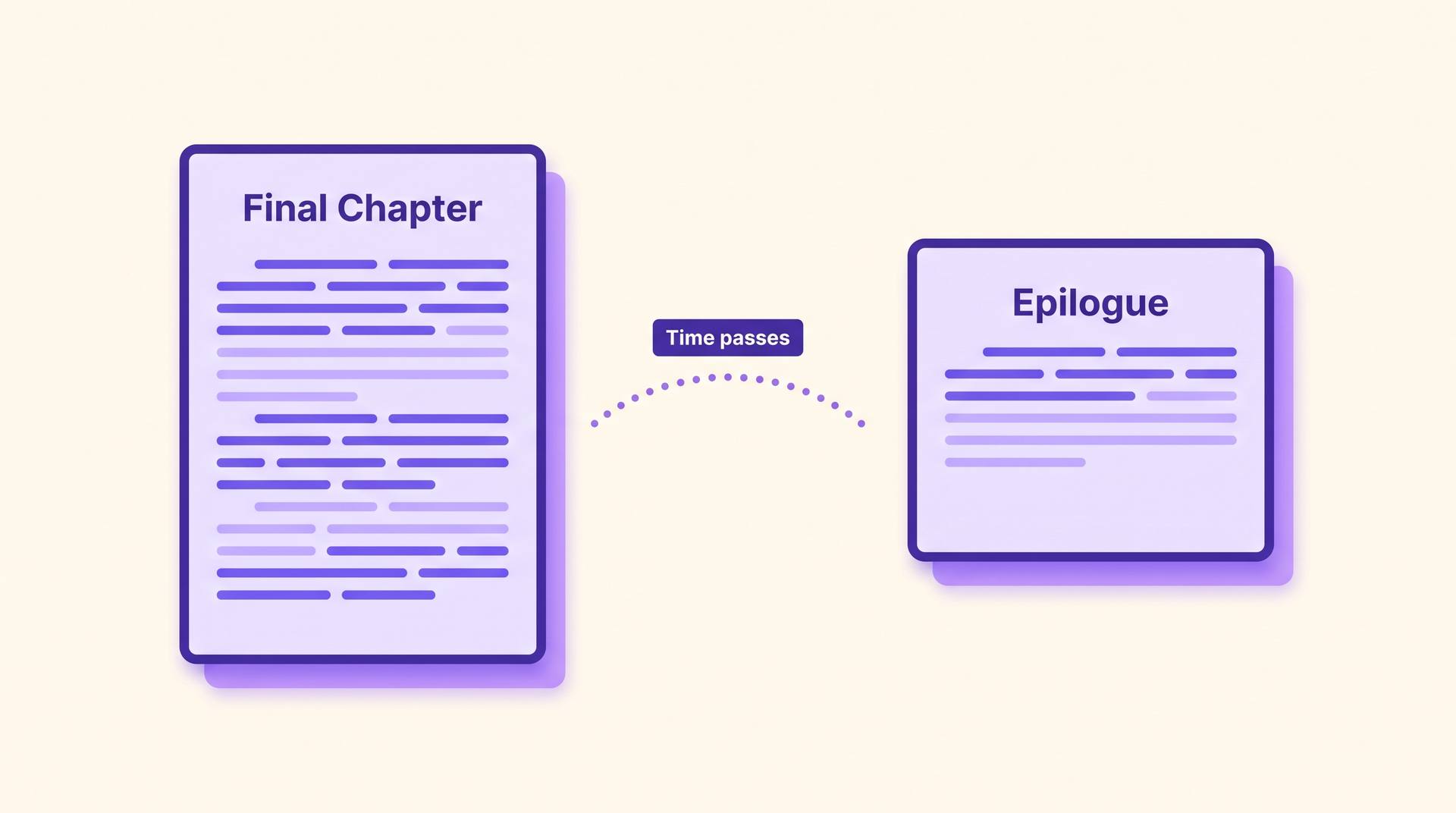
Your ending is finished. So what is this chapter for?
Readers arrive at an epilogue with their emotional business already settled. The question is answered, the villain is handled, the couple either got there or didn't. Anything you put on the page now has to justify keeping them in the book past the moment they were ready to close it.
That is the whole test, and almost every weak epilogue fails it the same way: it reports the future instead of changing the present. A list of who married whom and who took over the family farm is information, not story. It reads as the author reluctant to stop typing.
A good epilogue does one thing the final chapter structurally cannot do, because it stands on the far side of a gap in time. It can show consequence. It can prove a promise was kept, or quietly reveal it wasn't. It can widen the frame so the story turns out to have been about something slightly larger than you let on. None of that is available to a chapter that happens ten minutes after the climax.
Epilogue, ending, denouement: the actual difference
These four terms get used interchangeably in craft advice, which is why so many writers write an epilogue when what their book needed was two more pages of falling action. The distinction is structural, not stylistic.
| Element | Where it sits | What it does |
|---|---|---|
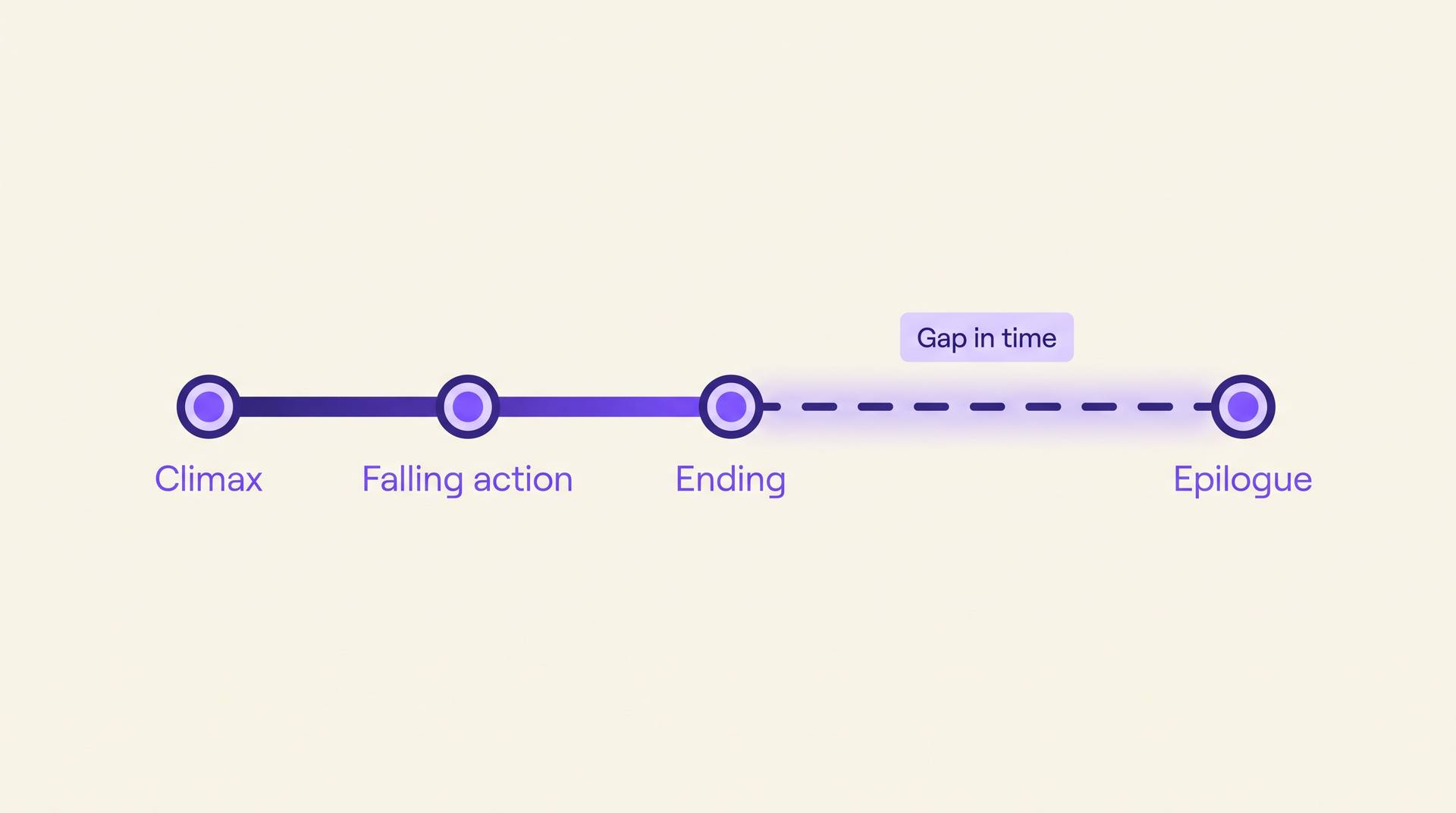
| Climax | Peak of the story | The decisive confrontation. Everything before it was setup; everything after is consequence. |
| Falling action | Immediately after | The dust settles in real time. Injuries, arrests, confessions, the drive home. |
| Denouement | End of the final chapter | The knots untie. Open questions get answers and the character lands in their new normal. |
| Epilogue | After a gap in time | A separate scene, later, that recontextualises what the ending cost or set in motion. |
| Afterword | Outside the story | You talking to the reader as yourself. Research notes, thanks, why you wrote it. |
If your draft has no time gap, you do not have an epilogue — you have a final chapter with a fancy label. And if your last chapter still has questions hanging in it, fix that first: the denouement is where loose ends get tied, and an epilogue cannot do that job at a distance of five years.
The four jobs an epilogue can do
Before you write a word, name which of these your epilogue is for. Trying to do three at once is how you end up with four pages of pleasant nothing.
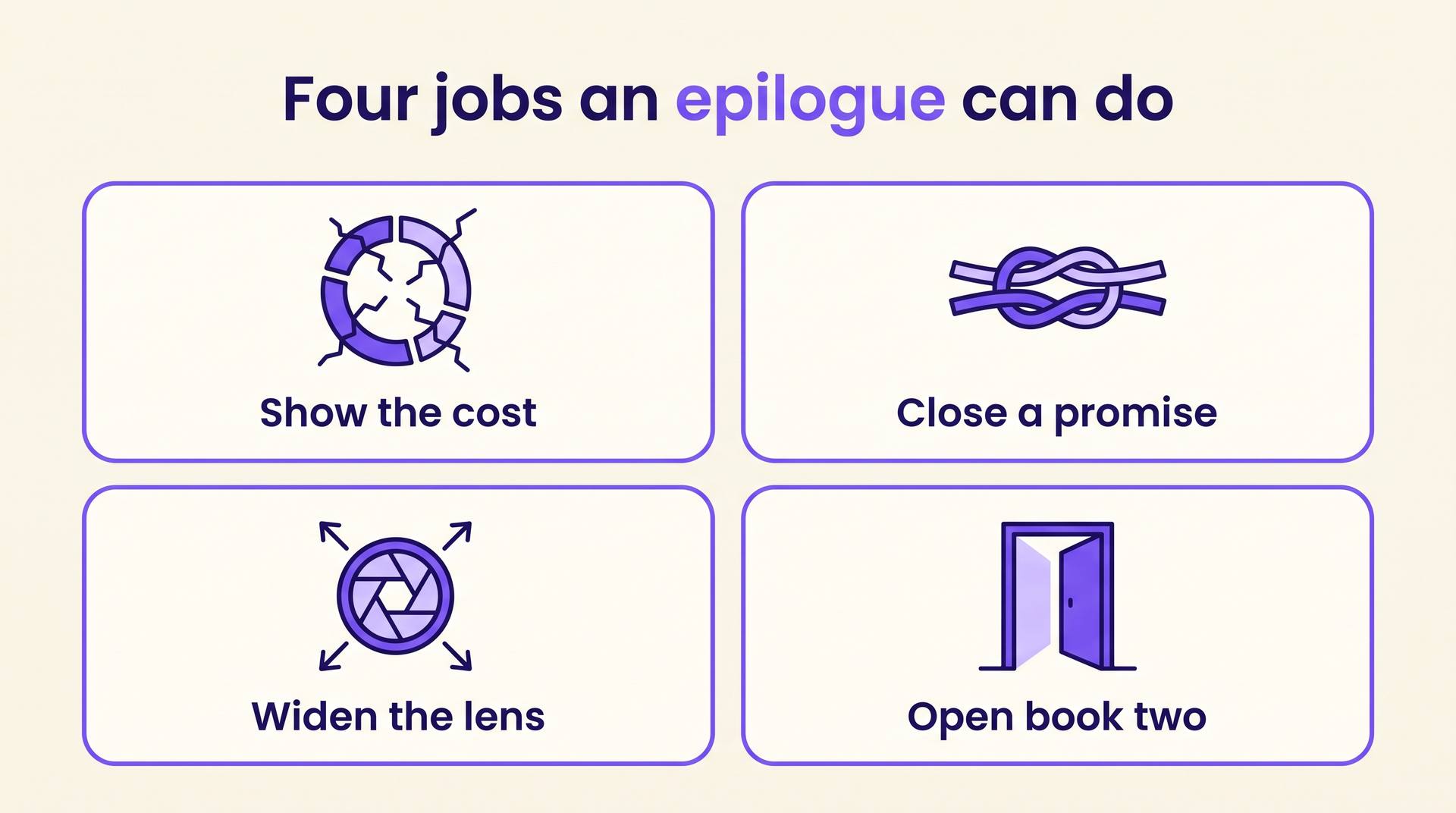
Show the cost
The climax was a win. The epilogue shows what the win was paid for with — a friendship that never recovered, a hand that still shakes, a town that quietly stopped inviting her. This is the most emotionally powerful option and the least used.
Close a promise
You planted something early that the plot never needed to resolve: a letter, a name, a debt, a returning ship. The epilogue pays it off. This works best when the reader half-forgot it, so the payoff lands as recognition rather than bookkeeping.
Widen the lens
Switch scale or point of view. A minor character tells the story's aftermath as gossip; a museum placard describes the events a century on; the narrator's grandchild finds the object we watched being made. The book was about a person; now it is also about time.
Open book two
A sequel hook — but only if book one's own ending is genuinely complete. Readers forgive a new question; they don't forgive an unanswered old one. If you're writing a planned series, decide the hook while outlining, not after.
Notice what is not on that list: summarising what happened, telling us everyone was fine, or explaining your theme. If your epilogue's real job is "let the reader say goodbye," that feeling belongs in the last page of your final chapter, where it is free.
Pick your time gap first
The distance between the ending and the epilogue is not a detail — it decides what the scene can carry. Pick one and the content almost writes itself. Tap a gap to see what it buys you.
Five years
Proof that the change held. Enough time for consequences to compound and for a promise to be kept or broken.
The default for most novels. It is long enough that we need a concrete anchor in the first line — a season, a place, a child who can now walk — and short enough that we still care about these exact people.
800 to 1,500 wordsA six-step method that works
This is the order I'd use on a draft that already has a solid ending. It takes an afternoon, and the first three steps are the ones that decide whether the epilogue is worth writing at all.
Write the one-sentence justification
"This epilogue exists so the reader learns X, which chapter thirty could not show because Y." If you cannot fill in Y honestly, stop here. You have saved yourself 1,200 words and a reviewer complaint.
Choose one job and one gap
From the two sections above. Write both at the top of the page and leave them there while you draft — they are the fence that keeps the scene from sprawling into a life update for every surviving character.
Find the single image the scene is built on
Not an event: an image. The repaired boat. The second, smaller scar. The name on a new mailbox. Epilogues live or die on concrete objects, because after a time skip the reader has nothing to hold on to and an object orients them instantly.
Open with the anchor, not the explanation
First sentence establishes when and where, physically. "The orchard took four years to come back." Never open with a paragraph of catch-up narration; that is the single most common reason readers skim an epilogue to its last line.
Restrict yourself to one scene and one viewpoint
One place, one continuous stretch of time, one head. The moment you cut to a second location you have written a montage, and montages feel like credits rolling.
End on a line that reaches forward, not back
The last sentence should imply motion — something about to happen, a choice half-made, a door not yet opened. Endings that summarise are inert. Endings that lean forward leave the reader with the pleasant feeling that the world continues without them.
If your epilogue's job is to open book two, this is the point to check that the hook is consistent with where the sequel actually starts. Our series planner maps book-to-book arcs, and inside AIWriteBook you can carry an existing book's characters, world, and voice into the next one instead of re-describing them from scratch.
It is the small, dull details of continued life that make an ending true.
Almost every memorable epilogue is built on an ordinary, verifiable detail — a bus timetable, a hospital corridor, a paid-off mortgage — rather than on a dramatic reveal. Grand epilogues age badly; small ones don't.
A worked example, rewritten
Here is a generic fantasy epilogue of the kind that appears in perhaps a third of the drafts I see, followed by the same material doing actual work. Same characters, same facts, roughly the same length.
The padding version
Five years after the siege, Maren was queen, and the kingdom prospered. She had married Tomas, and their two children played in the gardens where soldiers had once fallen. Trade returned to the harbour. The old wounds had healed, and the people sang songs about the Battle of the Low Gate. Sometimes, in the evenings, Maren thought about her brother, and she smiled, because she knew he would have been proud.
Everything here is a report. Four facts, zero scene, no image, and a final line that tells the reader which emotion to feel. It also answers nothing the last chapter left open — it just confirms that things went fine.
The working version
The masons finished the Low Gate in autumn, and they built it two hands narrower than before. Maren noticed on the first morning she rode through it, her knee brushing stone. Nobody had asked her. Nobody had asked anyone; the men had simply decided, the way people decide things after, that a gate wide enough for a column of horse was a gate wide enough for the next one. She said nothing about it that day, or the week after. On the anniversary she came down alone with a chisel and cut her brother's name into the inner arch, low, at the height of a child's eye, where the masons would have to work around it forever.
Same five-year gap, same peace, same dead brother. But now there is one image (the narrowed gate), one concrete action, and a cost that nobody states: the kingdom has quietly agreed there will be a next war. The last line reaches forward — the name will outlast her — instead of summarising backward.
The rewrite is not more dramatic. It is more specific. If you want more of this technique applied across a whole manuscript, our guide to showing instead of telling covers the same move at sentence level.
Six mistakes that make readers skim
The wedding-and-baby default
An epilogue in which the couple are married with children is not wrong — in romance it is often contractual — but it is only interesting if something in it is specific to these two people. Give them one detail no other couple could have.
Tying knots the chapter should have tied
If readers need the epilogue to find out whether the protagonist survived, your ending is incomplete. Epilogues add resonance to a closed story; they cannot close an open one.
The roll call
One paragraph per surviving character, reporting their fate. This is the structure of a yearbook, not a scene. Pick one character and let the others be visible only through them.
Explaining your own theme
"She understood, at last, that home was not a place but the people in it." If the book worked, the reader got there on their own two chapters ago and resents the tutorial.
A sequel hook that steals the ending
The shadowy figure watching from the treeline, three lines from the end. It converts a finished book into an advertisement, and it is the single most common one-star complaint about series fiction.
Different prose than the rest of the book
Epilogues tempt writers into a grander, more lyrical register than they used for 90,000 words. The tonal jump is audible. Write it in the voice the book has earned, not the voice you wish it had.
Drafting one with AI without flattening it
AI is genuinely useful here and genuinely dangerous here, for the same reason: an epilogue is the most formulaic chapter in fiction, so a model will happily hand you the wedding-and-baby default in polished prose. Use it for the parts that are analysis, and keep the image for yourself.
Audit before you draft
Ask it to list every promise, planted object, and unanswered question in your manuscript, with chapter numbers. This is genuinely tedious to do by hand across 90,000 words, and the list usually contains two or three threads you'd forgotten. Those are your epilogue candidates.
Generate options you will reject
Ask for eight epilogue premises across different jobs and time gaps, one line each. Do not ask for prose. The point is to see the obvious ones written down so you stop accidentally choosing them, and to find the one option that surprises you.
Draft in your own voice, not a generic one
In AIWriteBook you can set a writing style from your own sample text, so the generated chapter comes back in the register the rest of the book uses rather than the polished-neutral default that makes epilogues sound like press releases.
Revise line by line, not wholesale
The chapter AI chat lets you rewrite one paragraph at a time and accept or reject each change as a diff, which is the right granularity for a chapter whose whole value is in five or six specific sentences.
Whatever you generate, the single image in step three should be yours. That is the part readers quote back to you, and it is the part no model has any way of knowing.
Questions writers actually ask
Most working epilogues run between 600 and 1,500 words — usually shorter than your average chapter. Length should follow the time gap: a six-month jump can sustain more scene than a hundred-year one, which works best as a short, cold fragment. If yours is running past 2,000 words, it is probably doing two jobs and should either be split or demoted to a final chapter.
The test, one more time
Before you keep the epilogue you just wrote, read the final chapter's last line, then skip straight to the epilogue's last line. If the book is better for the distance between them — if something has been paid for, proved, or reframed — keep it. If the two lines say roughly the same thing in different words, delete the epilogue and let your ending be the ending.
The writers who get this right tend to be the ones who decided during outlining that the book needed a coda and what it was for, rather than discovering at 88,000 words that they weren't ready to stop. It is much easier to earn an epilogue than to retrofit one.
If you're working through structure more broadly — where the climax sits, how much falling action a genre wants, when a time jump helps — the rest of our guide to writing a book covers the chapters that come before this one.