

Why the ending carries the review
An ending is not the place where the story stops. It is the place where the reader finds out what the story was about. Every scene before it was a claim; the ending is the evidence. That is why a book with a shaky first act and a devastating final chapter gets recommended, and a book with a brilliant opening and a limp close gets described as "good but" — the two most damaging words in a review.
There is a practical reason too. The last page is the closest point to your back matter. A reader who closes the book feeling something is a reader who will scroll one more screen to your also-by list, your newsletter signup, and the first chapter of book two. A reader who closes the book feeling cheated closes the app instead.
The mechanical part of that hand-off is easy to get right — an author note, a series list and a review request in the right order — and worth assembling once you know how the story lands, with the free back matter generator.
The promise-and-payoff test
Almost every unsatisfying ending fails the same test. Somewhere in the first fifty pages you made the reader three promises, usually without naming them: a question they now want answered, a desire they now want fulfilled, and a threat they now want resolved. The ending is where you settle all three — or deliberately, visibly refuse to.
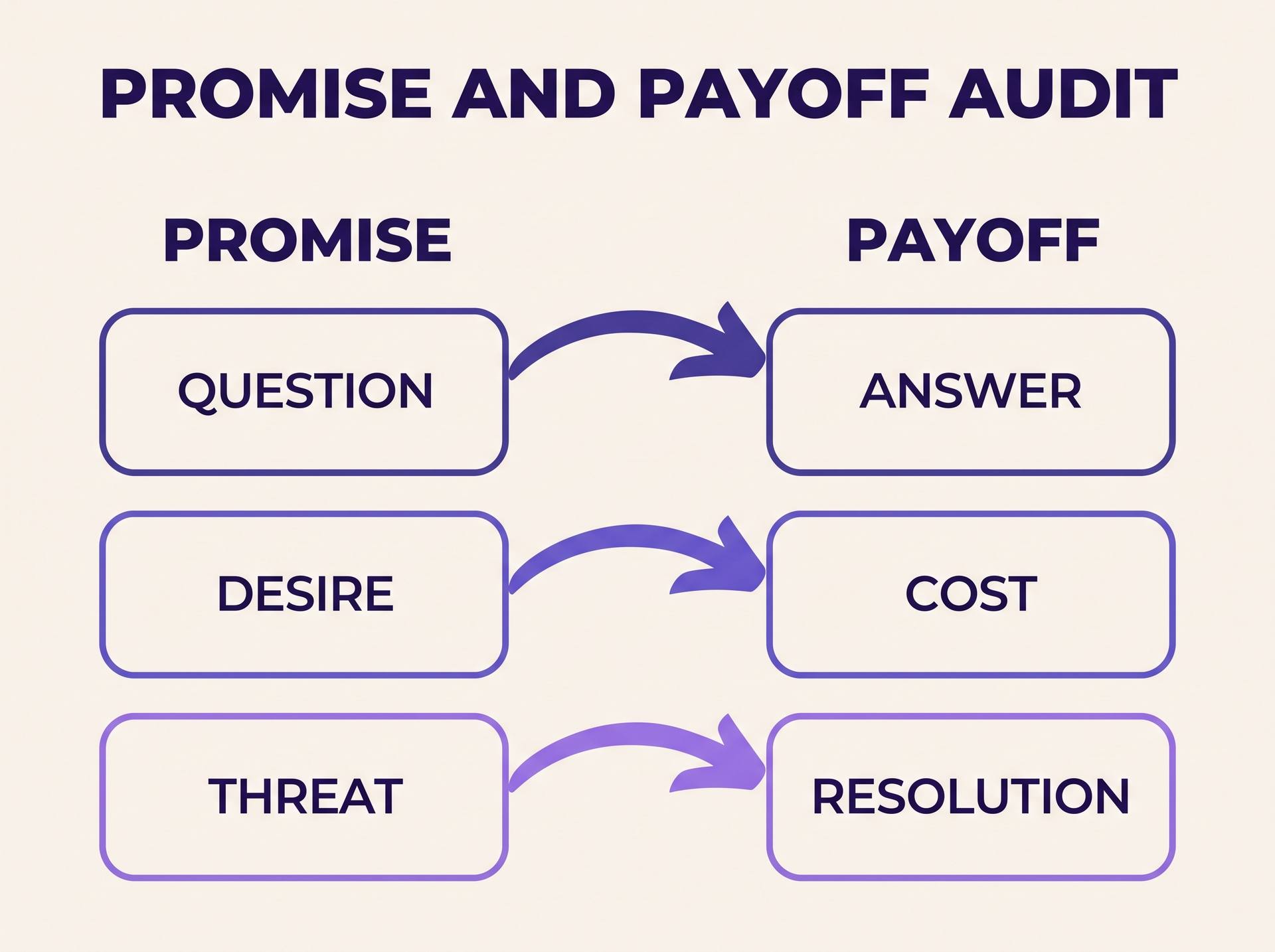
Run the audit literally. Open your first chapter and write down the exact question the reader is left holding, the exact thing your protagonist wants, and the exact thing that could take it away. Then open your last chapter and find the sentence that answers each one. If you cannot point at a sentence, the reader cannot either — that is the gap they will describe as "it just sort of ended".
The audit also catches the opposite failure: payoffs for promises you never made. A rescue that arrives from nowhere, an ability the hero never had before, a villain who confesses for no reason. That is deus ex machina, and readers detect it instantly even when they cannot name it. The fix is always upstream — plant the thing earlier, in a scene that has its own reason to exist.
The reverse discipline matters just as much: anything you loaded in act one should fire before the end, or be cut. That is the whole of Chekhov's gun, and it is the cheapest structural edit available to you.
Six ending types, and when each works
"Happy or sad" is not a useful axis. What actually differs between endings is how much the reader is left holding. Here are the six shapes worth knowing, from the most closed to the most open.
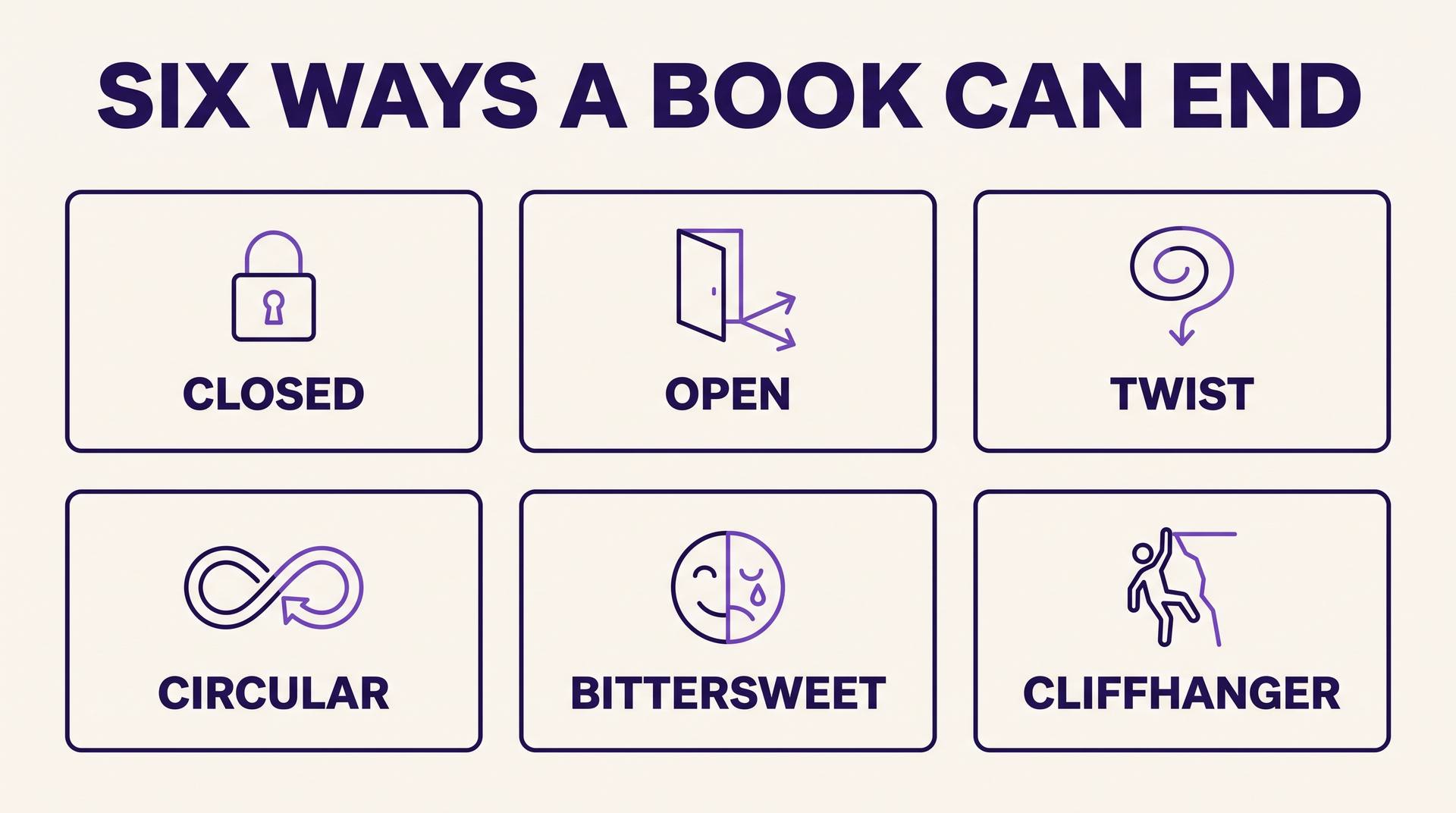
Closed
Every major thread is resolved and the reader is told what it meant. The default for commercial fiction and the only safe choice in romance and cozy mystery, where an unresolved ending is a genre violation, not a bold move.
Best when: the pleasure of the book is the puzzle or the relationship.
Open
The central conflict resolves, but the consequences are left for the reader to imagine. Not the same as unfinished — an open ending still answers the story question, it just declines to narrate the aftermath.
Best when: the theme is ambiguity, and literary readers expect to do work.
Twist
A late reveal reframes what came before. It only works if the reader can reread the earlier chapters and find the twist was there the whole time, visible and misread. A twist that requires new information is a cheat.
Best when: you have planted at least three legitimate clues.
Circular
The ending echoes the opening image, line or situation, with everything changed underneath. Cheap to execute, disproportionately satisfying, and the single most reliable way to make a book feel designed rather than merely finished.
Best when: your protagonist changed but their world did not.
Bittersweet
The goal is achieved at a cost the reader feels. Usually the most memorable of the six, because it refuses to pretend the story was free. Requires that the cost be something you made the reader care about earlier.
Best when: the book is about a trade-off rather than a victory.
Cliffhanger
The book's own conflict resolves, and a new one opens on the final pages. The rule that keeps readers rather than losing them: resolve this book, then raise the next question. A cliffhanger that withholds this book's payoff reads as a sales tactic and gets reviewed as one.
Best when: book two is written, or at least dated.
If you are planning a cliffhanger, decide the shape of the whole arc before you write it. Mapping which questions close in each volume and which stay open is the difference between a series and a serial that runs out of road. series planner.
A six-step method for the last act
The ending is not one scene; it is a sequence with a fixed job list. Work through these in order and most of the guesswork disappears.
- 1
Name the story question in one sentence
Write it as a yes-or-no question: will she get the farm back? Will he tell the truth in court? Everything in the last act either moves toward answering it or gets cut. If you cannot phrase it in one sentence, the ending will feel diffuse because the book is.
- 2
Force the protagonist to choose, not to win
The climax lands when the outcome depends on a decision only this character, changed by this book, could make. If the ending would play out identically with a different protagonist, it is an event, not a climax. More on how a climax earns its place.
- 3
Pay the cost on the page
Whatever the victory costs — a person, a belief, a version of themselves — show it happening rather than reporting it afterwards. Endings feel unearned mostly when the cost is summarised in narration instead of dramatised in a scene.
- 4
Untie the secondary threads in order of the reader's attachment
Resolve subplots in ascending order of how much the reader cares, so the last thing they read is the one they cared about most. This stretch is the falling action, and its length is a genre decision more than a personal one. Worked examples of falling action in real books.
- 5
Show the new normal
One short scene of life after the change does more for reader satisfaction than three pages of reflection. This is the part most first drafts skip entirely, and it has a name: the denouement.
- 6
Cut backwards from the true last line
Find the last sentence that has real weight, then delete everything after it. Most first-draft endings run one to three pages long because the writer kept explaining after the story had finished speaking.
What each genre demands
Genre is a contract about endings more than about content. Break the wrong one and the one-star reviews will all say the same sentence.
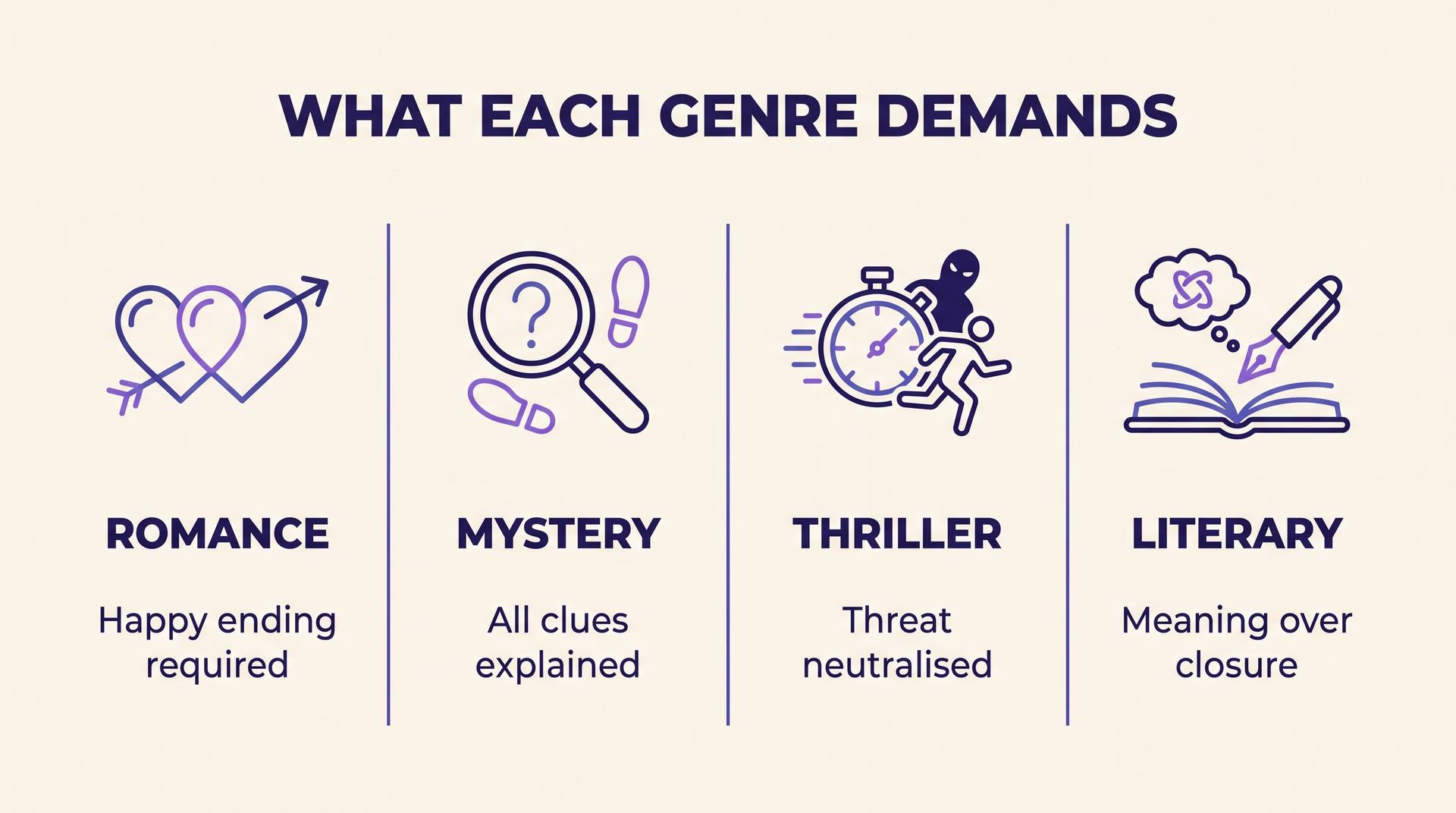
| Genre | Non-negotiable | Typical after-climax length | How it fails |
|---|---|---|---|
| Romance | A happy ever after, or happy for now, for the central couple | One to two chapters | Any other outcome is a genre breach, not a twist |
| Mystery | Every clue explained, culprit motivated, no new information | One chapter of explanation, one short scene after | A solution the reader could not have reached |
| Thriller | The threat neutralised and the stakes visibly settled | A few pages, deliberately short | Long reflective wind-down after a fast climax |
| Literary | Thematic resolution, plot resolution optional | Variable, often a single scene | Ambiguity used to cover an undecided author |
| Fantasy and SF | This volume's arc closed even inside a longer series | Two to three chapters, world included | Epilogue sprawl that dilutes the climax |
Length here is proportional, not absolute. Across the structural traditions, everything after the climax tends to occupy roughly the last five to ten percent of a manuscript — enough to land, short enough to keep the climax as the peak. three-act beat map.
Five mistakes that flatten an ending
Resolving with information instead of action
A character explains what happened, and the reader watches a conversation instead of a consequence. If your last chapter is mostly dialogue about events that occurred off-page, the ending is a report.
Introducing a new character or capability late
Anything that solves the problem must exist before the last act. A late arrival reads as the author intervening, no matter how well written the scene is.
Ending on the climax
The reader needs a breath after the peak. Cutting straight from the decisive moment to the last page leaves the emotional payoff unclaimed — you built it and then walked past it.
Tying off threads the reader forgot
Not every minor thread deserves a resolution scene. Chasing completeness for its own sake pads the ending and buries the thread that actually mattered.
Withholding this book's payoff to sell the next one
The most expensive mistake in a series. Readers who feel the first book was an advertisement do not buy the second, and they say so in the reviews the second book depends on.
Writing the last line
The last line does one of three jobs: it lands the image, it lands the change, or it lands the irony. Trying to do all three is why so many final sentences read as overwritten. Pick the job first, then write the sentence.
So we beat on, boats against the current, borne back ceaselessly into the past.
It resolves nothing about the plot. It states the book's argument in one image — which is the job of a last line, not summary.
Two practical habits help more than any amount of polishing. First, write your last line before you write the last chapter, then aim at it; you can always replace it, but having a target keeps the final pages from wandering. Second, read the last three paragraphs aloud. Endings are heard more than they are read, and the sentence that stumbles when spoken is nearly always the one to cut.
It also helps to reread your own opening line side by side with your closing one. The relationship between them is what makes a circular ending work, and it is easier to see once both exist. how strong openings are built.
The AI-assisted shortcut
The reason endings are hard is not that writers lack ideas — it is that they only get to test one. You write the ending, you are too close to judge it, and rewriting it costs a week. The useful thing AI changes here is the cost of comparison.
In AIWriteBook you can generate several distinct versions of your final chapter from the same outline and the same established characters, then read them next to each other. Written in your book's own context, the differences are structural rather than cosmetic: one version pays the cost on the page, another resolves off-stage, a third ends two pages earlier. Seeing them together makes the right choice obvious in a way that staring at a single draft never does.
Three things in the app do most of the work on an ending. The chapter AI chat edits your final chapter with a diff view, so you accept or reject each change instead of surrendering the paragraph. The writing style setting keeps every generated version in your voice rather than a house voice. And if you are writing a series, book two can be built on book one's characters and events, so a cliffhanger written now still has to be paid for later. chapter writing.
If you are only stuck on the reveal itself, the free plot twist generator will throw twenty late-story turns at your premise in a few seconds — most will be wrong for your book, and the two that are not will be worth the minute.
Three templates you can fill in
Fill these in with your own nouns before you write the scene. If a slot resists being filled, that is the part of the ending that is not decided yet.
The closed ending
[Protagonist] finally chooses [the thing they refused in act one], which costs them [specific loss]. [Antagonist force] is defeated because of [decision planted in chapter X]. In the final scene, [protagonist] is seen [ordinary action] — the same action as in chapter one, now meaning [new meaning].
The bittersweet ending
[Protagonist] gets [the goal], and loses [person or belief] to get it. The last conversation is with [character who represents the cost]. The book ends on [image of the goal] with [absence] visible inside it.
The series cliffhanger
This book's question — [question] — is answered: [answer]. The cost is [loss]. In the last two pages, [new information] arrives that makes [next book's question] unavoidable. Nothing this book promised is left open.
The test for all three is the same: hand the filled-in template to someone who has not read the book. If they can tell you what the story was about, the ending is doing its job.
Common questions about ending a book
Everything after the climax usually runs about five to ten percent of the manuscript — roughly four to eight thousand words in an eighty-thousand-word novel. Thrillers sit at the short end, fantasy and romance at the long end. If your after-climax section is longer than fifteen percent, you are almost certainly narrating things you could imply.
It depends entirely on genre. In literary fiction an open ending is a legitimate choice readers expect. In romance, cozy mystery and most commercial thrillers it reads as an unfinished book and shows up directly in reviews. The safe version everywhere: answer the central story question, then leave the aftermath open.
Writing the final scene early is one of the most useful things a drafting writer can do, even if you later replace it. It converts the middle from open-ended exploration into a route to a known destination, and it exposes missing setup while there is still time to plant it.
Close this book's story question completely, pay its cost on the page, and only then open the next one — ideally in the last two pages rather than the last two chapters. Readers accept a new question; they do not accept an unpaid old one.
It can write several credible endings from your outline and characters, quickly, which is genuinely useful for comparison and for breaking a stall. The judgement about which one is true to your book stays yours — and the version that ships is nearly always one you generated, then edited hard.
Finish the way you started: on purpose
Good endings are rarely the product of inspiration on the last day of drafting. They come from knowing which promises you made, choosing a shape deliberately, paying the cost in a scene rather than a summary, and cutting back to the sentence that actually carries weight. Every one of those is a decision you can make before you write the final chapter.
If you want the whole arc rather than just its last stretch, the full guide covers structure, drafting and publishing end to end. How to Write a Book.