


The denouement is the final section of a story, after the climax, in which the remaining tension is released, the consequences of the climax are shown, and the reader learns what the characters' lives look like now. It answers "so what happened to everyone?" rather than "who wins?"
Pronunciation
day-noo-MAHN (the final consonant is nasal and nearly silent, as in French). You will also hear the anglicized dey-NOO-mont. Both are accepted; the French-leaning version is more common among editors.
Why it's called "untying the knot"
Denouement comes from the French denouement, from denouer, to untie, built on the Latin nodus, knot. The image is exact and worth keeping in your head while you draft: a plot is a knot you spend the whole book tightening, the climax is the moment the knot is pulled hardest, and the denouement is the slow, deliberate loosening of every strand you twisted in.
That metaphor also tells you what belongs there. A strand you never tied does not need untying. If a subplot never created real tension, resolving it in the final chapter adds pages without adding relief. The denouement is not a place to introduce; it is a place to release.
Denouement vs falling action vs resolution vs epilogue
These four words get used interchangeably online, which is why the term confuses people. Here is how editors actually distinguish them.
| Term | Where it sits | What it does | Quick example |
|---|---|---|---|
| Falling action | Immediately after the climax | Discharges the physical momentum of the climax: the chase ends, the smoke clears, the wounded are carried out. | The battle is over and the survivors walk off the field. |
| Denouement | After the falling action, through the last page | Shows the new normal and settles emotional and thematic questions, not just plot ones. | We see who the survivors became a year later. |
| Resolution | A point, not a stretch | The specific moment the central story question gets its answer. It sits inside the denouement rather than replacing it. | The couple finally says yes. |
| Epilogue | After the story proper ends | An optional, clearly separated coda, usually with a time jump or a shift of narrator. It is a formatting choice, not a structural stage. | "Nineteen years later." |
In practice: every story has a denouement, even if it is one paragraph. Not every story has an epilogue, and "resolution" is best used for the moment rather than the section.
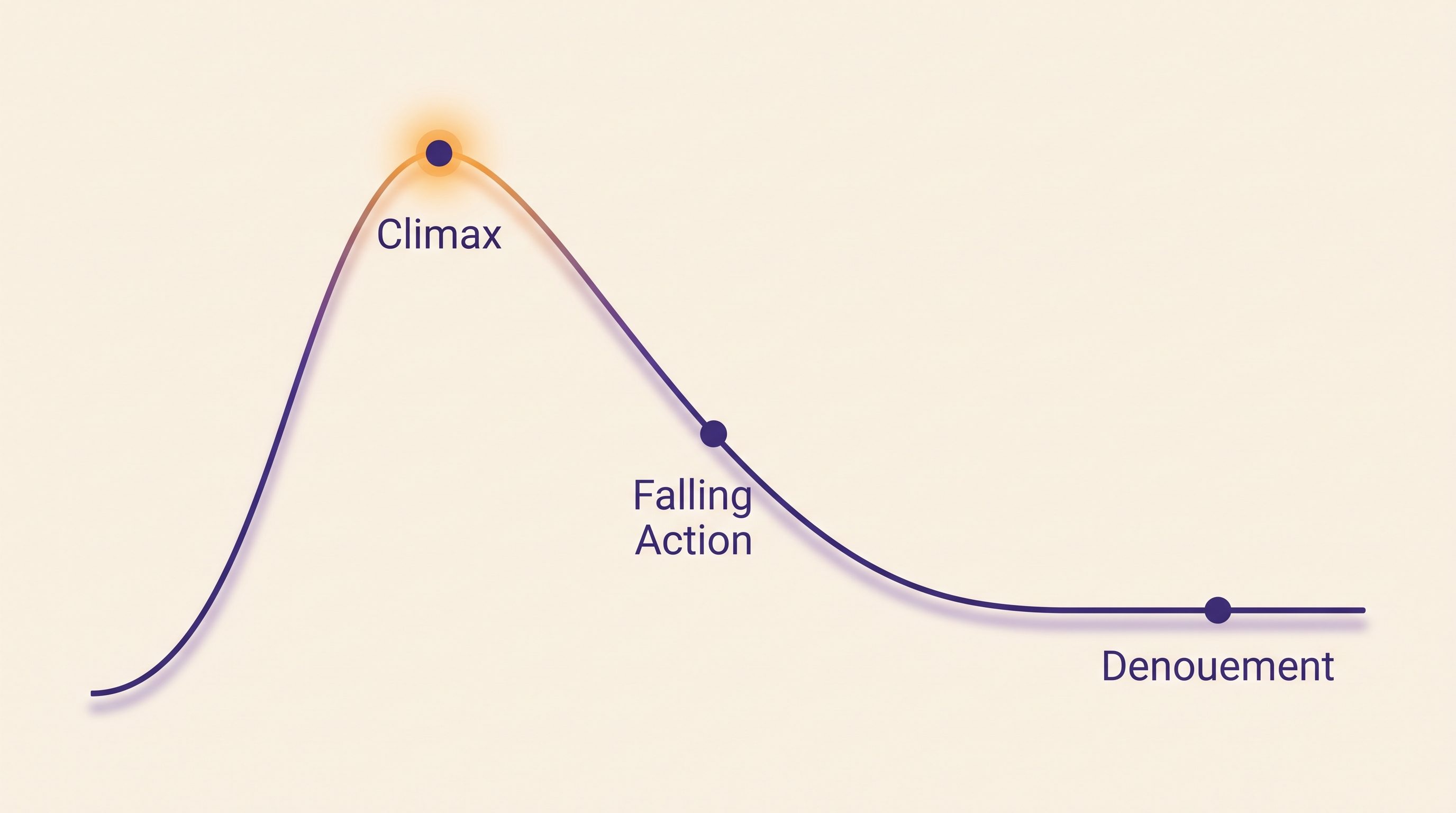
The denouement is the flat stretch at the end of the arc, where tension has already been discharged and the story settles into its new normal.
Three denouements worth studying
The useful thing about famous denouements is how differently they are paced. Length is a choice, and each of these authors chose deliberately.
Harry Potter and the Deathly Hallows
Rowling splits the work in two. The King's Cross chapter is a quiet, dreamlike conversation that explains what the climax actually meant before the final duel resolves it. Then the closing platform scene jumps ahead and shows the new normal in a few pages: the same station, the same train, a generation later, with nothing left to fear. The explanation and the emotional landing are handled by two separate scenes rather than crammed into one.
The Lord of the Rings
Tolkien wrote the most famously long denouement in English fiction. The Ring is destroyed, and the book keeps going: the coronation, the journeys home, the Scouring of the Shire, and the Grey Havens. Readers argue about it to this day, and both camps are right. It is genuinely slow, and it is also the only way the book can prove its thesis, which is that the hobbits who left cannot simply slot back into the life they left. A shorter ending would have been tidier and would have said less.
Pride and Prejudice
Austen goes the other way. Once Elizabeth accepts Darcy, the remaining chapters move fast and slightly dryly, sorting out the double wedding, Lydia's finances, Lady Catherine's fury and Mr Bennet's amusement in brisk summary. The tone shifts from scene to narration on purpose, signalling that the tension is over and the reader is being walked to the door.
Well, I'm back.
The last line of a very long denouement, and the reason it exists: the whole point of the ending is that someone comes home changed.
How long should it be?
As a working rule, the denouement runs about 1 to 5 percent of the book: roughly one to four pages in a 300-page novel, one or two chapters at the outside. Thrillers and horror sit at the short end because lingering deflates the fear. Epic fantasy, family sagas and literary fiction sit at the long end because the reader has invested in a whole world, not just an outcome.
The genre matters less than the count of open emotional threads. Tally the promises you actually made to the reader, give each one a beat, and stop. If you are unsure how much room that leaves you, our guide to how many chapters a book should have is a useful sanity check.
How to write one that lands
Five things that do most of the work.
- 1
Answer the emotional question, not just the plot one
The reader already knows who won from the climax. What they still want is to know whether it was worth it. Show the cost being paid or the relief being felt.
- 2
Give the protagonist one deliberate choice
A denouement in which everything simply happens to the characters reads as an epilogue. Let the hero make one small, uncoerced decision that would have been impossible for them in chapter one. That is your proof of change.
- 3
Return to an early image
Bring back the setting, object or line from your opening and let the reader feel the difference. It is the cheapest and most reliable way to make an ending feel designed rather than stopped.
- 4
Close subplots in descending order of heat
Hottest thread first, coolest last. Ending on a minor loose end makes the whole book feel anticlimactic, and ending on the biggest one leaves the remaining pages feeling like admin.
- 5
Cut the last scene, then read it again
Most drafts have one scene too many. Delete the final one and reread the new ending. If nothing is missing, you found your real last page.
The two mistakes almost everyone makes
Stopping at the climax
The manuscript ends on the last punch. It feels bold, and it usually reads as abrupt, because you have spent a whole book raising the reader's pulse and then closed the door while it is still high. Even a single page of quiet, giving the reader somewhere to land, changes how the entire book is remembered.
Three chapters of goodbyes
The opposite failure, and the more common one in first novels. Every side character gets a farewell scene, every minor question gets a paragraph, and the tension leaks out long before the last page. A good test: if a scene contains no new information and no new feeling, it is a goodbye, not a denouement. Summarize it in a sentence or cut it.
A useful sanity check on either failure: read the last ten pages aloud and mark where your own attention drops. That line is where your denouement should have ended.
Where AI actually helps with endings
Endings fail for a boring reason: by the time you get there you have forgotten half of what you promised. A thread you planted in chapter four is invisible to you in chapter thirty-one. This is the one part of drafting where a machine with perfect recall of your manuscript is genuinely more useful than a fresh pair of human eyes.
In AIWriteBook, the chapter AI chat reads your actual book rather than a summary of it, so you can ask it to list every open thread and every character whose arc has no closing beat, then apply its suggestions as tracked changes you accept or reject line by line. Nothing is rewritten behind your back.
If you are still shaping the ending rather than fixing it, the free outline generator will lay out the closing beats before you commit words to them, and the scene builder is useful for drafting the one quiet scene most denouements are missing.
Find every thread you left untied
Import your draft or start a new book, and let the chapter chat read the whole manuscript before you write your last page.
Related structure terms
The denouement only makes sense relative to the beats around it.
Climax
The peak of tension and the moment the central conflict is decided. Everything in the denouement is a consequence of it.
Falling action
The short stretch of physical fallout between the climax and the denouement proper.
Freytag's Pyramid
The five-part model that named these stages, and the reason "denouement" appears in almost every school diagram.
Inciting incident
The event that ties the knot in the first place. A denouement is only as satisfying as the promise made here.
The last page is a handshake
A denouement is not decoration and it is not a victory lap. It is the part of the book where you tell the reader what the story was about, by showing them what it cost and what remains. Get it wrong in either direction, too abrupt or too long, and a strong book ends on a weak note that readers remember better than the middle.
Untie every knot you tied. Untie nothing else. Then stop.