

Why chapter endings sell the next chapter
Readers do not put a book down in the middle of a scene. They put it down at the white space after a chapter, when the tension has resolved and the bedside lamp is still on. The last paragraph of each chapter is where you win or lose the next reading session.
For series authors the stakes are larger still. Readers who buy book two decided during the last chapters of book one, and in Kindle Unlimited you are paid for pages that actually get read. A book people finish is worth more than a book people start.
That does not mean every chapter needs a gunshot. It means every chapter should end with the reader holding a question they want answered.
The rule: question, stakes, fast payoff
A fair cliffhanger has three parts. Leave one out and it either falls flat or feels like manipulation.
A specific question
Not 'what will happen?' but 'who sent the text?' or 'will she tell him?'. The sharper the question, the harder it pulls.
Real stakes
The reader must already care about the answer. A cliffhanger in chapter one pulls less than one in chapter twenty because the stakes are not yet built.
A fast, honest payoff
Answer the question early in the next chapter, and answer it truthfully. Then raise a new one. That rhythm is what keeps readers up past midnight.
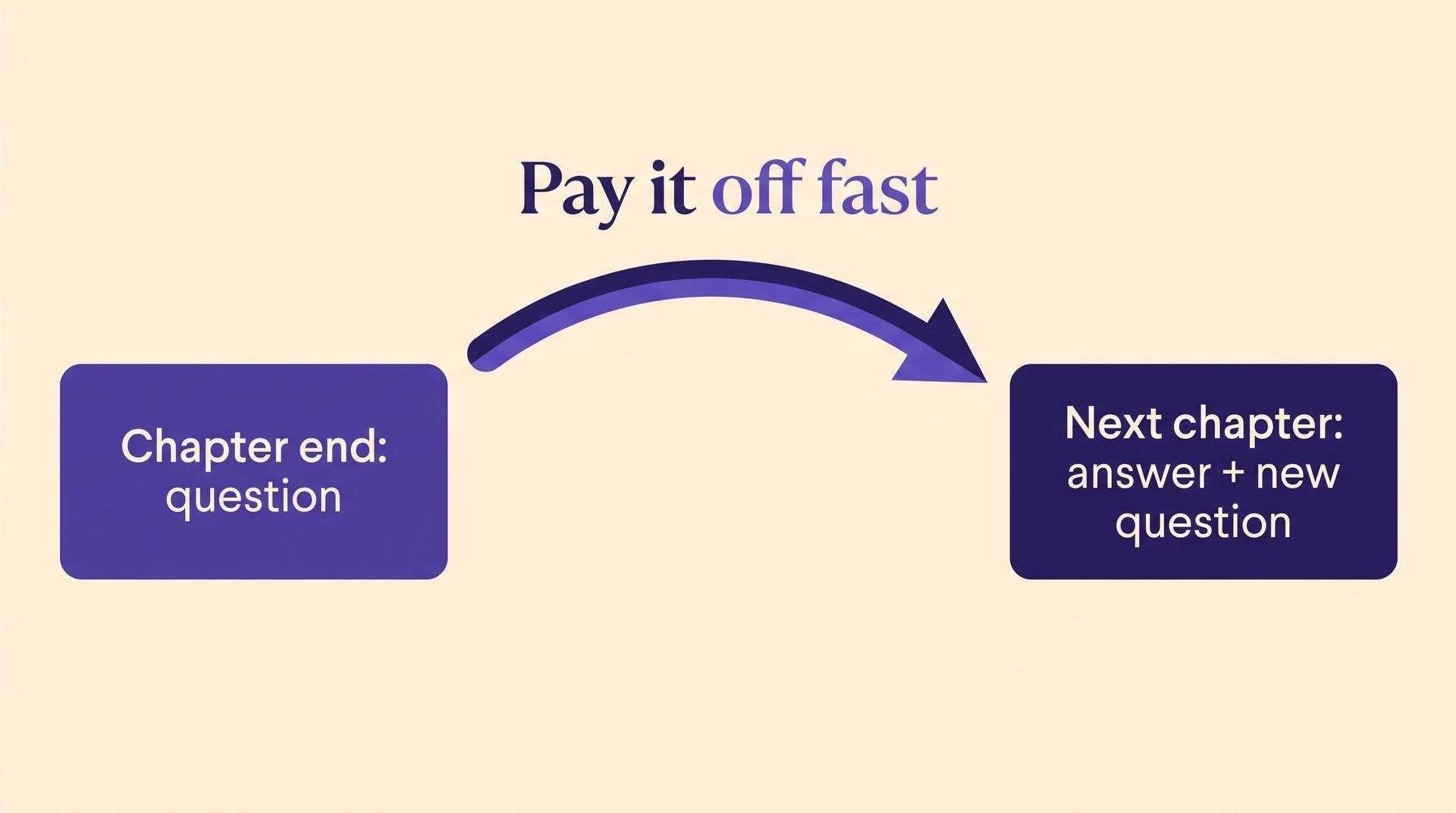
The payoff does not have to be the answer the reader expected. It has to be the real answer, delivered without a trick. Surprise is welcome; a cheat is not.
Four types of cliffhanger
Most chapter-ending hooks fall into four families. Rotate them so the reader cannot predict how the next chapter will end. Tap a type to see an example.
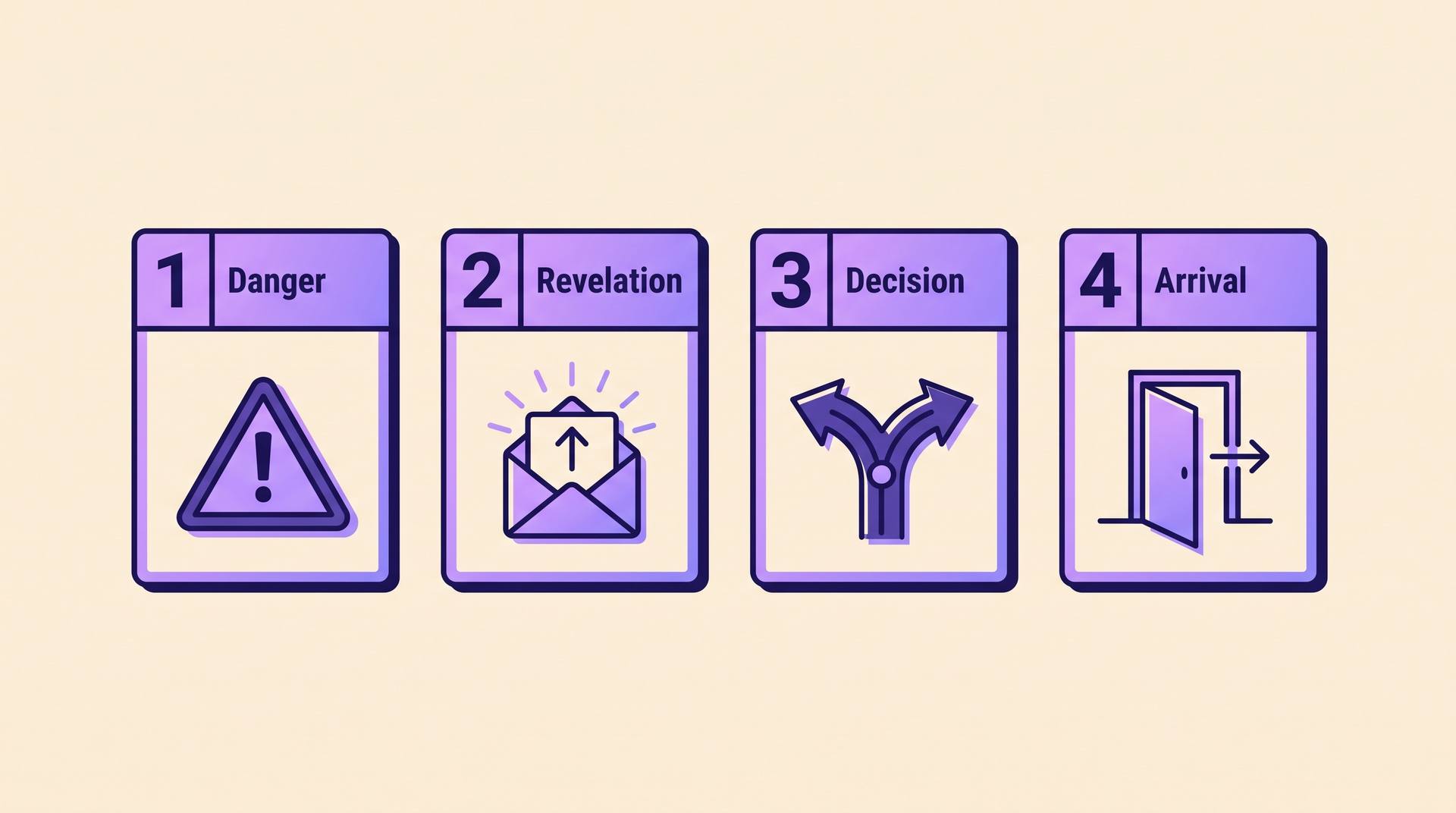
The brakes went soft under her foot. Below the guardrail, the reservoir was very black and very still.
The most familiar kind and the easiest to overuse. Keep it for the high points of your plot, or readers learn that danger always resolves safely.
Twists make the best revelation cliffhangers. If you need raw ideas, the free plot twist generator suggests turns based on your premise, and you can test whether they hold up before you commit a chapter ending to one.
Writing one, step by step
Decide what the next chapter answers
Write the next chapter's opening line before you write this chapter's last one. If you do not know the payoff, you are not writing a cliffhanger, you are hoping for one.
Cut earlier than feels comfortable
Find the moment the question is clearest and end there. Most drafts run one or two paragraphs past the best cut, into the reaction. Delete the reaction.
End on the concrete thing
The last sentence should be an image or an action, not a feeling. 'He was wearing her husband's coat' beats 'she felt a chill of dread'.
Shorten the last line
Short sentences read as final. If the last line has a comma in it, try splitting it and keeping only the second half.
Open the next chapter close to the answer
Pay off within the first page, ideally the first paragraph. If you cut away to another point of view, keep that detour short and make it raise its own question.
Check the pattern across the book
List every chapter ending on one page. If more than a third are the same type, vary them. Some chapters should end quietly so the loud ones land.
Chapter length affects how often you can do this. Our guide to how many chapters a book needs covers how pacing and chapter size interact, and the one on subplot examples shows how cutting between plotlines gives you twice as many natural cliffhanger points.
Fair or cheating? Test yourself
Each pair is a chapter ending and the next chapter's opening. Decide whether the payoff is fair, then reveal the verdict.
Chapter ends
A hand closed over her mouth in the dark.
Next chapter opens
'Shh, it's me,' her brother whispered. 'Don't scream, they're in the hall.'
Chapter ends
The gun went off.
Next chapter opens
Mira woke with a start. It had all been a dream.
Chapter ends
'I know what you did in Lisbon,' the message said.
Next chapter opens
Four chapters about a different character follow, and Lisbon is never mentioned again until the epilogue.
Chapter ends
He signed the contract.
Next chapter opens
The first thing the new owner of the lighthouse did was change the locks. The second was to find out why the last owner had left in the middle of the night.
Mistakes that break reader trust
- The fake-out
Dreams, misunderstandings that a single sentence clears up, and 'it was just the wind'. Do it once and readers stop believing your danger.
- Hiding information the viewpoint character has
'Then she saw who it was.' If the point-of-view character knows, and the next chapter opens in her head, withholding the name is the author cheating, not the story.
- A cliffhanger on every chapter
Constant peaks flatten into noise. Readers need a few endings that close quietly so the jolts feel like jolts.
- Ending the book on one with no sequel plan
A series can end book one on an open question if the main story is resolved. A standalone that stops mid-plot reads as unfinished, and reviews will say so. Our guide on how to end a book covers what a final chapter owes the reader.
- Stakes that arrive with the cliffhanger
A threat to a character we met two pages ago pulls weakly. Build the stakes during the chapter, then put them at risk at the end.
Using AI to plan and test endings
Cliffhangers are structural, which makes them a good fit for planning tools. The creative call of which question to leave hanging stays yours.
- Plan the hooks in the outline. In AIWriteBook's outline builder, each chapter has its own summary, so you can write the ending hook into every summary before a word of prose exists and see the whole book's pattern of endings at once.
- Generate chapters that stop in the right place. The AI chapter generator writes each chapter from your outline and characters, so if the outline says the chapter ends on the arrival at the door, that is where the draft goes.
- Sharpen the last paragraph. Select a chapter's final lines in the chapter AI chat and ask it to cut the reaction and end on the concrete image. Every change appears as a diff you can accept or reject.
- Test the opening. For the first chapter, which has to hook without built-up stakes, the free first chapter hook generator gives you several opening variations to compare.
Templates
Fill in the brackets. These are shapes, not sentences to paste; the specifics are what make them work.
Revelation
[Character] finally [gets the thing they were looking for]. It proves [the one fact that makes their plan impossible].
Decision
[Option A, concrete] on one side. [Option B, concrete] on the other. [Character] [makes a small physical move toward one].
Arrival
[The door, phone, car] [opens, rings, stops]. It is [the one person who should not be here], and they are [carrying or wearing a telling detail].
Payoff opener
[Direct answer to last chapter's question in the first sentence]. [Consequence]. [The new, larger question].
Cliffhanger questions
No. A book where every chapter ends on a peak trains readers to discount the peaks. Aim for a question at the end of most chapters, a sharp cliffhanger at the plot's turning points, and a few endings that simply close a scene.
The one test
Before you keep a cliffhanger, read the next chapter's first page. If a reader who turned the page with their heart racing would feel rewarded rather than tricked, keep it.
Chapter endings are one part of pacing a whole manuscript. For planning, drafting and finishing the rest, see our step-by-step guide to writing a book.