


Read this first
Most comparisons online are out of date
Two things moved in the last eighteen months. IngramSpark stopped charging title setup fees and now takes a market access fee on every copy sold through its distribution network, raised to 1.875% of list price on February 1, 2026. BookBaby, meanwhile, rebuilt its print-on-demand program around exactly two sales channels: its own BookBaby Bookshop and Amazon.
That second change is the one older reviews miss. If you picked BookBaby because you expected your paperback to show up in the Barnes & Noble and library catalogs, read BookBaby's current print-on-demand page before you pay. Its ebook distribution is still wide. Its print distribution is not.
Two different businesses wearing the same label
Both get called print on demand, but you are buying different things.
IngramSpark
A distributor you drive yourself
Part of Ingram Content Group. You upload a finished interior PDF and cover, set a list price and a wholesale discount, and Ingram's catalog feed carries the book to retailers and libraries. Nobody formats, edits or designs for you. It costs nothing to start, and you pay through the discount, the print cost and the market access fee on each sale.
BookBaby
A service shop with its own press
Owned by Disc Makers. You pay up front for services (conversion, cover design, editing, distribution) and a publishing specialist handles setup. Books are printed in BookBaby's own US plant on G7-certified presses. BookBaby takes no commission on ebook sales from retailers, and the Bookshop pays a flat share of list price.
The fee ledger, line by line
Upfront costs and per-sale costs sit in different columns for a reason. IngramSpark is cheap to enter and takes its cut per copy. BookBaby charges up front and takes less per copy on its own store.
| Item | IngramSpark | BookBaby |
|---|---|---|
| Cost to set up a title | Free for print and ebook | $199 Bookshop-only POD, or $399 Bookshop + Amazon POD; ebook distribution $299 |
| ISBN | Free for US publishers (imprint shows as Indy Pub, locked to IngramSpark), or bring your own | ISBN assignment and barcode included with publishing services |
| Changing files later | Free until you approve the eproof; see note on later revisions | Handled through your publishing specialist |
| Per-copy deduction (print) | Wholesale discount + print cost + 1.875% market access fee | Bookshop: you get 50% of list. Amazon: about 10–15% of list reaches you |
| Ebook payout | 85% of the net revenue IngramSpark receives | 100% of net from retailers; 85% of list on Bookshop |
| Ebook conversion | $0.60 per page if you want theirs | From $99, with an ePub proof before release |
| Bookstore returns | Your choice: non-returnable, returnable and destroyed, or returnable and shipped back | No returns on any channel |
| When you get paid | About 90 days after the end of the month of sale | Bookshop within a week; Amazon print sales in about 90 days |
Revision fees are the one line in flux. IngramSpark's December 2025 notice said every revision would cost $25 from February 2026; the company later said revision uploads would become free, and several 2026 guides report them as free. Check the Pricing & Services Guide inside your IngramSpark account before you plan a round of fixes.
Where your book can actually be bought
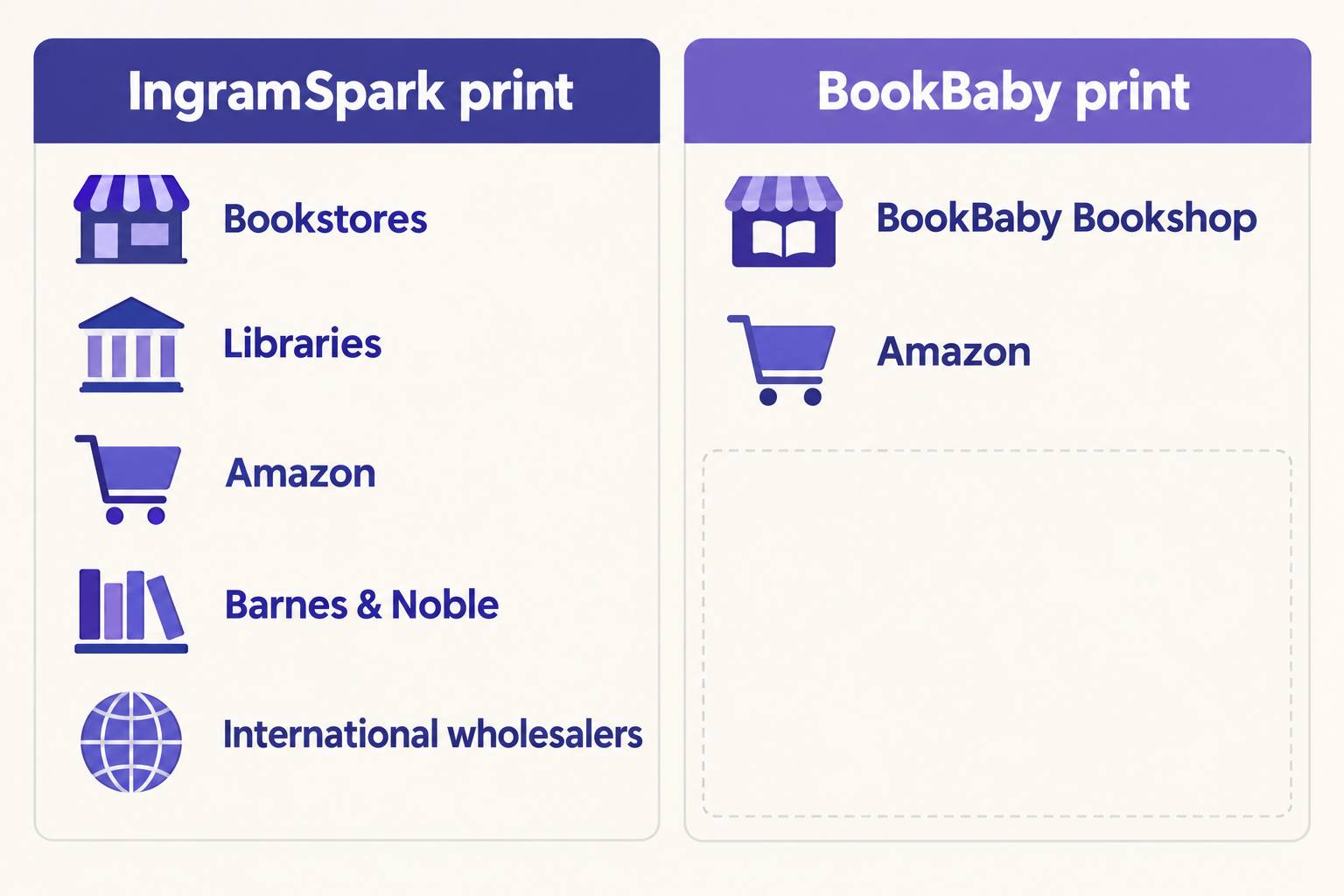
This is the real fork. IngramSpark's user guide says its network makes a title available to more than 40,000 retailers and libraries, including Barnes & Noble, independent bookstores, Amazon and international wholesalers. Available is the key word: a store still has to decide to order you.
BookBaby's current print program lists your paperback in two places. Its own page says why: in its data, independent authors earn their print money on Amazon and the Bookshop, so it stopped chasing listings elsewhere. If you want Barnes & Noble or a library supplier later, BookBaby says you can request your files and take them to another distributor.
Ebooks flip the picture
For ebooks BookBaby is the wider of the two on paper: 60+ stores in 170 countries for $299, including Amazon, Apple Books, Barnes & Noble, Kobo, Scribd and library services such as Hoopla and Libby through its partners. IngramSpark reaches 40+ ebook retailers and library platforms for free. Many authors skip both for ebooks and upload to Kindle, Apple and Kobo directly.
If you go direct, our walkthroughs for publishing on Kobo and publishing on Apple Books cover each store step by step.
What you keep per copy: a worked $20 paperback
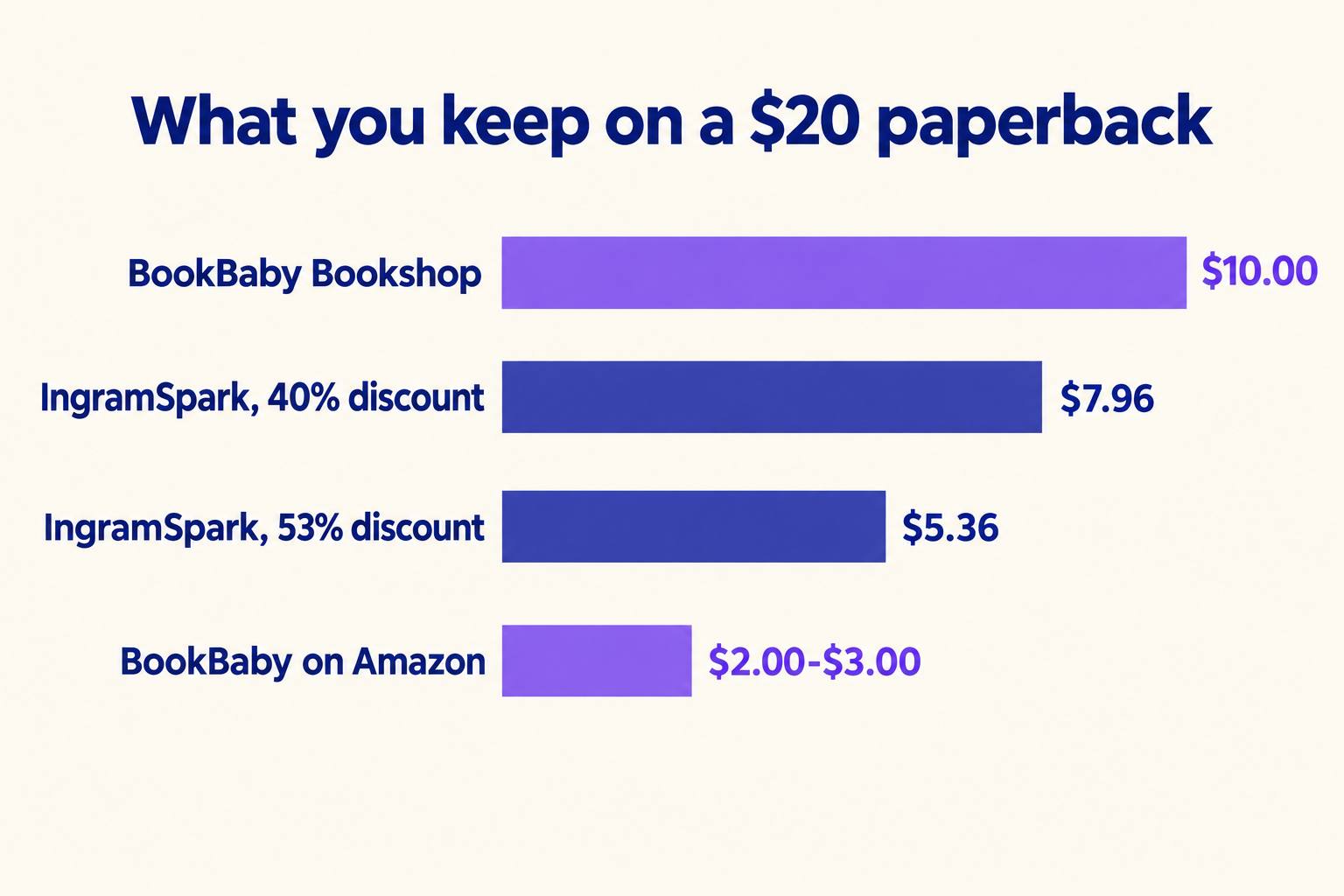
IngramSpark's own user guide uses a $20 US paperback with a $3.66 print cost. Running the same book through both services shows how the models differ.
IngramSpark at a 53% trade discount
Drop the discount to 40%, the level authors often use when they only care about online retailers, and the same book pays about $7.96. Bookstores will rarely order at 40%, though, because they expect the 53–55% trade discount.
On BookBaby's Bookshop the same $20 book pays $10.00, because the Bookshop pays half of list price. The catch is traffic: nobody browses the Bookshop, so every sale there is one you drove yourself from your newsletter, website or social posts. The same book sold on Amazon through BookBaby pays roughly $2 to $3, since BookBaby puts that channel at 10–15% of list after retail costs.
Run your own numbers
Enter your list price and the print cost from IngramSpark's print calculator. BookBaby's Bookshop and Amazon figures come from its published rates.
- IngramSpark pays you
- $5.36
- BookBaby Bookshop pays you
- $10.00
- BookBaby via Amazon pays you
- $2.00 to $3.00
Estimates only. IngramSpark: list × (1 − discount) − print cost − 1.875% of list. BookBaby Bookshop: 50% of list. BookBaby via Amazon: 10–15% of list. Currency conversion and tax are not included.
For the Amazon side of the same decision, our free royalty calculator works out KDP print and ebook royalties from your list price and page count.
A five-step way to decide
Answer these in order. Most authors know their answer by step three.
- 1
Name where your readers buy
If they buy on Amazon and from you at events or online, both services can work. If your plan depends on bookstores, libraries or school suppliers ordering the book, only IngramSpark gets you into that catalog.
- 2
Decide who formats the files
IngramSpark expects a print-ready PDF interior and a full cover wrap sized to your page count. BookBaby will build them for a fee. If you can produce clean files yourself, IngramSpark's zero setup cost is a real saving.
- 3
Count the sales you can drive yourself
The Bookshop's 50% only matters if you send readers to it. An author with a 3,000-person newsletter can make it pay; an author with no list is effectively paying for an Amazon listing that earns less than KDP.
- 4
Price for the channel, not the ego
At IngramSpark, set list price and discount together and check the compensation calculator for a positive number in every market you enable. On BookBaby, compare the $399 Amazon option with what KDP pays for the same book.
- 5
Settle the ISBN before you upload
Buy your own ISBN if the book might ever move between services. IngramSpark's free ISBN stays in its system, and switching later means a new ISBN and losing the review history attached to the old one.
Three authors, three answers
A debut novelist with a finished manuscript and no budget
Best fit: IngramSpark, plus KDP for Amazon
Free setup, a paperback that local bookstores and libraries can order, and no upfront bill before the first sale. KDP handles the Amazon edition at a better Amazon royalty than either option here.
A consultant publishing a full-color business book to sell at talks
Best fit: BookBaby
Color printing quality matters, sales come from the stage and an email list, and the Bookshop pays half of list with weekly payouts. A specialist handling setup is worth the upfront fee to someone billing by the hour.
A children's author pitching school libraries
Best fit: IngramSpark, returnable at 55%
Library and school suppliers buy through wholesalers on trade terms. BookBaby's print program does not reach them, and non-returnable books are a harder sell to that buyer.
Many working indies run KDP for Amazon and IngramSpark for everything else. Our KDP vs IngramSpark comparison explains how to split one book between the two without an ISBN conflict.
Common mistakes that cost authors money
Buying BookBaby for bookstore reach. Its print distribution today is Bookshop and Amazon. Wide reach is an ebook feature at BookBaby, not a print one.
Setting a 40% discount and expecting shelf space. Stores order at trade terms. A 40% discount keeps more money per copy and all but guarantees no bookstore stocks you.
Making a book returnable without a reserve. Returned copies are charged back at the wholesale price, plus $3 per book in the US if you choose to have them shipped to you. Put part of each payout aside or start non-returnable.
Feeding Amazon from two printers. If BookBaby's Amazon option and IngramSpark both list the same edition, you get duplicate or conflicting listings. Pick one print source per retailer per ISBN.
Forgetting the 90-day lag. IngramSpark pays about 90 days after the end of the month of sale, and so does Amazon through BookBaby. Launch money arrives a season later.
The AI-assisted shortcut: arrive with finished files
The biggest hidden cost in this comparison is file preparation. IngramSpark rejects files that do not match its specs, and BookBaby charges to build them. If you write or import your manuscript in AIWriteBook, the book formatter exports a print PDF at nine trim sizes including 6 x 9, a validated EPUB and a cover wrap, the same files either service asks for.
The cover generator produces front-cover art you can finish in the app's cover designer, and the ISBN guide explains how to buy one number per format before you upload anywhere. You still check the proof yourself; no tool should approve a print run for you.
Spec sheet template: fill it in before you upload
Both services ask for the same facts in different forms. Copy this, fill it in once, and paste from it during setup.
Title / subtitle:
Author name as printed:
Imprint name:
ISBN (paperback):
ISBN (hardcover):
ISBN (ebook):
Trim size:
Page count:
Interior: black and white / standard color / premium color
Paper: white / cream
Cover finish: gloss / matte
List price USD / GBP / EUR / AUD:
Wholesale discount (IngramSpark):
Returns: non-returnable / destroy / deliver
BISAC categories (up to 3):
Keywords:
Short description (under 350 characters):
Long description:
Publication date:
Where this edition sells: IngramSpark / BookBaby Bookshop / Amazon via ___
Frequently asked questions
IngramSpark is cheaper to start: setup is free and a US ISBN can be free. BookBaby charges $199 to $399 for print-on-demand distribution and $299 for ebook distribution, plus any design or conversion work. Per copy, BookBaby's Bookshop pays more on direct sales, while IngramSpark usually pays more on retail sales.
Not through its current print-on-demand program, which lists paperbacks on the BookBaby Bookshop and Amazon. BookBaby's ebook distribution does include Barnes & Noble. For print in other stores, BookBaby says you can request your files and use another distributor.
A charge on each copy sold through Ingram's distribution network, set at 1.875% of list price from February 1, 2026. It replaced the old title setup fee.
Yes, if you own the ISBN and each service handles different channels, for example BookBaby for the Bookshop and ebooks, IngramSpark for bookstores and libraries. Avoid having both feed the same edition to Amazon.
BookBaby prints in its own US facility on G7 color-certified presses and leans on that for full-color books. IngramSpark prints through Lightning Source plants in the US, UK, Australia and the UAE plus partner printers abroad. Order a proof from either before you release a color title.
With KDP for the Amazon edition, then IngramSpark if you want bookstores and libraries. BookBaby makes most sense when you want done-for-you setup and plan to sell directly to your own audience.
The short version
Choose IngramSpark if you want your paperback orderable by bookstores and libraries and you can supply your own files. Choose BookBaby if you want someone else to handle production, care about color print quality, and have an audience to send to your Bookshop page. For ebooks, compare BookBaby's $299 wide package with going direct.
Whichever you pick, Amazon is still where most indie print copies sell; our Amazon KDP guide covers the setup, pricing and metadata for that side of the launch.
Ready to set up the IngramSpark side? Follow our step-by-step IngramSpark publishing guide.