

Why the rules matter more than the magic
Readers do not put a fantasy novel down because the magic was insufficiently imaginative. They put it down because the hero, cornered and out of options, suddenly remembered a power nobody mentioned in three hundred pages. The wonder survives almost anything; the trust does not.
That is the whole design problem in one sentence. Magic is the only element of a story where the author controls the physics, which means it is the only element where the author can cheat without noticing. Every satisfying magical climax in the genre works the same way: the reader already had the pieces and the character used them in an order the reader did not expect. Every unsatisfying one works the other way around.
So the useful question is not "what would be cool?" It is "what does the reader need to know so that my ending feels earned rather than announced?" Answer that and the rest of the design falls out almost mechanically.
The hard-soft spectrum (it is a dial, not a switch)
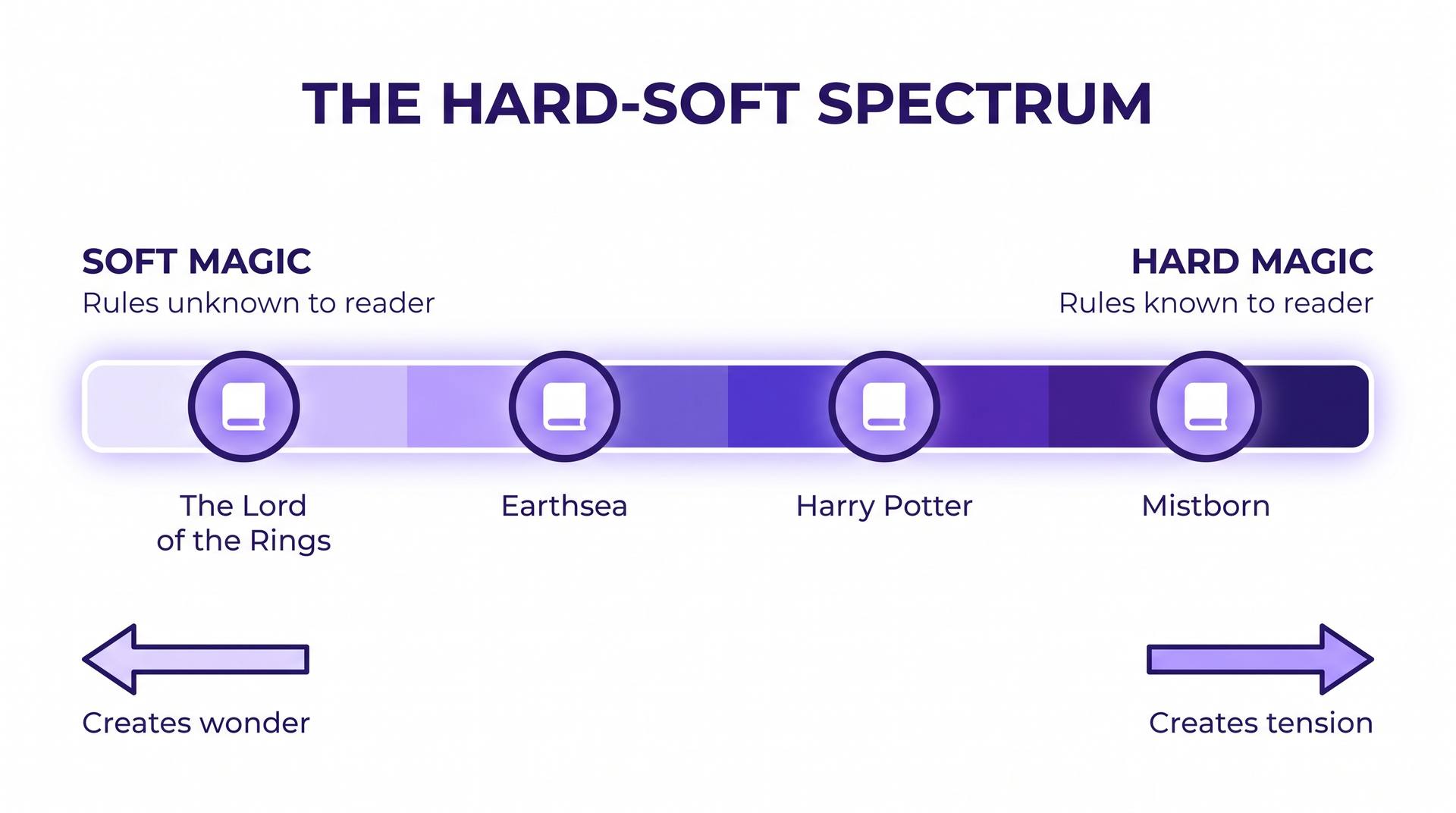
Hard and soft magic are not two categories you pick between. They are the ends of a dial, and the dial measures exactly one thing: how much of the rule set the reader has been told.
Soft: the reader knows almost nothing
Gandalf's power is never quantified. We are told he is a wizard and shown roughly what that means when it matters, and Tolkien never lets a fight be resolved by a rule we could have looked up. Soft magic buys awe and mystery, and it pays for that by being unable to solve the plot. Gandalf falls with the Balrog; he does not vaporise it.
Middle: a named system with fuzzy edges
Le Guin's Earthsea gives us one hard principle, true names, and one hard cost, the Equilibrium, then leaves the rest deliberately vague. Rowling names hundreds of spells but never publishes the limits, which is why Harry Potter's endings turn on love, sacrifice and choices rather than on spellcraft. Both sit comfortably mid-dial.
Hard: the reader could sit an exam
Sanderson's Allomancy in Mistborn is closer to a periodic table than a mystery: sixteen metals, a stated effect each, a finite supply burning in the user's stomach. The climaxes are legible in advance, and the pleasure is watching a clever character out-think you with tools you were holding the whole time.
Both ends work. What fails is the accidental slide between them: a system introduced as engineering that quietly turns into mystery whenever the plot needs a favour. Pick a position on the dial, write it at the top of your notes, and defend it.
Sanderson's three laws, and what they actually mean
Brandon Sanderson published three laws of magic as working advice rather than genre legislation. They are the most useful three sentences in fantasy craft, and they are widely quoted and rarely applied.
The ability to solve conflict with magic is directly proportional to how well the reader understands it. This is the licence rule. Want the wizard to win the last battle with a spell? Then teach the spell early, on the page, in a scene where it costs something. Do not want to explain it? Then it may create problems for your characters, never solve them.
Limitations are more interesting than powers. Flight is boring; flight that only works while you are falling is a story. Almost every memorable magical character is memorable for what they cannot do. When a system feels flat, the fix is almost never another power, it is a sharper wall.
Expand what you have before you add something new. Most drafts have three underused magical ideas and a fourth being invented in chapter twenty. Go back. Ask what the existing rules imply about war, farming, medicine, love and law, and you will find plot you already own.
The three questions that build the system
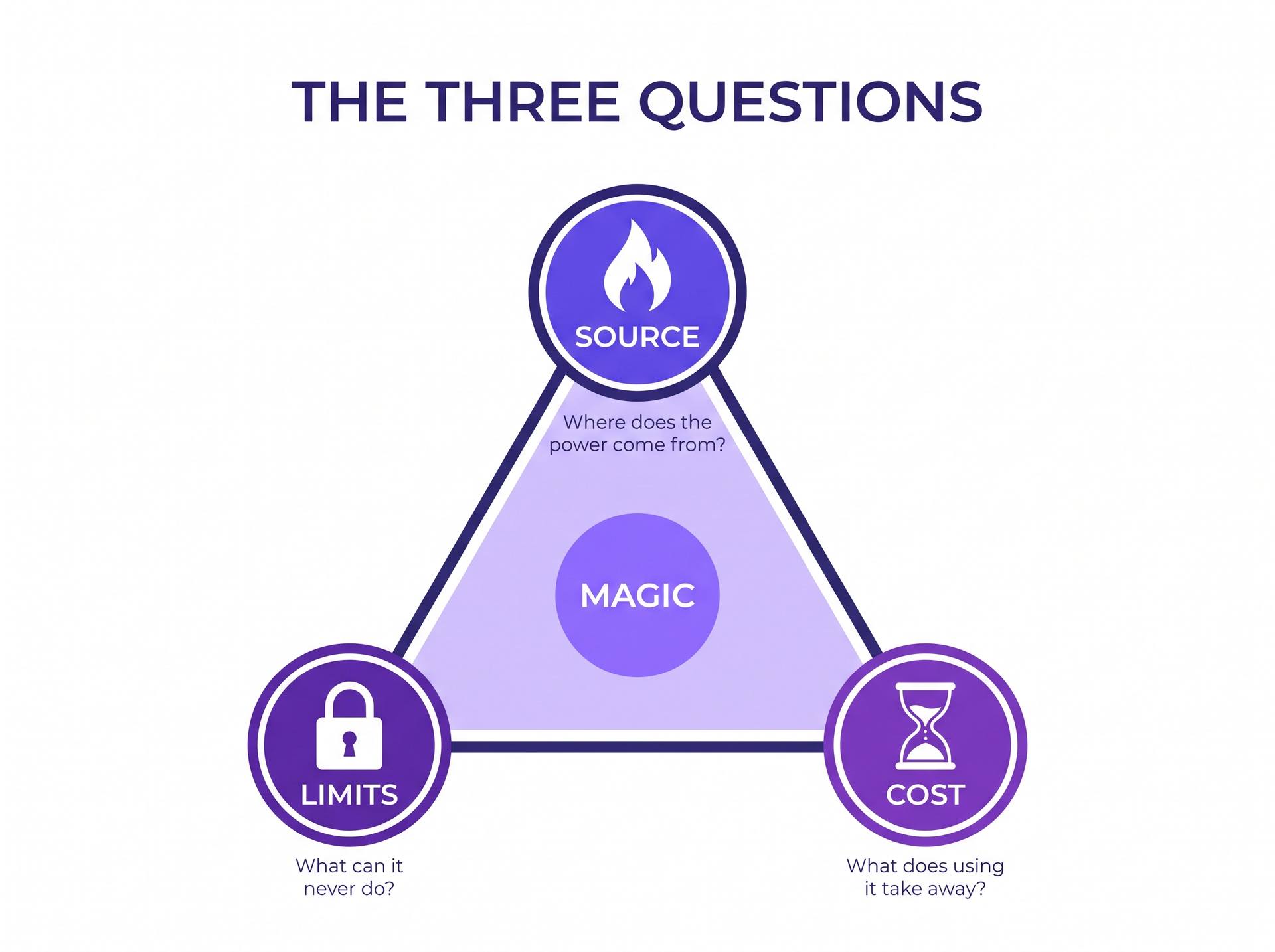
Strip away the terminology and every workable magic system answers three questions in a way the author can repeat identically at two in the morning in chapter thirty-one.
Source: where does the power come from?
Innate bloodline, learned discipline, borrowed from a being, extracted from a substance, or granted by a place. The source decides your politics for you. Bloodline magic produces aristocracies. Learned magic produces schools, gatekeepers and forgeries. Substance magic produces mines, cartels and wars over supply.
Limits: what can it never do?
Write the hard nevers, not the soft rarelies. "Cannot raise the dead" is a limit. "Rarely raises the dead" is a loophole you will use in act three and regret. Give at least one limit that hurts your protagonist personally, because that is the one readers will remember.
Cost: what does using it take away?
Cost is the tension engine, and it must be paid in something the character values. Fatigue is the weakest currency in fantasy because sleep refunds it. Memory, years, reputation, sanity, another person's safety, the ability to feel a specific emotion again - these compound, and compounding costs make escalation write itself.
If you can answer those three in eight sentences without contradicting yourself, you have a magic system. Everything after this is elaboration.
Build it in six passes
Do not design in one sitting. Each pass answers a different kind of question, and running them in this order keeps you from decorating a system that has no load-bearing wall yet. If you are starting a fantasy draft from scratch, run these alongside the wider fantasy novel walkthrough.
- 1
Start from the ending you want
Write the climactic magical moment first, in two paragraphs, before any rules exist. Then reverse-engineer the smallest rule set that makes it inevitable rather than convenient. Designing forward produces encyclopedias; designing backward produces plots.
- 2
Fix your position on the dial
Decide how much the reader will be told, and write that decision down as a sentence. Hard enough to solve the climax, or soft enough that the climax must be solved by character? You cannot have both from the same power in the same book.
- 3
Answer source, limits, cost
One paragraph each, in plain language. If a paragraph needs a diagram to make sense, it is too complicated for a reader who is also tracking eleven characters and a war.
- 4
Push the consequences outward
Ask what your rules do to money, law, medicine, transport, warfare and marriage. A world where healing is cheap has no soldiers with limps and probably no inheritance system as you know it. This pass is where the setting stops feeling like a stage set - it is the same discipline covered in our worldbuilding guide, applied to one subsystem.
- 5
Break your own system on purpose
Spend an hour trying to win the whole plot in chapter two using only your stated rules. If you succeed, you have found the loophole a reader will find on page ninety. Close it with a limit, not with a character forgetting.
- 6
Plant the payoff early
Every rule that resolves something late must appear at least twice earlier, doing something small and unrelated. This is Chekhov's principle applied to magic, and it is the difference between a twist and a cheat.
The one-pager template
Everything above collapses into six fields. Fill them in and you can write consistently for a year; leave any of them blank and that gap is exactly where your draft will contradict itself.
| Field | What to write | Worked example |
|---|---|---|
| Source | Where the power originates and who controls access to it | Ingested metals; anyone born with the trait, awakened only by near-death trauma |
| Limits | Two or three absolute nevers, stated as nevers | Cannot create matter, cannot affect a living body directly, cannot work without the metal present |
| Cost | The valued thing that using it consumes | The metal is finite, expensive and burns out mid-scene; heavy use permanently dulls the senses |
| Users | Who has it, how they find out, who trains them | Roughly one in nine hundred; discovered by accident, trained by criminal crews or noble houses |
| Society | How law, class, religion and commerce reorganised around it | Noble houses hoard the trait through marriage contracts; metal supply is taxed like a weapon |
| The unbreakable rule | The one line you will not cross even when the plot begs | No character ever gains a new ability off the page |
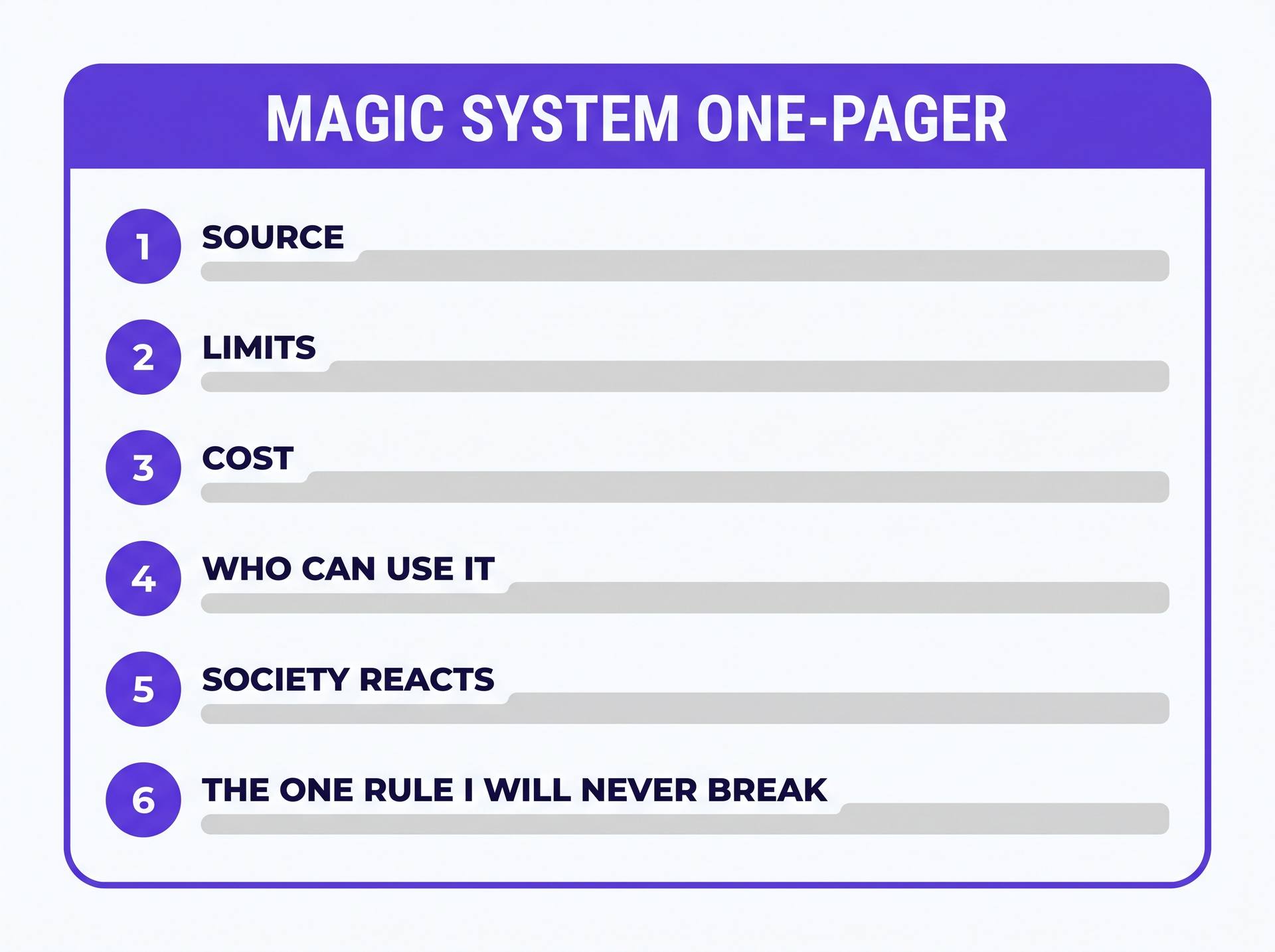
That last row is the important one. Write it as a promise to yourself, because the temptation to break it always arrives at exactly the moment you are most tired.
Five mistakes that show up in almost every first draft
Powers without a price
A system with no cost is a system with no scenes. If magic solves problems for free, your characters have no reason to be brave, clever or desperate, and bravery, cleverness and desperation are the entire product.
The retroactive rule
The rule invented in chapter twenty-eight to justify the escape. Readers forgive a lot, but they can smell this instantly, and it is the fastest route to a review complaining about a deus ex machina ending.
Encyclopedia paralysis
Forty pages of taxonomy and no story. If a rule never changes what a character does in a scene, it is a hobby, not worldbuilding. Keep the notes, cut them from the manuscript.
Magic as plot spackle
Using the system to fix pacing problems rather than to create them. When magic makes travel, communication and injury trivial, you have deleted three quarters of your available obstacles.
The economics nobody ran
If a first-year student can purify water, famine and cholera are gone and your medieval society is not medieval. Follow the cheap spells to their conclusion; the interesting worlds live in what that conclusion breaks.
Tracking consistency across a long book
Contradictions do not come from forgetting the rules. They come from remembering them slightly differently on day ninety than on day three. The defence is boring and effective: a single magic ledger where every scene that uses power gets one line - who, what, what it cost, what it left behind.
Read that ledger straight through before you draft each act. Nine times in ten the contradiction is already visible in the list, weeks before a reader would have found it. In a series it matters more, because the rule you casually stretched in book one becomes the load-bearing wall of book three.
The AI-assisted shortcut
The slow part of magic design is not invention, it is the consequence pass - sitting there asking what your rules do to inheritance law, and then to armies, and then to the price of grain. That interrogation is exactly what a model is good at, provided you supply the constraints rather than asking it to be imaginative.
In AIWriteBook the world builder tool takes your source, limits and cost and pushes them outward into the societies, factions and conflicts they imply, so you get the second-order effects without three evenings of staring at a wall. Pair it with the character creator when you need people whose lives are shaped by the system rather than merely equipped with it.
Inside the app the system stays attached to the book itself, so when you generate or revise a chapter the model is writing against your stated rules instead of improvising fresh ones. The chapter chat lets you ask for a rewrite and accept or reject the change line by line, which is the practical fix for the moment a draft quietly grants someone a power they should not have. If you are planning a trilogy, series support carries the same rule set forward so book two cannot contradict book one by accident.
Frequently asked questions
Neither is better; they do different jobs. Hard systems let magic resolve conflict and produce clever, legible climaxes. Soft systems preserve awe and force your endings to turn on character. Problems come from drifting between them, not from picking one.
Three to five that the reader actually learns, plus whatever you keep in your notes. Readers track fewer rules than authors imagine, and every rule you state is a promise you have to keep for the rest of the book.
You can reveal that a rule was incomplete, if the earlier text supports the revision on a reread. You cannot replace a rule. The test is simple: would a careful reader of book one nod, or feel cheated?
Every system that solves problems does. Purely atmospheric magic that never rescues anyone can run costless, because it is not doing plot work. The moment magic wins a scene, it needs a price the reader can feel.
Write the contract, then keep it
A magic system earns its keep when it constrains your characters, not when it impresses your readers. Decide how much you will explain, name the source, write the nevers, charge a real price, and then spend your creative energy on the consequences rather than on new powers.
Do that and the climax will feel inevitable in retrospect, which is the only kind of ending anybody remembers. For the surrounding craft - structure, characters, and getting the whole draft finished - the rest of our how to write a book guide picks up where this leaves off.