


Novelette word count
The numbers most writers use come from the Science Fiction and Fantasy Writers Association, whose Nebula Awards define every length category. The Hugo Awards use the same boundaries. Outside genre fiction the term is used more loosely, but when an editor says novelette, this is almost always the range they mean.
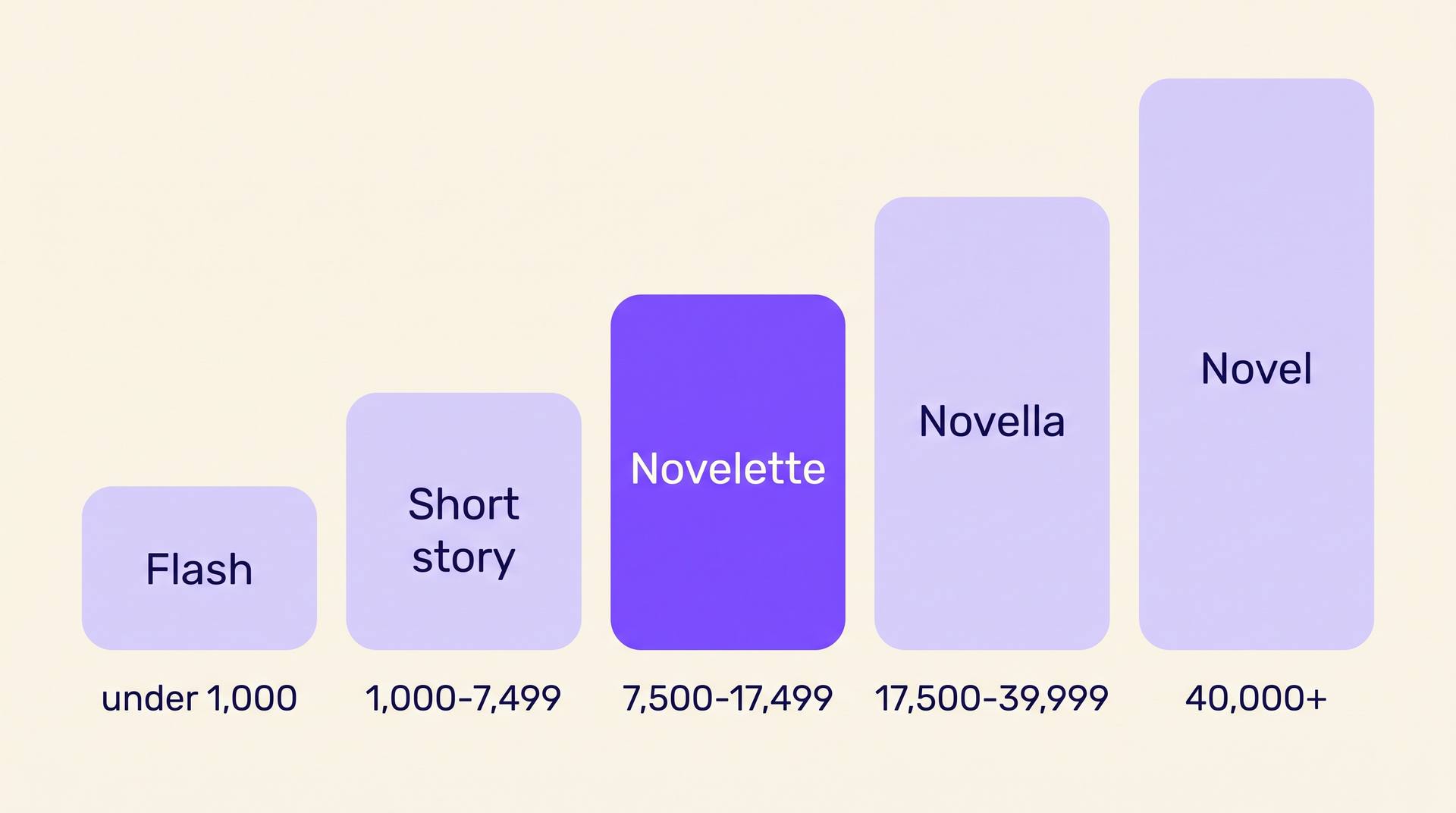
| Form | Word count | Rough paperback pages |
|---|---|---|
| Short story | Under 7,500 | Up to about 30 |
| Novelette | 7,500 to 17,499 | About 30 to 70 |
| Novella | 17,500 to 39,999 | About 70 to 160 |
| Novel | 40,000 and up | 160 and up |
Page estimates assume around 250 words per page in a standard 5 x 8 inch paperback. Font, trim size and spacing move this a lot, so treat it as a sense of scale rather than a spec.
Is your draft a novelette?
Paste your word count and see which category it falls in, and how far you are from the nearest boundary.
Enter a number to see the category.
Not sure of your count? Paste the text into the free word counter first.
Novelette vs novella vs short story
Word count is the official line, but the forms also feel different to read and to write.
Short story
One moment, one turn. Usually a single point of view and a single scene or a tight chain of them. Everything serves one effect.
Novelette
Room for one subplot, a second viewpoint, or a meaningful jump in time. The ending can land on a change that has been building rather than a single reveal.
Novella
A full arc with several movements, often a secondary cast with lives of their own. Close to a novel in shape, with less sprawl.
If you are deciding between the two longer forms, our novella vs novel guide covers pricing and page-count realities in depth, and how many words a short story should be covers the lower end by market.
Famous novelettes
Award lists are the easiest place to find novelettes, because the length category is printed on the trophy.
The Bicentennial Man
Isaac Asimov, 1976
Won both the Hugo and Nebula for best novelette. It covers two centuries of a robot's life by skipping between key moments, a structure that a short story could not hold and a novella would slow down.
Sandkings
George R. R. Martin, 1979
Also a Hugo and Nebula novelette winner. One man, one terrible hobby, and an escalation that needs more pages than a short story allows, but never needs a second storyline.
The Merchant and the Alchemist's Gate
Ted Chiang, 2007
Hugo and Nebula novelette winner built as nested tales. The extra length is spent on stories within the story, each short, adding up to one quiet emotional point.
A short history of the word
In nineteenth-century Britain, novelette often meant a cheap, sentimental romance, and "novelettish" still carries that sneer in some dictionaries. The modern, neutral meaning comes from genre magazines and awards, which needed a name for stories between short fiction and the novella. When you use the word today, editors hear a length category, nothing more.
What the form is good at
Writers often land at novelette length by accident. It is worth choosing it on purpose for these kinds of stories.
- A single relationship followed across years, told in a handful of scenes.
- A speculative idea that needs a little world-building before the emotional turn works.
- A mystery with one real suspect list, without the red herrings a novel expects.
- A prequel or side story for an existing series that readers finish in one sitting.
It is a poor fit for stories that need a large ensemble, several reversals, or a slow-burn romance. Those want a novella or a novel.
Where novelettes get published
Genre magazines and anthologies
Science fiction, fantasy and horror markets are the most open to this length, and some award categories exist only because of it. Caps vary by magazine, so check each one's guidelines before you submit.
Self-published ebooks
A novelette makes a clean standalone ebook or an entry in a numbered series. In Kindle Unlimited, where authors are paid per page read, a short work earns less per borrow, so many writers use novelettes as series openers rather than main income.
Reader magnets and bonus content
A side story about a favorite character is one of the most common newsletter sign-up gifts. The length is right: generous enough to feel like a gift, short enough to write between books. If you run a series, the series planner helps you slot a novelette between main installments without breaking continuity.
Collections
Three or four related novelettes can form a collection with more room to breathe than a book of short stories.
Common mistakes
Calling it a novella in a submission
A 12,000-word story labeled novella tells the editor you do not know the categories. Use the right word; it costs nothing.
Padding a short story to reach the range
Extra description and repeated beats do not make a novelette. If you want the length, add a thread that changes the ending: a second viewpoint, an earlier timeline, a consequence.
Compressing a novel into it
If your outline has three subplots and a large cast, cutting to 15,000 words produces a synopsis, not a story. Accept that it wants to be longer.
Pricing it like a novel
Readers check page counts. A short work priced alongside full-length books draws complaints in reviews, even when the story is excellent.
Revising to fit the form
Most novelettes are found in revision, when a short story will not close or a novel idea turns out to be smaller than planned.
- 1
Count by scene, not by page
List every scene with its word count. A novelette usually carries somewhere between six and fifteen scenes; far more than that and each one is starved.
- 2
Find the second thread
Name the one thing that makes this longer than a short story. If you cannot name it, you are probably trimming toward short-story length instead.
- 3
Cut from the middle
Openings and endings carry the form. The middle is where drafts over 17,500 words usually sag, and where a scene can be merged or dropped.
- 4
Line edit last
Structural cuts first, sentence polish after, so you do not spend an hour on a paragraph you later delete.
AIWriteBook's chapter AI chat is built for exactly this pass. Ask it to tighten a scene by a third or to merge two scenes, and every change comes back as a diff you accept or reject line by line, so the cuts stay under your control. You can also import an existing draft through manuscript import and revise it there instead of starting over. See how the editing flow works on the AI book editor page.
The short version
A novelette is fiction between 7,500 and 17,499 words, the length that gives you one extra thread without the scaffolding of a novella. Use the term when you submit, choose it on purpose when a story needs a little more room, and do not pad or compress to force a draft into it.
Length is only one part of getting a draft ready. The book editing guide covers the full revision process, from structural edits to proofreading.