

What a paradox actually is
A paradox is a self-contradictory statement or situation that nonetheless expresses a genuine truth. The two halves seem to cancel each other out — and yet the sentence refuses to collapse, because underneath the contradiction there is something real. "You have to be cruel to be kind" should be nonsense; instead it names a hard fact about love that a plain sentence could never carry with the same force.
It helps to separate two meanings that share the word. A logical paradox — the liar's "this statement is false," or Zeno's arrow that can never reach its target — is a genuine dead end, a knot in reasoning with no exit. A literary paradox is different: it looks like a dead end but opens a door. The writer builds the contradiction on purpose so the reader has to stop, hold both ideas at once, and feel a truth that direct language would flatten. The contradiction is the point, not a mistake to fix.
The two families: verbal and situational
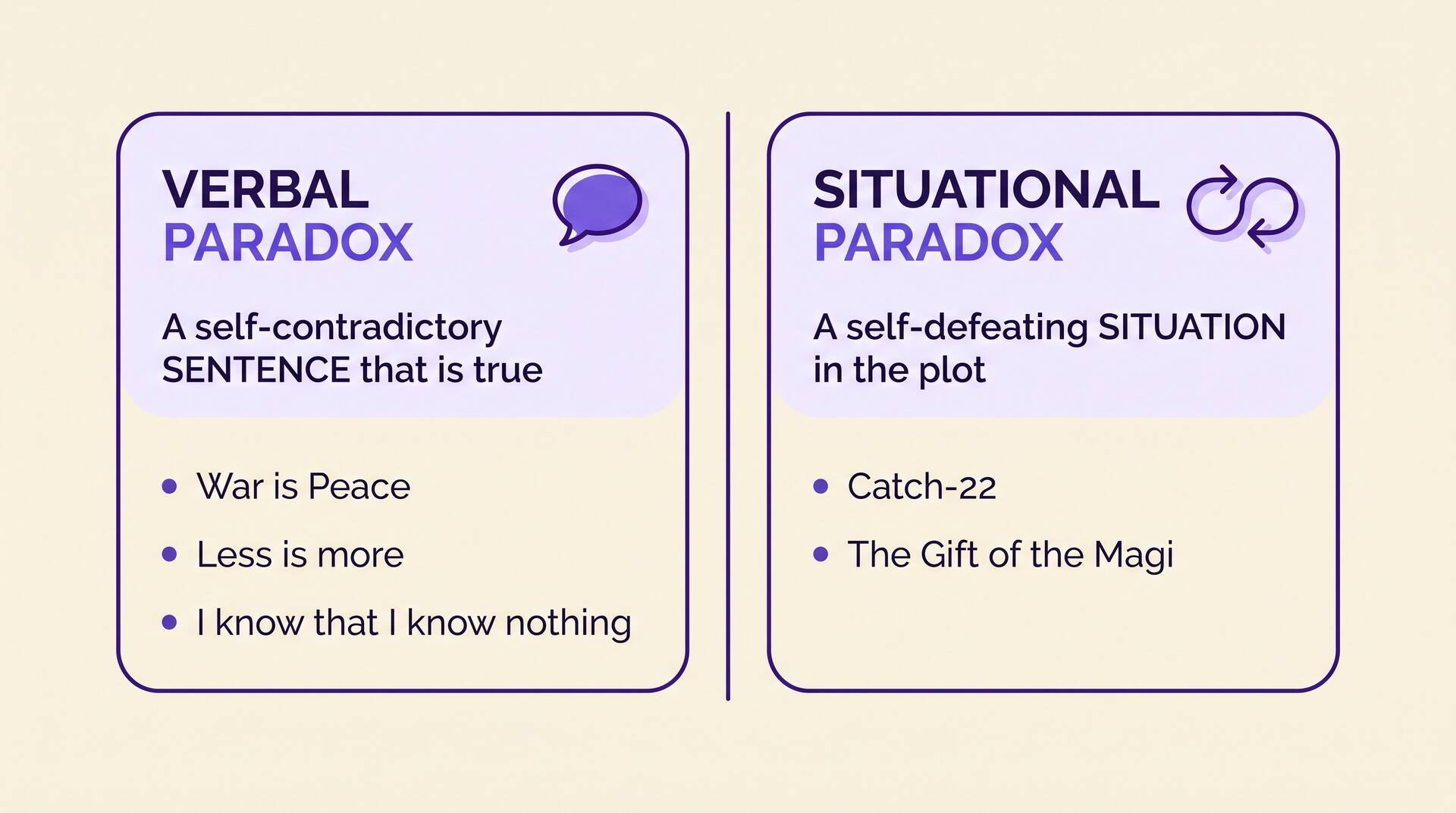
Almost every paradox you meet in fiction belongs to one of two families. Telling them apart is the fastest way to understand how the device works — and how to build one yourself.
Verbal paradox
A verbal paradox lives in a line of language. It is a phrase or sentence whose words contradict each other, compressed into something quotable. This is the paradox of the aphorism, the slogan, and the epigram — a whole idea folded into a few words that shouldn't fit together.
War is Peace. Freedom is Slavery. Ignorance is Strength.
The Party's three slogans are the purest verbal paradoxes in modern fiction. Each fuses a word with its own opposite, and that fusion is the entire argument of the book: a regime that can make you believe two contradictory things at once — doublethink — owns your mind completely. Orwell never explains the slogans. He lets the contradiction do the work.
I can resist everything except temptation.
Wilde built a career on the verbal paradox. The line pretends to boast of self-control and confesses the opposite in the same breath — and the wit is inseparable from the contradiction. Kill the paradox and you kill the joke.
Situational paradox
A situational paradox lives in events, not sentences. It is a circumstance that traps a character in a self-defeating loop: the very act that should solve the problem is the thing that makes it unsolvable. No clever line required — the contradiction is baked into the plot.
There was only one catch and that was Catch-22.
Heller's title has entered the language for good reason. A pilot can be grounded for insanity — but he has to request it, and anyone who wants out of dangerous combat missions is obviously sane, so the request proves he can't be grounded. The rule guarantees its own opposite. The paradox isn't a phrase you could underline; it's the shape of the whole trap.
Each sold the most precious thing they owned to buy a gift for the other.
Della sells her hair to buy Jim a chain for his watch; Jim sells the watch to buy combs for her hair. Both gifts are made useless by the sacrifice that paid for them — and that useless exchange is the most loving thing either could do. The story's meaning lives entirely inside the situational paradox.
Paradox vs oxymoron vs irony vs juxtaposition
These four devices get tangled together constantly, because they all trade on contrast. Here is the clean version. The key questions are how big the contradiction is (a word, a statement, a situation) and whether there's a real contradiction at all.
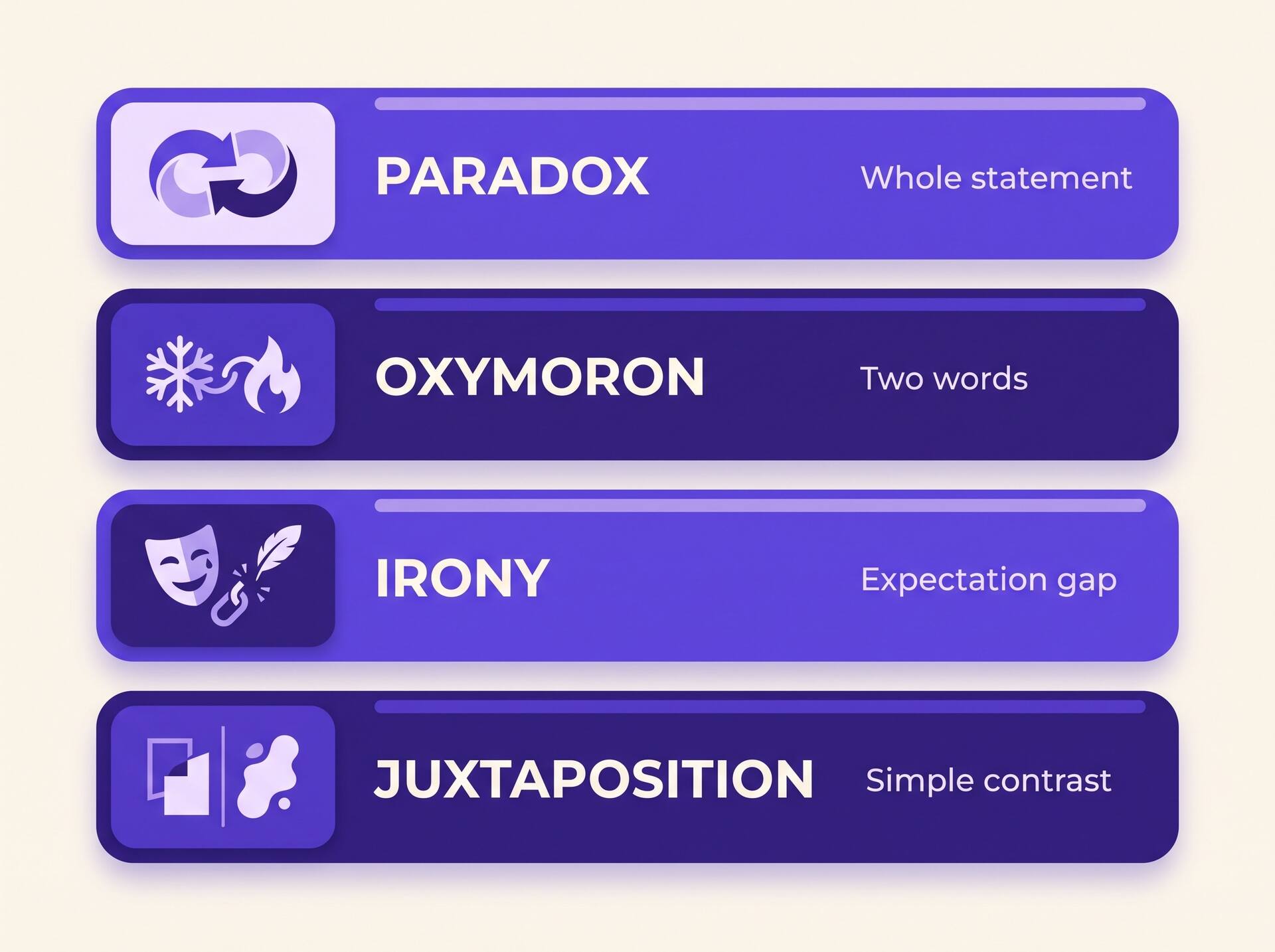
| Device | What it is | Scope | Example |
|---|---|---|---|
| Paradox | A statement or situation that contradicts itself yet reveals a truth. | A full sentence or a whole circumstance. | "I must be cruel only to be kind." |
| Oxymoron | Two contradictory words placed directly side by side for effect. | Two adjacent words. | "Deafening silence," "bittersweet," "living dead." |
| Irony | A gap between what is said or expected and what is actually meant or happens. | A line, a moment, or a whole outcome. | A fire station burning down. |
| Juxtaposition | Two contrasting things set next to each other — but not necessarily contradictory. | Any two images, ideas, or scenes in sequence. | A wedding scene cut against a funeral. |
The two you'll confuse most are paradox and oxymoron. Think of it as a matter of size: an oxymoron is a paradox shrunk to two words. "Deafening silence" is an oxymoron; expand it into "the silence in that room was louder than any shout" and you've built a paradox. And note the outlier — juxtaposition needs no contradiction at all, only contrast, which is why it's the loosest of the four. Where a recurring paradox starts standing in for the book's deeper meaning, you've crossed into symbolic territory, which we unpack in the guide to symbolism in writing.
Famous literary paradoxes worth studying
Read these not as trivia but as blueprints. Each one holds a real contradiction steady long enough for a truth to surface — and each does a different job.
All animals are equal, but some animals are more equal than others.
A whole revolution's betrayal in one line. "More equal" is grammatically impossible — equality has no degrees — and that impossibility is exactly how Orwell exposes the lie of the pigs' regime.
I must be cruel only to be kind.
Hamlet justifies wounding his mother as an act of care. The paradox is doing moral reasoning the character can't do plainly — it lets him be both tender and brutal in the same sentence.
Death, thou shalt die.
The one thing that kills everything is itself killed. Donne's paradox turns the poem's whole argument — that death is not the end — into a single unforgettable reversal.
I know that I know nothing.
The founding paradox of Western philosophy, and a template writers still borrow: claiming knowledge of your own ignorance is the humblest and the boldest thing a thinker can say.
It was the best of times, it was the worst of times.
The most famous opening in English rides a stacked paradox: an age can't be both best and worst — unless the book's real subject is a world split against itself, which is exactly Dickens's point.
Paradox as a theme engine
A clever paradoxical line is a decoration. A paradox that runs through a whole book is structure. This is where paradox stops being a device you sprinkle in and becomes the thing your story is about — and it works on two levels.
Contradictory characters
The most memorable characters are walking paradoxes: the coward who commits the story's bravest act, the priest losing his faith, the tyrant undone by getting exactly what he wanted. Macbeth is destroyed not by failure but by the crown he schemed for — the wish granted is the punishment. A character built on a genuine internal contradiction generates plot automatically, because the two halves can't both win. If you're shaping a lead whose surface and depths pull against each other, our free character creator tool is built for exactly this: it prompts for the wound behind the mask and the value a character betrays, so the contradiction is deliberate rather than accidental. For the wider taxonomy of characters who change under pressure, the guide to dynamic characters pairs naturally with this.
Thematic tension
Zoom out further and a paradox can become the question a whole novel is built to hold open: you have to lose yourself to find yourself; the only way to keep something is to give it away; freedom requires limits. The book never resolves the paradox — it dramatizes it, letting every scene test both sides. This is why a strong theme so often sounds like a contradiction, and why the paradox at the midpoint of a well-built plot lands so hard: the situational reversal of the three-act structure is frequently a paradox made physical, the moment the hero's goal turns into the thing standing in their way. When you're drafting toward that kind of thematic charge, AIWriteBook's chapter writer and plot generator feature help you keep the contradiction alive across the whole arc instead of accidentally resolving it in chapter three.
Common mistakes — and when not to reach for paradox
Paradox is high-risk. Used well it's the most quotable device you have; used badly it reads as confusion. Watch for these.
Confusing a paradox with a plain contradiction
A paradox reveals a truth once you unfold it. A contradiction is just an error — a character who's an only child on page 4 and has a sister on page 90. If a reader can't find the truth under the contradiction, you don't have a paradox; you have a mistake.
Over-explaining it
The power of a paradox is the pause it forces. The instant you gloss it — "which was, of course, ironic" — you rob the reader of the discovery and the line goes flat. Trust the contradiction to do its own work.
Decoration with no payoff
A paradox that sounds clever but connects to nothing in the story is empty wit. The great examples all pay off a theme or a character. If your paradox isn't earning its keep thematically, it's a bumper sticker.
When not to reach for it
And sometimes the right move is to skip it. In a scene that needs speed and clarity — an action beat, a moment of raw grief, a plot-critical instruction — a paradox slows the reader down exactly where you want them to move. Directness is a craft choice too. Save the paradox for the moments that reward a second reading.
Write contradictions that actually cohere
The hard part of paradox at book length isn't inventing one clever line — it's sustaining a character's or a theme's central contradiction across 60,000 words without letting it slip into an outright plot hole. That's an editing problem, and it's where AIWriteBook's chapter AI chat earns its place: it drafts and revises a chapter at a time and shows every change as a diff you accept or reject, so you can pressure-test whether a paradoxical line still lands, whether a character's contradiction stays consistent, and whether the theme's tension survives to the last page — all while keeping the prose in your own voice.
Build the contradiction into your actual book
Draft your chapters, then hold every paradox and character contradiction steady across the whole arc with accept/reject diffs that stay in your voice.
Paradox FAQ
A paradox is a statement or situation that seems to contradict itself but actually expresses a truth. "You have to be cruel to be kind" looks like nonsense, yet it names something real about tough love. In literature the contradiction is deliberate — it makes the reader stop and feel a truth that plain language would flatten.
Scale. An oxymoron is two contradictory words placed side by side — "deafening silence," "bittersweet." A paradox is a full statement or an entire situation that contradicts itself yet reveals a truth. Think of an oxymoron as a paradox shrunk to two words: expand "deafening silence" into a sentence about silence being louder than any shout, and you've built a paradox.
Verbal and situational. A verbal paradox is a contradictory line of language — Orwell's "War is Peace," Wilde's "I can resist everything except temptation." A situational paradox is a circumstance that traps a character in a self-defeating loop, like Catch-22, where asking to be grounded for insanity proves you're sane. One lives in a sentence; the other lives in the plot.
No. A paradox is a contradiction that turns out to be true. Irony is a gap between what's said or expected and what's actually meant or happens — a fire station burning down. They overlap (a situational paradox is often ironic too), but a paradox always resolves into a truth, while irony highlights a mismatch.
Because a paradox can say two opposite things at once and mean both — which is exactly what complex characters and honest themes require. It forces the reader to pause and hold a contradiction, and that pause is where insight happens. At its most powerful, a single paradox can carry a book's entire argument, the way "some animals are more equal than others" carries the betrayal at the heart of Animal Farm.
The best paradox is the one your whole book is arguing
Paradox is the device that lets fiction be as contradictory as real life. Learn to tell the verbal kind from the situational kind, keep it clear of its cousins — oxymoron, irony, juxtaposition — and, above all, make it earn its keep: a paradox that pays off a theme or a character is unforgettable, while one that just sounds clever is a bumper sticker.
Steal the shapes from Orwell and Heller and Wilde, then find the one contradiction only your story — with its specific people and its specific stakes — could ever hold true.
Explore the full How to Write a Book guide — craft from first idea to finished draft →