


What passive really means for a book
A book is an asset with front-loaded work. You write, edit, design and launch it once, and every later sale costs you almost nothing. That is the passive part. What is not passive is getting the book discovered, and keeping it discovered as newer books push it down the rankings.
A more accurate phrase is 'leveraged income': the work does not scale with the sales. Ten copies or ten thousand, the manuscript took the same effort. That leverage is real, and it is why building a catalog over years can work.
Myths vs reality
Publish one book and it sells forever
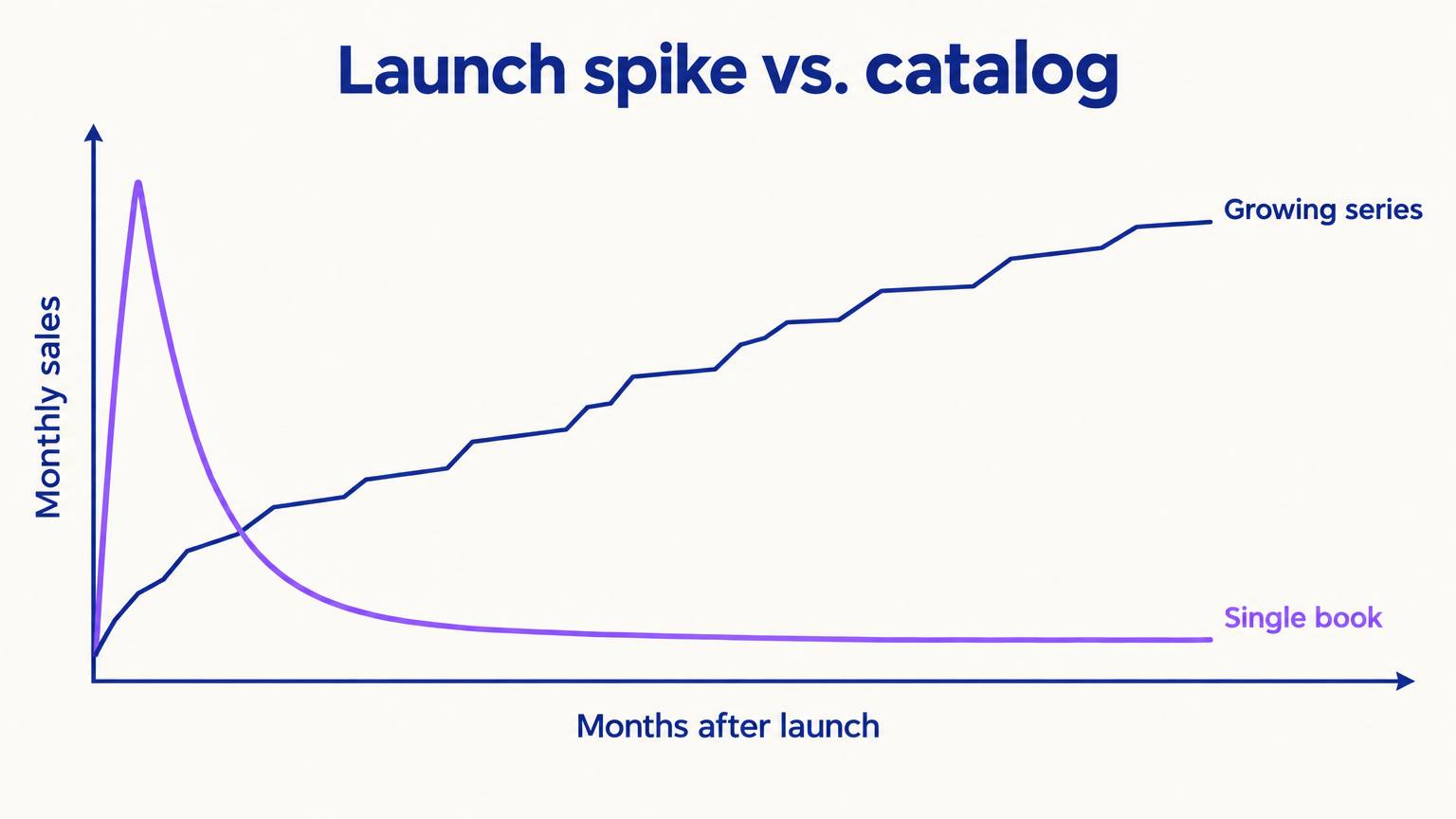
Most books sell most of their copies in the first few months, then settle into a small tail unless something keeps driving readers to them.
Amazon will market it for you
Amazon's algorithms amplify books that already sell. The first readers usually come from your own effort: ads, a list, promotions or a series that feeds itself.
Any niche works if you publish enough
Saturated low-effort niches give low returns per book. Demand, competition and reader expectations decide what a book can earn.
Low-content books are free money
Journals and logbooks have tiny margins and huge competition. A few sellers do well, mostly with strong design and many listings.
Passive means zero work
Expect ongoing light work: price tests, keyword updates, occasional ads and new books that refresh the old ones.
The income models, ranked by how passive they are
A book can earn through several channels at once. Each has a different effort profile after launch.
Ebook royalties
After-launch effort: LowOn KDP, ebooks priced from $2.99 to $9.99 can earn the 70% royalty option, minus a small delivery fee. Outside that range the rate drops to 35%. Once listed, the ebook sells with no inventory and no shipping.
Kindle Unlimited page reads
After-launch effort: LowIf you enroll in KDP Select, you are paid per page read from a shared monthly fund. It suits binge-read genres like romance and thrillers, but requires ebook exclusivity to Amazon.
Paperback and hardcover
After-launch effort: LowPrint on demand means no stock to manage. Your royalty is a share of the list price minus the printing cost, so page count and trim size directly affect margin.
Audiobooks
After-launch effort: MediumAudio opens a separate audience of listeners. The traditional cost was narration; AI narration lowers it, though distribution rules vary by retailer.
Translations
After-launch effort: MediumThe same book in Spanish, German or Portuguese is a new product in a less crowded market. Quality review by a native reader is still recommended.
Direct sales and a reader list
After-launch effort: MediumSelling from your own page or emailing your list keeps more of each sale and makes every future launch less dependent on algorithms.
Back-end offers
After-launch effort: HigherFor non-fiction, the book often earns most through what it leads to: courses, coaching or consulting. Powerful, but no longer passive.
Royalty math on one ebook
Here is a simple worked example for a single novel on KDP, so you can see where the numbers come from. The figures are illustrative; plug in your own with the free royalty calculator.
At about $3.40 per sale, a book that sells three copies a day earns roughly $300 a month. One copy a day is closer to $100. Those are realistic tail numbers for a decent book in a reasonable niche; a breakout is possible but should not be the plan. Our guide to KDP royalties explains every rate and fee in detail.
Why catalogs beat single books
The strongest compounding effect in book income is read-through. A reader who finishes book one of a series and enjoys it is the cheapest possible buyer for book two. Every new book also sends traffic back to the older ones.
That is why the passive-income curve of a growing series looks so different from a standalone launch. The standalone spikes and fades. The series steps up with each release and holds a higher base.
In practice this means planning several connected books before writing the first one. The free series planner helps sketch the arc, and AIWriteBook's book series support writes book two from the characters, world and events of book one, so continuity survives the gap between releases.
Pick the lane carefully first. A series in a niche with real demand and beatable competition earns more than three unrelated books. The niche finder is a quick place to start.
Scaling with AI, honestly
AI can shorten the time from idea to finished, formatted book. It does not remove the need for a good concept, careful editing and honest metadata. Amazon also asks you to disclose AI-generated content when you publish, and readers punish books that feel generic in reviews.
Where AI helps a book business most is multiplying formats of a book that is already good. From one finished manuscript in AIWriteBook you can create an audiobook, a full translation into 30+ languages, and an author page that captures reader emails. Each is another income line for work you have already done.
Realistic expectations
Plan in years and books, not months and dollars. A reasonable path for a new author looks like this:
Learn the whole process. Earnings are usually small. The goal is a finished, well-presented book and your first readers.
Read-through starts. A series in one lane begins to earn something steady, and you can test ads with a better sense of what a reader is worth.
The catalog effect becomes visible. New releases lift old books, translations and audio add income lines, and a reader list makes launches predictable.
For a broader view of how the numbers look across self-published authors, see our KDP success rate analysis, and for the step-by-step publishing side read how to publish a book on Amazon and make money.
Passive book income questions
Yes, in the sense that a finished book can keep selling for years with little extra work. Most authors who earn meaningful passive income do it with several books, often a series, rather than a single title.
There is no reliable average, because results are extremely uneven. Many books earn little, while a small share earns most of the money. Genre, series strategy, cover, reviews and marketing explain most of the difference.
Genres where readers read a lot and read fast, such as romance, thrillers, mystery and fantasy, tend to reward series and Kindle Unlimited. Evergreen practical non-fiction can also sell steadily for years.
Often for fiction in binge-read genres, because page reads add up across a series. The trade-off is that your ebook must be exclusive to Amazon while enrolled.
Light ongoing work helps: refreshing keywords, occasional price promotions and, above all, publishing new books that send readers back to the old ones.
Build assets, not lottery tickets
Passive income from books is real, but it is earned by building a catalog in a lane readers want, then giving each finished book as many formats and markets as it can carry.
To get the publishing side right from the start, work through our Amazon KDP guide.