


The three clean ways to switch
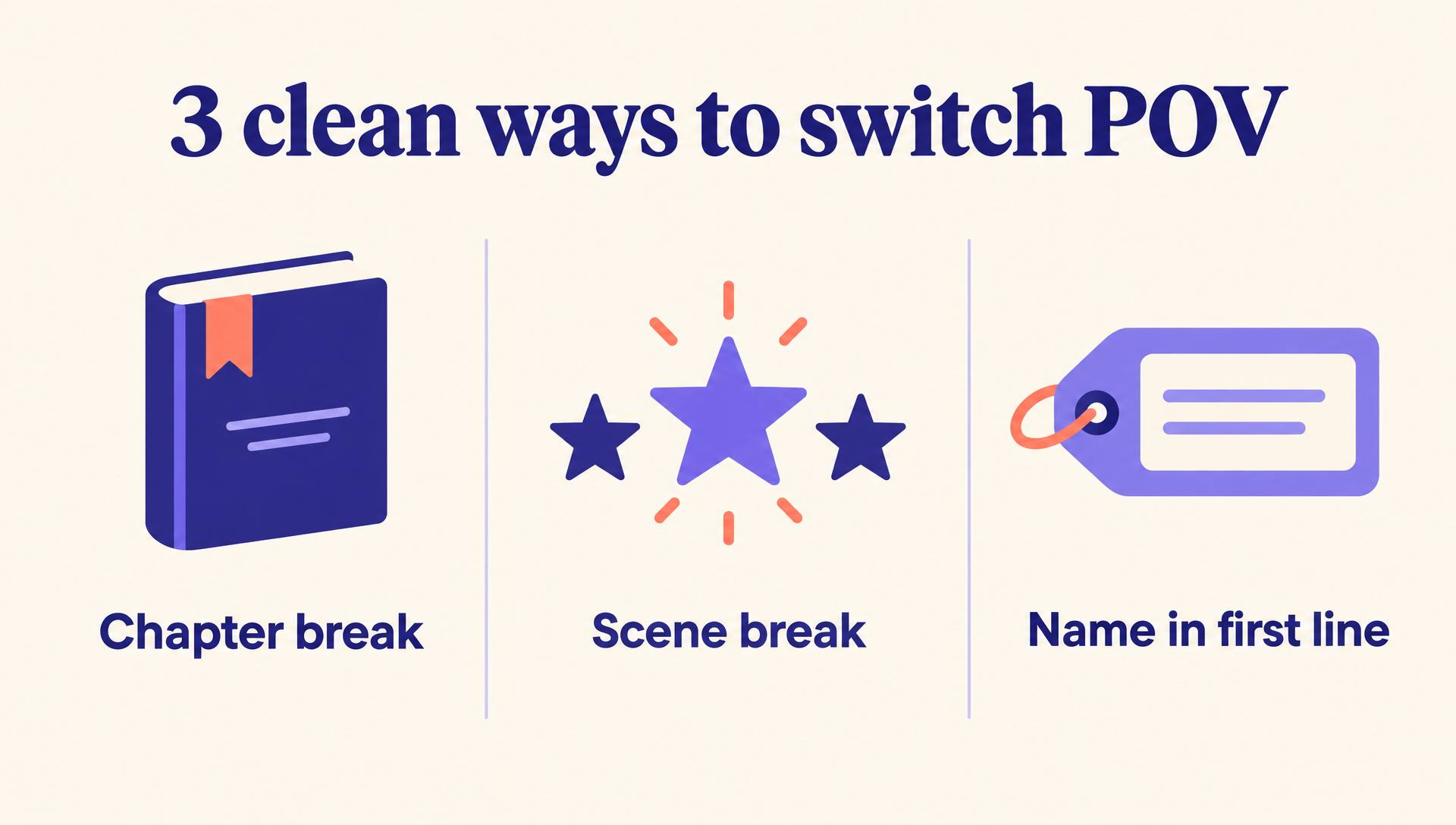
1. Chapter break
The safest switch. Many multiple-POV novels give each chapter one narrator, and some put the narrator's name in the chapter heading, as A Song of Ice and Fire and The Help do.
2. Scene break
A blank line or a centered ornament inside a chapter. Fine for experienced readers of your genre, as long as the next line anchors the new narrator immediately.
3. Name in the first line
Whichever break you use, put the new POV character's name, and something only they would notice, in the first sentence after it.
Anchor the new narrator in one sentence
The first sentence after a switch has three jobs: say who we are with, where they are, and roughly when. Readers will hold their breath for about a paragraph before they start to feel lost.
Weak opening after a break
The rain had not stopped all night, and the street outside was empty.
Anchored opening
By the time Elias reached the docks, the rain had soaked through the coat Mara had lent him, and he hated that he still smelled her perfume on the collar.
The second version names the narrator, places him, and shows a thought only he could have. It also reminds us of the last POV character, which ties the threads together.
Switching vs head-hopping
Head-hopping is switching POV inside a scene without a break, so the reader jumps between two characters' thoughts from one paragraph to the next. It is the most common reason editors flag POV in a manuscript.
Jen smiled, hoping he hadn't noticed her hands shaking. Mark thought she looked calmer than he felt.
In that example, the first sentence is Jen's head and the second is Mark's. Pick one. Mark's calm or nerves can show in what Jen observes: his jaw, his voice, what he does with his hands.
True omniscient narration, where a narrator's voice sits above all the characters, is a different and legitimate choice. The difference is a consistent narrator rather than an accidental jump. Our guide to third person omniscient explains how that works, and third person limited covers the single-head discipline most multiple-POV novels use.
Before you switch: a checklist
Run this on every switch in your draft. Tick each item as you check it.
Make each narrator sound different
Names and breaks get readers oriented. Voice keeps them oriented. Give each POV character distinct sentence length, vocabulary, and preoccupations. A soldier notices exits. A painter notices light. A teenager notices who is looking at them.
It helps to write those differences down. In AIWriteBook each character in your character builder has a voice field for speaking style and dialect, alongside personality, motivation and arc, and chapters are drafted with that profile in context. If you are still inventing the cast, the free character creator gives you a starting profile you can edit.
For a sense of how first and third person handle multiple narrators differently, read first person vs third person before you commit.
Rules of thumb for multiple-POV novels
Do
- Limit POV characters to the people whose arcs carry the plot.
- Keep a rough rotation so no narrator disappears for too long.
- Switch at a moment of tension, so the reader keeps turning pages to get back.
Avoid
- Adding a POV just to reveal one piece of information.
- Replaying the same scene from a second POV unless it changes its meaning.
- Switching in the middle of a scene's climax.
Break, name, voice: those three habits handle almost every POV switch. For the rest of the drafting process, see our how to write a book guide.