

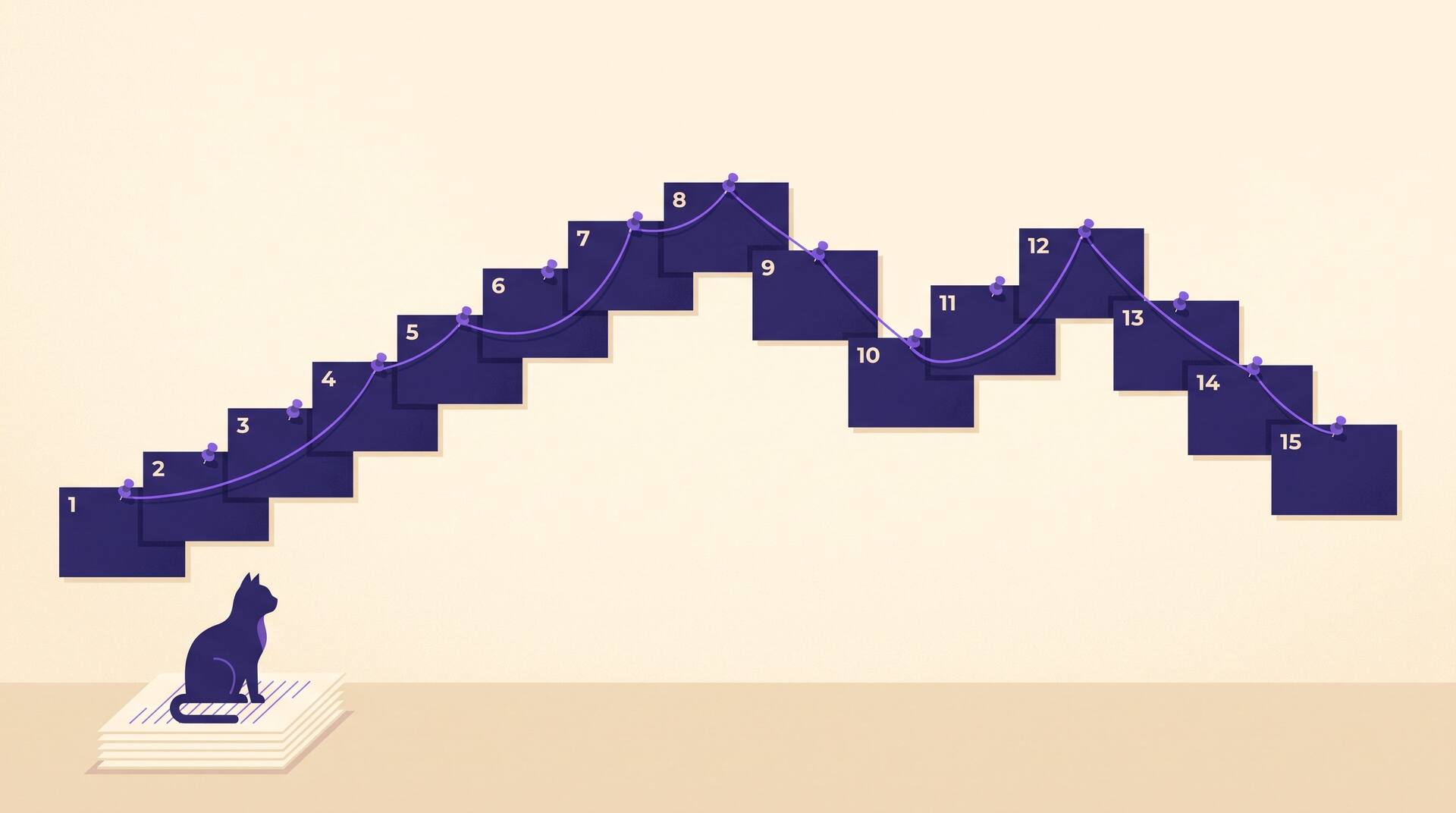
The save the cat beat sheet is a fifteen-beat structural map published by screenwriter Blake Snyder in Save the Cat! (2005) and adapted for fiction by Jessica Brody in Save the Cat! Writes a Novel (2018). Snyder's version came with page numbers pinned to a 110-page screenplay: Catalyst on page 12, Midpoint on page 55, All Is Lost on page 75. That specificity is why writers love it and why critics call it a formula.
Both reactions miss the point. The page numbers are not a rule about when things must happen; they are a description of where audiences have been trained to expect a change in pressure. Miss them by a wide margin and the reader feels it as pace — a slow start, a sagging middle, an ending that arrives out of nowhere. This guide walks all fifteen beats, maps a novel most people have read onto them, and is honest about the three books a year where the sheet actively hurts.
In one sentence
The Save the Cat beat sheet is a fifteen-point sequence of story events — from Opening Image to Final Image — placed at fixed percentages of a narrative's length, designed so that every act break, reversal, and low point arrives where a reader's attention needs it.
"Save the cat" itself is not one of the fifteen beats. It is Snyder's name for a small early moment where the protagonist does something decent — feeds a stray, covers for a colleague — so the audience commits to them before the plot demands anything. It lives inside the Set-Up.
The fifteen beats, in order
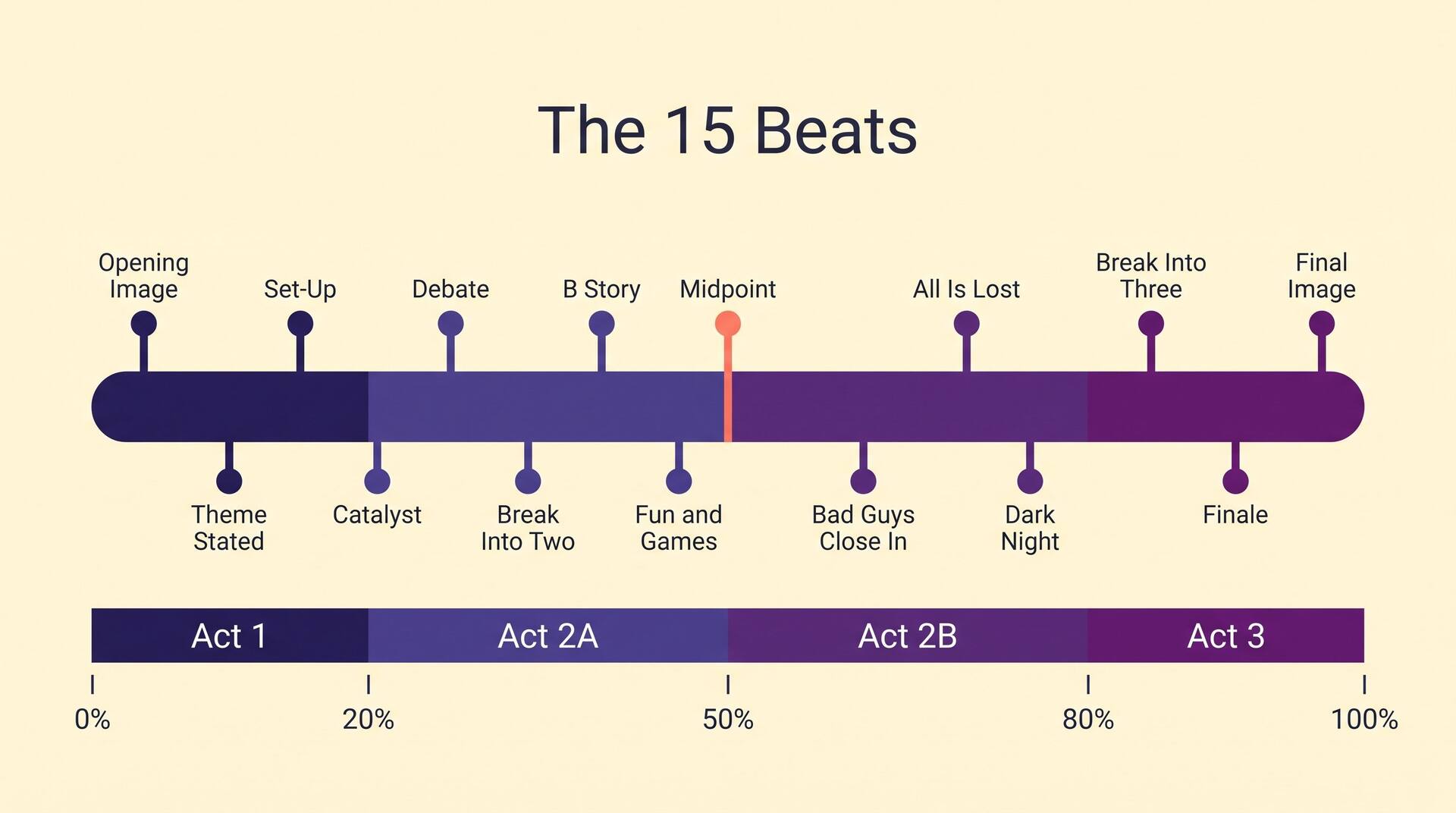
Each beat below carries Snyder's screenplay page, the equivalent percentage for prose, and — more usefully — the dramatic job it does. Open any beat to see what it is for and how The Hunger Games (Suzanne Collins, 2008) handles it.
Tap a beat to open it
Placement: Page 1 · 0–1%
What it does
A snapshot of the world and the protagonist before anything changes. Its real job is to be the "before" half of a pair — it only pays off when the Final Image contradicts it.
In The Hunger Games
Katniss wakes in a District 12 house where the mattress is stuffed and the cat is unwelcome, then slips under the electric fence to hunt illegally. Poverty, competence, quiet law-breaking: the whole character in a page.
Where the beats land in a real manuscript
Screenplay pages are useless to novelists, so convert to words. Here are the four hinge beats at three common lengths. Treat the numbers as a zone roughly five percent wide, not a mark.
| Beat | % of book | 60,000 words | 80,000 words | 110,000 words |
|---|---|---|---|---|
| Catalyst | 10% | 6,000 | 8,000 | 11,000 |
| Break Into Two | 20% | 12,000 | 16,000 | 22,000 |
| Midpoint | 50% | 30,000 | 40,000 | 55,000 |
| All Is Lost | 75% | 45,000 | 60,000 | 82,500 |
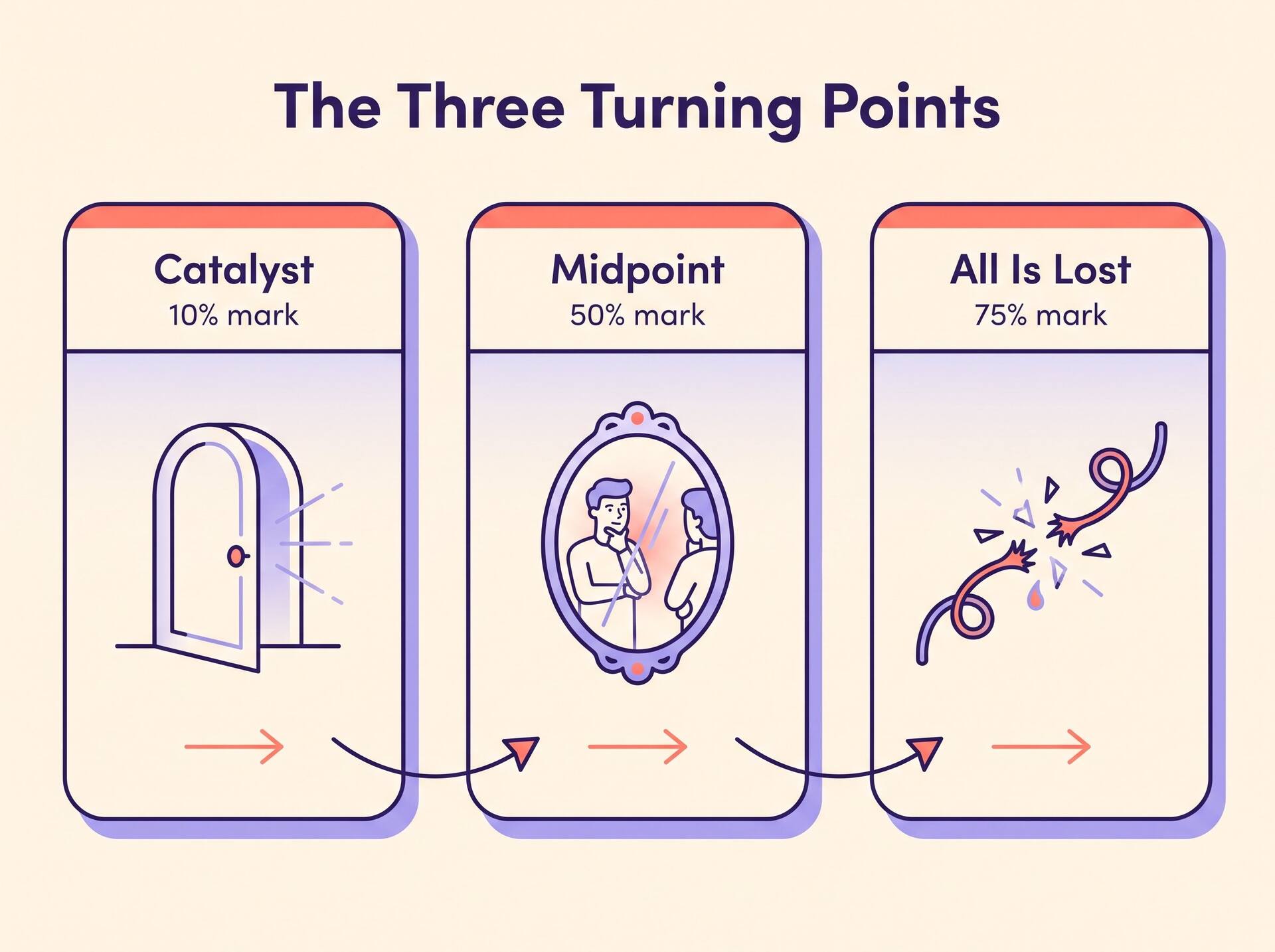
The single most common structural failure in a first novel is a Catalyst that arrives at 25% instead of 10%. Everything after it compresses, the Fun and Games has no room, and the book reads as slow then rushed. If you check one number, check that one.
In chapter terms: an 80,000-word novel in 3,000-word chapters is about 27 chapters, which puts the Catalyst around chapter 3, the Break Into Two around chapter 5 or 6, the Midpoint at chapter 13 or 14, and All Is Lost around chapter 20. We go deeper on sizing in our piece on how many chapters a book should have.
Four ways writers break the sheet
Treating it as a generator instead of a diagnostic
The sheet is far better at telling you why a draft drags than at telling you what happens next. Writers who fill in fifteen boxes before knowing their characters get fifteen plausible events that belong to no one in particular. Draft or outline the story you actually want, then overlay the beats and look at the gaps.
A Fun and Games that is just delay
This is the biggest single stretch of the book — thirty percent of your word count — and the easiest to fill with travel, banter, and errands. The test: does each sequence deliver something the reader bought the book for, and does it change what the protagonist believes or can do? If a chapter passes neither, it is padding wearing a beat's name.
An unearned All Is Lost
Killing a character at 75% because the sheet says the low point goes there produces a shock, not a low point. The loss must be traceable to the flaw you set up in act one. Ask: could the protagonist have prevented this if they had already changed? If the answer is no, the beat is decoration.
Stating the theme out loud
Theme Stated works because it is said by the wrong person, at the wrong moment, to someone not listening. A protagonist announcing the book's meaning in chapter one is a summary, not a beat. Bury it in an argument about something else.
When not to use it
The sheet is a model of one kind of story: a single protagonist with a want, a flaw, and an arc, told in roughly linear time. Outside that, forcing it costs you more than it gives.
- Multi-protagonist and ensemble novels. Four viewpoint characters cannot share one Midpoint. Run separate beat sheets per thread and use the sheet only to check that their low points do not all land in the same chapter.
- Literary and mood-driven fiction where the interest is texture, voice, or a slowly revealed situation rather than escalation. A Dark Night of the Soul imposed on a novel like that reads as a borrowed gear.
- Non-linear structures — braided timelines, frame narratives, novels that open at the end. The beats may still exist in story order, but the page percentages are meaningless once the reading order is scrambled.
- Non-fiction. Argument-driven books have their own shape. If you are writing one, our guide to non-fiction book writing is the more useful map.
There is also a genre caveat. Snyder paired the beat sheet with ten story types — Monster in the House, Golden Fleece, Whydunit and the rest — and the beats behave differently in each. A Whydunit's Midpoint is an information reversal; a Monster in the House Midpoint is usually a body count. Applying the beats without the genre is half the tool.
How it relates to three-act structure and the Hero's Journey
These three models describe the same territory at different resolutions, which is why arguments about which is "correct" go nowhere.
Three-act structure gives you two walls — roughly the 20% and 80% marks — and says nothing about what happens between them. The beat sheet is that structure with the middle filled in: the Break Into Two is the first act break, the Break Into Three is the second, and the Midpoint is the load-bearing beam Snyder added to stop act two collapsing. If you want the coarser version first, start with our guide to three-act structure and add beats afterwards.
The Hero's Journey, from Campbell by way of Vogler, maps almost cleanly onto the same spine: Call to Adventure sits on the Catalyst, Refusal of the Call on the Debate, Crossing the Threshold on the Break Into Two, Meeting the Mentor near the B Story, the Ordeal near the Midpoint or All Is Lost, and the Return with the Elixir on the Final Image. The difference is emphasis — the Journey is a psychological pattern and is comfortable being loose about placement, while the beat sheet is a pacing tool and is not. Our walkthrough of the Hero's Journey covers the stages in full.
In practice: use the Hero's Journey to work out what a stage means for your character, and the beat sheet to work out which page it belongs on. And if you want the simplest visual of the underlying arc, the plot diagram version is exposition, rising action, climax, falling action, resolution — the beat sheet is that curve at fifteen-point resolution.
The fifteen-beat audit
Print this or tick it in the browser. Run it against a finished outline or a completed draft — the questions are diagnostic, not generative. Progress is saved in your browser.
Using the sheet without a corkboard
The bookkeeping is the tedious part: fifteen beats, a chapter list, and a word-count target for each hinge, all of which shift every time you cut a scene. Two things make it lighter.
For a first pass, our free outline generator turns a premise into a chapter-by-chapter structure in the browser, which is the artifact you actually overlay the beats onto — you can see immediately whether your Catalyst chapter is third or eighth. If you are stuck earlier than that, the book ideas generator is the step before it.
If you are writing the book on AIWriteBook, the outline builder keeps the structure attached to the draft: you approve or rewrite every chapter's plan before any prose is generated, so a Midpoint that has drifted to 65% is a two-sentence fix rather than a 20,000-word rewrite. The per-chapter AI chat then lets you push a specific beat harder — asking for a stronger All Is Lost in chapter 20 and accepting or rejecting the change as a diff — without touching the chapters around it.
For series work the same beats repeat per book while a larger arc runs across all of them, and the series feature keeps characters, world rules, and the running arc consistent between volumes so book three's Midpoint still pays off something planted in book one.
Common questions
The short version
Fifteen beats, four of which carry the weight: Catalyst at 10%, Break Into Two at 20%, Midpoint at 50%, All Is Lost at 75%. Get those four in their zones and the pacing problems that kill first novels mostly disappear. The other eleven are refinements. And when the sheet fights your book — ensemble cast, non-linear time, a novel about texture rather than escalation — the sheet is the thing that should give way.
Structure is a planning decision, which means it is cheapest to fix before you write and most expensive after. Our complete guide to writing a book covers where beat-sheeting sits alongside premise, outline, drafting, and revision.