


Definition
A sensitivity reader (also called an authenticity reader) is a reader with lived experience or deep expertise in an identity, culture, condition or experience your book portrays, hired to flag inaccuracies, stereotypes and harmful patterns in how it is written. They advise. You decide.
What a sensitivity reader does, and what they do not
The work is narrower and more practical than the arguments about it online. A good report reads like a specialist's margin notes: this term is dated, this detail is wrong for that region, this scene repeats a pattern readers from this community are tired of, and here is why.
They do
- Catch factual errors about customs, faith, food, language, medical reality or daily life.
- Spot stereotypes and worn-out tropes, like the disabled character who exists to inspire, or the side character whose only trait is their identity.
- Flag dated or loaded terms, and check that slurs on the page do the work you intend.
- Check dialogue, names and code-switching for authenticity.
- Point out descriptive habits, such as describing only some characters' skin with food words.
They do not
- Rewrite your book or approve it.
- Speak for every person who shares their identity.
- Guarantee nobody will criticise the book.
- Do your copyedit or your developmental edit.
That last point matters for budgeting. A sensitivity read sits next to your other edits, it does not replace them. Our guide to hiring a book editor covers the developmental, line and copy edits it sits beside.
Does your book need a sensitivity reader?
Answer six quick questions. The result suggests a scope, not a verdict.
Does a main or point-of-view character share an identity you do not?
Does the book portray a culture, religion or language you did not grow up in?
Does a character have a disability, chronic illness or mental health condition you do not have?
Does the plot turn on trauma, like racism, abuse or displacement, experienced by a group you are outside?
Is the book written for children or teens?
Do you plan to pitch agents, libraries or schools?
0 of 6 answered
When to book a sensitivity read
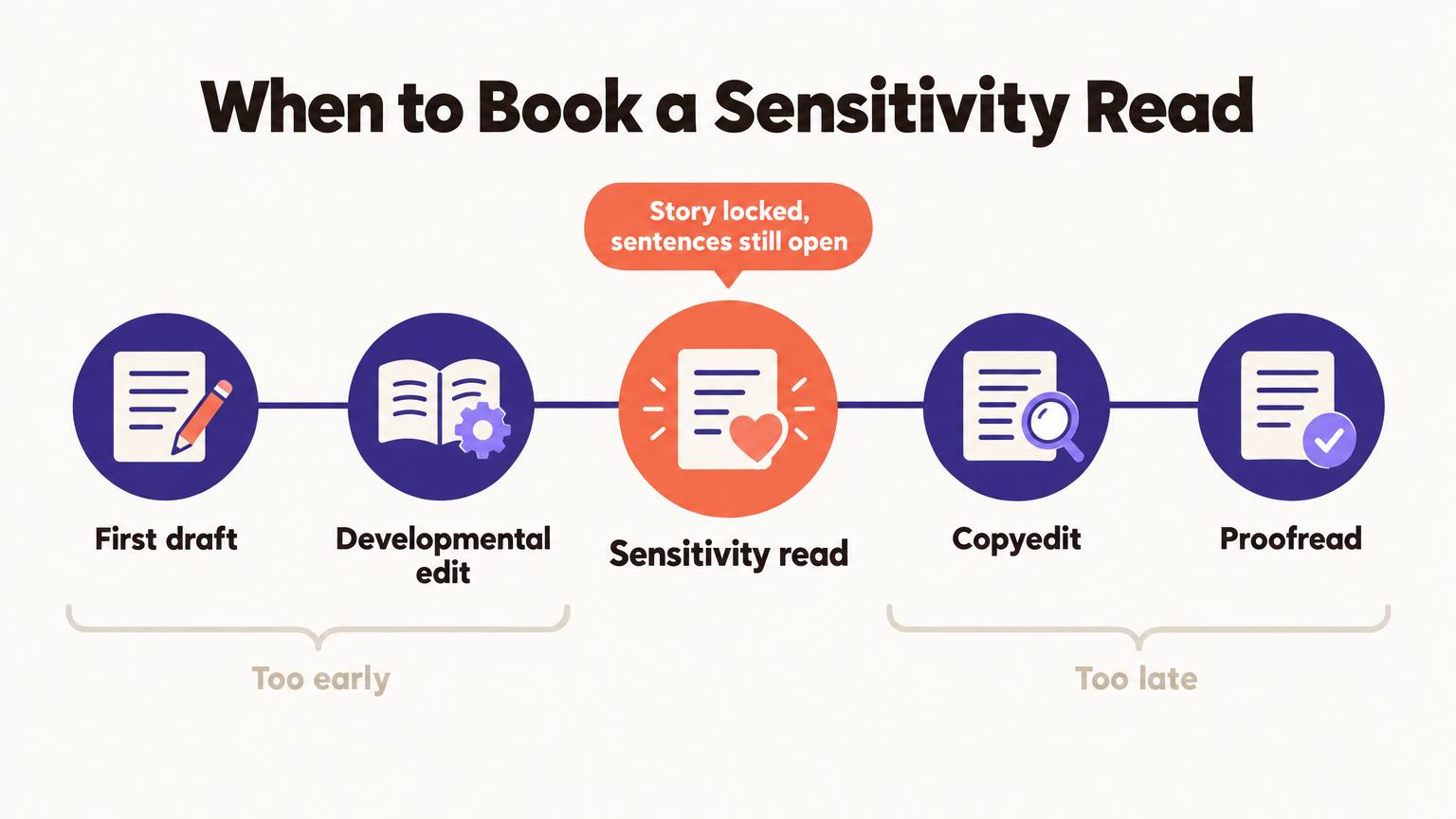
Book the read once the story is locked and the sentences are still open. Earlier, and the reader comments on scenes you are about to cut. Later, after the copyedit, and every change you make undoes work you already paid for.
The exception: if a character's identity drives the plot, talk to a consultant at the outline stage. Fixing a premise is cheap in an outline and expensive in a finished draft. Several services sell a short cultural consultation for exactly this.
Book early. Writing Diversely, for example, asks authors to reach out at least five weeks before any deadline and quotes roughly three weeks of turnaround for a typical manuscript.
Sensitivity reader cost in 2026
Most sensitivity readers price per word with a minimum fee. These are published figures you can check, not estimates.
| Source | Published rate | Notes |
|---|---|---|
| EFA rate chart: sensitivity reading | 1.5 to 2.0 cents per word, or $50 to $60 per hour | Survey of members, not a fixed price |
| EFA rate chart: authenticity reading | 1.5 to 3.8 cents per word, or $50 to $55 per hour | Wider range for specialist expertise |
| Salt and Sage Books: sensitivity and expert read | $240 for up to 10,000 words, then 2.4 cents per word | Editor's letter plus inline comments |
| Salt and Sage Books: editorial sensitivity read | $490 for up to 10,000 words, then 4.9 cents per word | Adds craft feedback on arcs, pacing, plot |
| Writing Diversely | From $300 minimum, quotes in the 1.3 to 4 cent range | About three weeks turnaround |
Estimate your read
Low end (1.5¢ per word)
$1,200
Salt and Sage formula ($240 + 2.4¢ above 10,000)
$1,920
High end (3.8¢ per word)
$3,040
Two ways to spend less without cutting corners. First, scope it: if the character in question appears in eight chapters of thirty, send those eight plus a synopsis. Second, get the length right before you request quotes. Paste the relevant chapters into the free word counter so every quote is for the same number.
Expect to pay more for a second reader, a rush, or a follow-up read of revised chapters. Ask about all three before you sign.
How to find a sensitivity reader
Agencies and collectives
Services such as Salt and Sage Books and Writing Diversely match you with a reader and handle contracts and payment. You trade a little cost for vetting and a backup if a reader drops out.
Editor directories
The Editorial Freelancers Association's directory lets you search members by service. Filter for sensitivity or authenticity reading and the subject you need.
Acknowledgments pages
Authors usually thank their sensitivity readers by name. Find two or three books that portray the same community well, read the acknowledgments, and look those readers up. It is the best-kept trick in the business, and our guide to writing an acknowledgments page explains why those thanks are there.
Community organisations
Disability, cultural and faith organisations often know readers who do this work professionally. Ask for a referral, never for free labour.
Before you hire, check three things
- Their lived experience matches the specific identity on the page. A reader from Lagos is not interchangeable with a reader from Atlanta.
- They can show a sample report or a reference from another author.
- The contract states scope, word count, deliverable, deadline, whether a follow-up question round is included, and whether they want to be credited.
How to brief a sensitivity reader
A vague brief ("tell me if anything is offensive") gets a vague report. A specific brief gets specific notes. Include these six parts.
- 01The book
- Title, genre, age category, word count, and a one-paragraph synopsis.
- 02Who to read for
- Name the characters and the identity or experience you want checked, with chapter numbers where they appear.
- 03Your worries
- List the scenes you are least sure of. Readers work faster when you point at the risk.
- 04Out of scope
- Say what you do not need: typos, pacing, plot notes. It keeps the report focused and the price fair.
- 05Format and deadline
- File format, the date you need the report, and whether you want a short follow-up call.
- 06Credit
- Ask whether they want to be named in the acknowledgments. Some do, some prefer not to be.
Send the character profiles too. If you keep them in AIWriteBook's Characters step, or built them with the free character creator, paste the relevant profiles into the brief so the reader sees how you think about the person, not only what made it to the page.
How to take the feedback
Read the whole report once without opening the manuscript. Some notes will sting. That is normal, and it is not a verdict on you. Then sort every note into one of three bins.
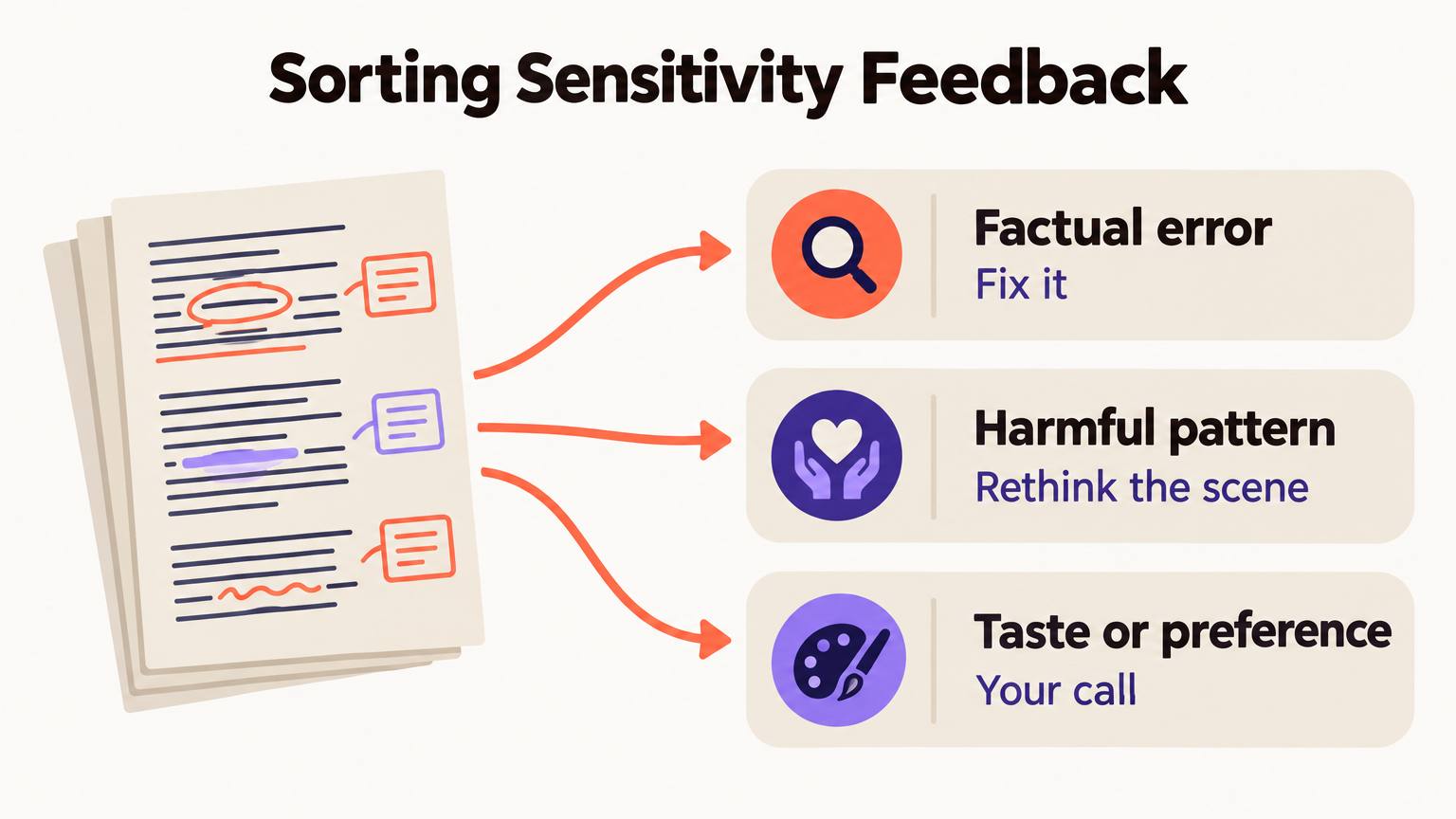
Factual error
The wrong name for a holiday, a mobility aid that does not work that way, a dish from the wrong region. Fix it. There is nothing to debate.
Harmful pattern
A trope, a role or a description that repeats something hurtful. Changing a word rarely fixes it. Ask what the scene is doing for the story, and rebuild it so the character has their own goals. Our guide to character development helps here.
Taste or preference
A reader would have written it differently. It is your book. Decide, and write down why, so you can explain the choice later if you need to.
If a note confuses you, ask one clear follow-up question within the window your contract allows. Do not ask the reader to re-approve the revised manuscript. Their job was to advise, and a sign-off turns them into a shield, which is unfair to them and does not protect you.
Common mistakes
- 1Hiring one reader to cover several identities.
- 2Booking the read after the copyedit, then paying to copyedit the changes.
- 3Asking for a pass or fail instead of notes.
- 4Treating the read as a seal of approval in marketing copy.
- 5Asking acquaintances from a community for the same work for free.
- 6Cutting the character to avoid the work. Sometimes that is right for the story, but decide it on story grounds.
The AI-assisted shortcut
The reading itself is a human job: it is lived experience you are paying for. Where software saves real time is everything around it, before the read and after it.
Before: clean the manuscript so the reader's hours go on substance. The Book Editor in AIWriteBook gives you an editorial letter, line edits and a proofread pass that you accept or reject change by change, so the reader is not marking typos.
After: apply notes chapter by chapter with the chapter AI chat. Paste the note, ask for a revision of the passage, and accept or reject each change in the diff. Then update the character's profile in the story bible, so every later chapter, and the next book if you are writing a series, carries the corrected detail forward.
Frequently asked questions
A beta reader reacts to the book as a member of its audience. A sensitivity reader is hired for lived experience or expertise in a specific identity or subject the book portrays, and reports on accuracy and harmful patterns.
Hire for specifics, then decide like an author
A sensitivity reader is worth the money when you brief them on specific characters and scenes, book them at the right moment, and treat their report as expert notes rather than a verdict. Fix the facts, rethink the patterns, decide the matters of taste, and keep a record of why.