


The short version
- 1Finish your own revision first, so readers react to the story and not to typos.
- 2Recruit from three places: a free community, a critique swap, and your own readers.
- 3Run two or three small rounds instead of one big one.
- 4Send a one-page brief that says what you want and what to skip.
- 5Ask behaviour questions: where they skimmed, where they stopped, what they guessed.
- 6Count how many readers flagged each issue before you change a word.
In this guide
What beta readers catch that editors miss
An editor reads like a professional who has to finish. A beta reader reads like a customer who can stop. That difference is the whole value. The most useful thing a beta reader can tell you is not whether the book is good, it is the page where they put it down and the moment they started skimming.
Typical catches: the twist three of five readers guessed by chapter four, the love interest nobody warmed to, the cast where two side characters blurred into one, the middle stretch where the phone came out. None of these show up in a copyedit, and all of them show up in reviews.
Timing matters. Send the book to betas after your own revision pass and before you pay for copyediting, because there is no point polishing sentences in a chapter you may cut. If you plan to hire a developmental editor, betas can go either before (cheap, catches obvious problems) or after (checks that the big fixes worked). Our vetting playbook for hiring an editor covers where each paid edit fits.
Beta readers are not ARC readers
Beta readers get an unfinished book and help you fix it. ARC readers get a finished book shortly before launch and post honest reviews. Mixing the two burns your review team on a draft. When you are ready for reviewers, see the guides to NetGalley for authors and the Amazon Vine program.
Where to find beta readers
Tap a category to see the places that actually produce finished reports. Most authors who get good feedback use at least two categories, because each one fails in a different way.
r/BetaReaders
Best for
Fast responses for most genres. A good post states genre, word count, content warnings, a short blurb and the kind of feedback you want.
Watch out
Many offers are swaps, so budget time to read someone else's book in return.
Goodreads Beta Reader Group
Best for
Readers who already track and review books, often sorted by genre threads.
Watch out
Older threads go stale. Post fresh and follow up within a week.
Genre Facebook groups and Discord servers
Best for
Readers of your exact subgenre, which matters for romance, LitRPG and cozy mystery.
Watch out
Check each group's rules before posting, many ban self-promotion outside set threads.
How many beta readers, and how many rounds
One round of fifteen readers sounds efficient and is not. Fifteen people will all tell you about the same saggy middle, and after you fix it you have nobody left who can read the new version without remembering the old one. Small rounds with revision in between give you a test after every fix.
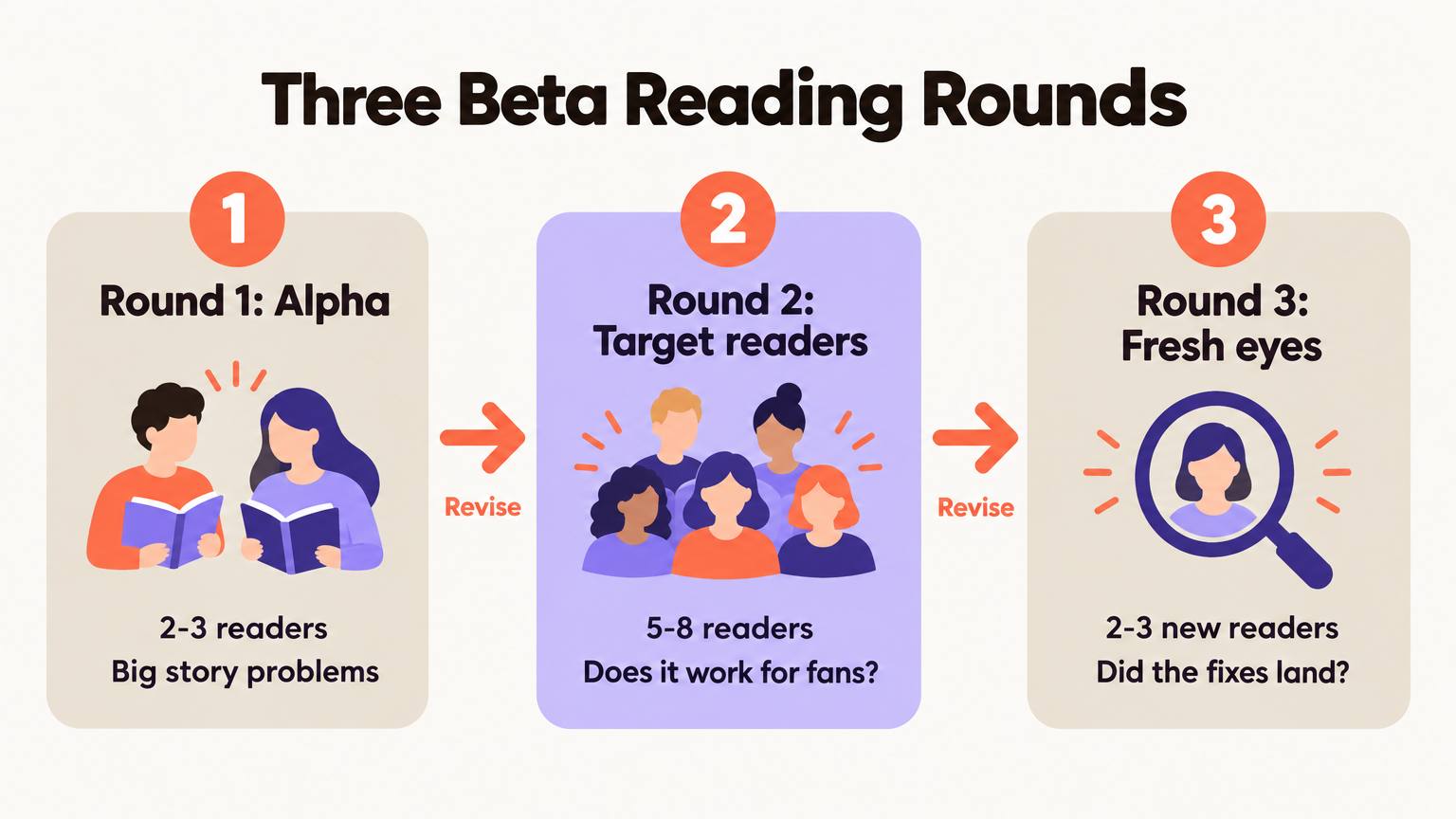
Invite one or two more readers than you need in each round. Some people go quiet, and that is normal: life happens, and a reader who drops out at chapter nine has still told you something about chapter nine.
For a long book, check the length before you recruit. Readers commit to a word count, not a page count, and a 120,000-word fantasy is a different ask from a 60,000-word cozy. Paste the manuscript into the free word counter and put the number in your post, and compare it against typical word counts by genre while you are at it.
The brief: what to send before chapter one
The brief sets expectations in both directions. It tells readers what you want, what to ignore and when you need it back, and it gives you a polite way to follow up later. Copy this and fill in the brackets.
Hi [name], thank you for reading.

The book: [title], a [genre] novel of about [word count] words. If you liked [comp title 1] or [comp title 2], you are the reader I wrote it for.

Where it is: this is a revised draft. A proofreader comes later, so please skip typos and commas.

What I need most: your honest reactions as a reader. Where you got bored, where you got confused, what you guessed early, and which characters you did or did not care about.

Content notes: [list any].

Deadline: [date, about 3 to 4 weeks out]. If life gets in the way, just tell me where you stopped. That helps too.

How to reply: comments in the file, plus the short questionnaire at the end.

Please keep the manuscript to yourself. Thank you, this genuinely shapes the book.
Send the file in the format they will actually read. Many readers prefer an e-reader, so offer an EPUB alongside the DOCX, and keep a Google Doc for readers who like commenting inline. If you write in AIWriteBook, the Export step gives you EPUB, DOCX and PDF from the same manuscript.
The beta reader questionnaire
Good questions ask about behaviour, not opinion. "Did you like the ending?" invites politeness. "Where did you first want to skim?" invites a page number. Pick the sets that match what you are worried about, then copy your questionnaire.
- Where, if anywhere, did you first want to skim? Give a chapter or page.
- Was there a point where you put the book down and did not want to pick it back up?
- Which chapter ending made you read the next chapter right away?
- Where were you confused about what was happening or why?
- What did you guess before the book revealed it, and when?
- Was there anything you expected to matter that never came back?
Keep the total under fifteen questions. Long questionnaires get answered in one word per line. For a long book, add a short check-in after the first act asking only the engagement questions, so you learn about an early drop-off while the reader still remembers it.
Paid vs free beta readers
Free readers cost time, paid readers cost money, and both can produce excellent or useless reports. The real differences are speed, reliability and who you can reach.
| Factor | Free and swap readers | Paid readers |
|---|---|---|
| Cost | Free, or the time to read their book | About $25 to $300 on marketplaces, more for services |
| Finish rate | Variable, some go quiet | High, a deadline is part of the deal |
| Reader fit | Often other writers | You can filter for genre readers |
| Honesty | Friends soften, strangers are blunt | Usually blunt, sometimes formulaic |
| Best use | Early rounds and swaps | Filling a gap in genre or timing |
Never pay for a review
A paid beta reader is buying their time for feedback on a draft. Do not ask paid readers to post a store review of the finished book: Amazon's rules prohibit reviews given in exchange for compensation. Keep the two relationships separate, and use the routes in our guide to getting book reviews on Amazon for launch.
How to process beta reader feedback
Feedback arrives all at once and it all feels urgent. It is not. Read everything once without editing, then wait two days. The comment that stung on Monday usually reads as useful on Wednesday.
Then put every note in a spreadsheet: one row per comment, with columns for chapter, reader, what they said and a short tag (pacing, character, clarity, ending, taste). Sort by tag and chapter, and count. The count decides more than your feelings do.
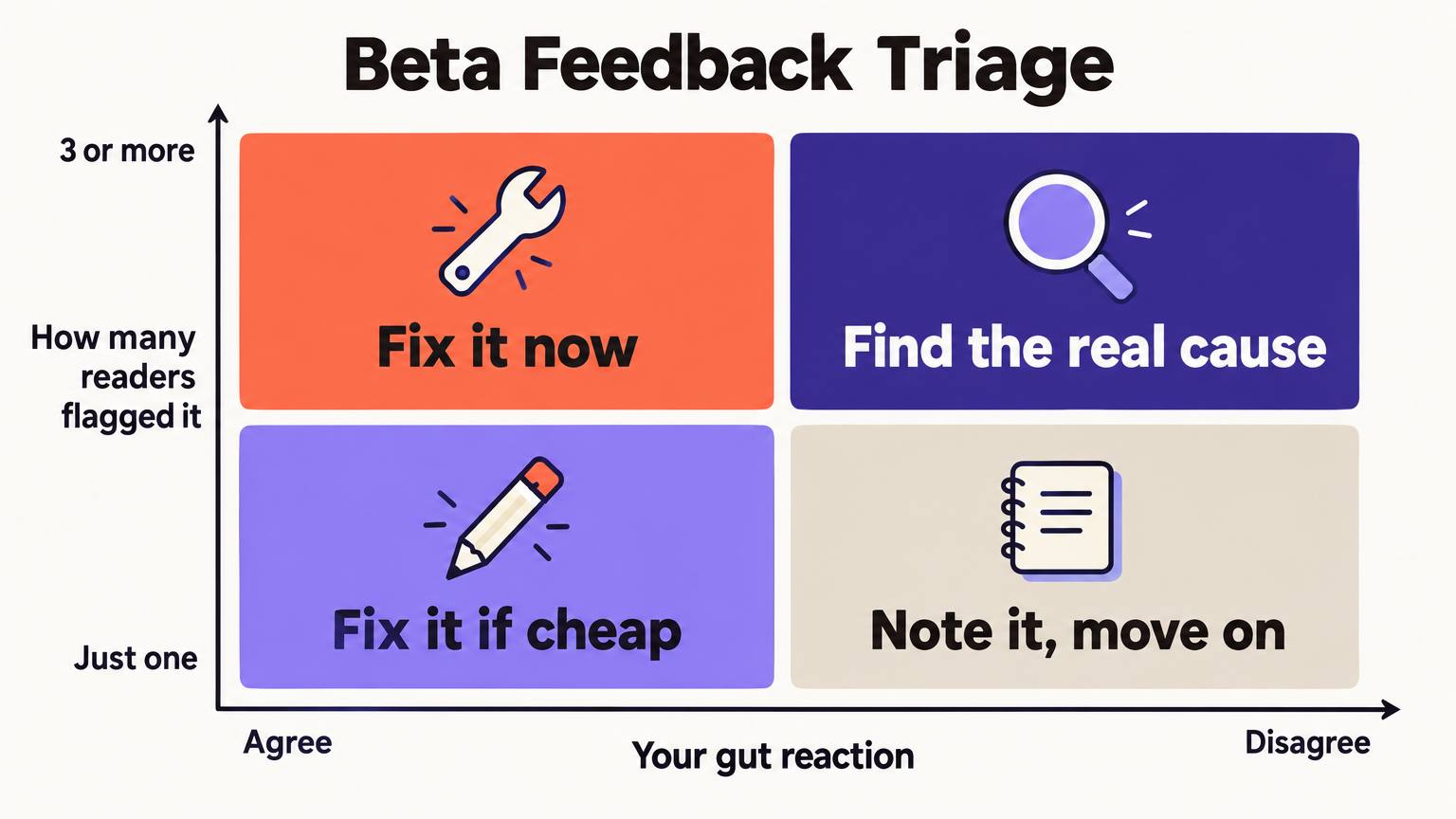
The top-right quadrant is the interesting one. When several readers flag the same scene and you disagree with their fix, they are usually right that something is wrong and wrong about what. Readers are reliable sensors and unreliable mechanics. "The villain is boring" can mean the villain needs more page time, or it can mean the hero never feels threatened. Our guide on how to write a villain helps diagnose that exact note.
Reply to every reader with a thank you and nothing else. Do not explain what they missed or defend the scene. If something is unclear, ask one follow-up question. Readers who feel heard come back for the next book.
Common mistakes
Sending a first draft
Readers spend their goodwill on problems you already know about. Do one full revision pass first.
Asking "what did you think?"
Open questions get vague praise. Ask for chapters, page numbers and guesses.
Using only writers
Writers give craft notes. You also need people who just read your genre and buy books in it.
Revising after every report
Wait until the round closes, then count. Fixing one reader's note at a time can undo the next reader's favourite scene.
Burning the whole pool in one round
Keep fresh readers back to test your revisions.
No deadline
"Whenever you get to it" means never. Three to four weeks for a novel is a fair ask.
The AI-assisted shortcut
Beta readers have limited attention, and every typo they stop to mark is attention they did not spend on your plot. Clear the mechanical noise before the book goes out, and readers spend their energy on what only a reader can tell you.
In AIWriteBook, bring an existing manuscript in with manuscript import (a Word file, your words left unchanged), then run the Book Editor. It produces an editorial letter, a style sheet, line edits and a proofread pass, and you accept or reject every change one by one. For a quick check on a single chapter, the free grammar checker works without an account.
When the feedback comes back, the chapter AI chat helps with the targeted fixes: describe the note ("three readers lost track of who Mara is in chapter six, add a clearer reintroduction"), and it proposes the change as a diff you accept or reject line by line. Your voice stays yours, and the decision stays with you.
Frequently asked questions
Between five and ten in total across two or three rounds works for most novels: two or three early readers for big story problems, five to eight target readers, then two or three fresh readers to check your fixes.
Yes. r/BetaReaders, the Goodreads Beta Reader Group, genre Facebook groups and Discord servers, critique sites like Scribophile and Critique Circle, and your own newsletter all work without payment, though swaps cost you reading time.
Marketplace gigs commonly range from about $25 to $300 depending on manuscript length and report depth. Dedicated services often quote around 1 to 3 cents per word.
Three to four weeks for a full-length novel is a fair deadline. Shorter works and novellas can take two weeks.
For most self-published fiction, a clear request to keep the manuscript private is enough. Unpublished work is already protected by copyright, and an NDA can put off volunteer readers.
Find readers, then listen carefully
Finding beta readers is the easy part. The skill is in the brief that tells them what to look for, the questions that pull out page numbers instead of compliments, and the discipline to count before you change anything. Do those three things and five strangers will teach you more about your book than another month of rereading it yourself.