

The short answer
A summary tells a reader what a book is about and stops before the ending. A synopsis tells an agent or editor everything that happens, in order, including the ending. The summary sells an experience; the synopsis demonstrates a structure.
Definitions
- Summary
- A condensed account of a book's content. In publishing, the summary an author writes is almost always the reader-facing one: the back-cover copy, the retailer description, the paragraph in a query letter. It introduces the protagonist, the situation and the stakes, sets the tone, and deliberately withholds the outcome.
- Synopsis
- A complete, chronological account of the plot written for industry readers: literary agents, acquiring editors, sometimes grant or contest judges. It covers every major turning point, the main characters' motivations and arcs, and the resolution. Spoilers are the whole point.
Outside publishing, a student's book summary may include the ending too. The distinction that matters for authors is audience: readers get a summary, professionals get a synopsis.
Side by side
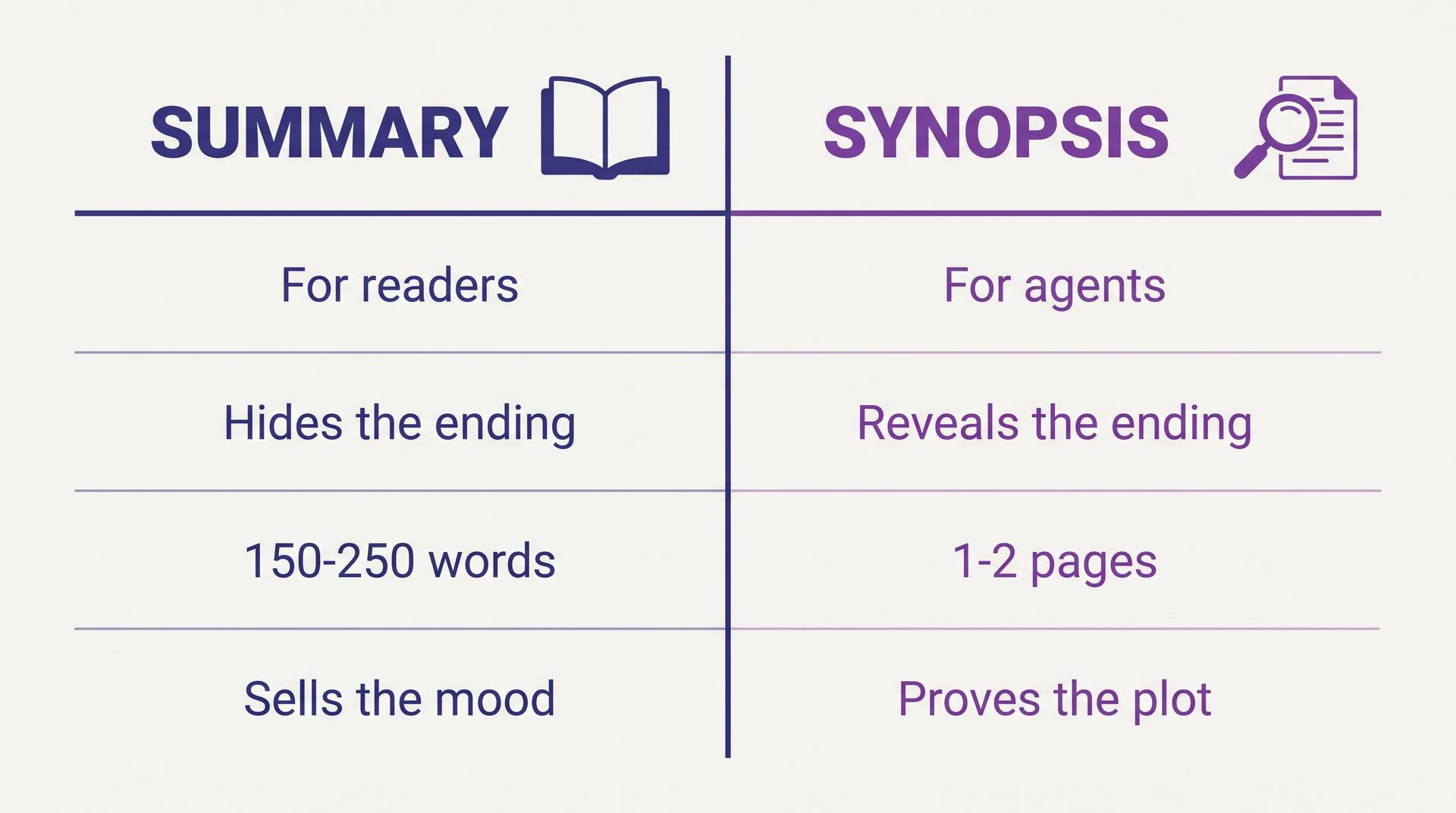
| Aspect | Summary | Synopsis |
|---|---|---|
| Reader | Book buyers, browsers, a query letter's first paragraph | Agents, editors, submission committees |
| Ending | Withheld | Always revealed |
| Typical length | 150 to 250 words | One to two pages, sometimes up to five if requested |
| Tense and voice | Present tense, voice matches the book's tone | Present tense, third person, plain and clear |
| Characters named | One or two | Usually three to five; minor characters get a role, not a name |
| Job | Create curiosity | Prove the story is complete and coherent |
Famous books, both ways
Switch between three classics to see the same story condensed for two different readers. Notice how the summary ends on a question and the synopsis ends on an answer.
Elizabeth Bennet is clever, quick to judge and in no hurry to marry, whatever her mother says. When the proud and wealthy Mr Darcy insults her at a country ball, she decides she knows exactly what kind of man he is. But first impressions have a way of being wrong, and a family scandal is about to test everything she believes.
Elizabeth Bennet, the second of five daughters in a family whose estate will pass to a male cousin, meets Mr Darcy, who snubs her at a ball. Her dislike deepens when the charming officer Wickham claims Darcy cheated him of an inheritance. Darcy proposes, clumsily; Elizabeth refuses and accuses him of ruining both Wickham and her sister Jane's romance with his friend Bingley. Darcy's letter reveals that Wickham tried to elope with Darcy's teenage sister for her fortune. When Elizabeth's youngest sister Lydia runs off with Wickham, Darcy secretly pays Wickham to marry her and saves the family's reputation. Elizabeth learns what he did, recognises her own prejudice, and accepts his second proposal, while Bingley and Jane are reunited.
The synopses are written the way agents like to read them: present-tense events, cause and effect, no rhetorical questions. The summaries borrow the book's mood and stop at the hook.
Which one do you need?
Choose who is going to read it.
Common mistakes
- Hiding the ending in a synopsis. Agents read it to see if you can land the story; a teaser tells them you can't, or won't.
- Writing the synopsis as back-cover copy, full of rhetorical questions and words like thrilling or unforgettable. Let the events do the work.
- Summarising scene by scene. A synopsis covers turning points and motivation, not every conversation.
- Naming too many characters. Past four or five names, readers lose track. Call the rest by role: her boss, the ship's captain.
- Giving away the twist in a summary on a retailer page. Readers feel cheated and say so in reviews.
- Forgetting emotion. A synopsis that lists events without saying why characters choose what they choose reads like a timeline, not a story.
Turning one into the other
Most authors write the synopsis first, because it forces you to know the story, and then carve the summary out of its first third.
From synopsis to summary
Keep the protagonist, the inciting incident and the central conflict. Delete everything after the midpoint. Replace the plain language with the book's own tone, and end on the question the reader will want answered.
From summary to synopsis
Keep the setup, then add each major turning point in order: the first plot point, the midpoint reversal, the crisis, the climax and the resolution. For each, say what happens and why the character acts as they do.
Need the full step-by-step with a fill-in structure? Our book synopsis template gives a seven-block layout and a complete worked example, and the query letter template shows where the summary sits in your pitch.
Where AI helps
The hardest part of a synopsis is seeing your own plot from above. If you draft in AIWriteBook, your book already has a chapter-by-chapter outline from the outline builder, which is most of a synopsis in raw form, so condensing it to one page starts from structure you have rather than a blank screen.
For the reader-facing summary, the free blurb generator drafts back-cover copy from your premise and genre, and in the app the KDP metadata step writes your Amazon book description alongside keywords and categories. Treat either draft as a starting point: check that it withholds the ending and sounds like your book.
Before you send anything to an agent, compare it with the advice in our guide to researching literary agents. Many publish exact synopsis preferences.
Frequently asked questions
No. A summary describes the premise and stops before the ending to make someone want to read the book. A synopsis recounts the whole plot, including the ending, so an agent or editor can judge whether the story works.
Two documents, two readers
Write the synopsis for someone deciding whether your story works, and give them the whole thing. Write the summary for someone deciding whether to spend an evening with your book, and leave them wanting the rest. If you know who is reading, you will know which one you need.
Both documents come after the draft itself. For every stage from idea to finished manuscript, see our How to Write a Book guide.