


The short answer
A motif is a concrete element that repeats: an object, image, color, sound or phrase. A theme is the abstract idea the story explores, best written as a full sentence. Motifs are evidence; the theme is the argument they support.
Definition
- Theme
- The central idea or question a story keeps returning to. "Loneliness" is a topic; "loneliness makes people cling to dreams they cannot reach" is a theme. It has no physical form, and a reader has to infer it.
- Motif
- A recurring concrete element that gathers meaning each time it appears. It lives on the page: you can highlight every instance and count them.
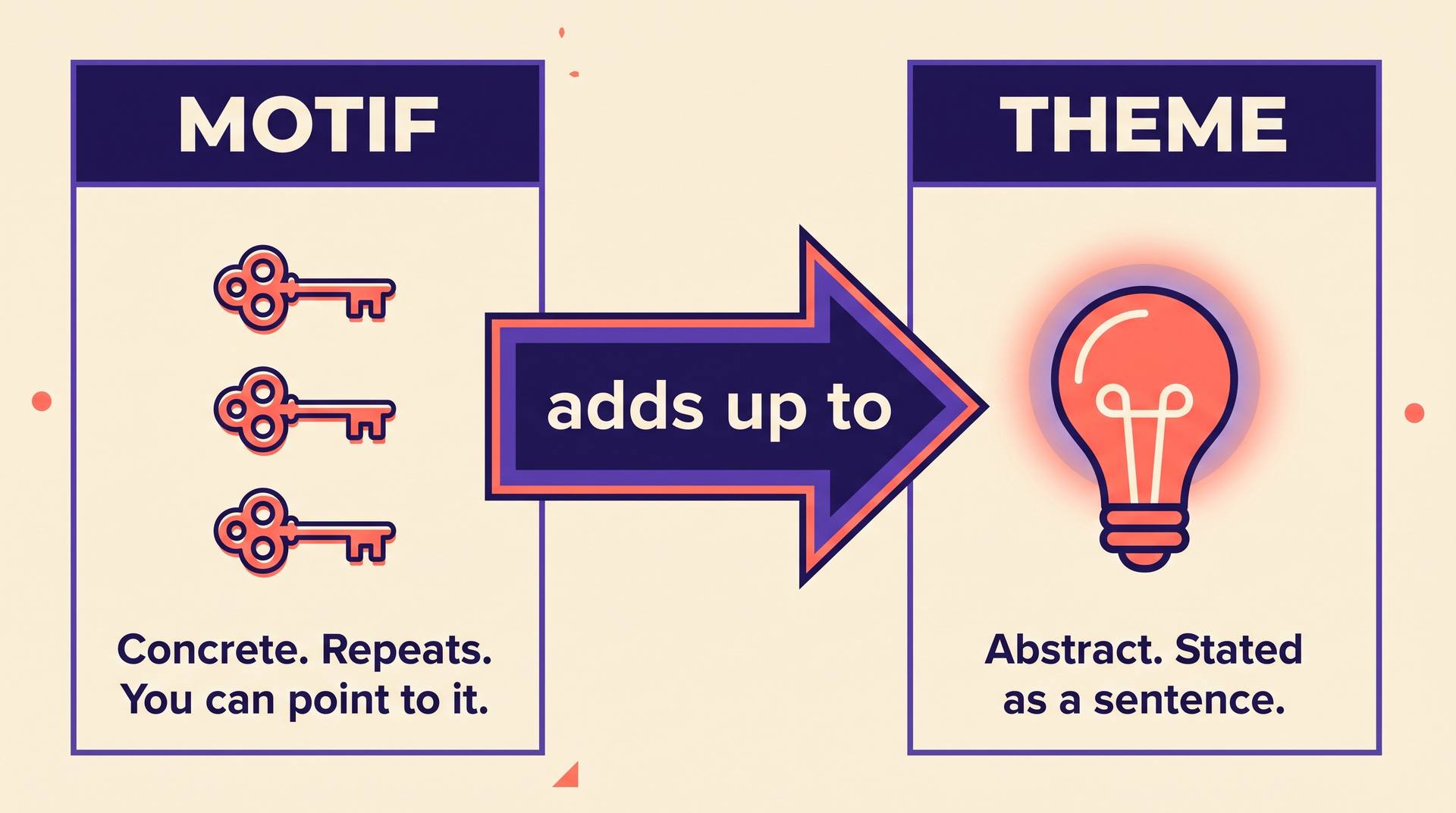
The relationship runs one way. Motifs serve themes; themes do not serve motifs. A story can have a theme with no motif, argued through plot and character choices alone, but a motif without a theme is only a repeated detail.
If you are also untangling symbols, our guide to motif examples in literature places motif, symbol and leitmotif on one ladder. This page stays on the theme side of the question.
Side by side
| Theme | Motif | |
|---|---|---|
| Form | An idea | A thing, image, sound or phrase |
| How you state it | As a full sentence | As a noun |
| Where it lives | In the reader's head | On specific pages |
| How many per book | One main, one or two minor | Several, each serving a theme |
| Can you cut it? | Not without changing what the book means | Yes, and the book still works, only thinner |
| When writers usually find it | Often during or after the first draft | Often in revision, by strengthening accidental repeats |
Test yourself
Eight items from well-known books. Decide whether each is a theme or a motif.
The fire the father and son are "carrying" in The Road
Ambition without conscience destroys the ambitious
Fire and ice in Jane Eyre
The dream of a small farm in Of Mice and Men
Knowledge pursued without responsibility turns monstrous
Isolation
The color red in The Handmaid's Tale
People need someone to talk to or they come apart
Four novels, taken apart
Each row pairs one motif with the theme it serves, so you can see the mechanism rather than two separate lists.
Of Mice and Men (John Steinbeck)
Motif
The retold dream of the farm
Theme it serves
Hope is what keeps lonely people going, and it is fragile
Each retelling is shorter and more desperate, until George tells it one last time at the end.
The Road (Cormac McCarthy)
Motif
"Carrying the fire"
Theme it serves
Goodness can survive when everything else is gone
The phrase is passed from father to son, so the motif itself enacts the theme.
Jane Eyre (Charlotte Brontë)
Motif
Fire and ice
Theme it serves
A person needs both passion and self-respect
Rochester is associated with fire, St John Rivers with ice. Jane refuses to live in either extreme.
Frankenstein (Mary Shelley)
Motif
Light and fire
Theme it serves
Knowledge pursued without responsibility turns monstrous
The creature discovers fire gives warmth and also burns: the novel's argument about knowledge, in one scene.
Want more motifs to study? Our motif examples breakdown covers seven more, from Macbeth to Mrs Dalloway.
Using both in your draft
Most writers do not start with a theme. They notice one halfway through the first draft. That is fine, and this order works with it.
- 1
Draft first, name the theme second
Finish a draft or at least the first act. Then ask what your protagonist keeps getting wrong. The answer is usually the edge of your theme.
- 2
Write the theme as one sentence
"Family" is not enough. "Family can protect you or trap you, and you cannot always tell which" gives you something to test scenes against.
- 3
Find the accidental repeats
Search the draft for objects, weather and phrases that already recur. Your strongest motif is often already there, half-built.
- 4
Give the motif a change
A motif that appears the same way every time is decoration. Let it shift, break or change hands as the character changes, like the farm dream in Of Mice and Men.
- 5
Place the last appearance deliberately
The final appearance should land at or near the climax, where the theme's argument is settled. That is the moment readers remember.
Common mistakes
- Calling a single symbol a motif. One appearance is a symbol; a motif needs to recur.
- Stating the theme as one word. "Love" is a topic. A theme says something about love.
- Explaining the motif. When a character spells out what the recurring image means, the motif stops working.
- Stacking too many motifs. Three strong ones beat ten faint ones, and readers only track a few.
- Letting the theme turn into a lecture. The plot should test the idea, and sometimes prove it wrong for a character.
When to use, when to hold back
Lean in when
- The book is long enough for patterns to build, usually novel length
- You want the ending to feel inevitable rather than announced
- The genre rewards rereading, like literary fiction, mystery or fantasy
Hold back when
- You are writing flash fiction, where one symbol usually does more
- The motif keeps pulling scenes off course to fit it in
- You are still in the first draft and the theme has not shown itself
AI assistance
Tracking a motif across 80,000 words is where writers lose the thread. Inside AIWriteBook, the chapter AI chat lets you ask about a chapter, for example "add a quiet callback to the broken watch here," and shows each proposed change as a diff you accept or reject. The motif stays yours; the tool handles the placement.
If you are still looking for a story to hang a theme on, the free story starter and writing prompts generator generate premises you can test against a theme sentence, and the chapter generator drafts chapters from your outline so you can check whether the theme holds up on the page.
AI can place and vary a motif. Deciding what your book means is still your job.
Frequently asked questions
A motif is concrete and repeats on the page, such as an object, image or phrase. A theme is the abstract idea those repetitions support, and it is best stated as a sentence.
The thing and the idea
When you are unsure, ask one question: can I point to it? If yes, it is a motif. If you need a sentence to say it, it is a theme. Build the motif so that, by the last page, it has made the theme's argument without anyone saying it out loud.
Theme is one layer of a finished novel. For the full process from idea to published book, see our step-by-step guide to writing a book.