

Ask ten readers what a motif is and you will get symbolism back nine times. The confusion is understandable, because motifs and symbols are made of the same raw material: an object, an image, a sound, a phrase. What separates them is not what they are. It is how many times they show up.
That distinction changes what you do at the desk. A symbol is placed; a motif is scheduled. If you came for motif examples in literature because an essay is due, the decoded seven are below. If you came because you are writing a book, the build method is where the mechanism lives.
What a motif actually is
Definition
A motif is a concrete, repeatable element — an image, object, sound, phrase, colour, or gesture — that recurs throughout a work and accumulates meaning with each return.
Two conditions have to hold. It must be concrete enough to appear on the page more than once, and it must recur. One striking appearance is a symbol or an image; the recurrence is what makes it a motif.
Motif vs symbol vs theme
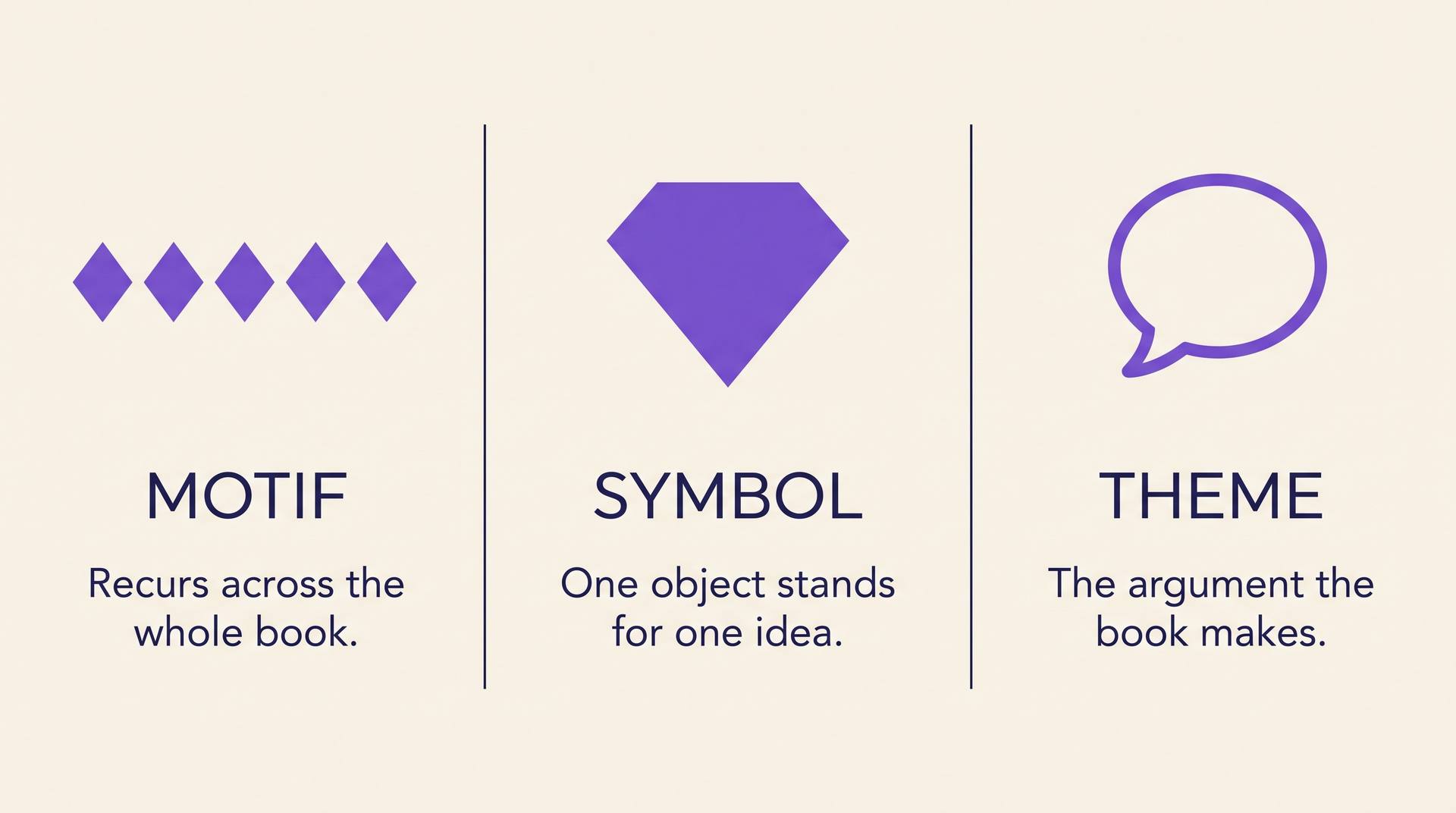
The three terms sit on a ladder that runs from concrete to abstract. A symbol is one object carrying one idea. A motif is a pattern of concrete returns. A theme is the abstract argument those returns add up to — and a theme is never an object, which is why "the mockingbird" cannot be a theme and "innocence destroyed by cruelty" cannot be a motif.
| Term | What it is | How often it appears | The test |
|---|---|---|---|
| Motif | A concrete element that recurs and gathers weight as it recurs | Many times, spread across the work | Can you list the page numbers? If there is only one, it is not a motif yet. |
| Symbol | A single object or image standing in for a larger idea | Once, or a handful of charged moments | Cut it and the plot survives; the meaning thins. |
| Theme | The abstract idea the work argues about | Everywhere and nowhere — it has no physical form | You state it as a sentence, not a noun. It cannot be photographed. |
| Leitmotif | A motif welded to one specific character, place or idea, announcing it every time | Every time that character or idea enters | Borrowed from opera. If the reader can predict who is about to walk in, it is a leitmotif. |
The overlap between motif and symbol is real and it is fine. A recurring object is usually both: each appearance works as a symbol, the sequence works as a motif. Our guide to symbolism in writing covers the single-object side; this page is about what happens when you do it five times. If every element of the story maps onto something outside it, you have crossed into allegory.
One neighbour worth naming: foreshadowing also plants early and returns later, but its job is to make a future event feel earned. A motif owes the plot nothing. It can recur forever and pay off nothing except meaning.
Seven motifs from real books
These are the ones worth studying because each does a different job. Read them as seven mechanisms, not seven trivia answers.
Blood — Macbeth (Shakespeare)
Blood runs from the wounded captain in Act I to Lady Macbeth's sleepwalking, changing function each time: first honour, then guilt Macbeth cannot wash off — "Will all great Neptune's ocean wash this blood clean from my hand?" — finally a hallucinated stain in "Out, damned spot!" The word recurs dozens of times in a short play, and that density is the point: the crime saturates the language.
The conch — Lord of the Flies (William Golding)
A shell that starts as a toy, becomes the rule that whoever holds it may speak, and is smashed at the moment Piggy dies. The cleanest example of a motif with a physical arc: the object's condition tracks the collapse of the boys' order, so the reader measures the decline against it without being told to.
The mockingbird — To Kill a Mockingbird (Harper Lee)
Named in Atticus's rule about the rifle, explained by Miss Maudie, echoed by Scout at the end when she says telling on Boo Radley would be "sort of like shootin' a mockingbird." Three appearances, no lecture in between. The motif does the arguing so the narrator does not have to.
The green light — The Great Gatsby (F. Scott Fitzgerald)
The textbook boundary case. Each single appearance works as a symbol, but it returns three times with different values: unreachable longing at the end of chapter one, a mundane dock light once Daisy stands beside it, then Nick's closing enlargement of it into everyone's receding future. A symbol that recurs and shifts meaning is functioning as a motif.
Sight and blindness — Oedipus Rex (Sophocles)
Not an object at all — a paired opposition. The blind prophet Tiresias sees the truth, the sighted king cannot, and the king ends by blinding himself. A motif can be an abstraction pair as long as it lands concretely each time, in eyes, in darkness, in the language of looking. This is the version that works where a physical prop would feel planted.
Rain — A Farewell to Arms (Ernest Hemingway)
Rain arrives with the cholera in the opening pages, with the retreat, with Catherine's fear of it, and with the final walk back to the hotel. Hemingway never explains the association. The motif works by conditioning: by the third downpour the reader dreads the weather. Motifs are the most efficient way to teach a reader an emotional reflex.
Striking clocks — Mrs Dalloway (Virginia Woolf)
Big Ben tolls through a single June day, its "leaden circles dissolved in the air," pulling every scattered consciousness back to the same minute. Here the motif is structural — it is what lets Woolf cut between minds without confusing anyone. Not every motif carries theme; some carry the architecture.
Shoot all the bluejays you want, if you can hit 'em, but remember it's a sin to kill a mockingbird.
The rule is stated once, in passing, about a rifle. Everything the novel later means by it is built by repetition, not by explanation.
Notice what none of them do. Nobody stops the story to say what the object means. The conch is never called civilisation; the rain is never called death. Meaning is assembled by the reader across the returns, which is why a motif survives a re-read and a stated theme does not.
Why repetition does the work
A motif works like a musical phrase. The first appearance is neutral information. The second is recognised, which is a small pleasure in itself. From the third on, everything the reader has felt in between attaches to the object, so one image on the page can trigger a chapter's worth of emotion.
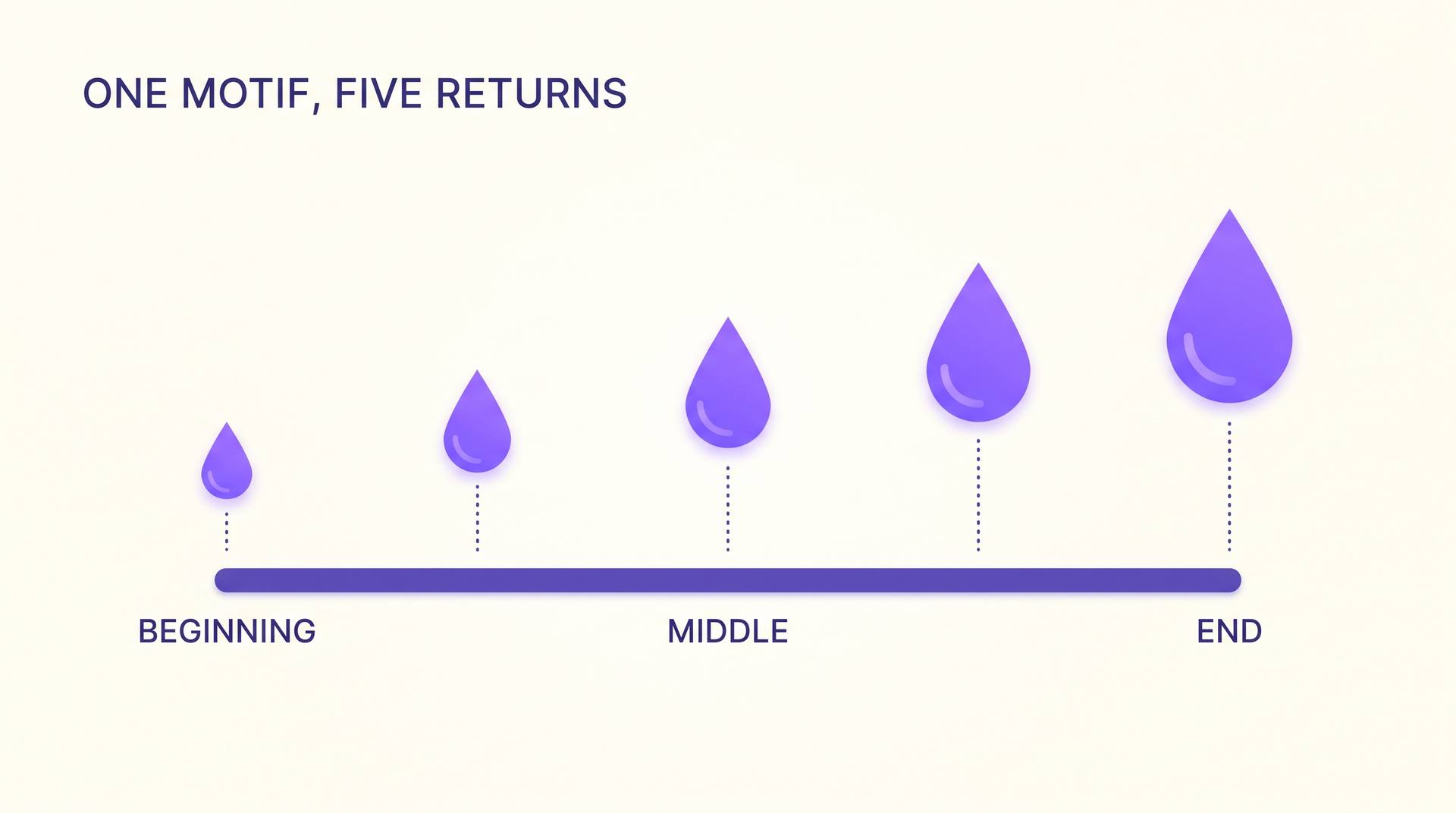
Placement therefore matters more than count. Three returns spread across beginning, middle and end out-perform eight crammed into one act, because the gap between appearances is where meaning accumulates. Seed it before the reader knows it matters, return at the point of maximum pressure, and let the last appearance be changed by everything that happened.
The best motifs change value as they return rather than repeating flat. Gatsby's green light means three different things; the conch is intact, contested, then destroyed. If your object means exactly the same thing on page 300 as on page 12, you have a running gag, and readers feel the difference even when they cannot name it.
Building a motif into your draft
Motifs are usually found, not planned. The reliable method is to draft without worrying about them, then look for what you already repeated by accident — most writers find two or three unplanned recurrences in a finished draft — and promote the best one deliberately in revision.
- 1
1. Name the theme as a sentence first
Not "loneliness" but "the character keeps choosing isolation because it feels safer than being known." You need the argument before you can pick an object that carries it, otherwise the motif floats free of the book.
- 2
2. Pick a concrete object your story already contains
The strongest motifs come from the story's own furniture — the job, the setting, the character's trade. Golding's boys were already on an island with shells. Search your draft for objects you reached for twice without noticing, rather than importing a fresh symbol.
- 3
3. Schedule the returns against your structure
Map appearances onto your act breaks: one before the inciting incident, one at the midpoint, one at the climax, one after. If you are working from a three-act structure, write the motif beats into the outline as their own line items so they survive rewrites.
- 4
4. Change its meaning at least once
Give the object a different weight at the end than at the start: broken, given away, refused, understood. A motif that develops reads as design; one that merely repeats reads as a tic.
Do this at the outline stage rather than after the draft is finished. Adding a motif beat to an existing chapter means finding a paragraph that can hold it without bulging; planning where the object recurs is far cheaper. Our free outline generator builds the chapter-by-chapter skeleton you can hang those beats on, and inside AIWriteBook the outline builder keeps that plan attached to the book so every chapter is written with it in view.
Five ways writers wreck a motif
Explaining it
The moment a character says "the storm was like our marriage," the motif dies. Trust the reader to make the connection; they will, and they will enjoy having done it.
Repeating without developing
Five identical mirror scenes is not a motif, it is an editor's note. Each return needs a new angle, a new context, or a new consequence.
Choosing an exhausted object
Mirrors for identity, birds for freedom, storms for conflict, seasons for time. All were once fresh. If your object is on that list, either bend it into something specific to this story or find another.
Over-seeding
Four competing motifs in one novel means none of them registers. One dominant motif and one quiet counter-motif is usually the ceiling for a first novel.
Letting it drift out of the ending
A motif you drop after the midpoint feels like an abandoned promise. If the object cannot appear in the final chapter in some altered form, it may not be the right object.
When not to use one
Motifs are not a quality requirement. Plenty of excellent books do without one, and forcing one in is more visible than leaving it out.
- Fast commercial thrillers and page-turners, where a recurring image slows the sentence-level momentum readers came for.
- Tight first-person voices that would never notice or dwell on a repeated object — the motif ends up sounding like the author reaching past the narrator.
- Short work with no room for the gaps between returns; a 3,000-word story usually supports one charged symbol rather than a pattern.
- Most practical non-fiction, where a recurring image reads as padding — though a running case study or a metaphor spine often earns its place in memoir and narrative non-fiction.
The honest test: if you removed the motif entirely and the book got faster and lost nothing, it was decoration. If it got flatter, keep it.
Tracking motifs with AI
The hard part of motif work is not invention. It is bookkeeping across 80,000 words — knowing the object last appeared in chapter 14, in what condition, and whether chapter 22 contradicts it. This is where a tool helps and where a lot of writers quietly give up.
In AIWriteBook the plan lives in the outline: write the motif beats in as their own items and every chapter is drafted with them in context. When you spot a missing return in an already-written chapter, the chapter AI chat can add that one beat and shows the result as a diff you accept or reject line by line, so you keep the prose you already liked.
Two more cases where the software carries weight. In a series, motifs are the main way book three feels connected to book one — AIWriteBook writes later books with the earlier ones as context, so a recurring object stays consistent instead of being reinvented. And when a scene needs the motif to appear physically rather than be referred to, the scene builder tool drafts the staging.
What AI cannot do is decide what your book is about. Ask a model for "a motif for a novel about grief" and you get water, or clocks, or an empty chair — the averages of everything ever written. The choice has to come from your material; use the tool for the tracking, not the taste. For wider craft context, our pieces on imagery in writing and character development pair well with this one.
Questions writers ask
A theme is an abstract idea you state as a sentence — "ambition corrodes the person who acts on it." A motif is a concrete thing that recurs on the page and points at that idea, like the blood in Macbeth. If you can photograph it, it is a motif; if you can only argue it, it is a theme.
Frequency. A symbol is one object standing for one idea, and it works in a single appearance. A motif recurs across the work and gathers meaning with each return. A recurring symbol is functioning as a motif, which is why the green light in The Great Gatsby is fairly described as both.
There is no rule, but three well-spaced appearances is the practical minimum for readers to register a pattern, and most novels sit somewhere between three and a dozen. Spacing matters more than the count: appearances spread across beginning, middle and end beat the same number clustered in one act.
Yes. Repeated phrases, sounds, colours, gestures, weather and even sentence structures all work. Woolf uses a striking clock; Hemingway uses rain. The only requirement is that it appears concretely on the page each time rather than being referred to in the abstract.
Both work, but finding them afterwards is more reliable for most writers. Draft freely, then read for objects you repeated without planning to, choose the one that best carries your theme, and strengthen it in revision. Planned motifs tend to feel dutiful; discovered ones tend to feel true.
A leitmotif is a narrower case borrowed from opera: a motif bound to one specific character, place or idea, sounding every time that thing appears. All leitmotifs are motifs; most motifs are not leitmotifs, because they roam the whole book rather than announcing one entity.
The one thing to take away
A motif is repetition with intent. Pick something your story already owns, put it where the pressure is highest, change it by the end, and never explain it. That is the whole craft of it — the rest is bookkeeping.
If you are working through the larger job of getting a book finished rather than a single device, our guide to writing a book covers the sequence from idea to published manuscript, and this page fits in the revision pass near the end of it.