

Search for unreliable narrator examples and you get a list of twist endings. That list is misleading in the same way a magic trick is misleading if you only ever watch the last two seconds. The twist is the payoff; the technique is everything that happens in the two hundred pages before it, when the narrator is saying things that are slightly, checkably wrong and the reader is being trained to notice without quite admitting it.
This piece is about that training. What the drift is made of, five kinds of narrator that produce it for five different reasons, where the reveal goes in a manuscript, and the specific failures that turn a clever structure into a book readers feel cheated by.
What unreliability actually is
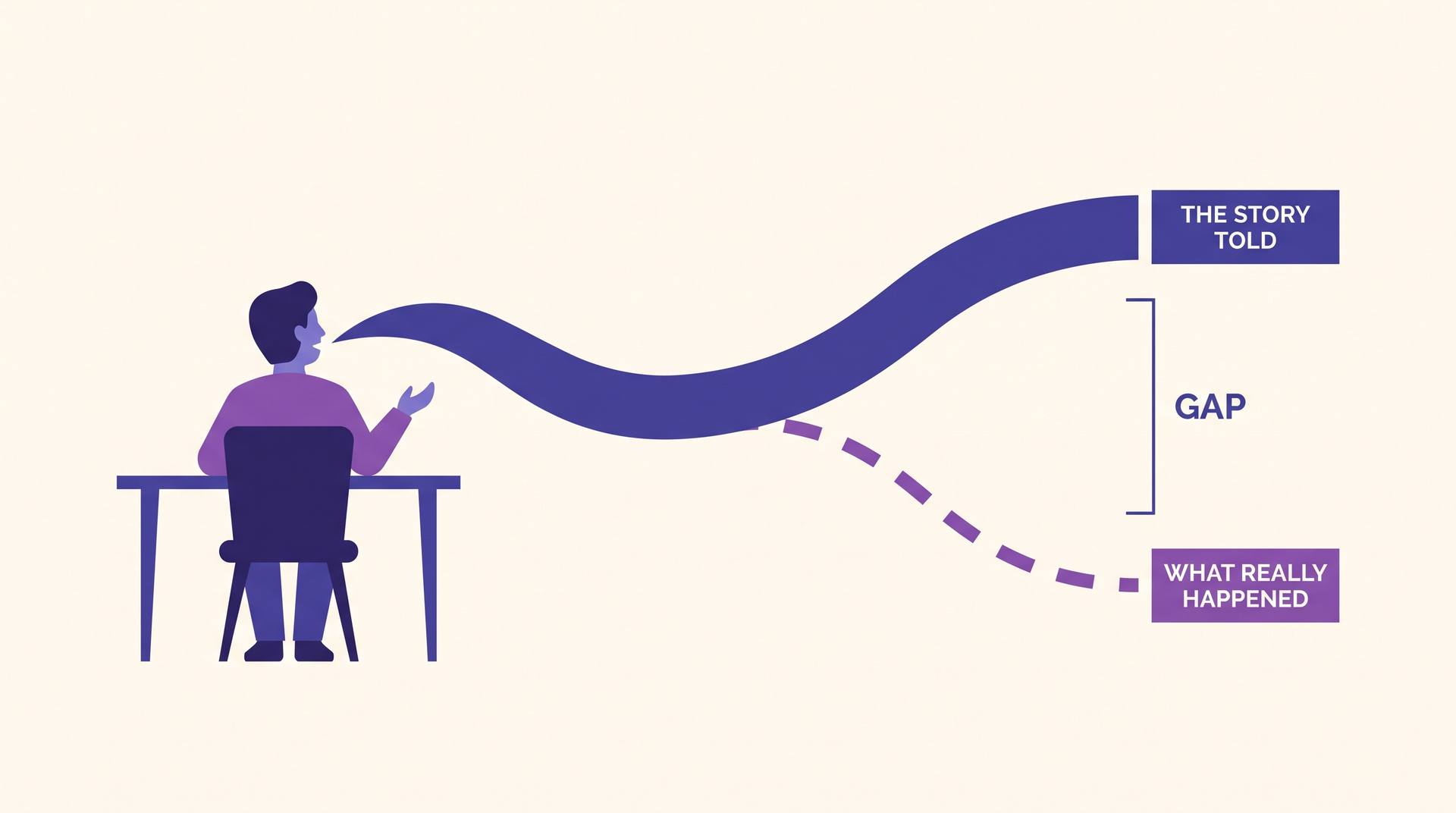
Every first-person novel has two stories running at once: the events, and the account of the events. In a conventional novel those two run flush. In an unreliable one they separate, and the separation is the book's real subject. The reader's pleasure is not being tricked — it is holding two versions in mind and watching the second one win.
Working definition
An unreliable narrator is a narrator whose account of events diverges measurably from what the novel itself establishes to be true, in a way the text lets an attentive reader detect before it is confirmed.
The detectable part is not optional. A narrator who is wrong about everything with no evidence available to the reader is not unreliable; the author is simply withholding, and readers can tell the difference.
That is also the honest test for whether your draft has one. Take any chapter and ask: could a careful reader, on this page alone, catch something that does not sit right? If the answer is no for every chapter until the reveal, you have written a bait-and-switch, not an unreliable narrator.
The distinction matters commercially too. A twist that lands sends readers back to page one — and rereading is what generates the five-star review that says "I immediately started it again." A twist that only shocks generates the two-star review that says "the author cheated."
Five kinds, five different jobs
Unreliability is a category, not a technique. These five behave differently on the page, and picking one before you outline saves a rewrite.
1
The liar
Knows the truth, tells you something else
Agatha Christie's Dr Sheppard narrates The Murder of Roger Ackroyd without ever stating a falsehood — he simply skips the minutes in which he commits the murder, describing them as "I did the little that had to be done." Amy Dunne's diary in Gone Girl is the modern version: a wholly fabricated document written to be found, which the second half of the novel reads back to us with the fabrication visible. The liar is the hardest to write, because every sentence must be technically defensible on the reread.
2
The self-deceiver
Believes his own account, and it is wrong
Stevens, the butler in Kazuo Ishiguro's The Remains of the Day, is not concealing anything from us on purpose. He recounts a 1956 motoring trip through the West Country while steadily minimising his employer's sympathies for Nazi Germany and refusing to name what he felt for Miss Kenton. Nothing he says is a lie; his framing is the lie. This is the most literary of the five and the most forgiving to draft, because the evidence is in tone rather than fact.
3
The limited perceiver
Reports accurately, interprets wrongly
Christopher Boone in Mark Haddon's The Curious Incident of the Dog in the Night-Time records what happens with unusual precision and misreads what it means, so the reader assembles the marriage collapsing behind him out of details he does not weight. There is no twist here at all — the gap opens on page one and stays open. Useful when you want the effect without a reveal to engineer.
4
The divided mind
The narrator is not who he thinks he is
The narrator of Chuck Palahniuk's Fight Club and Tyler Durden are the same man, which the text signals for two hundred pages through the two never being in a room together in a way anyone else corroborates. This kind lives or dies on physical logistics: readers forgive a lot, but they do not forgive a scene that could not have happened.
5
The blocked memory
Cannot access what she knows
Cadence Sinclair in E. Lockhart's We Were Liars has lost the summer of the accident to amnesia and migraines, and narrates her return to the family island as a recovery of the missing scene. The reveal — that the fire she and her cousins set killed them, and the companions she has been spending the summer with are not there — works because her symptoms were on the page from the start. Amnesia is the easiest premise to justify and the easiest to make feel cheap, so the pressure moves onto voice.
Notice how little the five have in common as craft problems. A liar needs an audit trail; a self-deceiver needs a consistent blind spot; a limited perceiver needs a second story readers can assemble; a divided mind needs airtight staging; a blocked memory needs a symptom pattern. Choosing "unreliable narrator" as a decision is not yet a decision.
The three signals
Whatever kind you pick, the drift reaches the reader through three mechanisms and essentially no others. Most weak drafts use one of them, repeatedly. Strong ones rotate.
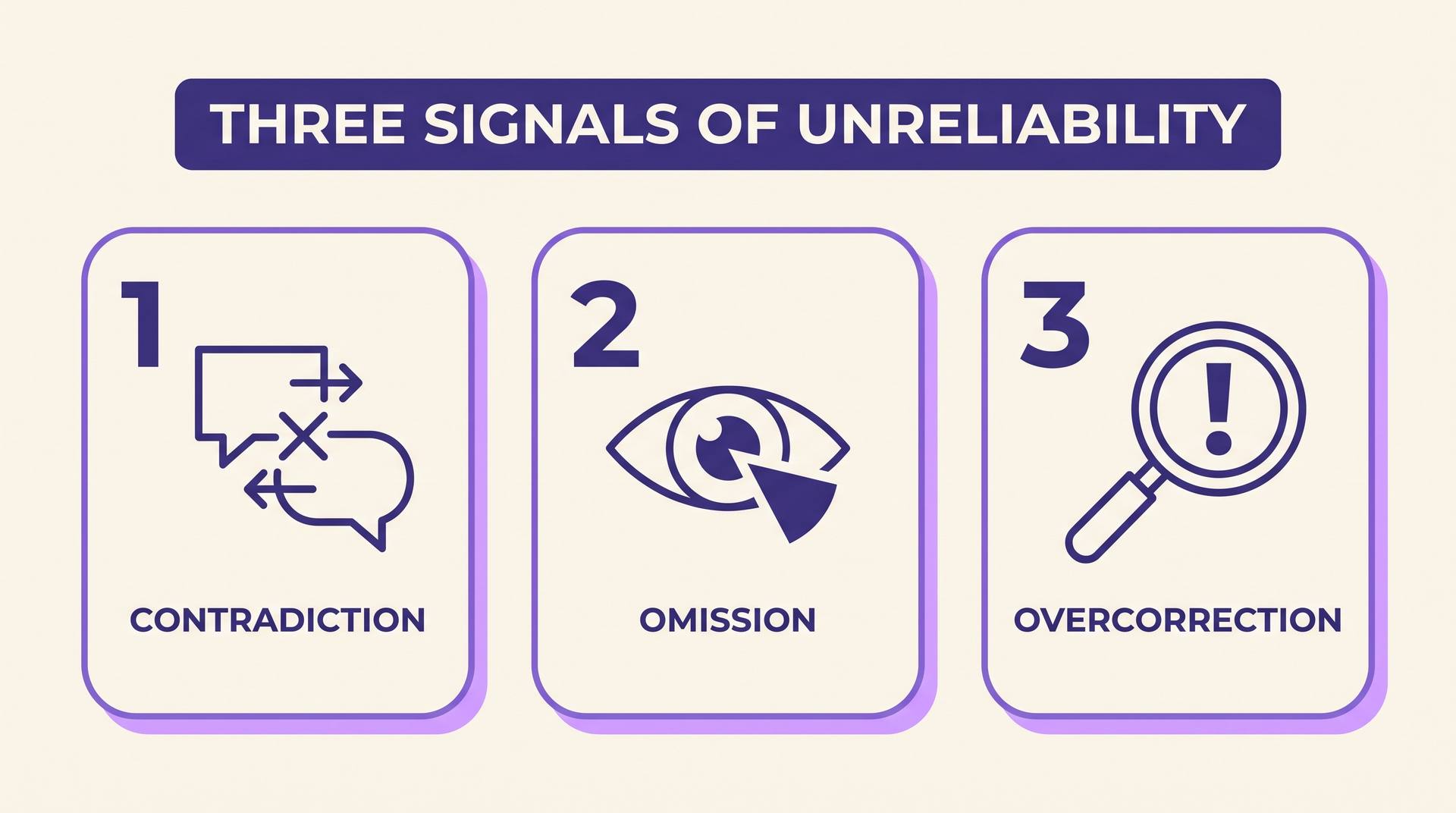
Contradiction
The narrator's account collides with something else in the book — another character's version, a document, a physical detail, or their own earlier sentence. Keep the contradictions small and unresolved rather than large and flagged. A neighbour who remembers the argument starting an hour earlier does more work than a character announcing that the narrator is lying.
Omission
The narrator moves the camera at the moment it matters. Christie's murder is an omission; so is every scene that ends one beat early. The trick is rhythm: if the narrator only ever cuts away from the incriminating thing, readers spot the pattern. Have them cut away from harmless things too, so the pattern reads as temperament rather than a tell.
Overcorrection
Volunteered denial. "Not that I was jealous." "I want to be clear that I have never lied to you." This is the most powerful of the three and the easiest to overdo. Two or three across a novel is a voice; ten is a neon sign, and readers who spot the sign stop reading forward and start reading for the trick.
A practical audit for a finished draft: mark every instance of each signal in the margin with C, O or V. If the marks cluster in the first fifty pages and then stop, your narrator becomes reliable halfway through the book without meaning to. Spread them, and let their density rise gently rather than spike.
The signals also govern how your reader reads forward, which is why they are close cousins of ordinary suspense technique. If you want the underlying mechanics, our pieces on foreshadowing examples and on planting a Chekhov's gun cover the honest version of the same move; red herrings cover the dishonest one, and an unreliable narrator is mostly a red herring wearing a first-person pronoun.
The reveal ladder
Reveals fail on placement more often than on content. Four rungs, expressed as a percentage through the manuscript so it scales to a novella or an epic.
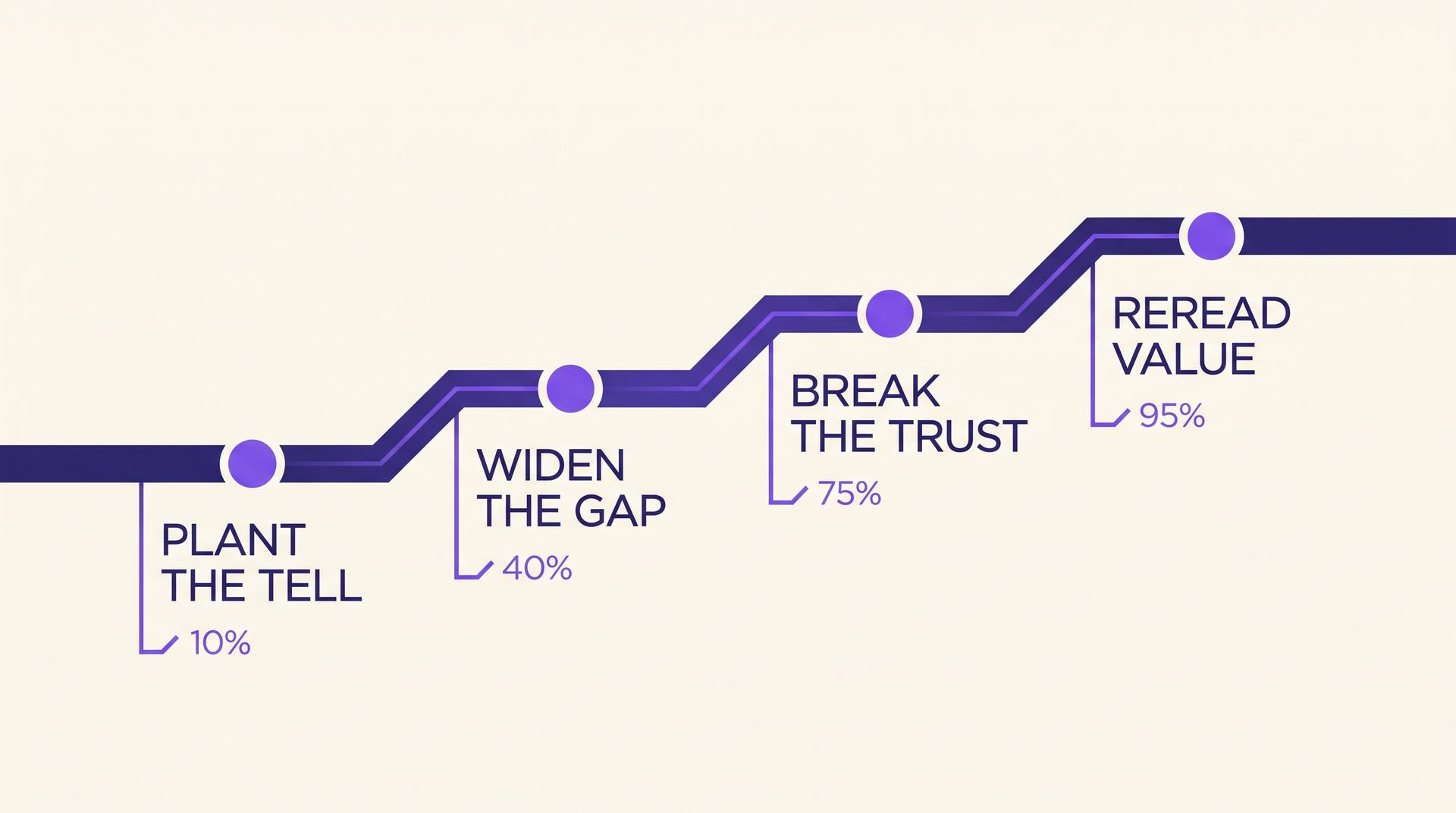
- 1Plant the tell — first 10%One detectable oddity in the opening chapters. Not a hint about the ending; a hint that this narrator's account is a made thing. Stevens's first page is an anxious rehearsal of whether he is permitted to take a holiday. That is the tell.
- 2Widen the gap — around 40%A second source enters and does not match: a letter, a witness, a timeline the narrator glides over. The reader now has two versions and no arbitration. This is the rung most drafts skip, and skipping it is why the ending arrives from nowhere.
- 3Break the trust — around 75%The confirmation. Gone Girl does this exactly here in structural terms, opening its second part with Amy's real voice and re-reading her own diary for us. After this point the book is a different genre than it was, and the last quarter exists to spend the new information rather than to hoard it.
- 4Pay the reread — final 5%Close on something that only means what it means the second time. A repeated line, an object, a phrase from chapter one returned in the narrator's real register. This is the rung that converts a shock into a recommendation.
The 75% placement is the one worth arguing about. Put the break at 95% and there is no room to dramatise the consequences, so the book ends on information rather than on a scene. Put it at 50% and the second half has to earn its keep some other way — which Gone Girl does by turning into a different kind of thriller entirely. Either is defensible; drifting into 95% because you ran out of book is not.
Because the ladder is really an outline problem, it is worth resolving before you draft chapters. If you build your outline in AIWriteBook, the outline builder is the right place to pin the four rungs to specific chapters, and the plot twist generator is a fast way to pressure-test a reveal you are not yet sure about — feed it your premise and see which of its suggestions your planted evidence could actually support.
A passage, rewritten
Here is the same beat written twice. Same narrator, same fact concealed. The first version is what a first draft usually produces.
Draft version
I got home at eleven, or near enough. Not that the time matters. I certainly wasn't watching the clock, and I had no reason to be anywhere else that night. Whatever anyone says about me later, I want that on the record: I was home by eleven, and I did nothing wrong.
Revised
I got home at eleven. The porch light was off again — Marion always turned it off at ten, whatever I said about the step being uneven. I hung my coat, ran the tap until it went cold, and stood there a while with the glass. It had been a long drive back from the office and my hands were still cold from it.
The draft version uses overcorrection three times in four sentences, which tells the reader the narrator is lying but nothing else. The revision uses one omission and one contradiction and never raises its voice: the porch light being off at ten places Marion's habit against his arrival, and the cold hands after a drive home are a detail that will not survive the reveal that the office is a nine-minute walk away.
That is the whole method in miniature. Evidence, not protest. If you want the general principle behind the second version, it is the one from show, don't tell applied to a narrator's honesty rather than their emotions.
Six ways writers blow it
- 1Withholding without evidence. If nothing in the first three hundred pages could have tipped a careful reader off, the reveal is not a reveal, it is an author changing the facts. This is the single most common failure and the one readers punish hardest in reviews.
- 2The narrator lies about their own interior. A first-person narrator can hide what they did; hiding what they were feeling in a sentence that reports their feeling breaks the contract readers accept when they open a first-person novel. Route the concealment through action and omission instead.
- 3Signal density that spikes. Ten tells in the first chapter, then eighty pages of clean prose. Readers register that as an author remembering the gimmick and then forgetting it.
- 4The staging does not survive an audit. Especially fatal for the divided-mind kind. Before the last draft, list every scene in which the concealed truth would have been visible to a third party and check each one holds.
- 5Unreliability with no thematic reason. If the narrator's distortion is not about something — class deference, self-preservation, grief, addiction — the technique reads as a device. Stevens's blind spot is the novel's argument about service and complicity, not decoration on top of it.
- 6A second narrator who is straightforwardly reliable, introduced early. This resolves the ambiguity for the reader long before the book does, and the tension deflates. If you use multiple viewpoints, keep the corroborating one late, brief, or partial.
Drafting one with AI
The genuinely hard part of an unreliable narrator is consistency across a long manuscript, and consistency is exactly the thing that degrades when you draft chapters weeks apart. That is where a drafting tool earns its place — not by inventing the twist, which is yours, but by holding the two versions of events steady while you write.
The practical setup: write the true sequence of events as a private document first, then the narrator's version, and treat the second as the manuscript. In AIWriteBook you can put both into the book's own context so that generated chapters keep the narrator's blind spot rather than accidentally reporting the truth — and the AI chapter writer comes with a chat assistant that revises a scene on a specific instruction like “remove the direct statement of what he felt here, keep the detail about the coat” and shows each proposed change as a diff you accept or reject individually, rather than regenerating the whole chapter.
Two more places it helps. The voice consistency that a self-deceiver depends on comes from the writing-style setting rather than from prompt wording — upload a sample of the register you want and the drafts hold it across chapters, which matters more for this technique than for almost any other. And if your narrator's distortion is rooted in a specific psychology, building them properly in the character creator before you outline gives every later chapter something to be consistent with.
What AI will not do for you is decide what the book is about. Ask a model to generate an unreliable narrator cold and you get amnesia, a twin, or a psychiatric ward, because those are the priors. The technique only works when the distortion belongs to a person you have already decided things about.
Three starter templates
Fill these in before the outline. Each is a contract with the reader that the rest of the book has to honour.
The confession template
Narrator is telling this to someone specific, for a specific purpose. Fill: who they are addressing, what they need that listener to believe, the one fact they will not say, and the moment the listener stops believing them. Best for the liar; the audience gives every evasion a motive.
The vocation template
Narrator's distortion comes from a role they have organised their life around. Fill: the role, the value it demands, the thing that value makes unsayable, and the late scene where the cost is finally visible. Best for the self-deceiver, and the most likely to produce a novel rather than a puzzle.
The reconstruction template
Narrator is assembling an event they cannot remember, in the present tense of the search. Fill: the gap, the symptom that proves it, the three false reconstructions they try, and what the true one costs them. Best for blocked memory; the false attempts are what stop it feeling cheap.
If you are writing crime or psychological suspense, where four of the five kinds live most naturally, the structural conventions of the genre interact with all of this — our guide to writing a mystery novel covers how a fair-play clue trail coexists with a narrator who is part of the trail.
Questions writers ask
A third-person limited narrator can be, because the filter is a character's perception. Ian McEwan's Atonement is the standard example: the whole novel is revealed in its final section to be Briony's own account, written to give two people an ending they did not get. Full omniscience is a different matter — an omniscient voice that turns out to be wrong reads as authorial error rather than as technique, unless the book establishes very early that the voice is a person.
No. The limited-perceiver kind never confirms anything; the gap is open from page one and the reader does the assembling throughout. That version is more literary and much less commercial, and it removes the placement problem entirely. It also removes the reread payoff, which is the main engine of word of mouth for this kind of book.
Usually the problem is overcorrection density rather than clue placement. Count your volunteered denials — if the narrator insists on their own honesty more than about three times in a novel, readers switch into detective mode. Replace most of them with omissions, which are invisible until the reread.
It is the natural home, because the account and the narrator are the same object. Second person can do a version of it, since the narrator is instructing a reader-character who may resist. Third-person limited works as described above, filtered through one character's perception.
It is cheap when the amnesia only exists to withhold. It is not cheap when the forgetting has a cause the book is genuinely about and symptoms the reader sees from the start, which is why We Were Liars survives a premise that has sunk a hundred thrillers. If you cannot name what the forgetting means, pick another kind.
Aim for a handful of specific earlier scenes rather than the whole book. If everything changes, the first draft was a decoy and readers feel their two hundred pages were spent on nothing. If three or four scenes flip hard, the reread has targets and the rest of the novel still stands on its own terms.
Where to start
Pick the kind before the plot. Write the true version of events as a document nobody will read. Then write the account, plant one tell early, widen the gap at the midpoint, and hold the break until the last quarter so the consequences get a scene rather than a paragraph. The technique is not the twist; it is two hundred pages of a reader slowly deciding not to believe someone.
And if the narrator is the part you are sure about while the structure around them is still fog, that is an outlining problem rather than a voice problem — our full guide to writing a book walks the whole sequence from premise to finished manuscript.