

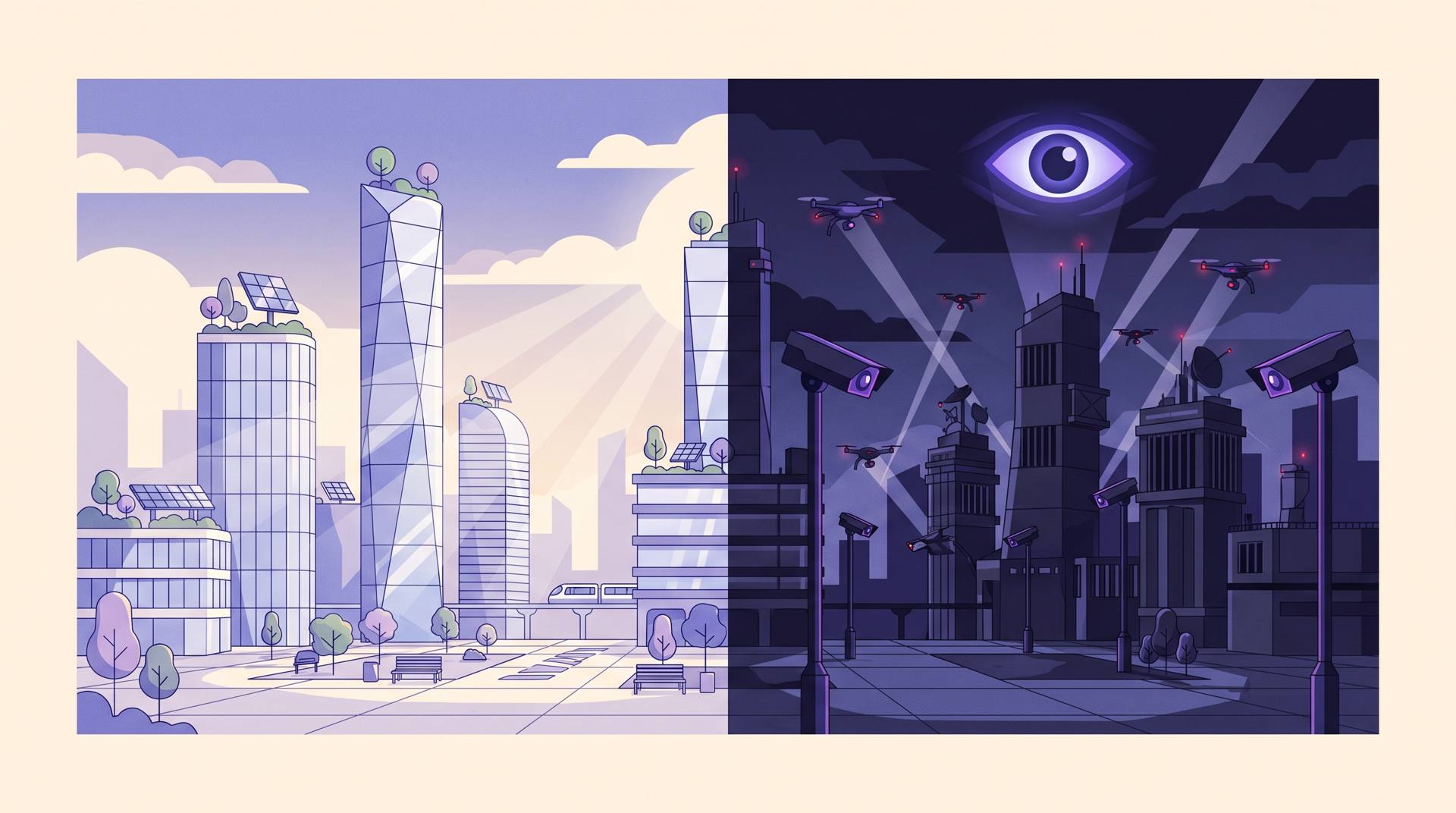
Two words, one idea, 350 years apart
Utopia
Coined 1516
Thomas More invented the word for his 1516 book about an island republic with communal property, six-hour workdays and religious tolerance. The joke is in the Greek: ou-topos means no place, eu-topos means good place, and in Latin they sound identical. More was signalling from the title page that the perfect society is the one that does not exist — and his island still keeps bondsmen and quietly pressures the incurably ill toward death.
Dystopia
Popularised 1868
Dystopia is the deliberate inversion: dys-topos, the bad place. It entered public English in 1868, when John Stuart Mill told the House of Commons that his opponents were too flattered by the name Utopians and should be called dys-topians instead. The word was born as an insult about policy, not as a genre label, and that origin still shows: a dystopia is always an argument about a decision somebody is making now.
The useful definition for a writer: a utopia asks what a society would have to give up to remove one misery. A dystopia shows the bill after it has already been paid.
The books that built both genres
Tap any entry to see what it added. The chronology matters: each of these writers was answering the one before.
Select a year
We
Yevgeny Zamyatin
Glass apartments, numbers instead of names, sex scheduled by coupon. Nearly every device that followed — the surveillance, the ration, the doomed diary — is already here in its first English edition.
Why most literary utopias are dystopias in disguise
Read the canon and a pattern shows up fast: almost no serious novel presents a functioning paradise and leaves it alone. The reason is structural. A society with nothing left to want has no story in it, so the author buries a price somewhere in the design and the novel becomes the process of digging it up.
The Giver is the purest case. Jonas's community has genuinely abolished war, hunger, unemployment and heartbreak. The currency it paid was colour, music, memory, the choice of a partner, and the infants who fail to thrive. Lowry does not present this as villainy — the Elders are sincere, careful people — which is exactly what makes the reveal land.
Huxley makes the trade explicit and argues it out loud. Mustapha Mond, the World Controller, is the most reasonable character in Brave New World: he can name what was traded away, defend the exchange, and concede that the one thing left to claim is the right to be unhappy.
Big Brother is watching you
Four words that do the work of a chapter. The surveillance is not hidden from the citizens of Airstrip One — it is advertised. That is the difference between a secret and a system.
So the practical question is never "am I writing a utopia or a dystopia?" It is "do the people inside this society know what it costs?" If they do and accept it, you are writing a utopia with an argument in it. If they do not, your reader is holding information the characters lack, and that gap is dystopian dread.
The difference, line by line
This is the comparison worth memorising. Every row is a decision you will make in your first chapter, whether you notice it or not.
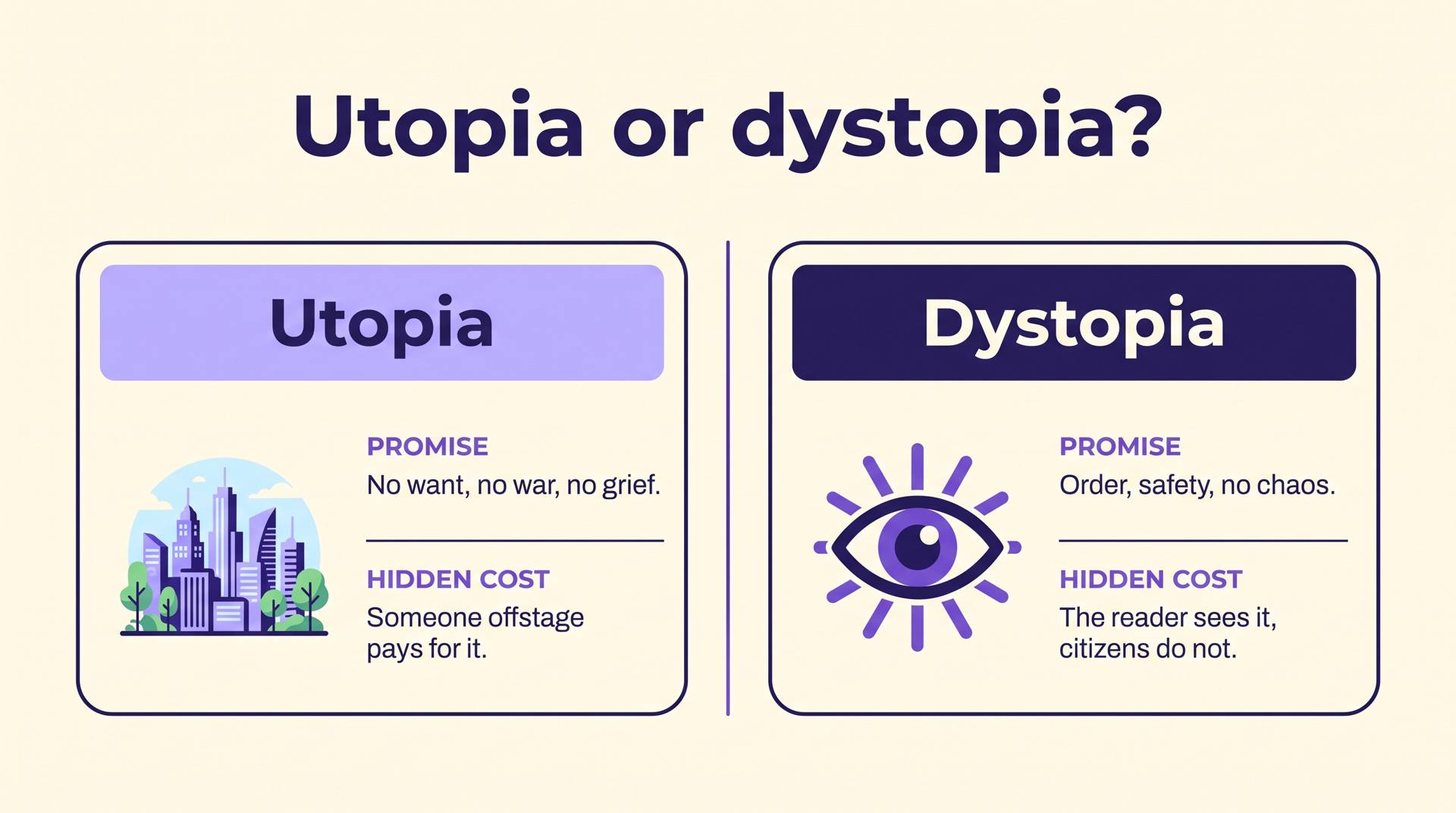
| Dimension | Utopia | Dystopia |
|---|---|---|
| Goal of the society | Abolish one named misery — want, war, grief, inequality — by design rather than by luck. | Preserve order, and the power that order exists to protect. |
| Cost hidden from citizens | Usually offstage. Someone else, somewhere else, or some unnamed class absorbs it. | Visible to your reader from page one and invisible to the people living in it. |
| Protagonist's role | A visitor or newcomer who asks the obvious questions on the reader's behalf. | An insider whose loyalty cracks — a clerk, a soldier, a censor, a favourite. |
| Typical ending | The visitor leaves and cannot explain it, or stays and stops asking. | Escape, destruction, or a compliance that reads as defeat. |
| Reader's emotion | Longing, then a slow unease that something has been left out. | Recognition first, dread second. The recognition is what makes the dread work. |
That protagonist row is where most drafts go wrong. A utopian visitor with no stake is a tour guide, and a dystopian insider who was never loyal has nothing to lose. If you are testing which one your story wants, our plot generator will build a full arc around the character you pick so you can see how each version plays out before you commit forty thousand words to it.
What each genre needs from your worldbuilding
A utopia needs a rule that would actually work
One rule, stated plainly, with a mechanism a reader can trace. "Everyone spends two years in care work between eighteen and thirty" is a rule. It raises the questions that make a society real: who covers the shortfall in a bad year, what happens to the person who refuses, who decides where you are posted. Answer those and your reader believes the island. Skip them and you have written a brochure.
Then you need one crack — the detail a newcomer notices on day three and everyone born there stopped seeing at six. The crack is your plot. In More's Utopia it is the bondsmen doing the slaughtering; in The Giver it is a word nobody will define.
A dystopia needs a plausible path from today
Three ingredients, in this order. First, the path: one crisis, one law and about fifteen years, traceable from something a reader has actually read in the news. Second, the control mechanism, nameable in a sentence — soma, the telescreen, the annual Reaping, the Ceremony of Twelve. Third, the thing the regime fears, because that is what your protagonist will turn out to be.
The regime is your antagonist and deserves the same care as any other. Our guide to what makes an antagonist work applies directly: a state that wants nothing except to be cruel is as weak on the page as a villain who wants nothing except to win.
Both genres live or die on internal consistency, which is the same discipline as worldbuilding for any invented setting and the same logic as a hard magic system: the reader forgives a strange rule, never an inconsistent one. Our free world builder is a fast way to draft the governing rules, the factions and the everyday texture of a society before you start chapter one.
Once you start writing in AIWriteBook, those rules stop being a document you have to remember. The book description and outline you set up front become the Story Bible in the chapter editor sidebar, each outline card carries its own locations and notes, and chapters are generated against them — so the ration system you invented in chapter two still behaves the same way in chapter twenty-nine.
Eight questions before you draft
Answer the four on your side of the fence in writing. If any answer is longer than three sentences, you have not decided yet.
If you are writing a utopia
If you are writing a dystopia
0 of 8 answered
Three mistakes that flatten either genre
A dystopia that is just bad government
Boot-stamping with no engine behind it. Every regime worth writing is solving something — a famine, a collapse, a war it believes will return. Gilead has a fertility crisis. Panem has a rebellion it will not survive twice. Give your regime a problem and its cruelty becomes logic, which is far more frightening than malice.
Evil for its own sake
The villain who enjoys being evil belongs in a different book. Huxley's World Controller is courteous, well-read and completely persuasive for three pages. If a smart reader cannot spend a moment genuinely tempted by your regime's offer, the offer is not real and neither is the refusal.
A utopia with no conflict
The most common failure, and the reason most utopias never get past the first draft. Conflict in a utopia does not come from things being bad. It comes from the price — who paid it, who is still paying, and what happens when one person decides they are done paying.
Build the world first
Apply It to Your Book
Sketch the rule, the cost and the crack, then let AIWriteBook build the outline and the chapters around them. The free plan covers the full plan plus your first chapter.
No credit card required
The short version
Utopia and dystopia are the same act of design, photographed from opposite sides. One shows you the promise and hides the invoice; the other shows you the invoice and lets you work out what the promise was. Decide which of those two your reader is holding, keep the rule consistent, and the genre takes care of itself.
If you are still deciding what kind of book this is, our guide to writing a book walks through the whole process from premise to publication, and the genre fiction hub covers how speculative settings behave differently in science fiction, fantasy and young adult.