

How the code is built
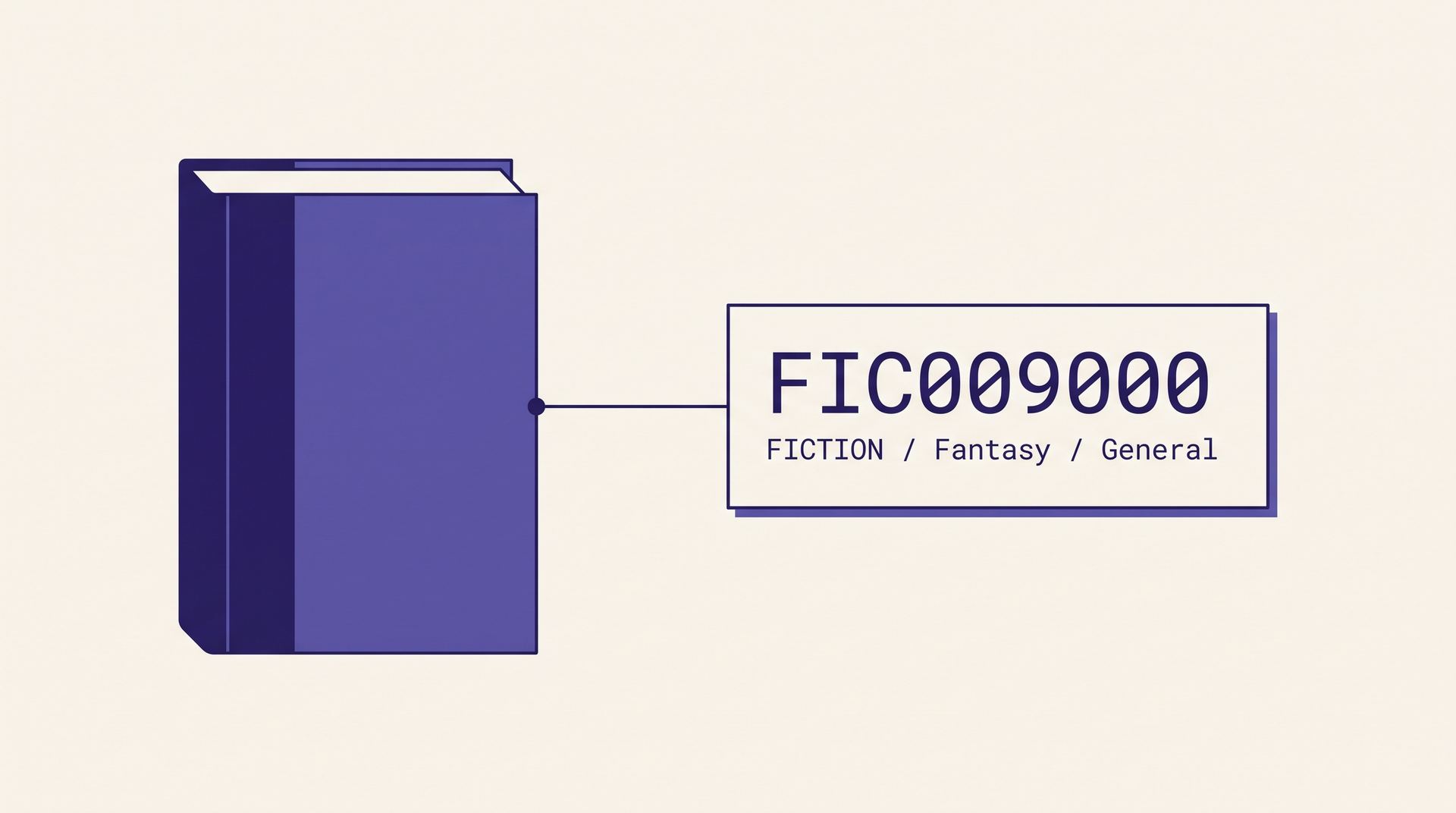
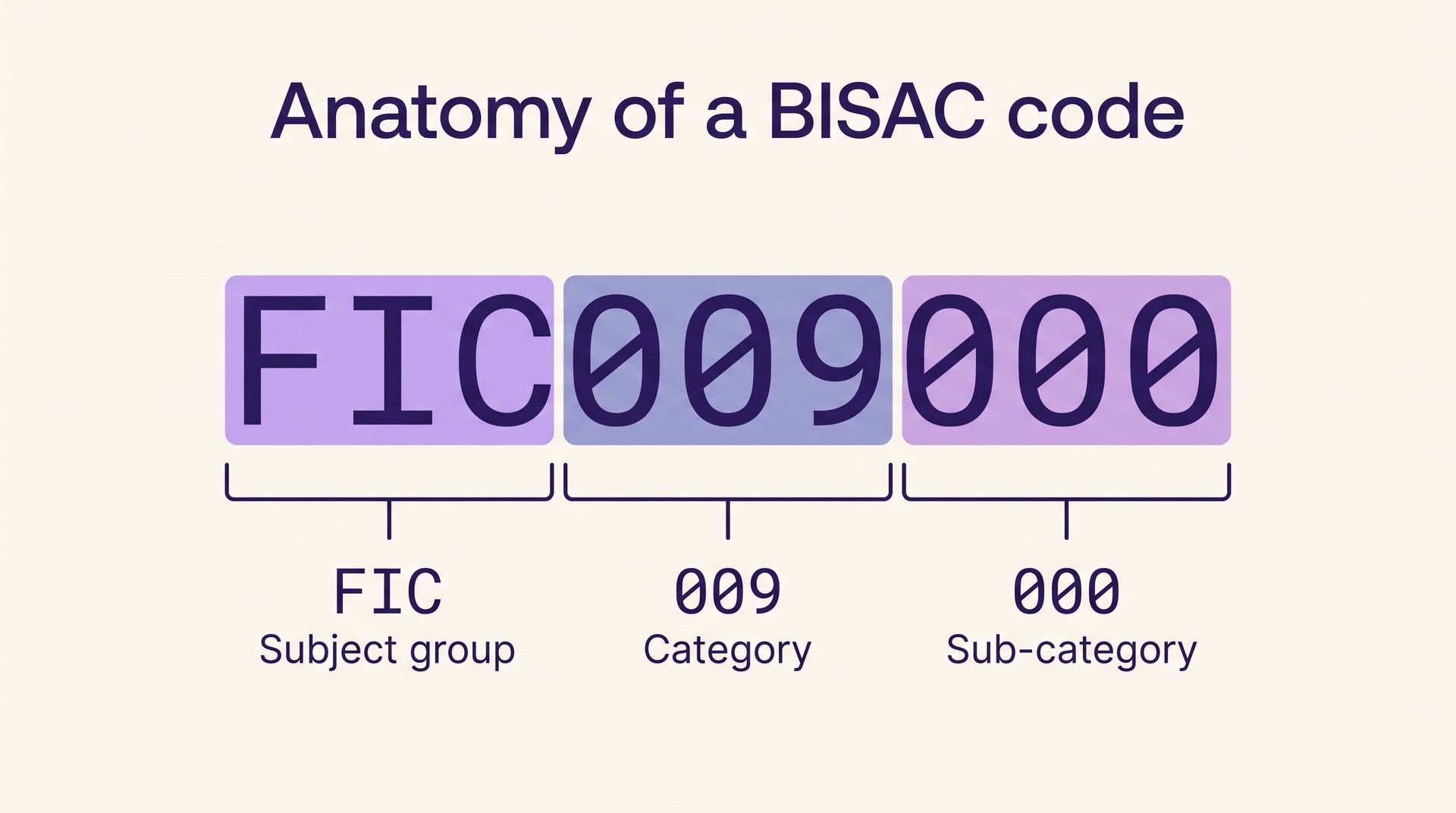
Read a BISAC code left to right and it narrows. The first three letters name the broad subject group — FIC for fiction, BUS for business and economics, JUV for juvenile fiction, SEL for self-help, and so on. The six digits that follow walk down the tree from that group into a category and then a sub-category, which is why a whole shelf of related codes shares a prefix.
FIC009000 is the canonical example. FIC puts the book in fiction, 009 lands on fantasy, and the trailing 000 means the general bucket rather than a narrower branch such as epic or historical fantasy. Every code also carries a human-readable heading — FICTION / Fantasy / General — and the heading, not the digits, is what a bookstore buyer actually reads.
The list is not frozen. BISG revises it periodically, adding headings as categories emerge and retiring ones that stopped being used. A code that was correct three years ago can quietly become a deprecated heading, which matters most if you have a backlist sitting in a distributor's catalogue and nobody has looked at the subject fields since launch.
How BISAC shows up in KDP
Here is the part that confuses most self-publishers: on KDP today you never type a BISAC code. Kindle Direct Publishing replaced the old subject-code fields with a browse-category chooser, and you pick up to three categories per book from Amazon's own hierarchy — the same paths readers click in the Kindle Store, such as Kindle Store › Kindle eBooks › Science Fiction & Fantasy › Fantasy › Epic.
Those Amazon paths are browse nodes, not BISAC headings. They overlap heavily, because Amazon built its tree on the same trade vocabulary, but they are not the same list and they do not map one to one. Amazon has categories BISAC has never had, and BISAC carries library-facing headings that would make no sense as a storefront shelf.
BISAC still follows your book everywhere else. Print distribution, library supply, wholesalers and most non-Amazon aggregators ask for at least one subject code, and it is the field that decides which buyers ever see the title in a catalogue. If you publish wide, you will be asked for a BISAC heading even though Amazon never mentioned one.
Picking the three Amazon categories is the higher-stakes decision for ranking, and it rewards research rather than instinct. Our free Amazon category finder surfaces the live browse paths and how crowded each one is, and the longer strategy — how to read competition, when to go narrow, how categories interact with keywords — is laid out in our guide to choosing KDP categories.
BISAC heading vs Amazon category
Two systems, two jobs. Keeping them straight saves a lot of wasted effort.
| BISAC heading | Amazon category | |
|---|---|---|
| Maintained by | Book Industry Study Group | Amazon, as store browse nodes |
| Looks like | FIC009000 — FICTION / Fantasy / General | Kindle eBooks › Science Fiction & Fantasy › Fantasy › Epic |
| Where you enter it | Print and wide-distribution setup, library records | The KDP categories step, up to three per book |
| Who reads it | Buyers, wholesalers, librarians, metadata feeds | Readers browsing, and Amazon's bestseller lists |
| Changes how often | Revised periodically by BISG | Amazon reshapes nodes without notice |
One practical consequence: a bestseller rank belongs to an Amazon category, never to a BISAC heading. If you are trying to work out which list your book could realistically chart on, you are looking at Amazon Best Sellers Rank and browse nodes, not at subject codes.
Where authors go wrong
- 1
Treating the code as a marketing lever
A BISAC heading routes your book to the right buyers and the right catalogue shelf. It does not push you up a chart. Authors who spend a week agonising over a subject code and five minutes on their three Amazon categories have the effort exactly backwards.
- 2
Picking the General bucket by default
Codes ending in 000 are the catch-all for their branch. They are the safe answer and usually the weak one: a romantic suspense novel filed under FICTION / Romance / General tells a buyer far less than the specific heading that actually exists for it.
- 3
Choosing a heading the book cannot honour
Subject codes are a promise about content, and returns follow broken promises. A memoir filed under a business heading because business sells better will reach readers who wanted a business book, and they will say so in the reviews.
- 4
Never revisiting it
Headings get deprecated and your own book can drift — a standalone that became book one of a series, a how-to that grew a large reference section. Re-reading the subject field when you refresh a backlist title costs minutes and occasionally fixes years of invisibility.
A worked example
Say you have written a cosy mystery set in a bakery. The BISAC heading you give a print distributor is FICTION / Mystery & Detective / Cozy / Culinary — narrow, honest, and exactly what a buyer stocking a cosy table wants to see. On KDP you would ignore codes entirely and choose three browse paths instead: the culinary cosy node, a broader cosy mystery node, and a third that reaches a nearby audience, such as women's fiction. Same book, same intent, two completely different fields — and only the second set moves your rank.
Related terms
The metadata fields that sit next to your subject code when you set a book up:
Frequently asked questions
The questions authors ask once they realise KDP never asked them for a code.
Not as something you enter. KDP now asks you to pick up to three categories from Amazon's own browse hierarchy rather than typing a subject code. BISAC is still the standard everywhere else in the trade, so if you also distribute print or go wide, you will be asked for a heading there.
Most distributors accept up to three, with the first treated as the primary subject. Use fewer if only one heading is genuinely accurate — a padded list of loosely related codes helps nobody and makes your metadata look careless to a buyer.
BISG publishes the full subject headings list, grouped by the three-letter prefix, and it is the only authoritative source. Third-party lists float around the self-publishing web and are frequently years out of date, which is how retired headings keep getting submitted.
No. An Amazon-exclusive ebook never needs one, because the categories step is all KDP collects. The moment you add a paperback through another printer, or list with an aggregator that feeds libraries and independent stores, a subject code becomes mandatory.
They are two views of the same thing, and the heading is what humans act on. Submit the number, but choose it by reading the heading out loud and asking whether a bookseller hearing that sentence would picture your book.
Subject codes are the least glamorous field in publishing and one of the easiest to get quietly wrong. Get the heading honest, spend the real effort on your three Amazon categories, and move on to the rest of the Amazon KDP guide.