

How the number is actually calculated
BSR is relative, not absolute. Amazon does not measure how well your book sold; it measures how well it sold compared with everything else on sale at the same moment. Sell fifteen copies on a quiet Tuesday in January and you may rank better than twenty copies sold on the Saturday before Christmas, because the competition moved too.
The clock matters as much as the count. The ranking recalculates roughly hourly, and the weighting is steeply front-loaded: sales from the last twenty-four hours dominate, sales from last week barely register, and a title that stops selling entirely will drift from #4,000 to six figures inside a fortnight. There is a long tail to it, though — a book with a year of steady history tends to hold a slightly better rank than a debut with identical sales this week, because the older units never fully stop counting.
Units are what count, not money. A 99c promo copy and a $14.99 hardback each move the rank by one unit, which is exactly why countdown deals shift rank so violently while doing very little for royalties. If you want to see what a price change does to the other side of that trade, the free KDP royalty calculator will show you the per-unit maths before you commit.
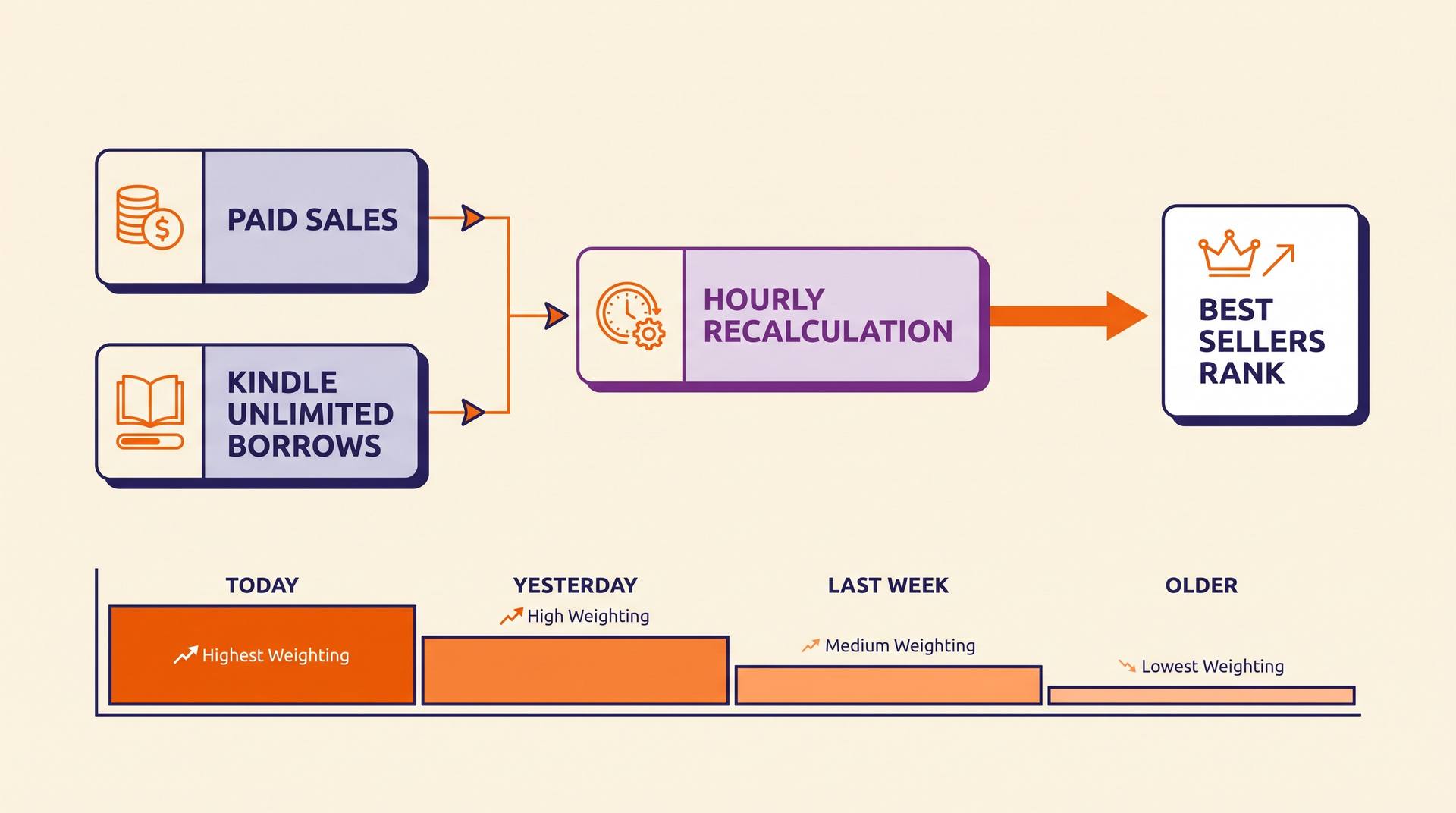
On the Kindle side, borrows count too. A Kindle Unlimited borrow feeds the Kindle Store rank once the reader actually opens the book and starts generating page reads, so a KU-heavy title can sit at a rank its paid sales alone would never earn. This is one of the reasons a competitor's rank can look inexplicable next to their review count — you are seeing borrows you cannot separate out. Our guide to making Kindle Unlimited pay walks through the trade-off in full.
Free downloads live on a separate ladder. During a KDP Select free promotion your book leaves the paid chart and ranks in the Free Kindle Store instead; the two lists never mix, and the paid rank you had before the promo does not carry over when the price goes back up.
What a rank roughly means in sales
There is no official conversion, and Amazon has never published one. The figures below are rough community estimates for the US Kindle Store, drawn from what authors observe across their own dashboards — treat them as order-of-magnitude only. They shift with season, store and category, and the print and Audible stores run on completely different scales.
| Best Sellers Rank | Rough units per day | What that looks like |
|---|---|---|
| #1 – #100 | 500 – 5,000+ | Top-of-store territory, usually trad-published or a major promo |
| #1,000 | 100 – 150 | A strong launch week or a well-run BookBub feature |
| #10,000 | 10 – 20 | A healthy backlist title in a busy genre |
| #50,000 | 2 – 4 | Ticking over with light or no advertising |
| #100,000 | About 1 | Roughly a sale a day, which is where most indie titles settle |
| #500,000+ | Under 1 per week | Effectively dormant until something drives traffic |
The one number worth internalising: the gap between #100,000 and #10,000 is about ten to twenty extra units a day, not hundreds. Rank looks like a mountain and behaves like a staircase.
Where it shows up (and where it doesn't)
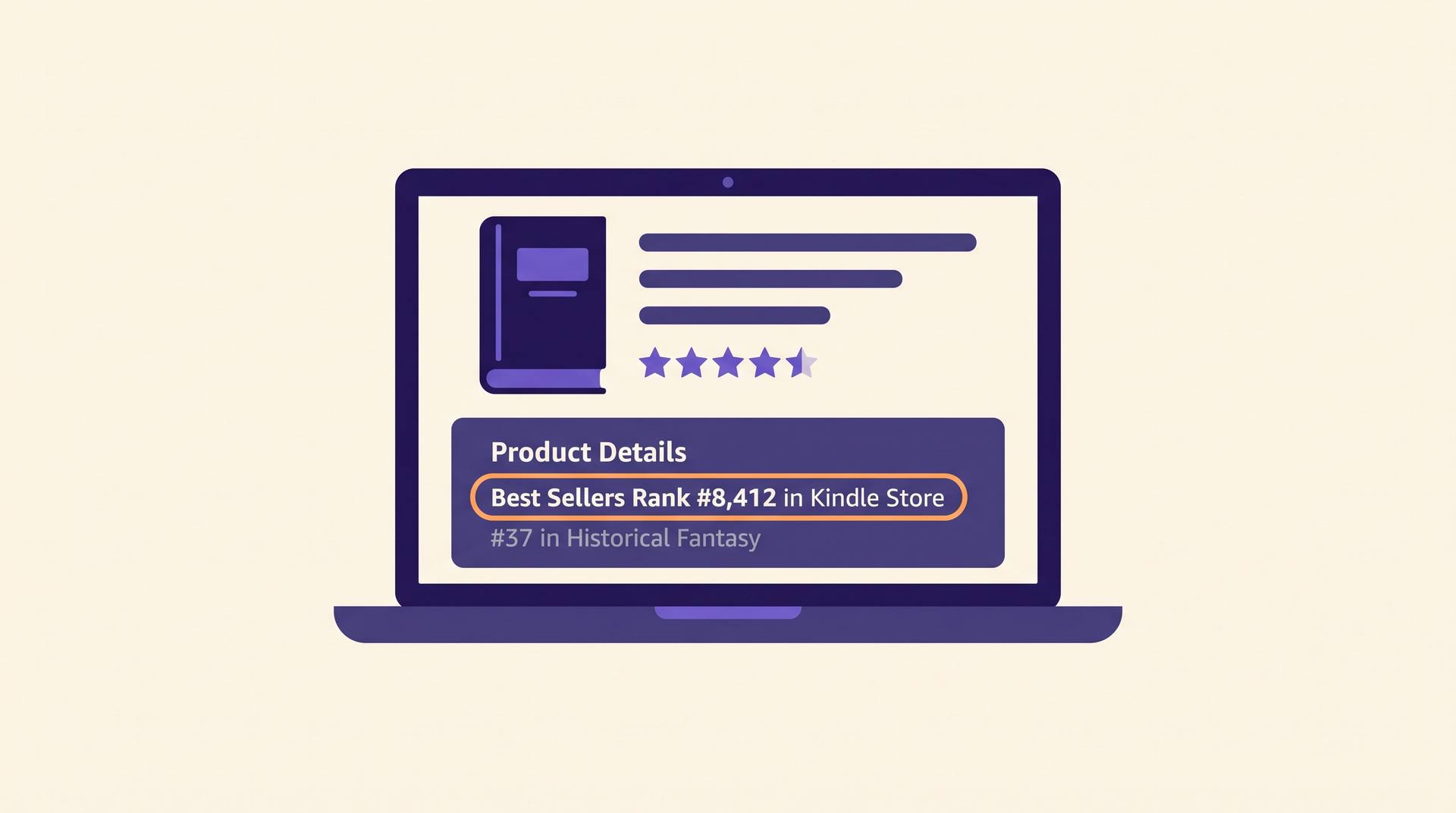
The rank lives on the public product page, in the Product Details block, printed as an overall store rank followed by two or three category ranks — "#8,412 in Kindle Store" and then "#37 in Historical Fantasy". Anyone can read it, including your competitors, which is precisely why it is the number every author-forum thread argues about.
It does not appear in your KDP Bookshelf. This surprises new publishers constantly: KDP Reports give you units ordered, KENP page reads and royalties, but never a rank. Amazon Author Central shows the rank for the books claimed to your author profile, and beyond that you are refreshing your own product page like everyone else.
The orange "#1 Best Seller" flag is a separate thing again. It is awarded live to whichever title currently sits first in a browsable category, so it can appear and vanish within an hour, and hitting it in a thin sub-category says far less than hitting it in a crowded one. Picking which categories you compete in is a real strategic decision — the free Amazon category finder surfaces the paths and how contested they are, and our deeper piece on choosing Amazon categories covers how to do it without gaming the system.
Five things BSR is not
Most of the bad advice about sales rank comes from reading it as something it was never designed to be.
- It is not a total-sales figure
- A book that sold 40,000 copies over three years can rank worse today than one that sold 60 copies this morning. The number describes velocity, not lifetime volume.
- It is not a quality score
- Rank responds to traffic and price. A discounted, heavily advertised book outranks a better book with no marketing behind it, every time.
- Category rank is not overall rank
- "#3 in Time Travel Romance" and "#180,000 in Kindle Store" routinely appear on the same listing. Small categories rank easily; that is the point of choosing them carefully, and also the reason a screenshot of a category rank proves very little.
- It is not comparable across stores
- Kindle Store, Books, Audible and each national marketplace are separate ladders with different sizes. A #5,000 on amazon.co.uk is a very different week from #5,000 on amazon.com.
- It is not Amazon Author Rank
- Author Rank ranks you against other authors on total sales across your catalogue. It moves slowly, it is not printed on product pages, and a strong Author Rank does not lift any individual book's BSR.
What to actually do with it
Use it as a thermometer, not a scoreboard. Check it once a day at the same hour, note the direction rather than the digits, and correlate it with what you changed — an ad turned on, a price dropped, a newsletter sent. Hour-by-hour refreshing tells you nothing except that the hourly recalculation happened.
It is genuinely useful for research on other people's books. Before you commit six months to a niche, look at the ranks sitting on page one of its main category: if the top titles hover around #200,000, there is no money there regardless of how underserved it feels. If they cluster under #20,000, readers are buying, and the question becomes whether you can compete on cover and blurb. Running a few of those checks through the competition analyzer is faster than doing it by hand, and our guide to KDP niche research explains what else to weigh alongside the numbers.
The lever that moves rank is not rank. It is discoverability: the categories you sit in, the seven backend keywords, the blurb that converts a click into a purchase. AIWriteBook generates a full KDP metadata set — description, category suggestions and keyword list — from the manuscript itself, and the free KDP keyword research tool pulls live Amazon search suggestions if you would rather build the list by hand.
Related terms and tools
Neighbouring vocabulary, and the free tools that touch the same numbers:
Questions authors ask
The four that come up in every launch thread.
Roughly once an hour for most listings. The timestamp is not published and the interval is not guaranteed, so a rank that has not moved in ninety minutes is normal rather than a sign that sales stopped.
Anything under about #100,000 in the Kindle Store means the book is selling roughly daily; under #20,000 means it is selling well enough to support advertising. Those thresholds are estimates from author-community observation, not Amazon figures, and they mean different things in different stores.
Yes. A borrow counts toward Kindle Store rank once the reader opens the book and page reads begin. That is why KU-enrolled titles often show ranks their paid sales alone would not explain.
Because the weighting is so heavily tilted toward the last day. A book selling two copies a day sits far lower than the same book selling fourteen in one day and none for six, even though the week's total is identical. Steady sales are worth more in royalties; concentrated sales are worth more in rank.
In short: Best Sellers Rank is an hourly, store-specific, velocity-weighted comparison — useful for reading a trend and sizing up a niche, useless as a measure of how good your book is. Treat it as feedback on your marketing rather than a verdict on your writing. For the rest of the picture on getting a book onto Amazon and keeping it selling, see our Amazon KDP guide.