

The short answer
How much to spend on book marketing, by stage
| Stage | Budget | Spend it on | Skip for now |
|---|---|---|---|
| 1. First book | $0 to $300 for the launch month | Advance reader copies, one discounted promo-site slot, a small Amazon Ads test | Paid PR, big-ticket newsletter features, monthly retainers |
| 2. Small backlist (2 to 4 books) | 20 to 30% of your average monthly royalties | Always-on Amazon Ads on the best seller, promo sites at each release, a growing email list | Ads on books that do not lead anywhere |
| 3. Series engine | Up to the break-even cost of a new reader, scaled only where it returns | Ads on book 1, price promotions, featured deals, audio and translations | Spend you cannot trace to a book |
Cover design and editing are production costs, not marketing. Pay for them first; a marketing budget cannot rescue a book that looks amateur in a search result.
Why the stage decides the budget
A reader who finishes your only book has nowhere to go. A reader who finishes book 1 of five might buy four more. That difference, not your genre or your ambition, is what sets a sensible budget, because it decides how much a new reader is worth to you.
So a first-book budget is really a research budget: you are paying to learn which cover, blurb and keywords convert, and to collect the first reviews. Once you have a backlist, marketing turns into a machine you feed with a share of what it earns. With a series, you can buy readers at a loss on book 1 and still profit, as long as you know your read-through.
The one number that caps ad spend
Before any ad, work out what one sale actually pays you. On Amazon, ebooks priced from $2.99 to $9.99 in the main stores can earn the 70% royalty, which is calculated after a delivery fee of $0.15 per megabyte in the US store. A $4.99 novel in a 1 MB file pays about $3.39 a copy. Price it at $0.99 and you drop to the 35% band: about $0.35.
That figure is your break-even cost per sale for a standalone book. If an ad costs more than that to sell one copy, you are paying to give the book away. With a series, add what an average reader goes on to buy. That total is the most you can pay for a new reader without losing money.
Formula
Value of a new reader = royalty on book 1 + (royalty on each later book x share of readers who reach it)
You do not have to guess the royalty. Our KDP royalty calculator gives the exact figure for your price, file size and store.
Reader-value calculator
Move the sliders to match your books. The calculator shows what one new reader is worth and the most you can pay to win them.
Royalty on a book 1 sale
$3.39
70% royalty band
Value of one new reader
$3.39
Break-even ad cost per book 1 sale
$3.39
Safe target cost per sale
$1.69
What to do with the number
With one book, every ad has to pay for itself on the first sale. Keep tests small and judge them on cost per sale, not clicks.
Assumes a 1 MB file in the US store and the same price for every later book. Kindle Unlimited page reads and print sales come on top. The safe target keeps half the value as margin while you learn what your ads really cost.
Where the money goes at each stage
The split matters as much as the total. These are starting allocations; move money toward whatever your numbers show is working.
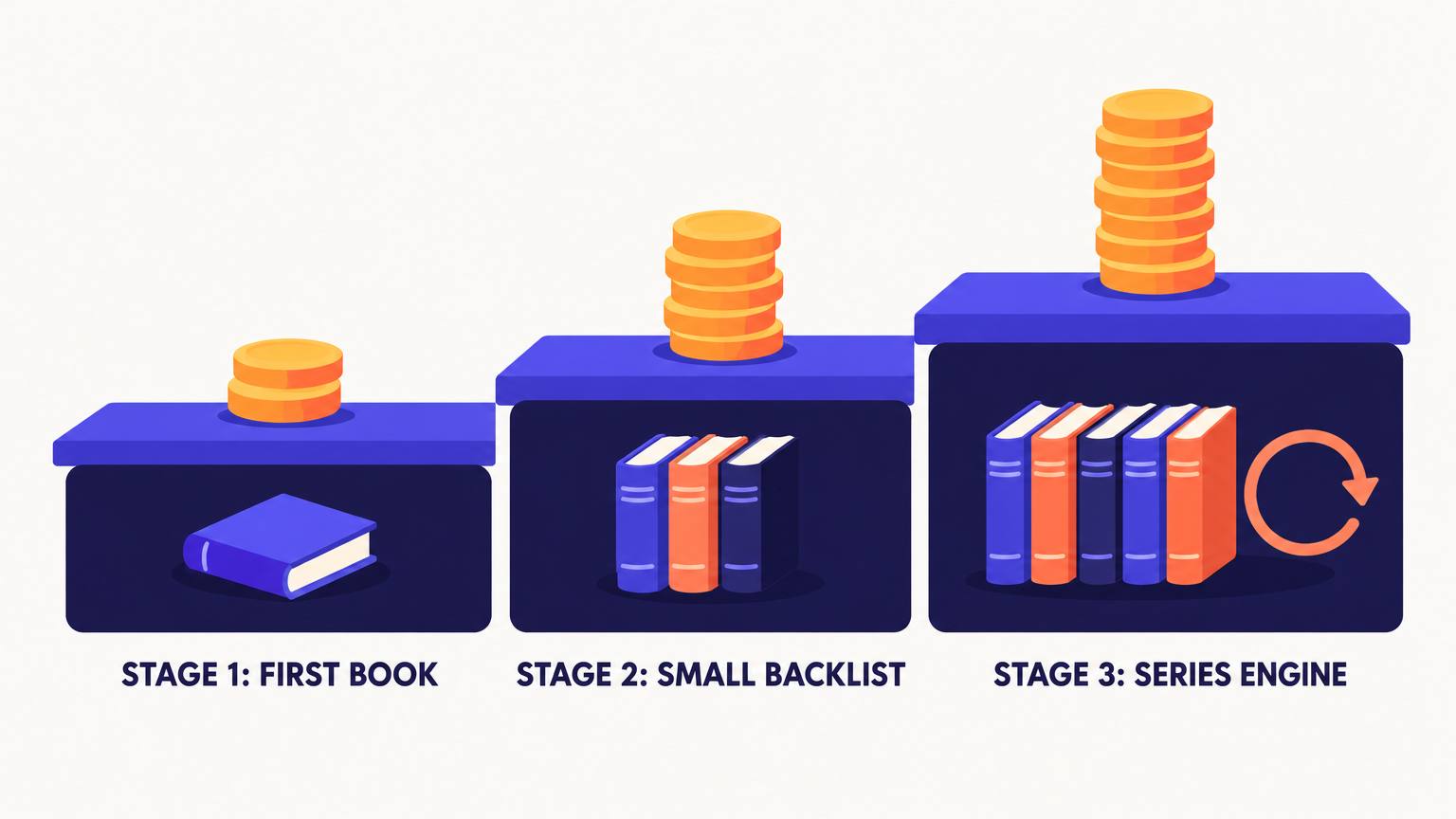
Stage 1: First book
Learn what converts and earn the first reviews.
- 40%Reviews and advance readers
- 30%One promo-site listing
- 30%Amazon Ads test
Advance reader copies cost you little more than files and time, and reviews lift every later ad. One discounted listing on a reputable promo site gives you a clean spike to measure. Then run a small Amazon Ads test on exact-match keywords for two weeks and read the cost per sale.
Stage 2: Small backlist
Feed the book that already sells and build the list.
- 50%Always-on Amazon Ads
- 30%Release-week promos
- 20%Email list growth
Put ads behind the book with the best conversion and let the others ride on also-boughts. Save a slice for promo sites in each release week. Spend the rest growing a list you own, because email is the one channel that gets cheaper the longer you run it.
Stage 3: Series engine
Buy readers for book 1 at or below their series value.
- 55%Ads on book 1
- 30%Price promotions and featured deals
- 15%New formats and markets
Now the calculator above sets the ceiling. Ads point at book 1, price promotions restart the series for new readers, and a featured deal on a big newsletter becomes worth the price. Audio and translations reuse books you already own to open new stores.
Set your budget in six steps
- 01
Write down your real royalty per sale
Use your actual price, file size and store mix. Guessing 70% of the list price overstates it.
- 02
Measure read-through, even roughly
Divide sales of book 2 by sales of book 1 over the same three months. Do the same for each later book. One book means read-through is zero for now.
- 03
Pick your stage and its budget
Use the table at the top. If you are between stages, use the lower budget until the numbers earn you the higher one.
- 04
Split the money before you spend it
Assign each dollar to a channel and a goal: reviews, a spike, a cost-per-sale test. Unassigned money gets spent on whatever someone sells you next.
- 05
Set a stop rule for every test
Decide in advance: if cost per sale is above break-even after a fixed spend, the test stops. Amazon Ads lets you start at a few dollars a day, so tests can stay small.
- 06
Review monthly and move money to winners
Once a month, compare spend to royalties by channel. Cut the worst line, add to the best, and recompute your stage budget from the new royalty average.
Three budgets, worked through
Illustrative authors, real arithmetic. Your prices and read-through will differ; the method will not.
A debut cozy mystery, no backlist
Budget
$180 for the launch month
At $3.99 the book pays about $2.69 a copy, so an ad sale has to cost under that. The plan: 40 advance reader copies through a free reader team, one discounted listing on a promo site during launch week, and $5 a day of Amazon Ads for 14 days on 20 exact-match keywords. Whatever the ads cost per sale, the author now knows, before writing book 2.
Three self-help titles earning about $600 a month
Budget
$150 a month
A quarter of average royalties. $75 goes to always-on ads behind the best seller, $45 is saved toward a promo week at the next release, and $30 pays for the email tool and a reader magnet that turns buyers into subscribers. The other two titles get no ads; they sell through also-boughts.
A five-book fantasy series
Budget
Up to $6.80 per new reader
Book 1 sits at $0.99 (about $0.35 a copy). Books 2 to 5 sell at $4.99 (about $3.39). With 60% of readers reaching book 2 and 85% going on each time after that, one new reader is worth about $6.80. Ads that sell book 1 at $3 each look like a loss on the ad dashboard and are clearly profitable across the series.
Mistakes that burn the budget
Advertising the only book you have at full scale
With no series behind it, the ad ceiling is one royalty. Big spend on a lone debut is almost always a loss.
Judging ads on clicks or impressions
The only number that pays rent is cost per sale against what a sale is worth. Cheap clicks that do not buy are expensive.
Paying for marketing before the cover and blurb work
Ads multiply conversion. If the product page converts badly, you are paying to show more people a page that does not sell.
Buying packages you cannot measure
Blog tours, social shout-outs and PR bundles with no sales tracking cannot be compared with anything, so you never learn whether to repeat them.
Spending your launch money in week one
Promo spikes fade. Keep part of the budget for weeks three and four, when the algorithm decides whether the book keeps selling.
The free part of the budget
Spend money on reach, not on copywriting
A good share of any launch is writing, not buying: the blurb, the A+ content, posts for every platform, the launch emails. Paying a freelancer for each piece eats a first-book budget before a single ad runs.
In AIWriteBook, the Book Marketing Kit writes that material from your own book: Amazon A+ content modules, a press kit with short, medium and long bios, posts for five social platforms, and launch emails, each one editable before you use it.
Before you spend on ads, check the keywords. The KDP keyword research tool reads real Amazon results and scores competition, so your ad keywords and your seven KDP keyword slots come from the same evidence. The blurb generator gives you descriptions to test against each other.
And the cheapest channel of all is a list you own. Your author page collects reader emails with a free chapter preview and sends launch broadcasts to that list, so every paid spike leaves subscribers behind.
Copy the budget template
Paste this into a spreadsheet or a notes app and fill it in once a month.
BOOK MARKETING BUDGET - MONTH: ________

STAGE: 1 first book / 2 small backlist / 3 series engine

ROYALTY PER SALE
Book 1: $____   Later books: $____
Read-through to book 2: ____%   to each later book: ____%
Value of one new reader: $____
Break-even ad cost per sale: $____   Safe target: $____

BUDGET THIS MONTH: $____
(Stage 1: $0-300 launch month. Stage 2: 20-30% of avg monthly royalties. Stage 3: up to break-even per reader.)

CHANNEL           | BUDGET | GOAL              | STOP RULE                  | RESULT
Amazon Ads        | $      | cost per sale     | stop if > $__ after $__    |
Promo site        | $      | sales spike       | -                          |
Reviews / ARCs    | $      | __ reviews        | -                          |
Email list        | $      | __ new subscribers| -                          |
Other             | $      |                   |                            |

TOTAL SPENT: $____   ROYALTIES THIS MONTH: $____
CUT NEXT MONTH: __________   ADD NEXT MONTH: __________
Frequently asked questions
How much should a first-time author spend on book marketing?
For the launch month, somewhere between nothing and $300 is enough to learn what converts. Spend it on advance reader copies, one promo-site listing and a small Amazon Ads test, and keep the cover and editing in a separate production budget.
What percentage of royalties should go back into ads?
Once you have two to four books out, 20 to 30% of your average monthly royalties is a sustainable range. With a series and known read-through, budget by the value of a new reader instead of a percentage.
What is a good daily budget for Amazon Ads on a book?
Small. A few dollars a day per campaign is enough to see cost per sale within two weeks. Raise the budget only on campaigns that sell below your break-even cost.
Is a $0 book marketing budget realistic?
For a first book, yes, if you trade money for time: advance readers, an author page with an email list, a strong blurb and correct keywords. Paid ads become worth it once you have a second book for readers to move on to.
Should cover design count as marketing?
Count it as production. It is a fixed cost every book needs, while marketing is spend you scale up or down by results. Mixing them hides whether your marketing pays.
The budget follows the backlist
Spend to learn on a first book, spend a share of royalties on a small backlist, and spend up to a reader's value once a series carries them. Whatever the stage, write down the break-even number before the first dollar goes out, and give every test a stop rule.
When you are ready to spend, start with the channel you can measure best: our beginner's guide to Amazon Ads for books sets up the first campaign, KDP free promotion days cost nothing but a few days of royalties, and BookBub is the featured deal to save for stage three. If you are unsure whether a line item is publicity or marketing, book publicity vs marketing draws the line.
A budget is one piece of the plan; our book marketing guide covers the rest of it.