

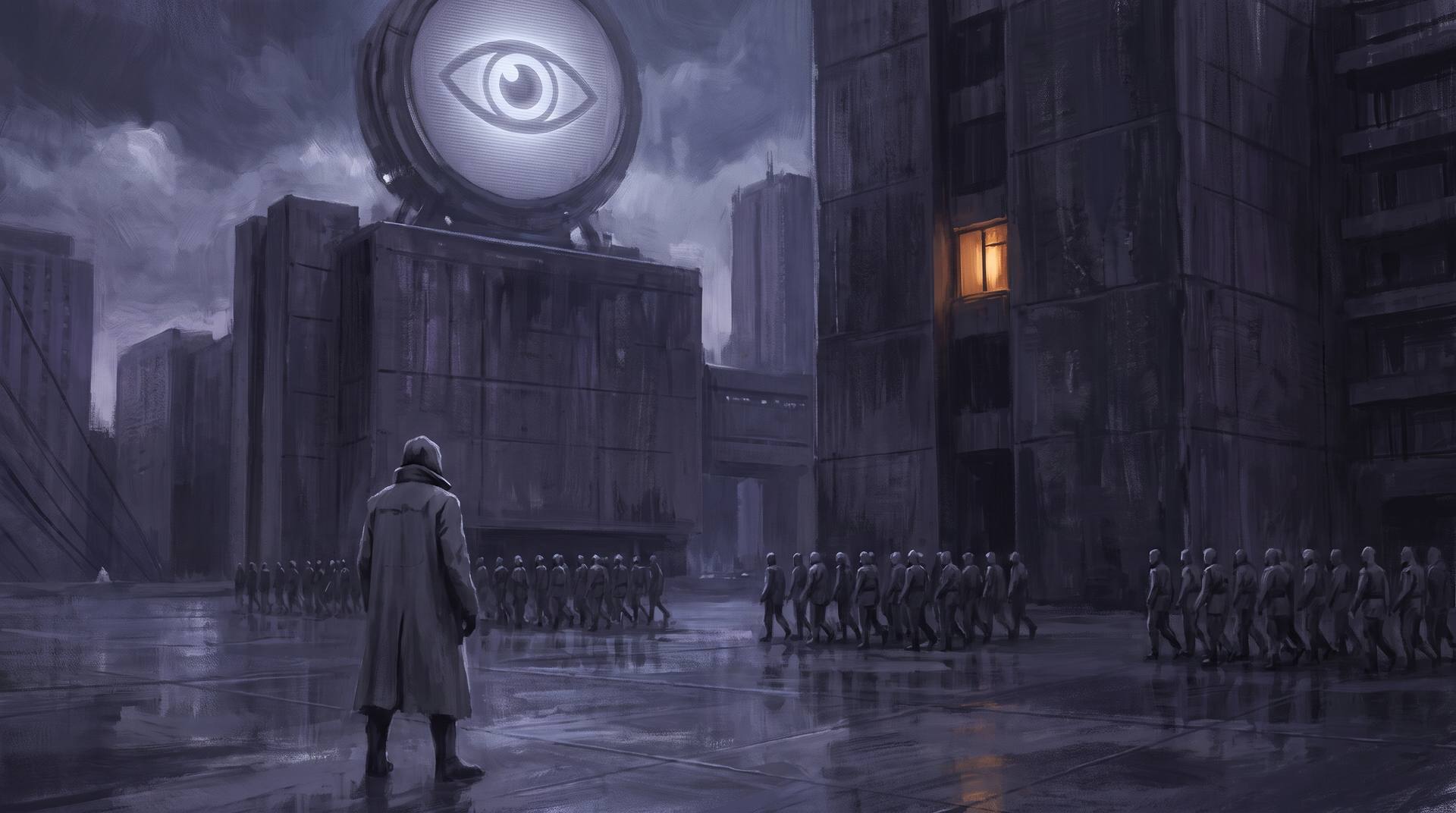
Definition
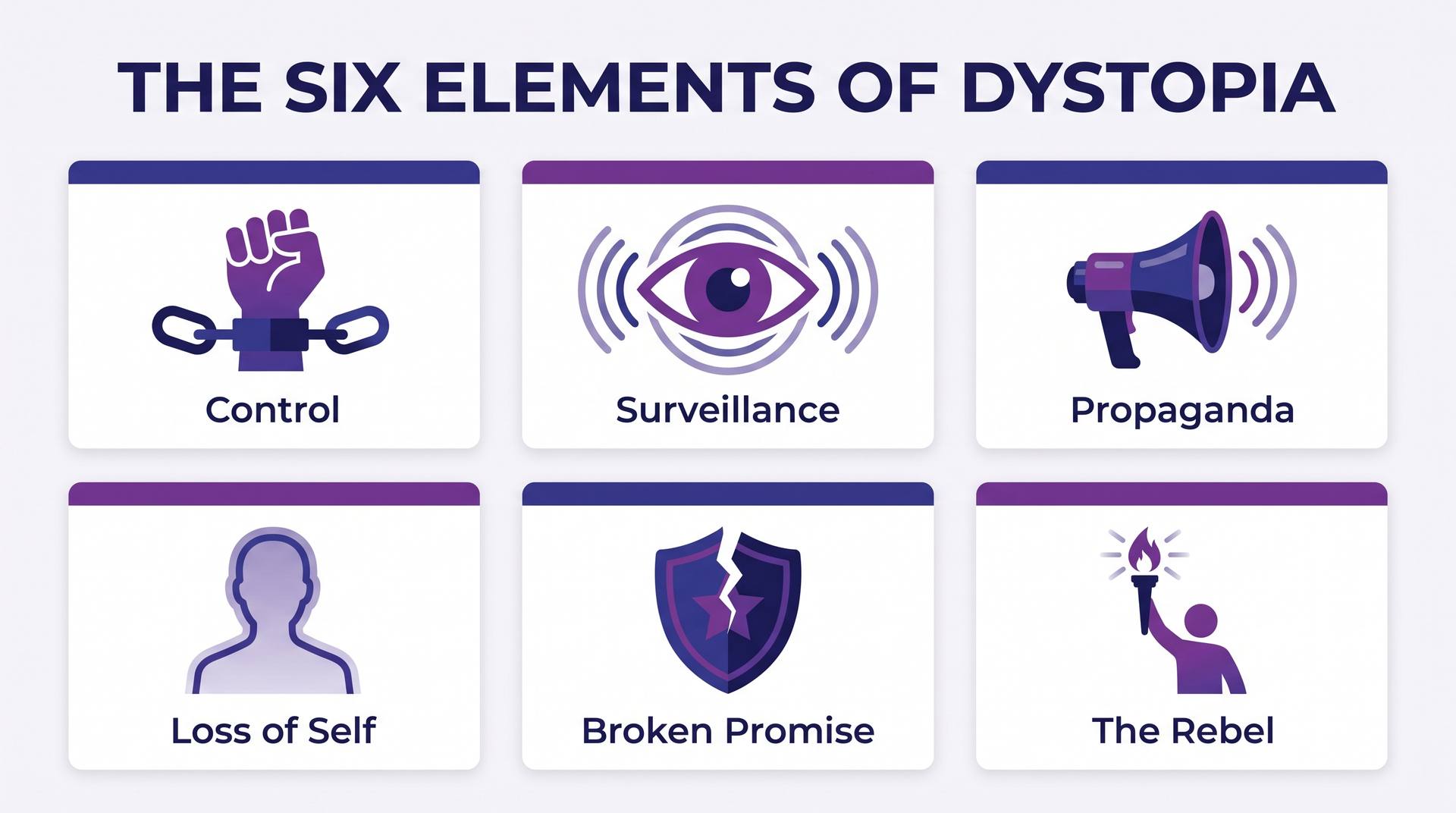
Dystopian fiction elements are the recurring conventions that make a fictional society feel oppressive: a controlling power, a way of watching people, a story the state tells about itself, the erosion of individual identity, a broken ideal the society was built on, and a character who notices the cracks.
One or two elements give you a bleak setting. A dystopia needs the elements to work as a system, where each one props up the others.
The six elements at a glance
Genre conventions are not a checklist you tick to qualify. They are the load-bearing walls. Readers of dystopian fiction expect to feel the pressure of the system on the protagonist in almost every scene, and each element is a different source of that pressure.
Think of them as questions your world has to answer: Who is in charge, and how do they enforce it? How do they know what you do? What story do they tell to justify themselves? What did people lose? What was the original promise? Who refuses?
Explore each element in famous books
Pick an element to see what it does, how three well-known novels handle it, and the question to ask of your own manuscript.
Control
A power that decides how people live, work, love and die. It can be a party, a corporation, a theocracy or an algorithm. What matters is that the rules are enforced and the cost of breaking them is visible.
In the books
- Nineteen Eighty-Four: the Party controls work, food, language and even the past through the Ministry of Truth.
- The Handmaid's Tale: Gilead controls women's bodies, names and the right to read.
- The Hunger Games: the Capitol controls the districts through hunger and an annual televised punishment.
Ask your draft
What exactly happens to someone in your world who breaks the most important rule, and has your protagonist seen it happen?
One scene, built from the elements
Here is the difference between a bleak setting and a working dystopia, shown in the same short moment: a woman buying bread.
Bleak setting only
The city was grey and the shelves were almost empty. Mara bought the last loaf and hurried home through the rain, past soldiers on every corner.
Elements working together
Mara pressed her wrist to the scanner and the bread was hers, along with a record that she had bought it. The baker thanked her for her contribution to the Harvest. She smiled at the camera above the till, because not smiling had been noted last month, and did not ask why the ration had shrunk again. At home she tore the loaf in half and hid one piece for her brother, who no longer officially existed.
What changed
- Control and surveillance arrive through a small everyday action, the wrist scanner, not through soldiers.
- Propaganda appears in the baker's language: buying food is a contribution to the Harvest.
- Loss of self is the smile she performs, and the brother who no longer officially exists.
- The rebel element is quiet: one hidden half-loaf. The reader now wants to know what happens if someone finds it.
No speech about the regime, no history lesson. The world explains itself through what Mara has learned to do without thinking. For more on this technique, see our guide to show, don't tell.
Common mistakes
Villains without logic
A regime that is cruel for no reason reads as a cartoon. Give it a problem it believes it solved and a reason ordinary people went along with it.
The history lecture in chapter one
Opening with three pages about the war that created the state stalls the story. Let the reader learn the system the way the protagonist lives it, a rule at a time.
Aesthetic without pressure
Ruins, grey uniforms and rain are atmosphere, not a dystopia. If the system never forces your character to choose, the genre promise is not being kept.
A rebellion that is too easy
If a teenager topples a surveillance state in a weekend, the state was never frightening. Make every act of defiance cost something real.
Borrowed furniture
Arenas, factions and choosing ceremonies are now reader shorthand for imitation. Build your control mechanism from a fear that feels current and specific to your story.
When to use the full toolkit, and when not to
Use all six when
- The society itself is the antagonist and the plot is about resisting or escaping it.
- You are writing for readers who shelve books as dystopian, YA dystopia or political science fiction.
- Your theme is a warning about a real trend, and you want readers to recognise it.
Use only a few when
- Your book is a thriller, romance or mystery that simply happens in a harsh world. Surveillance and control can raise the stakes without taking over the plot.
- You are writing post-apocalyptic survival. Those stories usually lack an organised power, which is the core of dystopia.
- The oppressive society is one location in a larger world, such as a single city in a fantasy series.
Dystopia and utopia are mirror images, and the line between them is often point of view. Our comparison of utopia vs dystopia traces how the two genres grew from each other.
Check your own draft
Tick each statement that is true of your manuscript. Four or more means the genre conventions are doing real work.
0 of 6 elements in place
Your world may read as a bleak setting rather than a dystopia. Start with the elements you left unticked.
Where AI helps
Dystopias fail most often in the worldbuilding, and that is also where a structured tool saves the most time. Our free world builder lays out a society's government, rules, economy and history, so you can see which of the six elements your world is missing before you write a word of the plot.
When you move to the full book, AIWriteBook's outline builder turns the premise into chapters with a clear escalation of pressure from the system, and the chapter AI chat lets you ask for a scene to show surveillance through action instead of explanation. Every suggested change appears as a diff you accept or reject, so the voice stays yours. If you are planning a trilogy, which the genre practically invites, series support writes book two from what already happened in book one.
Stuck on the moment the protagonist realises the truth? The free plot twist generator suggests reversals you can test against your world's rules.
Build the system, then break it
A dystopia works when its six parts support each other: control needs surveillance, surveillance needs propaganda to seem normal, and the loss of self is what makes the rebel's first small act matter. Design the system first, find the promise it broke, then put your protagonist exactly where the pressure is highest.
For more on building worlds readers believe in across every genre, continue with our Genre Fiction guide.