

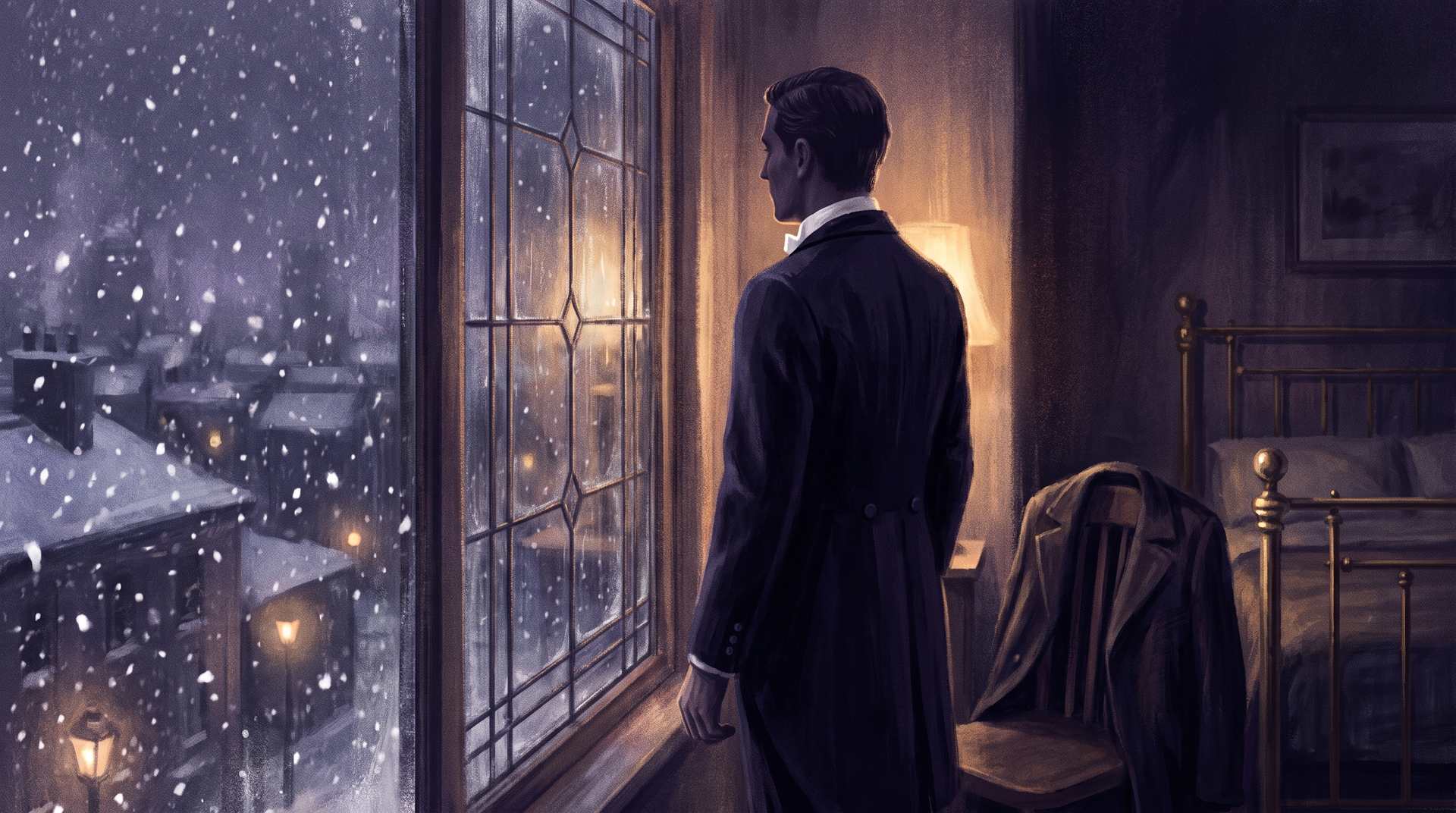
Every writing course teaches the epiphany and almost none of them teach the part that matters: the realisation itself is the cheapest component. Any character can be made to understand anything on any page. What costs you something is the fifty pages before it, where the reader watched the pattern the character could not see.
This guide covers the definition Joyce actually gave the term, six examples worth studying, the mechanics of building one, and the failure modes an editor spots in a paragraph.
What an epiphany actually is
Definition
An epiphany in literature is a sudden moment of revelation in which a character grasps the essential nature or meaning of something — usually about themselves — triggered by an ordinary object, gesture or remark rather than by an explanation.
The word comes from the Greek for a manifestation or showing forth, and reached English through the Christian feast of the Epiphany. James Joyce borrowed it for fiction.
Joyce is the reason the word means what it means to novelists. In his unfinished early novel Stephen Hero, his protagonist defines an epiphany as "a sudden spiritual manifestation, whether in the vulgarity of speech or of gesture or in a memorable phase of the mind itself," and says it is the writer's job to record such moments with extreme care. Note the range in that definition. A vulgar overheard sentence counts. The revelation arrives through the trivial, not through the grand.
That is the part most writers drop. They keep the sudden understanding and throw away the vulgarity of gesture, which is exactly the load-bearing half. An epiphany triggered by a speech is a lecture. An epiphany triggered by a coat left on a chair is literature.
It is also worth separating the epiphany from things it sits next to. It is not the climax — in most short stories the climax and the epiphany coincide, but in a novel the realisation often lands well after the action does. It is not the resolution either; a character can understand everything and still be ruined. And it is not character growth. Growth is a slope; the epiphany is a step on it, and a character can have one and change nothing.
If you want the structural context, our breakdown of the three conditions a climax has to meet covers the beat the epiphany is usually mistaken for, and the piece on falling action covers the stretch where a late realisation actually lives.
The four moves that make one work
Strip a working epiphany down and you find the same four components in the same order. Miss any one and the moment reads as authorial intervention.
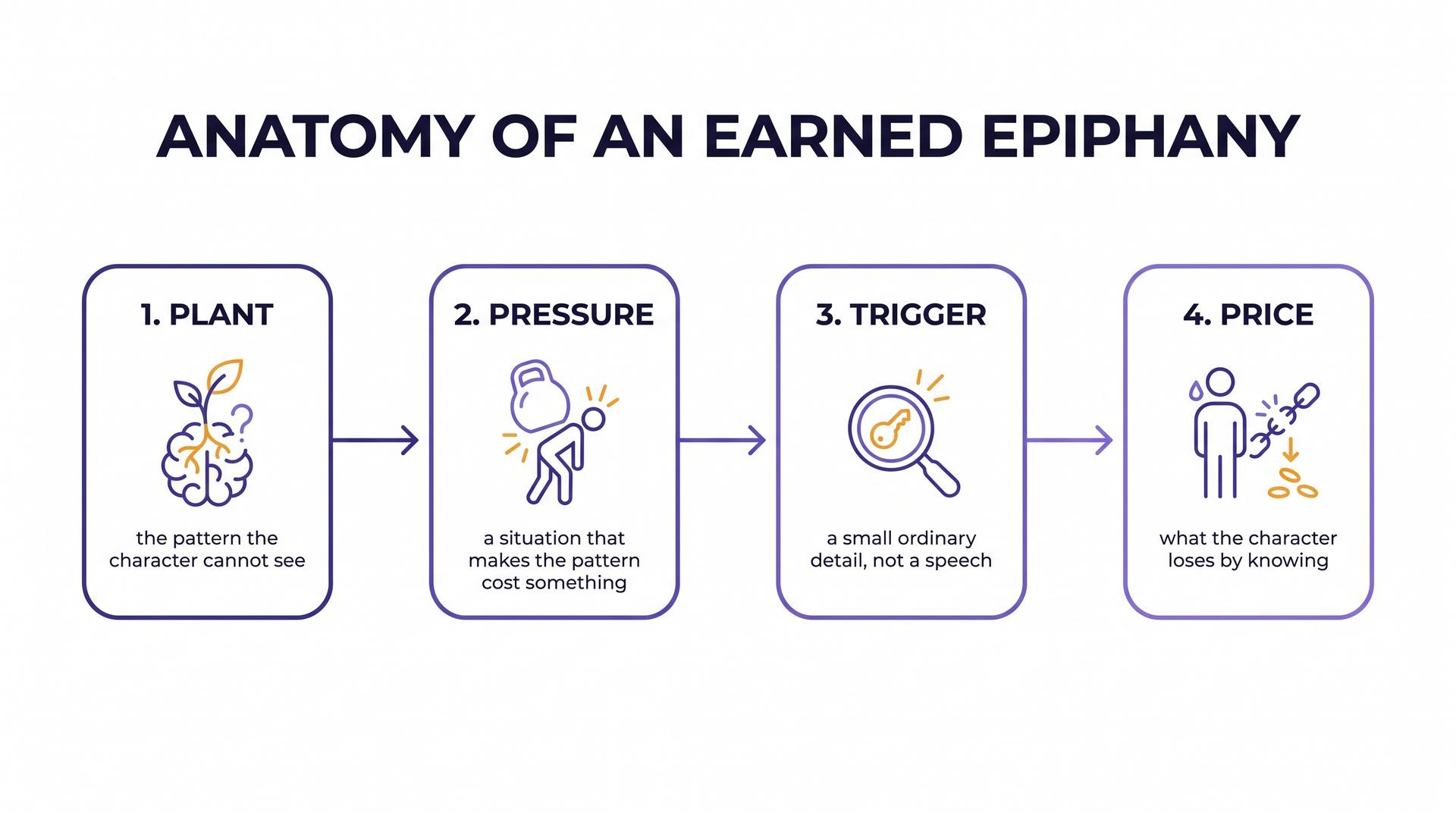
Plant the pattern the character cannot see
The reader must be able to reconstruct the truth before the character does. This is not foreshadowing an event; it is repeating a behaviour. Three or four instances of a character doing the same self-protective thing in different circumstances is enough. The reader files them without deciding what they mean.
Apply pressure that makes the pattern cost something
Blindness is comfortable until it is expensive. Put the character in a situation where the habit they cannot see costs them a specific thing they want — a person, a job, a version of themselves. Understanding is not free, so there has to be a reason to pay.
Trigger it with something small and physical
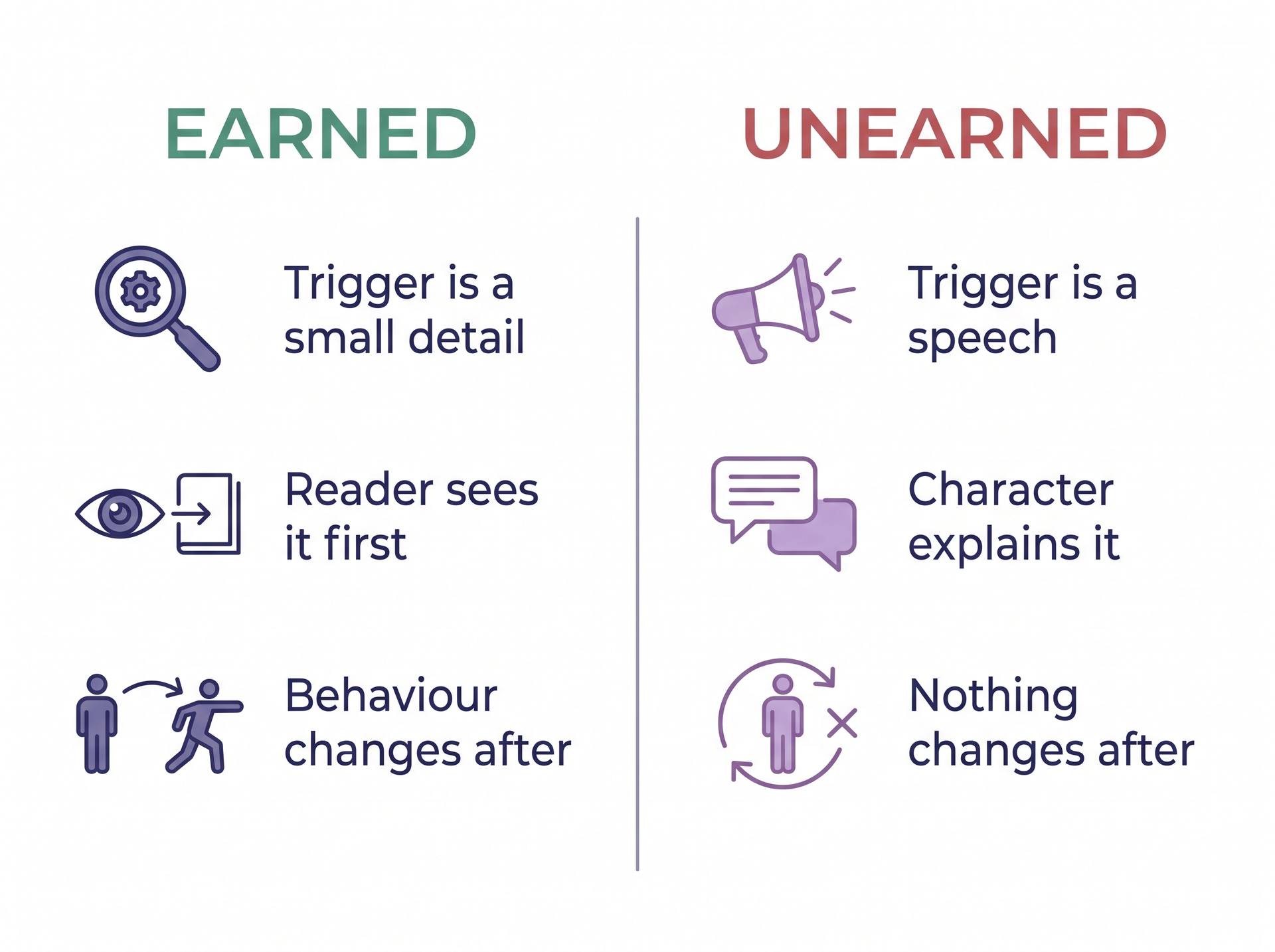
The trigger should be almost embarrassingly ordinary: a word used wrong, a photograph, a piece of clothing, someone humming. If your trigger is a monologue from a wise secondary character, you do not have an epiphany, you have exposition with a witness.
Charge a price for knowing
After the realisation the character has lost something — an excuse, an image of themselves, a way of talking about their marriage. If the character can hold their new knowledge and lose nothing, the reader registers the scene as decorative and moves on.
Six epiphanies, and what each one does
These are worth reading in full, but the mechanics are visible even in summary.
"The Dead" — James Joyce (Dubliners, 1914)
The reference case. Gabriel Conroy spends a long party being pleased with himself, then learns in a hotel room that his wife once loved a seventeen-year-old boy who stood in the rain for her and died of it. The trigger is a song heard on a staircase and, later, his own reflection. What he loses is his sense of being the centre of his marriage. The story closes on the snow "falling faintly through the universe and faintly falling, like the descent of their last end, upon all the living and the dead" — the recognition generalised outward, not explained.
"Araby" — James Joyce (Dubliners, 1914)
A boy travels across Dublin to buy a gift for a girl and arrives at a closing bazaar with almost no money. The whole story is romantic build-up; the final line detonates it: "Gazing up into the darkness I saw myself as a creature driven and derided by vanity; and my eyes burned with anguish and anger." The trigger is overheard flirting between a shop girl and two men — trivial, ugly, and enough.
The Metamorphosis — Franz Kafka (1915)
A useful counter-case. Gregor Samsa's epiphany near his death is that his family would be better off without him, and he holds it with tenderness. But Kafka undercuts it: the realisation is the final act of the self-erasure that ruined him, and the book's real turn belongs to his sister Grete, who stretches in the sun in the last paragraph. An epiphany can be sincere and wrong at the same time, and saying so is a legitimate move.
"A Good Man Is Hard to Find" — Flannery O'Connor (1953)
The grandmother's moment arrives at gunpoint: she touches the man about to kill her and says, "Why you're one of my babies. You're one of my own children!" O'Connor's model of grace requires extremity — her characters only see clearly when everything else has been taken away. The Misfit's verdict afterwards is the coldest craft note in American fiction: she would have been a good woman if there had been somebody there to shoot her every minute of her life.
"A&P" — John Updike (1961)
A supermarket clerk quits his job in a gesture nobody notices, then steps outside and understands what he has done: "my stomach kind of fell as I felt how hard the world was going to be to me hereafter." Nineteen-year-old realisations are small and permanent, and Updike prices this one exactly.
A Christmas Carol — Charles Dickens (1843)
The exception that proves the rule about triggers. Scrooge is given three supernatural tutors and an explicit tour of his own life, which by any strict definition is not an epiphany at all — it is instruction. What saves it is the last image: his own name on a headstone, no ghost speaking, nothing explained. Dickens spends four staves telling and then, at the decisive second, shows.
Gazing up into the darkness I saw myself as a creature driven and derided by vanity; and my eyes burned with anguish and anger.
Twenty-four words, no explanation of what the vanity was, no summary of the story's meaning. The reader has been assembling this sentence for four pages without knowing it.
Earning it in the scene
Assume the structure is right and you are now writing the paragraph. Six rules do most of the work.
- 1Give the reader the answer first. If the reader realises it on page 40 and the character on page 180, those 140 pages are suspense. If they land together, the scene is a surprise, which is a weaker and shorter feeling.
- 2Keep the trigger physical and off-topic. The detail that opens the door should not be thematically on the nose. A dead man's letter is too neat. His handwriting on an envelope about something else is right.
- 3Never let the character narrate the realisation in full. Write the perception, one degree of interpretation, then stop. "He saw that his coat was still on the chair where he had thrown it four hours ago" beats any sentence containing the words "he realised that he had always."
- 4Slow the prose down by two gears. Shorter sentences, concrete nouns, less subordination. Rhythm is how readers know a moment is load-bearing; if the epiphany is written at the same tempo as a scene of driving to work, it will be read at that weight.
- 5Cut the confirming dialogue. The instinct after a realisation is to have someone ask "are you all right?" so the character can half-answer meaningfully. This is the most common way a good epiphany is spoiled in the following paragraph.
- 6Prove it later with behaviour, not with a summary. Two or three chapters on, the character does something small they could not have done before — answers a call, does not answer a call, tells the truth about a minor thing. That is the receipt.
Rule three has a sibling worth reading in full: our guide to show don't tell, with before-and-after rewrites is essentially a manual for writing the epiphany paragraph, since the whole difficulty is resisting the summary sentence.
Before and after
Same character, same moment, two drafts. Nothing changes except how much the narrator says out loud.
Before
Standing there, Elena suddenly realised that she had spent fifteen years making herself smaller for a man who had never once asked her to. It was a devastating revelation, and she understood in that moment that everything about her marriage had been built on a lie she told herself. She would never be the same again.
After
Elena reached across the table for the salt and stopped. She had been reaching around him for fifteen years — around his elbow, his newspaper, his sleep. He was not even in the room. She put her hand back in her lap and looked at the chair.
The second version is shorter, states nothing, and hurts more. It also passes the behaviour test on its own terms: putting her hand back in her lap is the first thing she does with the new knowledge, and it is a physical action, not a conclusion. The reader assembles "fifteen years of making herself smaller" without being handed the phrase.
The word "suddenly" in the first version is doing the opposite of its job. If the moment reads as sudden, you do not need to say so; if it does not, the adverb will not rescue it.
Five ways an epiphany fails
- It arrives without a planted pattern. The character understands something the reader had no evidence for, which reads as the author speaking rather than the character seeing.
- The character explains the theme. The moment the realisation is phrased as a general truth about life, love, or grief, the scene stops being about this person and becomes a caption for the book.
- It costs nothing. Understanding that arrives with no loss attached is a good mood, not an epiphany.
- It changes everything instantly. Real recognitions are followed by relapse. A character who has one insight and is permanently transformed by page 200 reads as a mechanism, not a person — this is why Dickens has to spend a whole final stave showing Scrooge repeatedly choosing his new behaviour.
- There are three of them. Epiphanies do not stack; the second one devalues the first. In a novel, one per major character is generous, and one per book is defensible.
The fourth failure is a character-consistency problem more than a scene problem, and it is worth reading our character development guide alongside this one — an epiphany only lands if the person having it was specific enough beforehand to be surprised by.
When not to write one at all
The form has become close to compulsory in literary short fiction, which is a good reason to check whether your story actually wants one.
- Plot-driven genre fiction. A thriller's ending is a resolution of danger, not a change in self-knowledge. Bolting a realisation onto the last page of a chase reads as an apology for having written a chase.
- A character with no self-deception. If the protagonist has been clear-eyed throughout, there is nothing for the epiphany to break. Give them a reversal of circumstance instead.
- When the reader already has it. If your theme has been legible since chapter two, an epiphany in the last scene tells the reader something they finished thinking about a hundred pages ago.
- Comedy that depends on the character not learning. Some of the best comic protagonists are defined by their imperviousness, and granting them insight ends the engine of the book.
The honest alternative to an unearned epiphany is usually a decision. A character who chooses badly, knowing exactly what they are doing, generates more feeling than one who understands beautifully and then goes to bed.
Drafting one without losing the thread
The hard part of an epiphany is bookkeeping across distance. The pattern gets planted in chapter three and pays off in chapter twenty-nine, and by the time you write chapter twenty-nine you have forgotten two of the four plantings and invented a fifth that contradicts them.
If you are drafting on AIWriteBook, this is what the chapter-by-chapter workflow is for: you approve each chapter's plan before any prose is written, so you can see the pattern accumulating across the outline rather than discovering in revision that it never did. When it comes to the scene itself, the Chapter AI Chat is the more useful tool — you can ask for the realisation paragraph to be rewritten with the interpretation removed and accept or reject each change in a diff view, which is exactly the surgery the "before and after" above describes.
For the planning pass alone, our free scene builder will draft the shape of a single high-pressure scene from a premise, which is a fast way to test whether your trigger detail is doing enough work before you commit a chapter to it. And if the pattern you are planting is a symbolic object rather than a behaviour, our guide to symbolism in writing covers how to repeat an image so it gathers weight without announcing itself.
Common questions
A moment when a character suddenly understands something essential about their situation or themselves, usually set off by a small ordinary detail rather than by an explanation.
James Joyce adapted the religious term for fiction in his early novel Stephen Hero, where he defines it as a sudden spiritual manifestation arising from ordinary speech, gesture, or a phase of the mind. The device existed before him; the name and the emphasis on the trivial trigger are his.
No. In short stories they often occupy the same paragraph, but in novels the climax is the peak of external conflict and the epiphany is a change in what a character knows. A book can have one without the other.
Yes, and some of the strongest ones are. Gregor Samsa in The Metamorphosis concludes that his family is better off without him and dies believing it, while the narrative frames that conclusion as the last symptom of his illness rather than the truth.
One per major character at most, and often just one for the book. A second realisation of similar weight reduces the first to an episode.
Cut the sentence in which the character states what they understood. If the scene still works, it was earned. If the moment disappears with that sentence, the realisation was never in the story — it was in the summary.
The short version
An epiphany is not a thought a character has; it is a debt the story pays. Plant a pattern the reader can see and the character cannot, make the blindness expensive, trigger the recognition with something too small to be symbolic, and charge for it. Then write less than you want to at the decisive moment, and confirm it three chapters later with an action rather than a sentence.
Where the realisation falls is a structural decision, not a stylistic one, which means it belongs in the outline. Our guide to writing a book covers where that choice sits alongside premise, structure, and drafting.