


Most romance runs on one question: will these two end up together? Fated mates takes that question, answers it out loud in the first act, and dares you to keep the reader turning pages anyway. A bond snaps into place, a scent registers, a mark burns, a prophecy names them — and the uncertainty that powers every other love story evaporates.
Readers do not experience that as a spoiler. They experience it as a guarantee, and they buy it on purpose. Of all the paranormal romance tropes, this is the load-bearing one — it carries whole shifter, vampire, and fae subgenres on serial platforms and in Kindle Unlimited. What it does not carry, on its own, is a plot.
This piece is about the trade. What you buy when you promise destiny, what you owe the reader in exchange, and how to build a middle that still has teeth.
What the trope actually promises
Every successful trope is a contract. Fated mates has three clauses, and readers notice when you break any of them.
Certainty of connection
These two belong together, and the book will not renege. That is the emotional safety net that makes a reader pick this trope over a will-they-won't-they. Breaking it — a mate bond that turns out to be a misfire, a happily-ever-after with someone else — is not a clever subversion, it is a refund.
Intensity without a slow ramp
The bond licenses immediate, overwhelming feeling. Recognition on page thirty is not insta-love if the story has installed a mechanism that makes it plausible in-world. That is the trope's real superpower: it buys you emotional volume early without the four hundred pages of proximity a slow burn needs.
Being chosen, absolutely
Underneath the fangs, the fantasy is being wanted by someone who cannot be talked out of it. Not admired, not settled for. Chosen at a level that no rival, no bad hair day, and no better option can dislodge.
Notice what is not on that list: an easy road. Readers want the destination guaranteed and the trip expensive. Give them a cheap trip and the guarantee starts to feel like a shrug.
The structural problem it creates
Here is the mechanical issue, stated plainly. Romance structure is built to escalate a single dramatic question across three acts. Fated mates resolves that question in act one. If you do nothing else, your act two has no engine, and it shows up as the most common feedback a paranormal romance draft gets: the middle drags.
Writers usually try to patch this by adding scenes. More banter, more proximity, another attack by the rival pack. Volume is not the fix. The fix is to move the dramatic question somewhere else and let the bond be a premise instead of a plot.
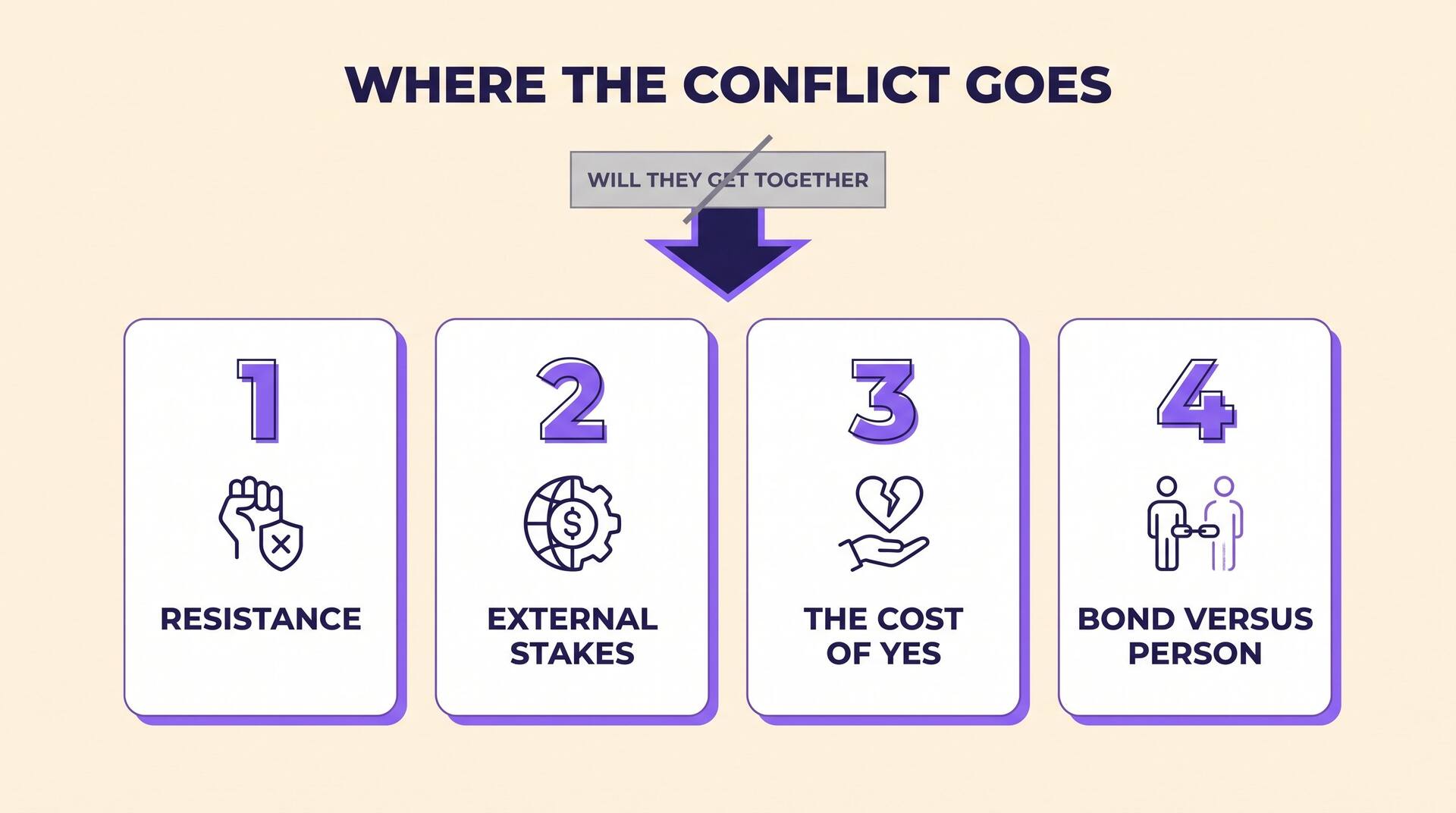
The four replacements below are not a menu where you pick one. The strongest books in this space run two or three at once, with one dominant.
If your middle is sagging and you are not sure which engine is missing, it is often a pacing problem wearing a plot costume — our breakdown of how to pace romantic tension without stalling applies directly to bonded couples, because a bond removes the stalling excuse most drafts lean on.
Four engines that replace the question
1. Resistance to the bond
The oldest and most reliable. One or both characters do not want this, and their reasons are specific and defensible. Not stubbornness for pacing — a real cost. She has spent eleven years building a life outside the pack that accepting the bond would liquidate. He watched his father's bond turn into a leash. The new question becomes: will they accept what is already true, and what will it take?
Test: write your resister's objection as a one-sentence argument you personally find persuasive. If you cannot, the reader will read the resistance as delay.
2. External stakes that outrank the romance
The bond is settled; the world is not. A rival claim, a succession crisis, a hunter faction, a treaty that the pairing violates. This is why fated mates fuses so naturally with urban fantasy: the plot lives outside the couple, and the bond becomes the thing they risk to solve it.
Test: could this external plot survive as a novella with the romance removed? If no, it is set dressing, not stakes.
3. The cost of saying yes
Underused and the most emotionally sophisticated of the four. Accepting the bond does not just cost pride — it costs something concrete and named. Mortality. A career. Custody. A magical debt that transfers. The reader knows they will say yes, and reads on to watch what saying yes takes from them.
Test: name the price in one noun. If the price is only feelings, raise it.
4. Mismatch between the bond and the person
The sharpest modern angle. The bond is real; the man is not who the bond implied. Destiny selected for compatibility of soul, not for kindness, sobriety, or a shared idea of what a life should look like. Now the book is about the gap between a perfect match and a workable partner, and the resolution is genuine change rather than surrender.
Test: write the flaw the bond does not fix, and make it the thing that nearly ends them in act three.
Engine four is where the interesting 2026 books live, and it needs a protagonist with real texture rather than a vessel for the bond. If your love interest is currently defined mostly by what he is — alpha, prince, last of his line — a pass through a concrete list of character flaws will give the bond something to fail to fix. Our free character creator will build the interiority faster if you feed it the mismatch you want, not just the archetype.
Five variants and what each one costs
Fated mates is a family of mechanics, not one device, and each variant sets different reader expectations. Choose deliberately — the mechanic you pick determines what your conflict can plausibly be.
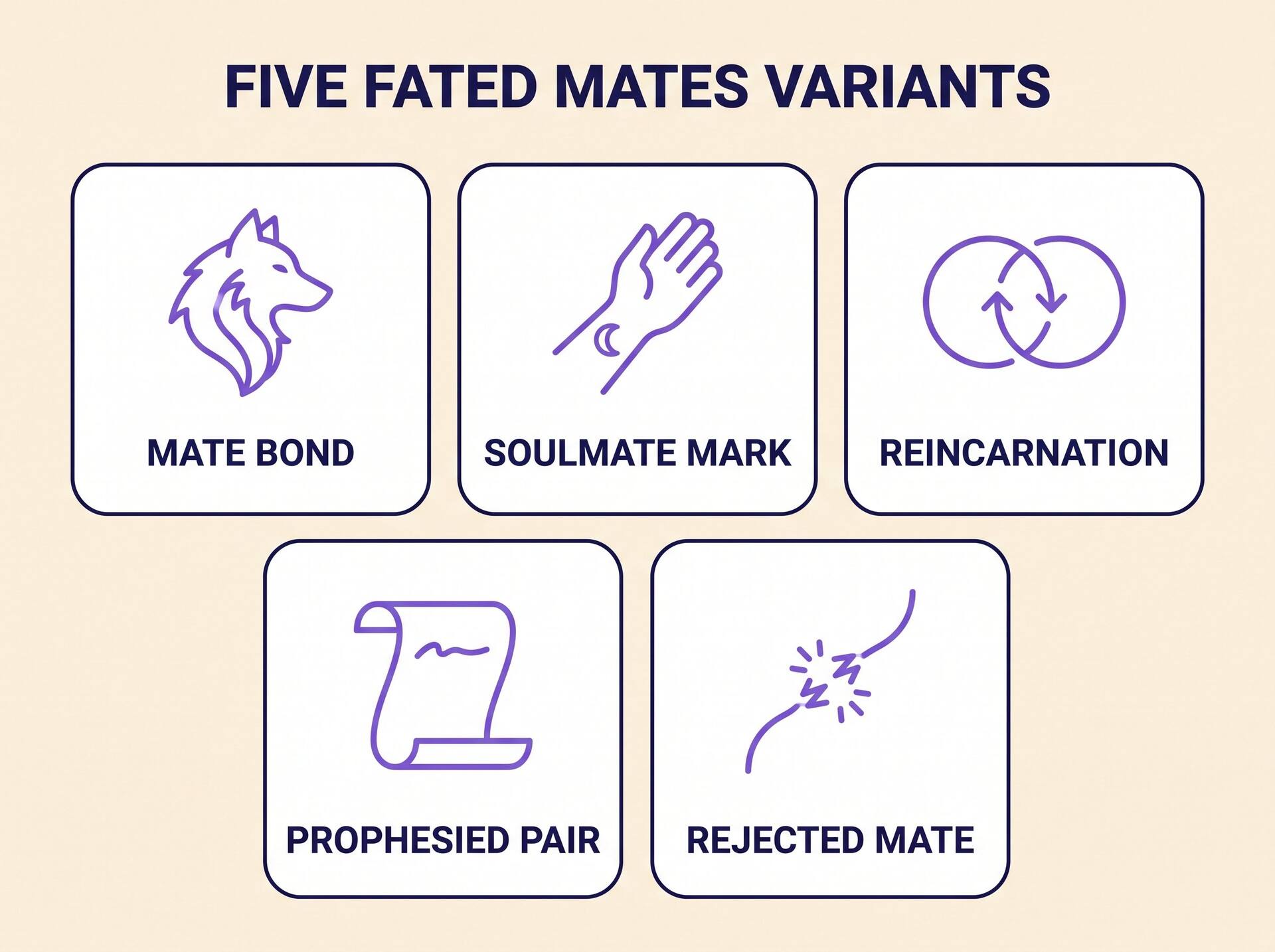
Tap a variant to see what it does and what it costs you.
Recognition through scent, a physical pull, sometimes a telepathic link and a heat cycle. Nalini Singh's Psy-Changeling books and Patricia Briggs's werewolf packs both build social structure around this, which is the lesson: the bond is a piece of infrastructure, not a private event. Cost: telepathic links kill secrets and misunderstandings, so any plot that depends on the couple not knowing something must route around the link. Decide the bandwidth of the bond early — emotions only, images, full sentences — and never widen it for convenience.
Mixing is fine and common — a rejected mate in a prophesied pairing is a perfectly good book. What is not fine is switching rules mid-draft. Write the mechanic down as a paragraph of in-world law before chapter one, then treat it as physics.
If you are stacking this with other tropes, the interaction matters more than the count. Our sorted romance tropes list is a decent way to check whether the second trope you are adding creates conflict or just repeats what the bond already gave you.
A nine-beat framework
This is a working skeleton, not a formula. Percentages are of total length, and the numbers are where these beats tend to land in books that do not sag — adjust freely, but if two of these beats are missing entirely, that is usually where the draft's problem is.
- 1Ordinary life with the exact wound the bond will exploitRoughly the first 8%. Show what she has built and what it cost her, because that is what the bond will threaten. A heroine with nothing to lose makes destiny cheap.
- 2RecognitionAround 10-15%. The scent, the mark, the jolt. Write it from the point of view of the character who least wants it. Interiority here is what separates a bond from insta-love — we need the thought that resists the feeling.
- 3Naming the rulesBy about 20%. Someone explains the mechanic, and it should be a character with an agenda rather than a neutral lore dispenser. What the bond can do, what it cannot, and what refusing it does.
- 4Refusal with a real reasonAbout 25%. The resister states their objection and the story treats it as valid. This is the beat most drafts fumble by making the reason vanity.
- 5Forced proximity with a job attached25-45%. They must cooperate on something external — an investigation, a negotiation, keeping a child alive. Proximity alone produces banter; proximity with a task produces competence, and competence is what makes attraction feel earned.
- 6The bond helps, and that is the problemAround the midpoint. Let the bond solve something — and make the solution create a new debt. This is the single most useful trick in the trope: every time destiny makes things easier, it should also make things more expensive.
- 7The price is named60-70%. What accepting actually costs becomes concrete and unavoidable. Not a hint. A number, a date, a name.
- 8Rupture that the bond cannot repairAbout 75-80%. The dark moment must be something destiny is structurally unable to fix — a choice, a betrayal, a lie told for good reasons. If the bond can heal it, the reader feels no danger.
- 9Chosen anywayFinal 10-15%. The resolution is not the bond winning; it is a character choosing what fate already assigned, with full knowledge of the price. That sentence is the whole trope. Fate proposes. The character has to consent, on the page, in words.
Working a skeleton like this into a real chapter plan is the part where most drafts stall. If you would rather see the beats laid out against your own premise before you write, our outline builder turns a premise into a chapter-by-chapter plan you can rearrange, and the free outline generator will do a rough pass without an account.
Paranormal romance also sells in series far more than as standalones, and the second book is usually where the money is. Worth planning the bond's rules with book two in mind — AIWriteBook can write a sequel with book one's characters, world, and established rules in context, which only helps if the rules were consistent to begin with.
Consent and agency, handled properly
This is not a disclaimer paragraph. It is craft, and getting it wrong is the fastest way to earn one-star reviews from exactly the readers who love this trope.
The problem is built into the premise. A bond that compels attraction, a heat cycle that overrides judgement, a claiming that is biologically irreversible — these are, described neutrally, mechanisms that remove choice. Readers of paranormal romance are not squeamish about that, but they are exacting about how the book handles it. The distinction they make is between a story that stages the loss of control deliberately and a story that has not noticed the question.
- Let characters name it. If the bond pushes, someone should say out loud that it pushes, and resent it. A heroine who articulates that she cannot tell which feelings are hers has agency even while compelled.
- Separate the pull from the decision. Physical compulsion can be involuntary; the commitment should not be. Put explicit, sober consent for anything that matters in a scene where the bond is quiet.
- Give refusal real teeth. If saying no is possible in principle but fatal in practice, that is not a choice, and the reader will feel the difference. At least once, someone should refuse something and survive it.
- Do not use the bond to retroactively excuse behaviour. A hero who tracks, isolates, or overrides her and is forgiven because destiny made him do it is the exact failure mode modern readers call out. Have him wrong, have him say so, have him change.
Handled well, this material is not a liability — it is the richest conflict the trope offers. The tension between a body that is certain and a mind that has not agreed yet is a better engine than any rival pack.
Five mistakes that flatten a fated mates book
Recognition without interiority
The bond hits and the narration reports it. What is missing is the resistance inside the sentence — the character noticing the feeling, distrusting it, checking it against what they know. That gap between sensation and belief is where the reader gets to feel something. Without it, you have written insta-love and put a costume on it.
A bond that solves every conflict
Telepathy resolves the misunderstanding, the pull locates her when she is taken, shared strength wins the fight. Each individually is fine; all of them together means the couple is never actually in trouble. Write the bond's limitations as explicitly as its powers, and put at least one limitation in the way of the climax.
A heroine who only reacts
She is chosen, informed, protected, and claimed. Count her decisions. If she makes fewer than five that change the plot, the book is happening to her. The fix is not to make her fight better; it is to give her one goal that predates the bond and survives it.
Lore delivered in one lump
Chapter four becomes an elder explaining mating law for eleven pages. Ration it: rules arrive when they cost someone something. The reader learns that a rejected bond is permanent at the moment a character is threatening to use it.
A third-act problem destiny can fix
If the bond can undo your dark moment, your dark moment was decorative. Choose a rupture in the one category fate has no jurisdiction over: what a person decided to do.
Staying fresh without breaking the promise
Freshness in a trope this codified never comes from subverting the payoff. The reader came for the bond; take it away and you have written a different book badly. It comes from changing what the bond is measured against.
- Make the bond fallible about compatibility but not about connection. Destiny got the soul right and the circumstances catastrophically wrong. They are meant for each other and one of them lives four hundred years.
- Give the mechanic a politics. Who benefits from a society organised around mate bonds? Somebody records them, somebody enforces them, somebody profits. A bureaucracy of destiny is instantly fresh and generates plot for free.
- Age the characters up. Two people at forty-two with histories, children, and businesses have vastly more to lose to a bond than two twenty-two-year-olds, and this is an underserved corner of the market.
- Let the second party be the resister. The bulk of the tradition has the heroine resisting; a hero who has spent a century refusing to be claimed by anyone, including her, flips the emotional load.
- Invert the scale. Instead of a bond that binds two people forever, one that must be renewed, deliberately, at intervals. Now the happily-ever-after is a repeated choice rather than a one-time verdict.
None of these break the contract. The couple still ends up together, the connection is still absolute, and the reader still gets the fantasy of being chosen. You have only changed what stands in the way.
Templates you can copy
Three fill-in-the-blank frames. Fill each one in a sentence before you outline; if you cannot fill one, that is the hole in your premise.
The premise line
When [protagonist], who has spent [time] building [the thing they'd lose], is recognised as the fated mate of [love interest], accepting the bond would cost her [concrete price] — and refusing it would cost [world-level consequence].
The bond's rulebook
The bond does: [three specific abilities]. The bond cannot: [three specific limits, one of which blocks the climax]. Refusing it causes: [named consequence]. It is recognised by: [who, and with what authority].
The act-three choice
At the end, [protagonist] knows the bond is real and knows it costs [price]. She chooses [him / it / neither] because [reason that has nothing to do with destiny], which she could not have said in chapter one because [what changed].
That third template is the load-bearing one. If the reason at the end is still "because we are fated," nothing in the book happened.
A pre-draft checklist
Tick these before you write chapter one. Every unticked box is a rewrite you are scheduling for yourself.
0 of 9 ticked
Questions writers actually ask
Where the software actually helps
Two honest notes, because this trope has specific mechanical needs. The first is consistency. A bond with rules is a continuity liability across 80,000 words and worse across a series — the telepathy that was emotions-only in chapter six becoming full sentences in chapter twenty is the kind of slip readers catch and reviewers mention. Writing the book inside a tool that keeps characters, world rules, and prior chapters in context is worth more here than in almost any other subgenre.
The second is content. Paranormal romance runs explicit, and general-purpose assistants refuse or water it down. AIWriteBook supports adult content without lecturing you, which for this genre is not a nice-to-have. If you want to sanity-check a specific scene's shape before drafting it, the free scene builder will block one out for you.
What software cannot do is choose your engine, price your bond, or decide what your heroine wants that has nothing to do with him. That is the work, and it is the whole difference between a fated mates book that sells through a series and one that stalls at book one.
The one-sentence version
Fated mates gives you the ending for free and charges you for the middle. Pay it in resistance, in stakes, in cost, or in the gap between the bond and the man — and end on a character choosing what fate already decided, for reasons fate had nothing to do with.
If you are building out a paranormal or romance list rather than a single book, the rest of our genre fiction guide covers the neighbouring structures — enemies to lovers, slow burn, and the trope stacks that sell alongside this one.