

Most drafts that get abandoned in the middle are slow burns. Not because the writer lost interest in the couple, but because somewhere around the 40% mark the book stopped moving and nobody could say exactly when it happened.
The failure is almost never the pace itself. Readers will happily wait three hundred pages for a first kiss. What they will not do is wait through the same scene written four different ways.
This piece gives you the diagnostic that separates the two — tension versus stalling — plus a twelve-beat map keyed to percentage of book, so you can check any manuscript against it in an afternoon.
Why the slow burn works, honestly argued
The usual explanation is anticipation, which is true and useless. Anticipation is what the reader feels; it is not what you write. What you write is a series of moments where a character wants something, is close enough to reach for it, and does not.
That gap does two things at once. It keeps the reader in a state of mild, pleasant unresolved attention — the same reason an unfinished melody nags at you. And it forces the characters to reveal themselves under pressure, because a person who cannot say the obvious thing has to say everything else instead. Restraint is a characterisation engine disguised as a pacing choice.
That is also why the payoff lands harder than in a fast romance. By the time the two of them finally close the distance, the reader has watched them build a hundred small proofs of who they are. The kiss is not the reward. The accumulated evidence is the reward, and the kiss is the receipt.
Which sets the bar for the rest of the book: if a chapter does not add evidence, it is not slow burn. It is delay.
Tension or stalling? The one-question test
Take any chapter in the middle of your draft and ask: if I deleted this, would the two of them know less about each other than they do now? If the answer is no, the chapter is stalling, however charged the prose feels while you are writing it.
The confusion happens because stalling and tension look identical on the page. Both involve two people who want each other and do not act. The difference is entirely in what changes.
This is tension
- He notices she lies to her sister the same way she lies to him — and now he knows what her lying sounds like.
- She asks a question she has been avoiding for two hundred pages, and he answers half of it.
- They agree to something small that will be expensive later: a shared room, a shared secret, a favour owed.
- One of them chooses distance on purpose, and the reader sees exactly what it costs.
This is stalling
- He notices she is beautiful again, in a new location.
- She reflects on how confusing her feelings are, in interiority that reaches the same conclusion as last chapter.
- They banter pleasantly and nothing is risked, admitted, or owed at the end of it.
- An interruption prevents a kiss for the third time, with no consequence for either of them.
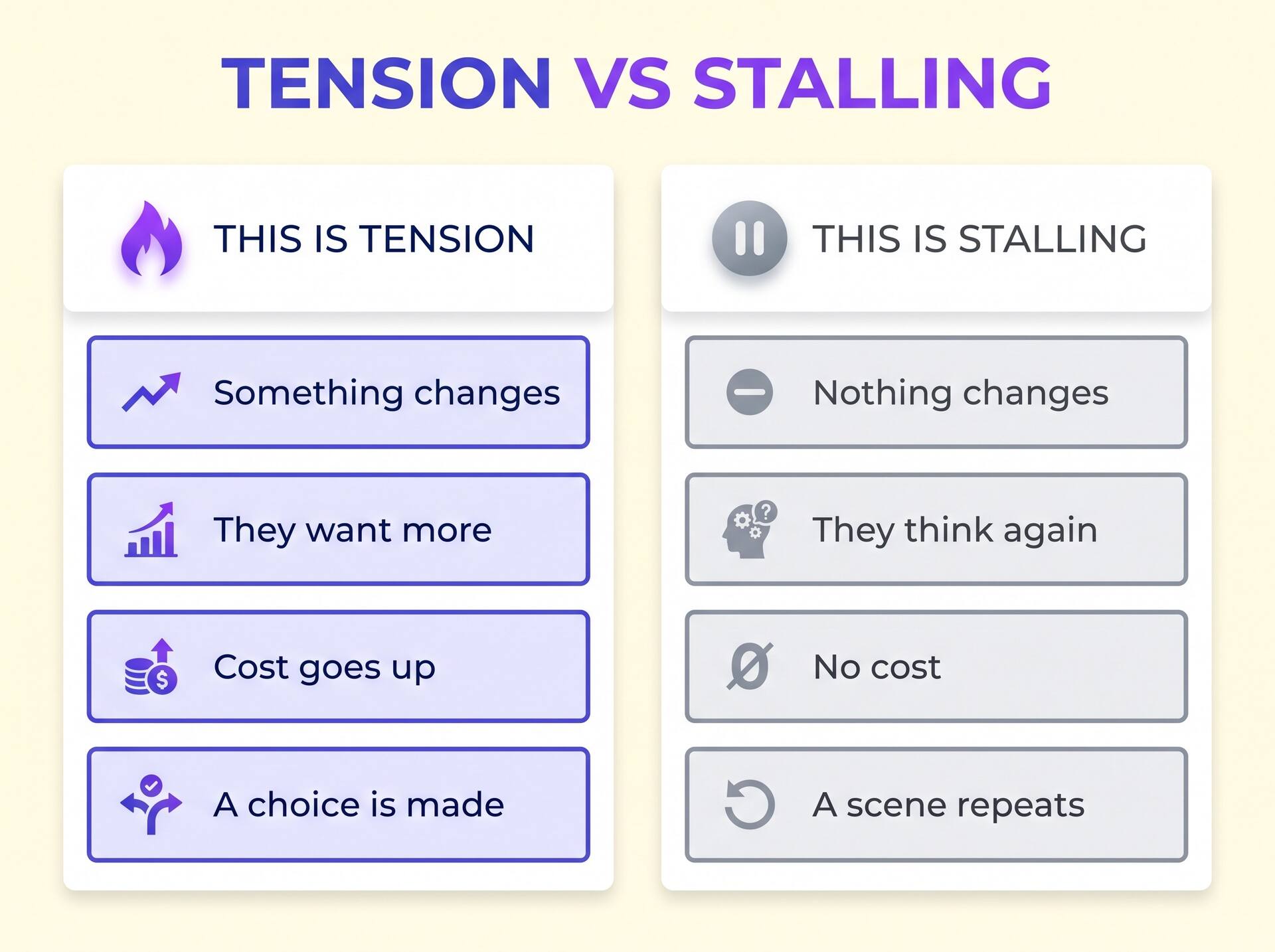
Notice that the stalling column is not badly written — those are all publishable sentences. They are just repeat readings of the same instrument. A slow burn needs the needle to move, even by one degree, in every scene the couple shares.
The cruel version of the test: highlight every scene where the relationship is in the same state at the end as at the start. In a stalled draft, that highlight covers most of act two.
The 12-beat slow burn map
Percentages, not chapter numbers. A slow burn breaks when the beats bunch — six things happen in the first fifth and then nothing happens for a hundred pages. Mapping to percentage of total length is the fastest way to see the bunching, and it works whether you are writing 55,000 words or 130,000.
Treat these as pressure checkpoints rather than a formula. If a beat lands twenty pages either side of its mark, fine. If two beats are eighty pages apart with nothing between them, you have found your sag.
| Beat | Mark | What must change in the relationship |
|---|---|---|
| Proximity | 0–5% | They are placed in a situation neither can walk away from. The trap is set before the attraction is. |
| First pull | 8% | One of them notices something they would rather not have noticed — competence, kindness, a scar. Awareness begins asymmetrically. |
| Denial | 15% | The attraction is acknowledged internally and immediately renamed: irritation, curiosity, professional respect. The lie to self is established. |
| Forced closeness | 22% | Plot, not desire, pins them together. Access increases without permission being given. |
| Confession withheld | 30% | One of them comes to the edge of telling the truth and stops. The reader now knows something one character does not. |
| Near miss | 38% | A moment almost happens and is broken — but this time both of them know it almost happened, and neither can pretend otherwise afterwards. |
| Alliance | 45% | They stop being each other's obstacle and start being each other's advantage. The relationship acquires a shared goal. |
| Jealousy or witness | 55% | A third party names the thing out loud, or threatens it. The feeling stops being private. |
| The almost | 65% | The barrier genuinely drops. Something real happens — and one of them puts the barrier back up, for a reason the reader can respect. |
| Rupture | 75% | The withheld truth from beat five surfaces at the worst possible moment. Distance is now maximum and it is earned, not manufactured. |
| The reach | 85% | One of them crosses the distance with no guarantee of being met. This is the beat that makes the book, and it must cost the reacher something public. |
| Union and proof | 92–100% | The payoff, then at least one scene afterwards showing the new state holding under a small ordinary pressure. |
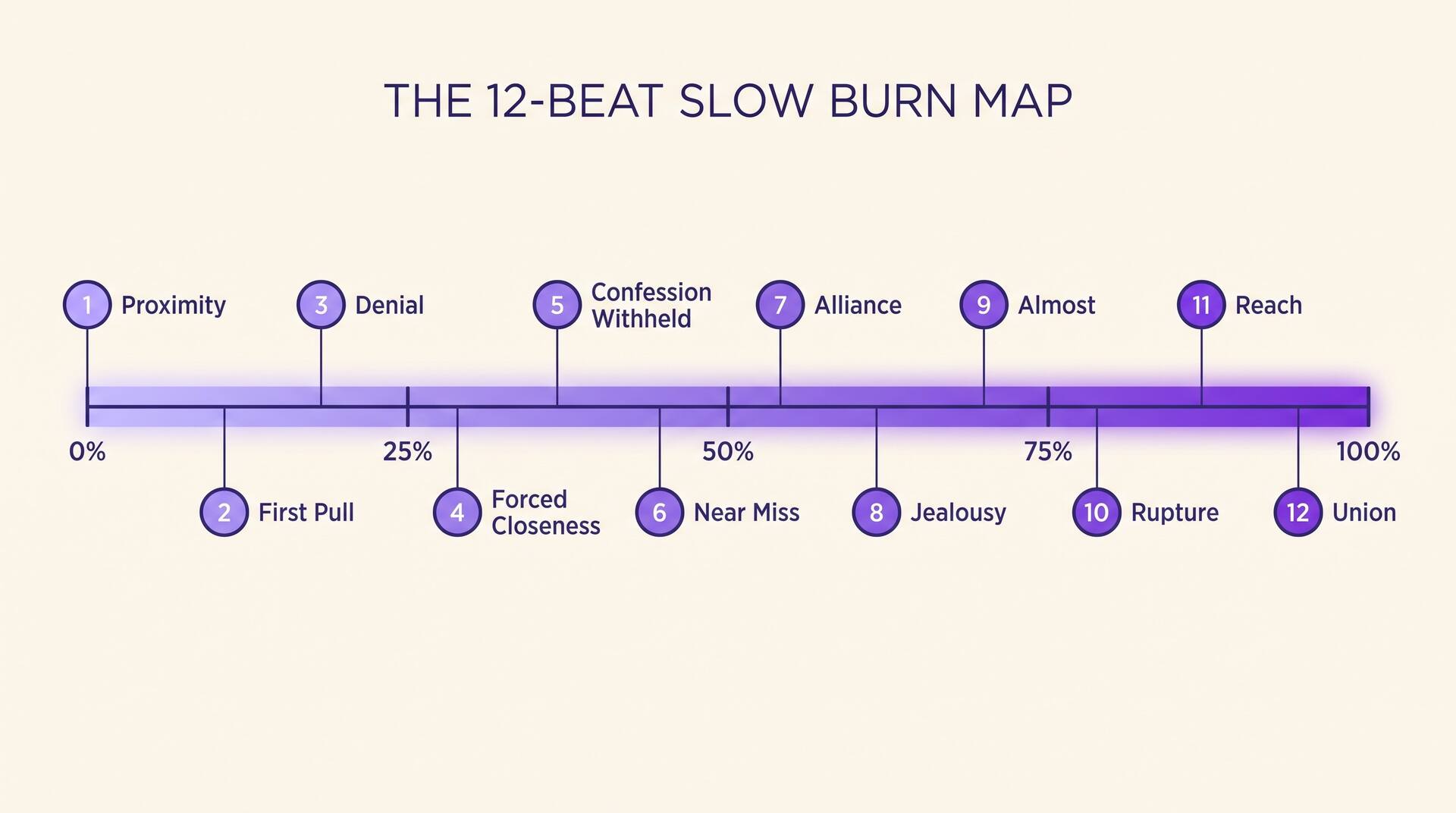
Beat eleven is where most slow burns underdeliver. Writers spend eighty percent of the book building distance and then resolve it with a conversation in which both parties are already safe. If the reach costs nothing — no public exposure, no forfeited plan, no admission that damages the person making it — the reader gets the kiss without the receipt.
Beat twelve is the second most skipped. Ending on the union alone reads as a stop, not a resolution. One quiet scene where the couple handles something mundane together is what converts attraction into a future the reader believes in.
Four currencies for raising heat without resolving it
If you cannot let them get together, you need something else to spend. There are four currencies, and a well-paced slow burn spends them in rotation rather than draining one and then panicking.
Access
How much of each other's life they can enter uninvited. Chapter three he waits in the lobby; chapter nineteen he has a key and uses it without asking. Access escalates silently and is the easiest currency to track — literally list which rooms, hours, and people each character has reached by each beat.
Honesty
The size of the truth each is willing to hand over. Escalate by category, not volume: a fact about the past, then an opinion about the present, then an admission about the other person. The third category is where slow burns get dangerous.
Risk
What each stands to lose if this goes wrong — a job, a family, a war, a reputation. Risk must rise as the book progresses, or the restraint stops making sense. If they could safely get together at chapter thirty, the reader will ask why they don't.
Touch
Not the ladder people assume. The most effective escalation is not more touch but more intent behind the same touch: a hand steadied on a horse in chapter four, the identical gesture in chapter twenty-eight when both know exactly what it means.
Rotate them. Two consecutive chapters that both escalate touch and nothing else read as a book losing patience with itself. A chapter that raises risk and lowers access is the shape of a great mid-book slow burn scene.
This is where scene-level planning pays for itself. If you know a scene must raise honesty by exactly one category and end with less access than it started, the scene practically drafts itself — and our free scene builder is built for exactly that kind of constrained brief: give it the two characters, the setting, and the shift you need, and it returns a scene shaped around the change rather than around the mood.
The same trope paces differently at 60k and 110k
The twelve beats are proportional, but the space between them is not neutral. In a 60,000-word category romance, beats land roughly every 5,000 words — close enough that momentum carries itself and your main risk is rushing the denial phase into something the reader does not believe.
In a 110,000-word fantasy romance the same beats sit 9,000 words apart, and that gap is where the genre lives or dies. You cannot fill it with more longing. You fill it with the other plot — the war, the heist, the court, the magic system — and you make that plot the thing that keeps forcing the couple into new configurations of access and risk.
The practical rule: in long-form romantasy, every relationship beat should be triggered by an external plot event, never by a character deciding it is time to feel differently. The siege puts them in the same tower. The trial requires one to speak for the other. Structure carries the burn.
If you are still deciding how to divide all of that into readable units, our breakdown of how many chapters a book should have covers the actual arithmetic, and the wider three-act structure guide is worth reading alongside this map — the rupture at 75% and the act-two climax want to reinforce each other, not compete.
Five common stalls, and what actually fixes them
The interruption loop
Three near-kisses broken by a knock at the door. Fix: allow only one true interruption in the book, and make its aftermath change something. Every subsequent stop must come from a character's own choice, which is a decision the reader can respect and an interruption is not.
Interiority as filler
Pages of a character analysing their feelings and arriving where they started. Fix: cap the reflection at the point where a new conclusion appears. If no new conclusion appears, the scene needed a second person in it.
The safe middle
Act two where the couple is comfortable and nothing external threatens them. Fix: raise risk before raising warmth. Comfort is only tense when it is expensive.
Symmetrical awareness
Both characters realising they are in love at the same time. Fix: stagger it by twenty percent of the book. One knowing before the other is the entire supply of dramatic irony a slow burn needs.
The unmotivated rupture
A third-act misunderstanding that a single sentence would resolve. Fix: plant the rupture at beat five. If the thing that breaks them was withheld on the page two hundred pages earlier, it reads as inevitable rather than convenient.
You pierce my soul. I am half agony, half hope.
Wentworth's letter arrives after eight years of silence and roughly four hundred pages of two people in the same rooms not speaking. It is the reach — beat eleven — and it works because writing it publicly is the most dangerous thing he could have done.
Where to watch the beats working
Austen's Persuasion is the cleanest published demonstration of the map: proximity forced by family and social obligation, an asymmetry of knowledge sustained almost to the end, and a reach that costs the reacher his composure in front of witnesses.
Pride and Prejudice runs the rupture early and inverts it — Darcy's first proposal lands as the disaster, and the remaining half of the book is spent rebuilding access and honesty from zero. Worth studying if your own draft's rupture feels stranded at 75%.
In contemporary romance, Sally Thorne's The Hating Game shows how much a single office setting can carry when access and risk keep shifting inside it, and Emily Henry's Beach Read stages the alliance beat as a literal working agreement between two writers. For the version of the trope where the distance is hostility rather than circumstance, our enemies-to-lovers guide maps the antagonism beats specifically, and the broader survey of guide to romance tropes covers how slow burn stacks with the other conventions readers shop for.
Keeping the burn even across a long draft
The reason slow burns sag is rarely a failure of imagination in any one scene. It is that nobody is holding the whole shape in their head at chapter twenty-eight, and the beats drift without anyone noticing until a beta reader says the middle dragged.
That is a planning problem before it is a writing problem. In AIWriteBook, the outline builder lets you lay out every chapter with its purpose before you draft, so you can put the twelve beats on the map and see immediately that beats seven through nine are crammed into four chapters while chapter fourteen through twenty-two have no relationship movement at all. You edit the outline until the spacing is right, then generate or write from it.
Two other things matter for this genre specifically. Each chapter is generated from the outline together with your character sheets and the previous chapter's full text, so the emotional state a scene inherits is the one the last scene actually left behind rather than whatever the model assumes — and the story bible sits in the editor sidebar, so you can check what a gesture meant in chapter four while you are writing chapter twenty-nine. And because slow burn readers rarely stop at one book, series support lets book two build on the first book's established relationship state instead of restarting the tension from scratch.
You pick the model per chapter — Gemini or Grok — and edit anything you disagree with directly, which for romance you will, often. The value is not the prose it hands you; it is that the pacing skeleton stops being something you carry in your head. If you would rather start from structure alone, the free outline generator produces a chapter-by-chapter plan you can pour these beats into.
The short version
Slow burn is not measured in pages between the meeting and the kiss. It is measured in how many times the reader watches two people choose distance for a reason they can respect, and how much that choice costs each time.
Run the deletion test on your act two. Map your beats to percentages and look for the eighty-page gaps. Spend your four currencies in rotation instead of draining touch and hoping. And make the reach at 85% genuinely dangerous — that beat is the whole contract.
For the surrounding craft — genre expectations, word-count norms, and what each category of reader is actually shopping for — start from our genre fiction guide.