

On this page
The oldest and strongest emotion of mankind is fear.
The essay's next line names the strongest kind: fear of the unknown. Most of this guide is about keeping things unknown for as long as possible.
Pick your subgenre: each one scares differently
Choose a subgenre to see the fear it runs on and the question a reader keeps asking.
Core fear
Forces beyond physics and beyond bargaining
Reader's question
What does it want, and can it be stopped at all?
Premise seed
A family moves into a house where every clock in it stops at the same minute each night.
The psychology of fear on the page
Fear needs three things: something the reader cares about, a threat to it, and uncertainty about the outcome. Remove any one and the scene goes flat. A monster attacking a character we have not met is spectacle. The same monster circling a character we like, in a way we cannot predict, is horror.
Readers fear what they imagine more than what they are shown, because their imagination is tuned to their own nightmares. Your job is to give the imagination enough to work with and then withhold the rest. Specific sensory details (a smell that should not be there, a sound from the wrong side of a wall) do more than adjectives like terrifying or horrible, which tell the reader what to feel and therefore stop them feeling it.
Fear is also social. A character who is not believed, or who cannot tell anyone, is more afraid than one with allies. Isolation, physical or social, is the most reliable amplifier in the genre.
Building dread: the slow part does the work
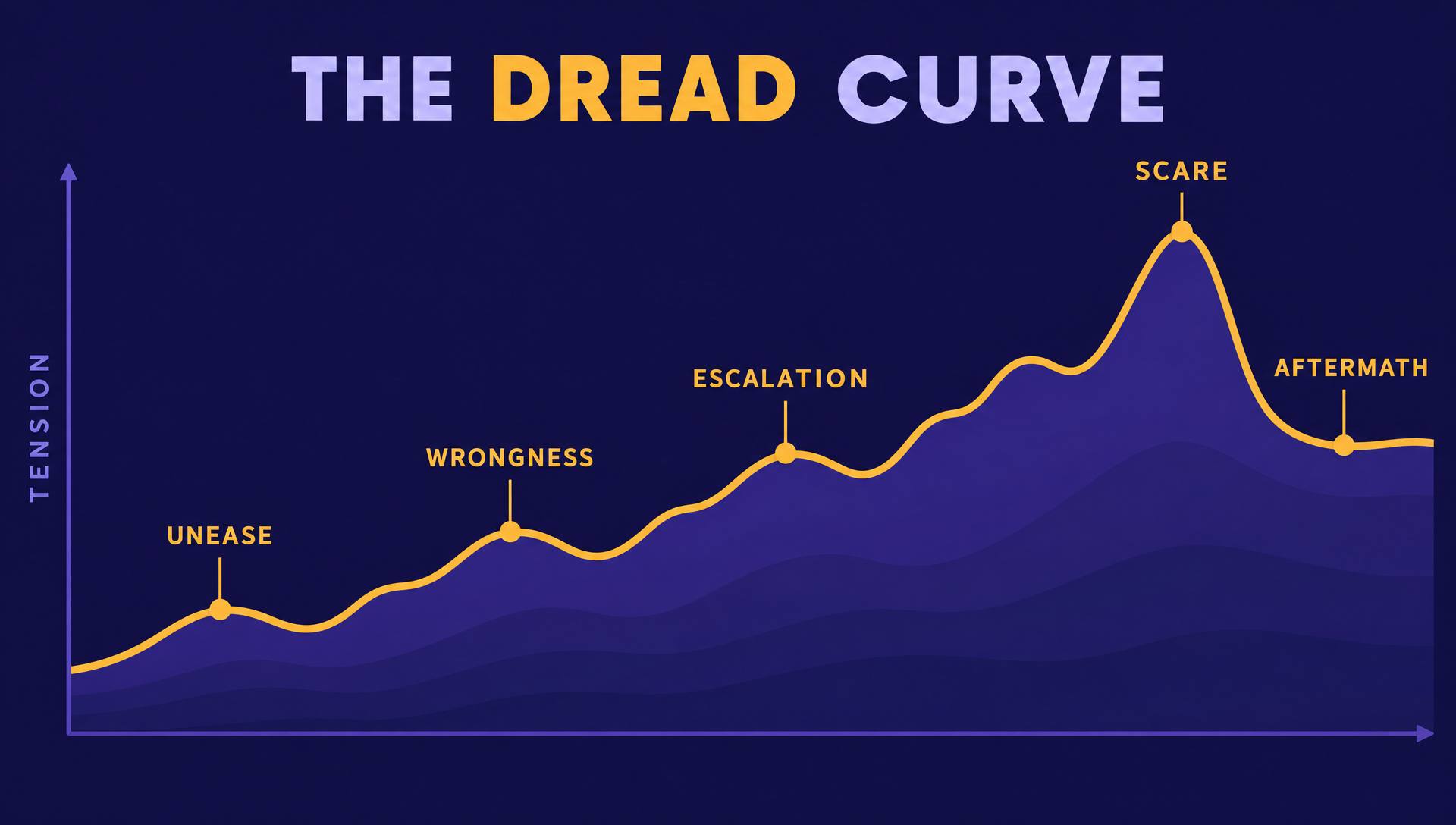
Dread is anticipation of something bad. It is built in stages, and each stage needs its own scene work.
- 1
Unease
Something is slightly off but explainable. The neighbor waves at the wrong window. Keep it deniable.
- 2
Wrongness
A detail cannot be explained away. The character notices, and now the reader is watching for the next one.
- 3
Escalation
The wrongness repeats, grows closer and becomes personal. Each instance must cost the character something.
- 4
The scare
The threat becomes undeniable. Short sentences, concrete action, no explanation.
- 5
Aftermath
A beat of quiet where the character and reader absorb what happened, which also resets tension for the next rise.
Plant early details that pay off later: an object, a phrase, a rule. Horror is the genre where foreshadowing is most visible to readers and most rewarded.
Four types of scares, and when to use each
The jolt
A sudden event that breaks a quiet passage. On the page it works only after a long, quiet build, and only a few times per book. Short paragraph, white space, one line.
The reveal
The reader learns something that recolors everything before it: the voice on the phone is coming from inside the house. Strongest when the clue was on the page all along.
The lingering image
An image the reader keeps after closing the book. Usually small and specific: the child's drawing with one more person in the family than there should be.
The moral scare
The character must choose between two terrible options, or realizes they have become part of the threat. This is where horror stays with readers the longest.
Creating the monster
A good monster, supernatural or human, follows rules even when the characters do not know them. Rules make the threat consistent, let readers try to outthink it and give the climax a mechanism. Decide what it wants, what it cannot do, and what it costs to stop it, and write those down even if they never appear on the page.
Show it in pieces. A sound, then a trace, then a partial glimpse, then the whole. Every time the monster is fully visible, it becomes a little less frightening, so save the full view for when it matters most.
The most effective monsters mirror the protagonist's flaw or fear: the overprotective mother haunted by something that takes children, the man who lies to everyone hunted by something that wears familiar faces. For building a human antagonist with real motives, see how to write a villain. AIWriteBook's character builder keeps the monster's rules and the cast's fears in the story bible, so they stay consistent across chapters.
Pacing horror
Horror moves in waves: rise, release, a slightly higher rise. If tension only climbs, readers go numb; if it never releases, the scare has nothing to contrast with. Alternate scenes of dread with scenes of normal life, and let the normal scenes get shorter as the book goes on.
Sentence rhythm is a pacing tool. Long, winding sentences slow time down in the approach. Short ones speed it up when something happens. Chapter endings should land on a question, not an answer. Our guide to pacing in fiction covers scene length and tempo in more depth, and setting as a character shows how to make the location itself part of the pressure.
Plan the dread before you write it
Build a chapter outline where each scene has its stage on the dread curve, then draft chapters from it and refine every scare with the chapter chat.
Gore vs psychological horror
Visceral horror
Psychological horror
Fear of pain and physical destruction
Fear of losing your mind, identity or loved ones
Effect is immediate and physical
Effect builds slowly and lasts longer
Loses power with repetition
Gains power as the reader's doubt grows
Works best in short, sharp doses
Needs room: novels and long stories
Most strong horror uses both. Gore is most effective when it is rare and earned by dread, so the reader has already imagined the worst and the text confirms it. Used constantly, it becomes texture rather than terror.
Using AI in horror writing
AI is weakest exactly where horror is hardest: it tends to explain, reassure and resolve, which kills dread. Use it for the parts of the job that are not the scare itself, and keep the uncanny details in your own hands.
- Brainstorming premises and the rules of the monster, then picking the one that unsettles you
- Outlining the book so every chapter sits at the right point on the dread curve
- Drafting the normal-life scenes, which you then roughen with wrong details
- Asking targeted edits such as cut every explanation from this scene, or end the chapter one paragraph earlier
For quick sparks, the free plot twist generator and story starter give you premises to bend into something darker. Inside AIWriteBook, the writing style builder keeps drafts in your voice, and the chapter AI chat shows each edit as a diff, so you can keep the AI from smoothing out the unease you built. For neighbouring genres, see the thriller writing guide.
Mistakes that kill fear
Explaining the monster
A full origin story turns terror into trivia. Explain enough to make the rules feel real, never everything.
Characters who make no sense
Readers forgive characters who make mistakes, not characters who act stupidly to serve the plot. Give each bad decision a reason.
Telling the reader to be scared
Words like terrifying and horrifying do the opposite of what they say. Describe the thing and let the reader be frightened.
Constant high tension
Without quiet scenes the scares have nothing to contrast with. Let the reader breathe so the next scene can take their breath.
Write what frightens you
The scares that work on readers are almost always the ones that worked on the writer first. Start with a fear you actually have, give it rules, keep it in the dark as long as you can, and build the dread one deniable detail at a time.