


In this guide
Why pacing decides whether a book gets finished
When a reader puts a book down at chapter nine, they rarely say the prose was bad. They say it got slow. Pacing complaints are vague because pace is felt, not seen: the reader can't point at the sentence where they stopped caring, only at the feeling that reading had become effort.
That vagueness is also why writers fix pacing badly. The instinct is to speed everything up: cut description, add a fight, shorten the chapters. Sometimes that works. Often it produces a book that is fast and exhausting, which readers abandon for a different reason. Good pacing is variation under control, and control starts with knowing which dial you are touching.
A working definition
Pace is change per page, as the reader feels it. A quiet chapter in which a marriage ends is fast. A car chase in which nobody's situation changes is slow.
The three levels of pace
Every pacing decision happens at one of three levels. Mixing them up is the most common reason a revision doesn't work: you can't fix a structural sag by cutting adverbs, and you can't fix a rushed climax by moving chapters around.
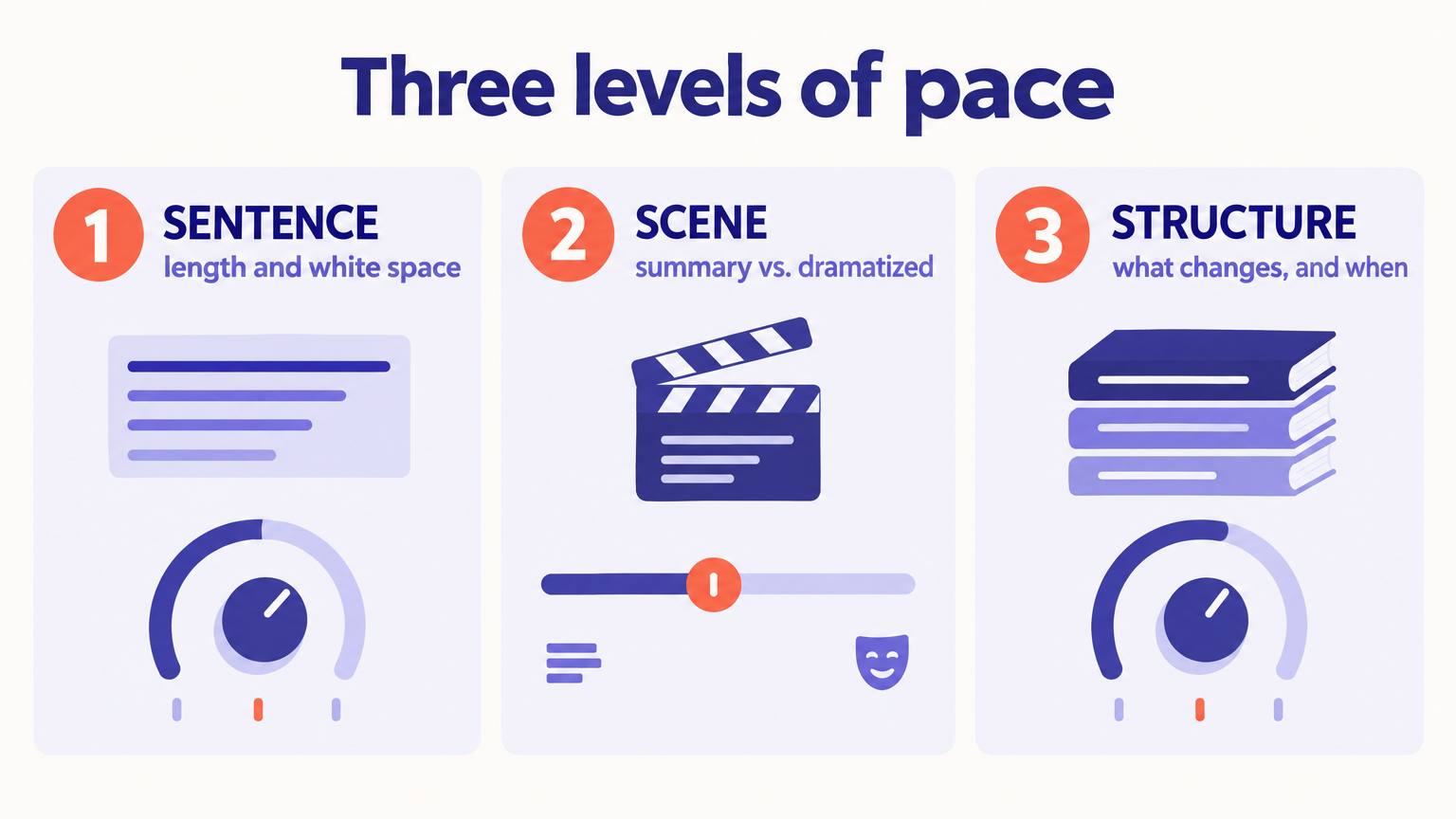
Sentence
Controls
How long each moment takes to read.
Your tools
Sentence and paragraph length, white space, dialogue density, how much interior thought sits between actions.
Scene
Controls
How much story time each page covers.
Your tools
Summary versus dramatized scene, where a scene starts and stops, the balance of action and reaction.
Structure
Controls
How often the situation changes.
Your tools
Where turning points fall, chapter breaks, subplot rotation, the order in which reveals land.
Sentence level: the reader's breathing
At the sentence level, pace is effort. A short sentence finishes quickly and drops the reader into the next one. A long sentence with subordinate clauses asks them to hold several things at once, which slows them down and, used on purpose, deepens the moment.
Paragraphing matters as much as sentence length. A page of one-line paragraphs reads far faster than a page of dense blocks with the same word count, because the eye moves down the page faster than it moves across. Dialogue works the same way: a run of short exchanges with few tags is the fastest prose there is.
Same moment, slow
Mara reached the top of the stairs and paused, taking in the long corridor with its peeling wallpaper and the row of doors on either side, most of them closed, though the one at the far end stood slightly open, and from behind it came a sound she couldn't quite place, something between breathing and the creak of a floorboard.
Same moment, fast
Top of the stairs. A corridor. Doors, all shut but the last. That one stood open an inch. Something behind it was breathing.
Neither version is better. The first suits the stretch where dread should build; the second suits the moment the dread pays off. The mistake is writing both moments the same way.
For how sentence rhythm works inside a single violent exchange, our guide to writing fight scenes maps sentence length onto the lull, the clinch and the aftermath.
Scene level: the speed dial
Every stretch of narrative sits somewhere on a dial between pure summary and stopped time. Summary covers weeks in a sentence. Scene plays a moment at roughly the speed it happens. Stretch slows a few seconds across a paragraph or more. Pause stops the clock for description, memory or reflection. Pick a setting below to see the same story beat at each speed.
The beat
Jonah finds out the bakery where he works is closing.
Story time to page time
Roughly real time
"You saw it," Della said. She didn't look up from the dough. Jonah peeled the notice off the till and read it twice. "When were you going to tell me?" "I just did."
Use it for
Any moment where something changes between people: conflict, decisions, reveals.
A chapter that drags is usually stuck on one setting. Six pages of scene with no summary between them make a book feel like real time, which is slower than any reader wants. Six pages of summary read like a synopsis. Most finished chapters move the dial three or four times.
The other scene-level control is the balance between action and reaction. Dwight Swain's scene and sequel model describes it as a cycle: a scene (goal, conflict, setback) is followed by a sequel (reaction, dilemma, decision) that launches the next scene. A book with no sequels feels breathless and emotionally flat. A book that is mostly sequel feels like characters thinking about doing things. When a chapter reads slow, check whether it is a sequel that has outstayed its decision.
Structure level: how often the situation changes
Structural pace is the gap between turns. A turn is anything that leaves the protagonist in a different situation than before: a new goal, a lost resource, a reveal that changes what an earlier scene meant. Readers tolerate a long gap if the scenes inside it build toward a turn they can sense coming. They won't tolerate a gap with no pressure in it.
Three structural tools do most of the work. Chapter breaks decide where the reader is allowed to rest, and ending a chapter mid-problem, the subject of our guide to cliffhangers that play fair, pulls them across the gap. Subplot rotation lets one thread rest while another advances. Reveal order decides when information lands, and moving a single reveal three chapters earlier can rescue a middle without changing a word of the scenes around it.
If you want reference points for where the big turns usually sit, the three-act beat map gives typical percentage placements. The pacing map below tells you where yours actually sit.
Build a pacing map of your draft
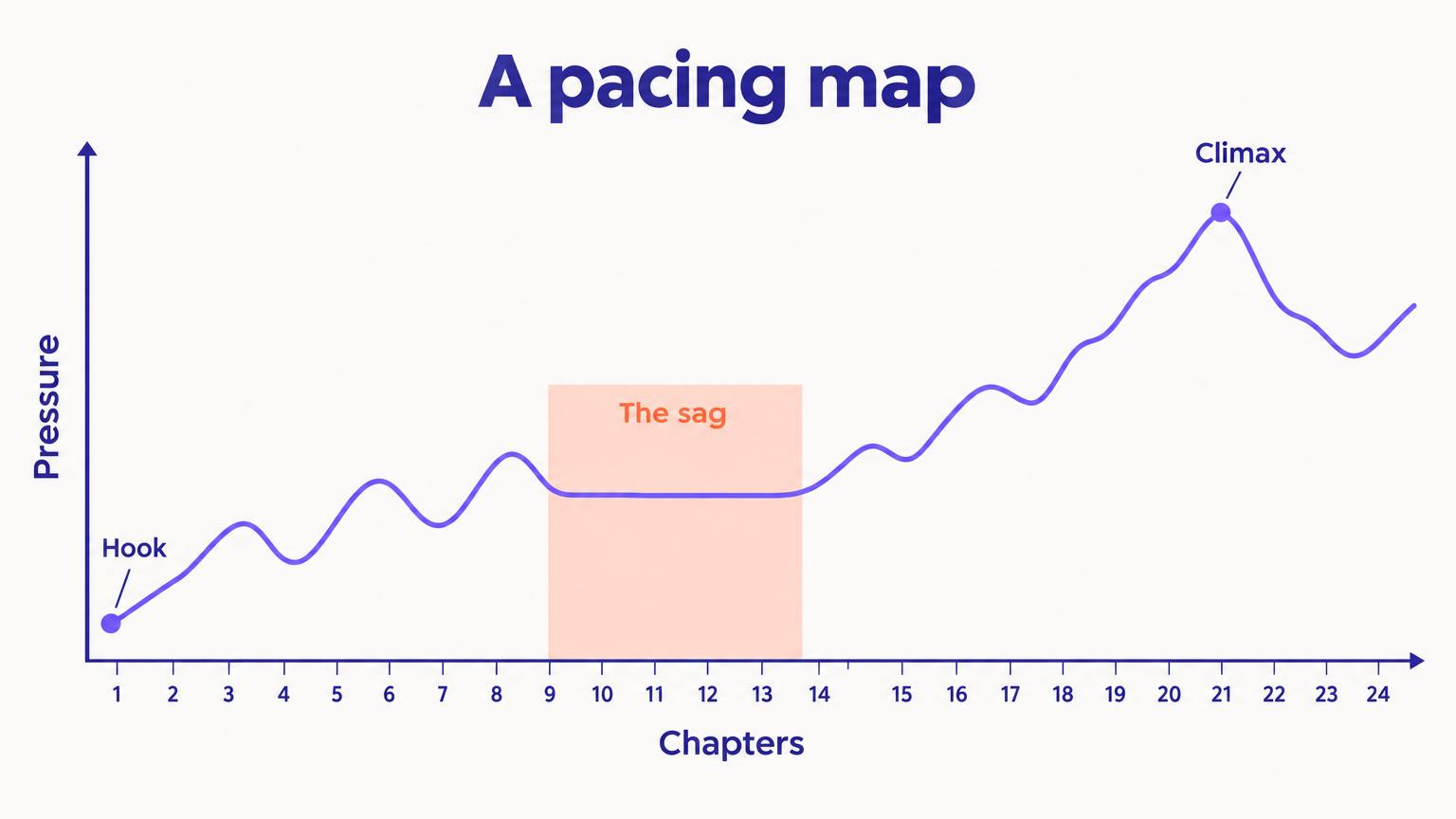
A pacing map is one line per chapter, scored for pressure. It takes an afternoon for a full manuscript, and it turns "the middle feels slow" into "chapters eleven to fourteen have no turn." Here is the method.
- 1
List every chapter in one line
Chapter number, word count, and one sentence on what happens. If you can't summarize a chapter in one sentence, note that too; it is often the first sign of a chapter trying to do two jobs.
Paste each chapter into the free word counter if your draft lives in separate files and you need exact lengths.
- 2
Write what changed
Next to each chapter, write what is different at the end compared with the start. Not what happened: what is different. Leave it blank if the honest answer is nothing.
- 3
Score pressure from 1 to 5
1 is calm, nothing at risk. 5 is the worst moment so far. Score how the reader should feel at the chapter's last line, not at its most exciting moment.
- 4
Tag the dial setting
Mark each chapter with its dominant speed: mostly summary, scene, stretch or pause. Long runs of the same tag deserve a look.
- 5
Plot it and read the shape
Draw the scores as a line. Look for three things: flat stretches of three chapters or more, drops that are never followed by a climb, and a climax that doesn't sit higher than everything before it.
Copy the template
Paste this into a spreadsheet or your notes and fill one row per chapter. The example rows show the level of detail that works.
Chapter | Words | What happens | What changed | Pressure (1-5) | Dial | POV
7 | 3,100 | Jonah finds the closing notice | He loses the job he built his plans around | 3 | Scene | Jonah
8 | 2,800 | Jonah walks home, remembers his first shift | Nothing | 2 | Pause | Jonah
9 | 3,400 | Della admits she sold to the developer | Jonah now has someone to blame | 4 | Scene | Jonah
Chapter 8 is the one to cut or merge: its change column is empty and its dial is pause.
Diagnosing a saggy middle
Once the map exists, a sag shows up as a flat line. The map tells you where; the symptoms below tell you why. The most common cause, scenes that could be undone without consequence, has its own diagnostic in our guide to rising action. These are the others.
| Symptom | Likely cause | Fix |
|---|---|---|
| Chapters feel interchangeable | Several chapters repeat the same kind of conflict at the same intensity. | Merge them, or escalate so each repetition costs more than the last. |
| A lot happens, nothing matters | Events without a goal attached. The protagonist reacts but wants nothing specific. | Give the middle its own goal, separate from the ending goal, with a deadline. |
| Readers skim the back half of chapters | Chapters keep going after their turn. | End the chapter on the turn. Move the aftermath to the start of the next chapter, or into summary. |
| Subplot chapters drag | The subplot runs in long blocks instead of alternating with the main plot. | Rotate threads, and make each subplot chapter change something in the main plot too. |
| Slow even though every scene is tense | No reaction beats, so tension has nothing to contrast with. | Add one short sequel after the biggest turn. Pressure needs a floor to be felt. |
| Fast start, stall around a quarter in | The opening was the strongest idea and the middle was never planned. | Plan a midpoint reversal that changes the goal, then outline forward from it. |
Map one draft this week
Score every chapter from 1 to 5, find your flattest three-chapter run, and fix only that. It is usually enough to change how the whole book reads.
Pacing mistakes that survive revision
Cutting for speed instead of change
Trimming a fifth of the words from a slow chapter gives you a shorter slow chapter. If the map says nothing changes, cut the chapter or give it a turn.
Uniform chapter length
Chapters that all land around three thousand words train the reader to expect one rhythm. A six-hundred-word chapter after a run of long ones is one of the strongest pacing tools you have.
Front-loading backstory
A pause in chapter one costs more than a pause anywhere else, because the reader has no reason yet to sit through it. Our guide to stopping info-dumps covers how to feed that material in later.
Rushing the climax
Writers who have learned to speed up action often rush the most important scene in the book. The climax is where stretch earns its place: slow the key seconds down.
Treating slowness as a chapter-length problem
Short chapters raise the speed at which pages turn, not the speed at which the story changes. They help a book that is already moving and disguise a stalled one only briefly.
The AI-assisted shortcut
The pacing map is worth doing by hand, because scoring pressure forces you to decide what each chapter is for. The fixes are where help pays off.
In AIWriteBook, the outline builder keeps every chapter as a short, editable summary, so you can move a reveal or merge two flat chapters at outline level before touching prose. Inside a drafted chapter, the chapter AI chat takes a targeted request, such as turning four paragraphs of bakery history into two sentences of summary, or ending the chapter on the line where Della admits she sold, and shows the change as a diff you accept or reject piece by piece.
For a whole-manuscript read, the Book Editor writes an editorial letter on your draft, which makes a useful second opinion to set beside your own map. If your manuscript already exists as a Word file, the importer brings it in chapter by chapter without rewriting your text.
Pacing questions writers ask
Pacing is how quickly the reader feels the story change. It is controlled at three levels: sentence and paragraph length, the balance of summary and dramatized scene, and how often turning points arrive.
Build a pacing map: one line per chapter with what changed and a pressure score from 1 to 5. Three or more chapters in a row with no change, or a flat pressure line, mark the slow stretch. Beta readers skimming the same chapters confirms it.
Yes. A book with no quiet chapters, no reaction beats and every scene at peak intensity reads as exhausting and oddly flat, because tension needs contrast to be felt. Readers describe it as a lot happening without them caring.
They speed up page turning, which suits thrillers and commercial fiction. They don't fix a story that isn't changing; a short chapter with no turn just gives the reader an earlier place to stop.
Mostly in revision. Plan the big turns in the outline so the structure is sound, then draft freely and build the pacing map once the whole book exists. Sentence-level pace is the last pass, not the first.
The short version
Pace is change per page. Fix it at the level where the problem lives: sentences for how a moment feels, the speed dial for how much time a page covers, structure for how often the situation turns. Map the draft before you cut anything, and fix the flat bands first.
Pacing is one revision pass among several; our how to write a book guide shows where it fits between the first draft and a finished manuscript.