

Why villains go flat
The definition is the easy part; our antagonist definition covers what separates an antagonist from a villain. The hard part is writing one readers remember. Villains go flat for one structural reason: the writer only thinks about them when they are on stage. Off the page, the hero has a life, fears, a backstory. The villain is in a cupboard waiting for chapter twelve.
Readers feel that. A villain who only acts in response to the plot reads as a plot device. A villain who is pursuing a goal while the hero is busy elsewhere, and who occasionally collides with the hero as a result, reads as a person. The fix is to give your villain the same development you give your protagonist, and then show only the tip of it.
Motivation: the four-part engine
"They want power" is not a motivation. It is a category. Every villain worth reading has four things, and if one is missing you will feel the gap even if you cannot name it.
1
The want
A concrete goal with a finish line. Not "control", but "control of the water rights before the drought".
2
The wound
Why this goal, for this person. The event or belief that made the want feel necessary rather than greedy.
3
The logic
The argument they would make in their own defence. If you cannot write that argument persuasively, the villain is not finished.
4
The line
One thing they will not do. A limit makes the rest of their cruelty feel chosen, and it gives the hero something to exploit.
The logic is the part most writers skip, and it is the part that separates a good villain from a great one. Readers do not need to agree with the villain. They need to understand them well enough to feel the uncomfortable pull of the argument for a moment. If you want the fears and contradictions underneath that logic, the character questionnaire works as well on villains as on heroes.
Build your villain's core
Fill in the four fields and get a one-sentence core you can keep above your desk while drafting. If any field is hard to fill, that is the part of the villain that needs work.
Need a name with the right weight? Try the character name generator.
The villain's own arc
Villains do not have to change, but they do have to be in motion. There are three useful shapes, and choosing one deliberately is the quickest way out of caricature.
Flat arc: the immovable test
The villain does not change; the hero does. The villain's certainty is the wall the hero has to grow strong enough to climb. This works when the villain represents a worldview the hero has to reject.
Negative arc: the fall
The villain starts sympathetic and crosses one line after another until there is no way back. Readers watch the decisions, so each step must feel like a choice, not a twist.
Positive arc: the turn
The villain changes for the better, often too late. Redemption needs a cost; a villain who is forgiven for free cheapens everyone they hurt.
Whichever shape you pick, the villain's arc and the hero's arc should press on the same question from opposite sides. That is why the best villains feel like dark mirrors, and why the foil character technique is so useful here. If you plan a trilogy, the villain's arc can span books: our guide on how to write a trilogy covers how to stage a villain across three climaxes.
Escalating the threat
A villain who is equally dangerous on page 30 and page 300 has stopped being a villain and become scenery. Threat should climb in four stages, and each stage should cost the hero something different.
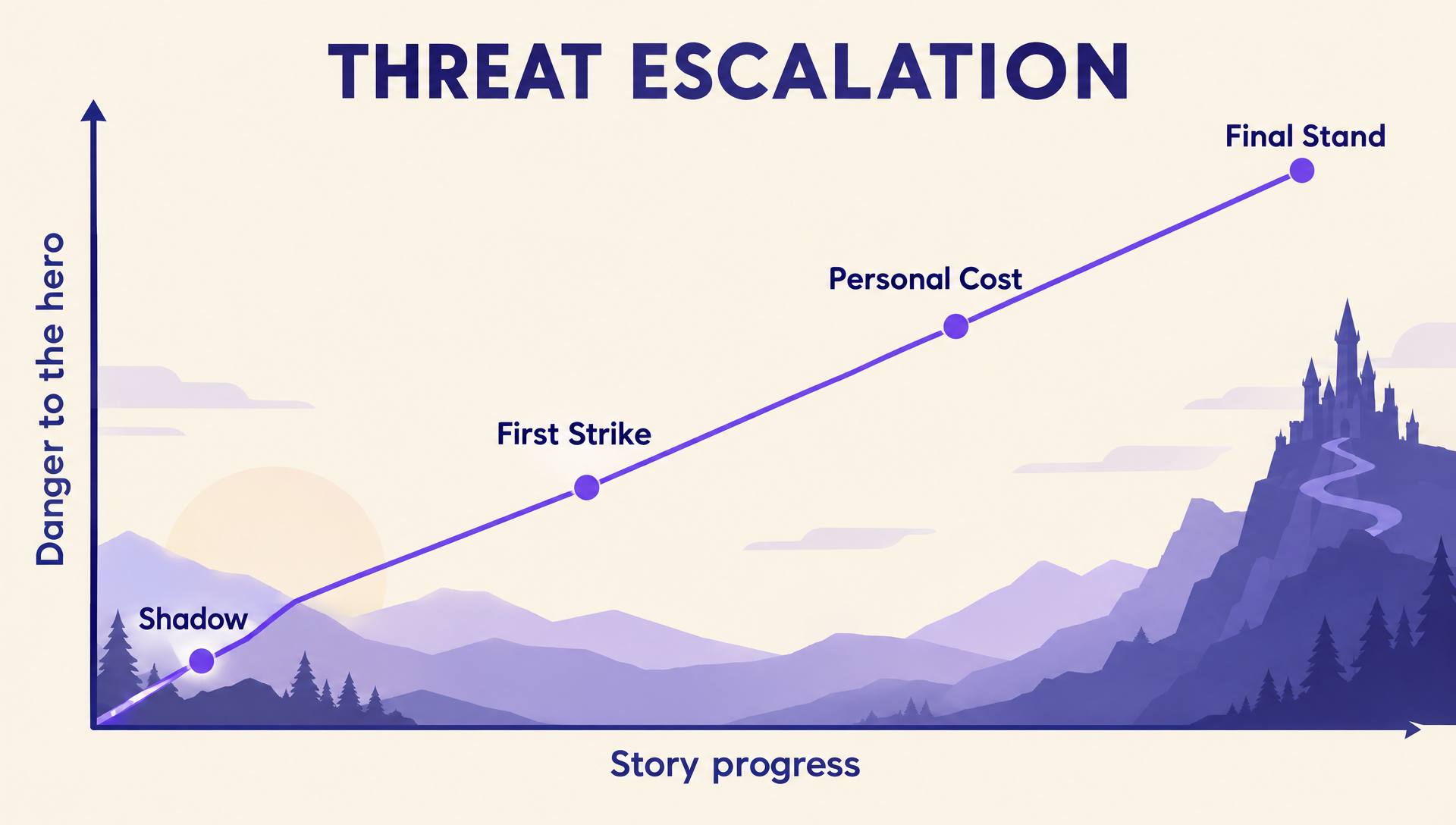
| Stage | What the reader sees | What the hero loses |
|---|---|---|
| 1Shadow | Evidence of the villain, not the villain. Consequences, rumours, other people's fear. | Certainty that the world is safe. |
| 2First strike | The villain acts directly and wins. The hero's first plan fails. | Confidence, an ally, or a resource. |
| 3Personal cost | The villain targets what the hero loves, often using what they learned about the hero. | Something irreplaceable. This usually lands at or near the dark moment. |
| 4Final stand | The villain at full strength, with the logic fully explained. | The old version of themselves, which is what lets them win. |
The personal cost is the stage most drafts get wrong. It should be specific to this hero, built on information the villain gathered earlier. That is how escalation also becomes rising action: the villain gets better at hurting this particular person, and the reader feels the walls closing in before the climax.
Six villain types
Types are a starting point, not a box. Most memorable villains blend two. Tap a type to see what drives it and how to keep it from going stale. For the deeper archetypal roots, see our character archetypes guide, and for the chaos-agent variant, the Joker archetype guide.
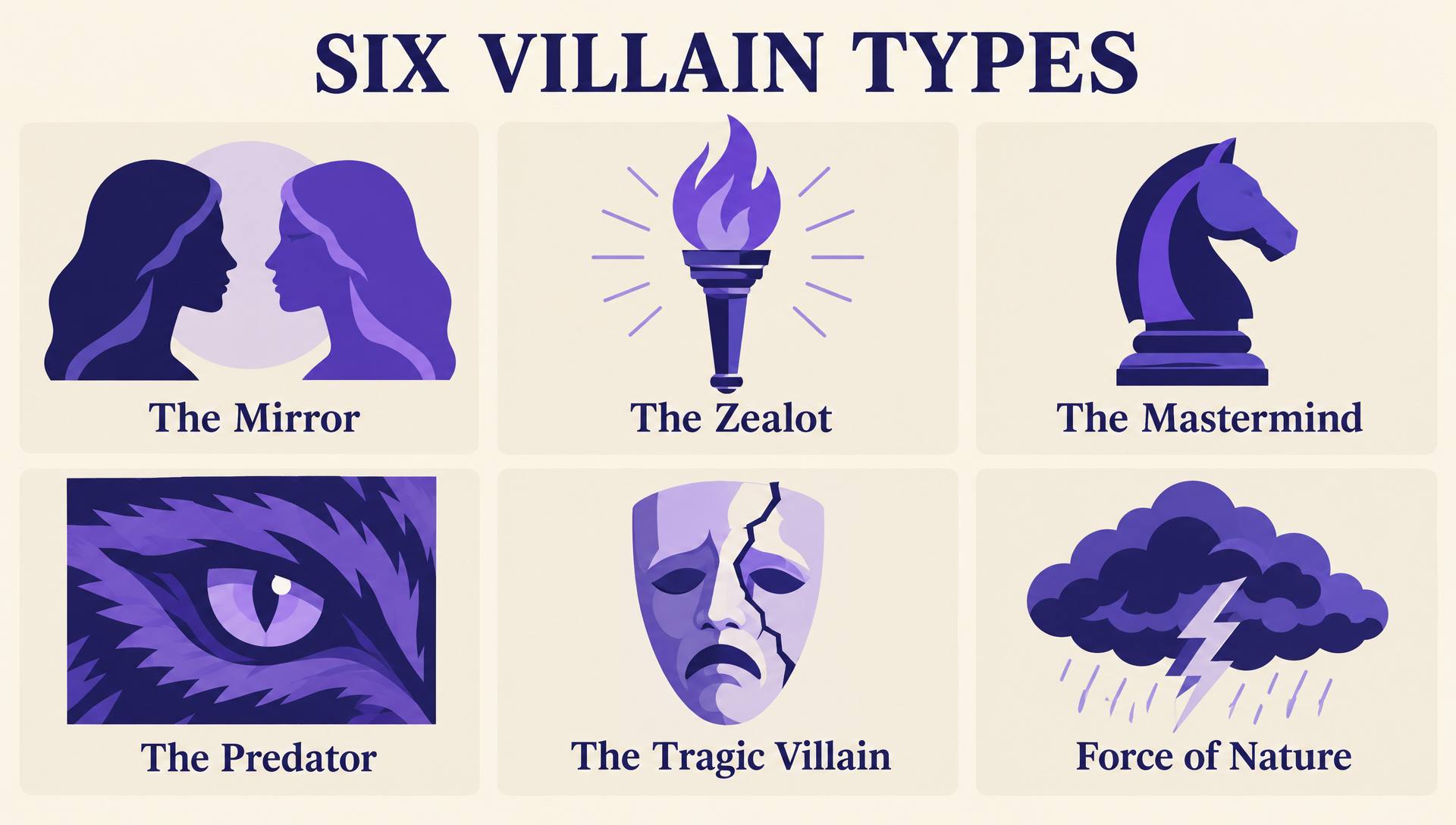
- What drives it
- Wants what the hero wants, by the road the hero refused.
- Known example
- Killmonger in Black Panther
- How to keep it fresh
- Give the mirror a real grievance the hero has to acknowledge, even while opposing the methods.
Caricature vs character
Most villain problems are one of these six. Read across each row and check which column your draft is in.
Evil because the plot needs an obstacle.
Pursuing a goal that collides with the hero's.
Explains the whole plan before the hero escapes.
Reveals the plan through consequences the hero has to piece together.
Cruel to everyone, all the time.
Has loyalties, preferences, and at least one person they treat well.
Only appears when the hero needs a fight.
Has scenes or visible effects that move the plot while the hero is elsewhere.
Gets dumber in the last act so the hero can win.
Stays smart. The hero wins by changing, not by the villain slipping.
Backstory dumped in one sad flashback.
Backstory leaked in fragments that change how earlier scenes read.
Row six deserves its own warning. A villain backstory chapter is one of the most common forms of info-dumping in genre fiction; our guide on how to stop info dumping shows how to spread it out.
Worked example: from cartoon to character
Here is one villain taken through the four-part engine, step by step.
Draft one
The Duke is a cruel ruler who wants to crush the rebels.
Add the want
The Duke wants to keep the kingdom's grain stores locked until spring.
Add the wound
He was a boy during the last famine, when an open granary was looted in a week and half the capital starved by winter.
Add the logic
"The rebels want bread today. I want people alive in March. Only one of us has done the arithmetic."
Add the line
He will hang rebels, but he feeds the orphanage from his own table, every night, and tells no one.
Nothing about the Duke is softer than in draft one. He still hangs people. But now the hero, who is fighting for the starving, has to answer his arithmetic, and the orphanage is a door the plot can open in act three.
Give your antagonist the same depth as your hero
In AIWriteBook every character, villain included, gets a role, background, motivation, internal and external conflict, stakes, and an arc, and every chapter is written with that profile in context.
The AI-assisted shortcut
The four-part engine is exactly the kind of structure an AI writing tool can hold for you, so the villain stays consistent from chapter three to chapter thirty.
In AIWriteBook, the Characters step generates a cast from your premise, and every character card has fields for role, background, motivation, internal conflict, external conflict, stakes, and character arc. Set the role to antagonist, put the want into motivation, the wound into background, the logic into internal conflict, and the line into stakes. The outline builder then places the villain's moves in the story bible chapter by chapter, which is where you plan the four escalation stages.
For a quick start outside the app, the free character creator drafts a full profile from a few lines, and the plot twist generator is useful for the moment a villain's plan goes wrong. If your villain survives into a sequel, book series support lets you write book two from book one, so the villain's history carries over. Our guide to building a series bible shows what to track.
Villain template
Copy this into your notes for every antagonist with more than three scenes.
- Want (concrete, with a finish line):
- Wound (why this goal feels necessary):
- Logic (their defence in one sentence):
- Line (one thing they will not do):
- Type, and the second type it blends with:
- Arc shape (flat, fall, or turn):
- What they are doing while the hero is off the page:
- Shadow, first strike, personal cost, final stand (one line each):
- One person they treat well:
- What the hero must become to beat them:
The short version
Give your villain a want with a finish line, a wound that explains it, an argument you could almost believe, and one line they will not cross. Choose an arc shape on purpose. Escalate in four stages, and make the personal cost specific to your hero. Then keep the villain smart until the end, because a hero only looks strong next to someone worth beating.
For the rest of the craft, from structure to character to endings, our How to Write a Book guide links every piece together.