

On this page
How long is a short story?
The categories most magazines and awards use come from the Science Fiction and Fantasy Writers Association, and they are widely followed outside genre too.
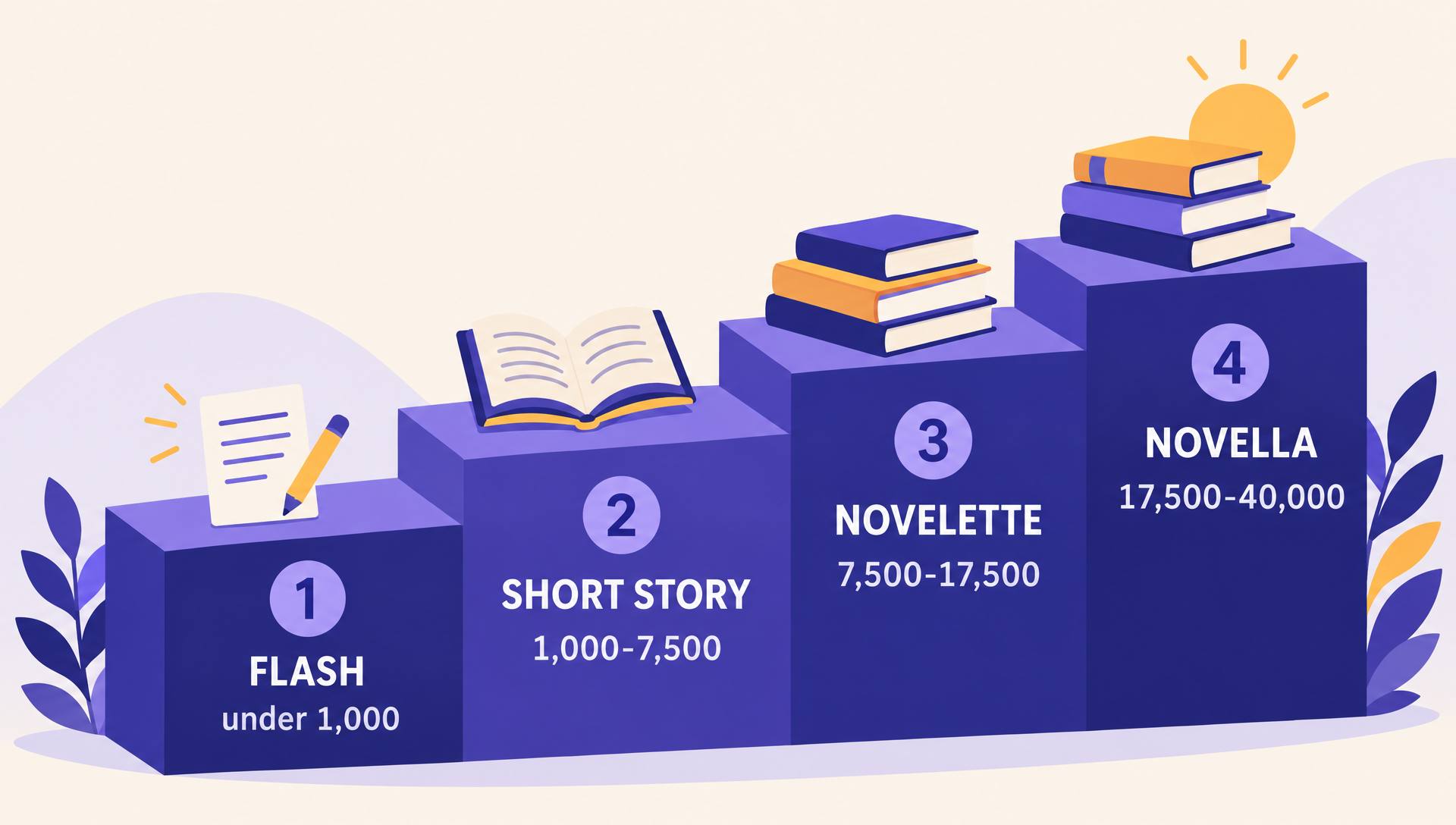
Most magazine markets prefer stories under 5,000 words, because a shorter story costs less space. For the full breakdown by market and genre, see how many words is a short story, and for the next steps up the ladder, what a novelette is and novella vs novel.
Structure: one change, three movements
Most short stories follow a compressed version of the classic arc: a character in a situation, a disturbance that forces a choice, and a moment that shows how they or their understanding have changed.
1
Situation
Who, where and what they want, established in the first few paragraphs. Start as close to the disturbance as you can.
2
Pressure
Complications that make the want harder to get. In a short story, two or three escalating beats are usually enough.
3
Turn
The choice, revelation or realization the story was building toward, and a final image that lets it land.
Short stories usually have one point of view, one main location and a short time span. Each extra character, setting or subplot costs words you do not have. If an element is not serving the turn, it probably belongs in a different story.
Characterization in few words
You cannot spend pages on backstory, so characters have to be revealed by what they do and notice. One precise detail, chosen well, tells the reader more than a paragraph of description: the man who irons his jeans, the girl who counts the stairs.
Give the protagonist a clear want in the opening, and let the reader learn who they are from how they pursue it. Secondary characters can be sketched with a single gesture or line of dialogue. The free character name generator helps when a name needs to carry age, place or class on its own.
Openings that earn the next sentence
The first line of a short story has to establish voice and raise a question at once. The first paragraph should tell the reader whose story this is and that something is wrong, unusual or about to happen.
Common openings that work: an action already in motion, a striking statement in the narrator's voice, or a concrete detail that is slightly off. Openings to avoid: waking up, weather with no tension, and a page of setting before anyone wants anything.
Endings: choose the kind before you write it
Short stories live or die on the last page. Choose an ending type to see how it works and when to use it.
How it works
The central question is answered and the character's change is visible on the page.
Use it when
The story is plot-driven or genre fiction where readers expect a clear outcome.
Whatever kind you choose, the final image should be concrete. Our guide on how to end a book covers ending patterns in longer fiction, and many of its principles carry over.
Revision: cut to the change
- Read the draft once without editing and write one sentence about what changes. If you cannot, find the change before revising anything else.
- Cut every scene, character and paragraph that does not move toward that change.
- Move the opening as late as possible. Many first drafts begin a page or two before the story does.
- Read the last page aloud. Cut the final paragraph if it explains what the image already showed.
- Check the line level last: grammar, repetition, weak verbs. The free grammar checker catches the mechanical errors.
Write a whole collection, not just one story
Draft each story as a chapter, keep characters and settings consistent, and refine every page with the chapter AI chat in your own style.
Where to publish short stories
Literary and genre magazines are the traditional route. Each publishes guidelines with word limits, genres and pay rates, and many accept submissions through online systems. Read a few issues before submitting, follow the formatting rules exactly, and send a story to one market at a time unless the guidelines say simultaneous submissions are fine.
Contests, anthologies and your own collection are the other routes. A self-published collection works especially well for authors with a novel series, as reader magnets or as short stories set in the same world. Our explainer on what an anthology is covers how multi-author collections work.
Using AI for short fiction
AI is useful at the edges of a short story: generating premises, testing several possible endings, and catching what you missed in revision. It is weakest at the precise, unexpected detail that makes short fiction memorable, so keep that work for yourself.
For ideas, the free writing prompts generator and story starter give you a seed to work from. If you are building a collection, AIWriteBook's chapter generator drafts each story as a chapter from your outline, and the writing style builder keeps every story in your voice.
Short story FAQ
How long should a short story be?
By SFWA's definition, a short story runs from 1,000 to 7,500 words. Most magazines prefer under 5,000. Under 1,000 words is usually called flash fiction.
How many characters should a short story have?
As few as the story allows. Most work with one protagonist and one to three secondary characters.
Can I publish a short story I posted online?
Many magazines treat a story posted publicly online as previously published and will not accept it. Check each market's guidelines before posting.
How long does it take to write a short story?
A first draft can take an afternoon; revision often takes longer than drafting. Many writers let a draft rest for a few days before revising it.
Write the next one
Short stories teach fast because they finish fast. Write one, revise it until the change is clear, send it out and start the next. The craft you build in a few thousand words carries into everything longer.