

Most articles about oxymorons open with jumbo shrimp and stop there. That is a shame, because the joke version and the literary version are different instruments, and only one of them will do anything for your novel. A comedian uses an oxymoron to point at a wobble in the language. A writer uses one to hold a feeling that has no single word for it.
This guide covers the definition that actually distinguishes an oxymoron from its four nearest relatives, the grammatical shapes it comes in, what the famous examples are doing structurally, and the specific ways the device fails on the page.
Definition
An oxymoron is a figure of speech in which two terms of opposite or incompatible meaning are placed in close syntactic proximity — usually adjacent, usually within the same phrase — so that the contradiction is felt as a single compressed idea rather than as an error.
Three things matter in that sentence: two terms, not a whole statement; close proximity, not merely the same paragraph; and a contradiction the reader is meant to notice, not one the writer failed to notice.
The word is its own best example
Oxymoron comes into English through post-classical Latin from Greek: oxys, meaning sharp or keen, and moros, meaning dull or foolish. Sharp-dull. The term for the device is itself an instance of the device, which is the kind of accident that makes philologists happy and is genuinely useful for remembering what it does.
That etymology also tells you the tone. This is not a neutral label. Ancient rhetoricians classified the oxymoron among the figures of pointed wit — the sharpness was the point, and the foolishness was the surface impression a reader had to see past. An oxymoron that reads as merely foolish has failed at the first half of its own name.
The four grammatical forms
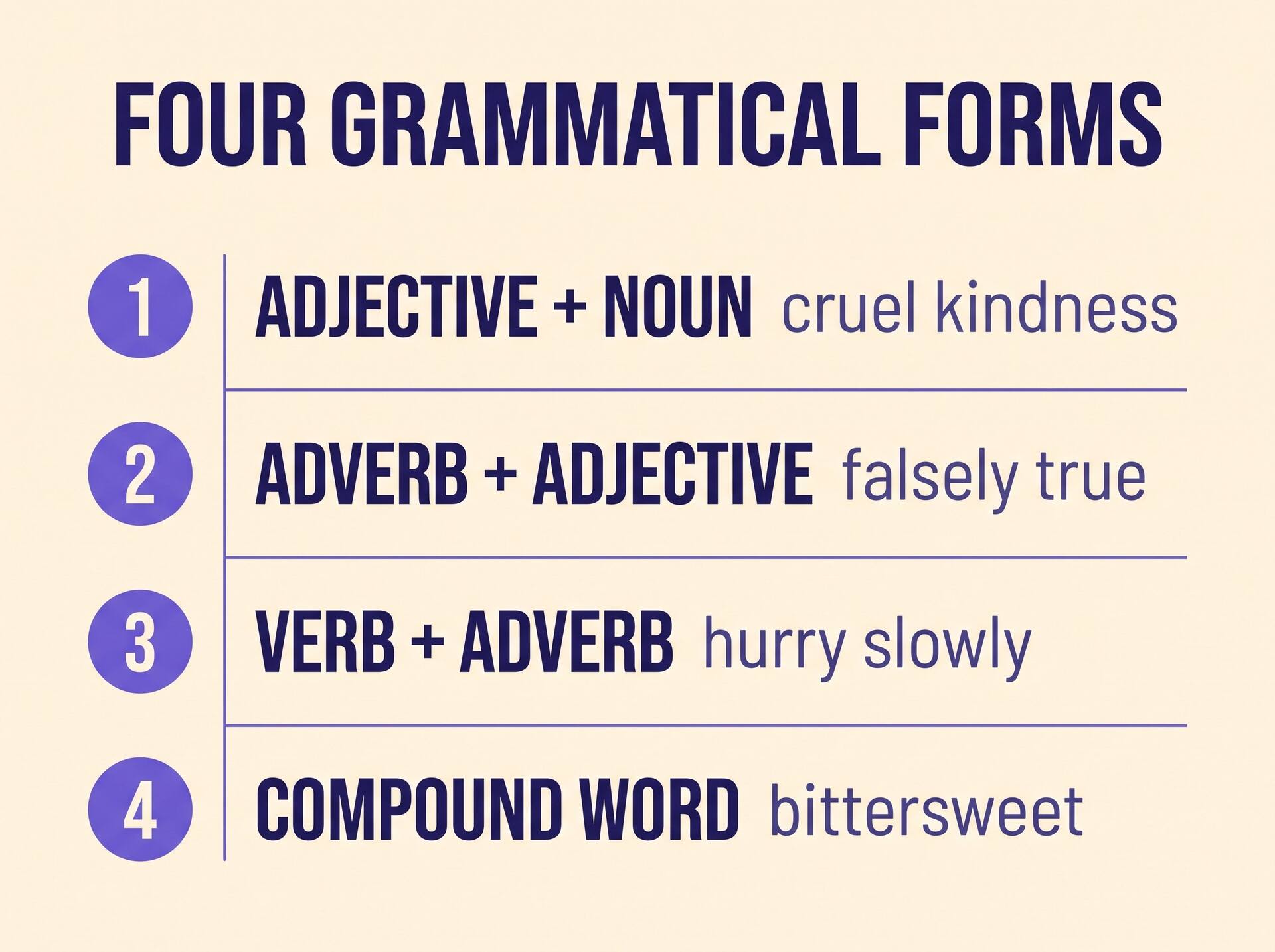
Almost every oxymoron in English falls into one of four grammatical shapes. Knowing which one you are reaching for is the difference between constructing a device and hoping one turns up.
Adjective + noun
The workhorse, and by far the most common shape: cruel kindness, wise fool, open secret, controlled chaos, honest thief. The adjective attacks the noun's core property. This form is the most flexible because English lets you stack an adjective in front of almost anything.
Adverb + adjective
Tennyson's falsely true, or the more common alone together and clearly confused. The adverb undermines the adjective's claim while leaving the claim standing, which produces a wobble rather than a clean clash. Useful for describing states of mind that will not resolve.
Verb + adverb
The rarest and the most physical: hurry slowly, an instruction attributed to the emperor Augustus, or the modern act naturally. Because a verb happens in time, this form implies a process at war with itself rather than a static condition. It is the form to reach for when a character is doing something they are simultaneously resisting.
The compound word
Bittersweet, pianoforte (Italian for soft-loud), and sophomore, traditionally traced to Greek roots meaning wise and foolish. These are oxymorons that have fused into single lexical items. They no longer read as contradictions at all, which is the terminal stage every successful oxymoron eventually reaches.
Not a paradox, not antithesis, not juxtaposition
The single most common error in writing about this device is calling a paradox an oxymoron. The distinction is not fussy — it is a difference of scale, and it changes what the sentence can do.
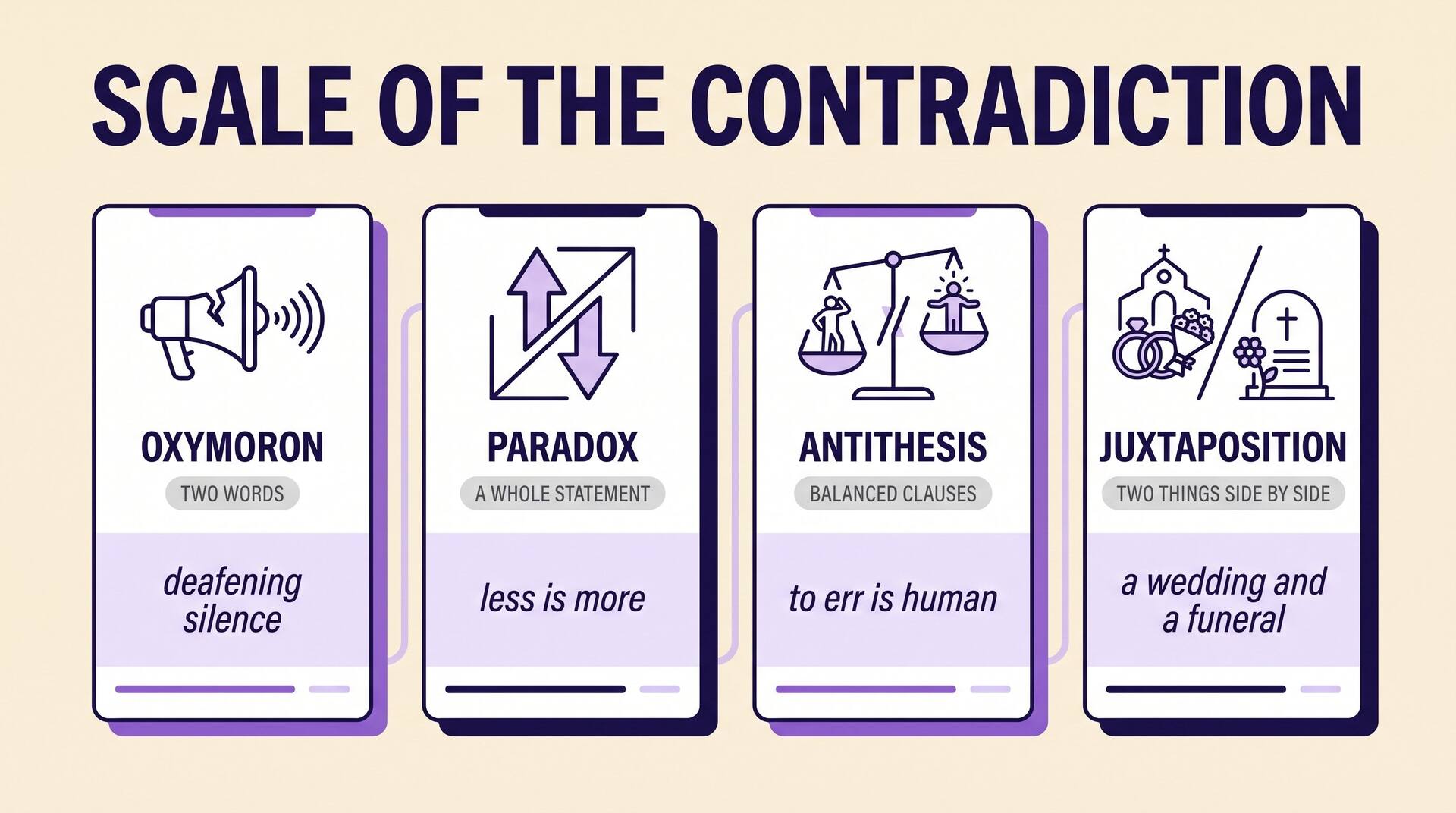
An oxymoron is two words. A paradox is a whole statement that appears self-contradictory but resolves into sense on reflection: less is more, the child is father of the man, I must be cruel only to be kind. You cannot lift a paradox out of a sentence and carry it around; it needs the sentence. You can lift deafening silence out and drop it anywhere.
Antithesis is different again: two balanced, grammatically parallel clauses set against each other, as in to err is human, to forgive divine. The opposition is architectural, built out of matched halves. Juxtaposition is broader still and not even necessarily verbal — placing a wedding scene immediately after a funeral is juxtaposition, and no contradictory words are involved at all.
And a contradiction in terms is the failure state of all four: a phrase whose two halves cancel rather than combine, producing nonsense instead of meaning. The line between a working oxymoron and a contradiction in terms is entirely a matter of whether a reader can hold both halves at once. If the paradox examples guide is closer to what you actually came here for, that is the one to read next — the two devices get confused constantly and it treats the statement-level version properly.
Quick test
Can you delete everything around the phrase and still hear the contradiction? Then it is an oxymoron. If the contradiction disappears the moment you remove the rest of the sentence, you have a paradox.
Oxymoron examples from literature, and what each is doing
The famous examples are famous for structural reasons, not because they are pretty. Here is what each one is actually accomplishing.
Shakespeare stacks them to show a mind that cannot settle
The single densest patch of oxymorons in English literature is Romeo's speech in Act 1, Scene 1 of Romeo and Juliet — before he has met Juliet, while he is still lovesick over Rosaline. He fires off nine or ten of them in six lines.
O brawling love! O loving hate! O any thing, of nothing first create! O heavy lightness! serious vanity! Mis-shapen chaos of well-seeming forms! Feather of lead, bright smoke, cold fire, sick health! Still-waking sleep, that is not what it is!
Read as decoration this is overwriting. Read as characterisation it is precise: Romeo is performing the fashionable Petrarchan lover, and the pile-up tells us his feeling is borrowed vocabulary rather than experience. Shakespeare gives him real language later, when he means it.
That is the lesson buried in the most-quoted example on the internet. The stacking is deliberate excess, placed in the mouth of a character whose emotion is not yet real. Notice how sparingly the play uses the device once Romeo actually falls in love — parting is such sweet sorrow is one phrase, not ten, and it lands harder than the whole earlier speech.
Juliet gets her own burst in Act 3, Scene 2, when she learns Romeo has killed Tybalt: beautiful tyrant, fiend angelical, dove-feather'd raven, wolvish-ravening lamb. Same technique, different job — here the contradictions are the only honest way to describe a person she loves and has just discovered is a killer. The oxymoron is doing what no single adjective could.
Milton uses one to describe something that cannot exist
In Book 1 of Paradise Lost, Milton has to describe Hell — a place lit by flames that give no light. The solution is two words.
yet from those flames No light, but rather darkness visible
Darkness visible is arguably the most efficient two words in English poetry. It is not a description of gloom; it is a description of a physical impossibility, and it works because both halves stay fully active. William Styron borrowed it as the title of his memoir of depression in 1990, which tells you how much the phrase carries.
This is the load-bearing use of the device. Milton is not ornamenting a describable thing. He needs a concept English has no word for, so he builds one out of two words that should not fit, and the reader's mind performs the impossible synthesis. Compare the effort of the alternative: three sentences of explanation that would have described the paradox instead of producing it.
Tennyson compresses a moral position into two words
In Lancelot and Elaine, part of the Idylls of the King, Tennyson describes Lancelot's position — loyal to Arthur, in love with Arthur's wife — in a couplet that ends: his honour rooted in dishonour stood, and faith unfaithful kept him falsely true. Falsely true is the whole of Lancelot's character in two words. He keeps every visible obligation and betrays the substance of all of them.
Orwell uses the form to show a language under attack
Nineteen Eighty-Four is the standard reference here, and it is worth being precise about what is what. War is peace, freedom is slavery, ignorance is strength are paradoxes, not oxymorons — each is a whole statement. The genuine oxymorons in the novel are the institutional names: the Ministry of Truth produces lies, the Ministry of Love administers torture, the Ministry of Peace conducts the war.
Orwell's point is that a state can weaponise this device. Every oxymoron asks the reader to hold two incompatible things at once; doublethink is that request made compulsory. It is the only case in this list where the device is being used against the reader rather than for them — which is exactly why it is unsettling.
Three shorter ones worth having in your head
- Milton again, in Samson Agonistes: a living death, describing Samson blinded and enslaved — the point being that both words are literally accurate about his condition, which is what separates it from a cliché.
- Hamlet's I must be cruel only to be kind is quoted as an oxymoron but is really a paradox with an oxymoron inside it — the cruel/kind pairing does the work, the sentence supplies the resolution.
- Chaucer's the smiler with the knife, from The Knight's Tale, is not strictly an oxymoron at all but a compressed image doing the same job — worth studying because it shows the alternative route when two contradictory adjectives would be too neat.
Dead oxymorons: the ones to stop using
A successful oxymoron dies. Readers meet it, feel the collision, and then meet it again until the collision stops registering and the phrase becomes an ordinary unit of meaning. Bittersweet was once a genuine device; now it is just a word for a flavour and a mood. This is not a failure of the phrase — it is the phrase working so well that the language absorbed it.
The practical consequence is a list of phrases you should retire from your prose unless you are actively refreshing them:
None of these are wrong. They are simply invisible — a reader's eye passes over deafening silence exactly the way it passes over very quiet, so you have spent a device and bought nothing. If a dead oxymoron is the honest phrase for what you mean, use it and move on. Just do not count it as an effect.
There is a second, sneakier list: the joke oxymorons. Jumbo shrimp, military intelligence, civil war, business ethics, virtual reality. Some of these barely qualify — jumbo shrimp leans on a pun between the animal and the slang for something small, and civil war uses civil in its sense of relating to citizens, so no real meanings collide. The ones that do qualify are comic oxymorons: the contradiction is played for a smirk about vocabulary, not for meaning. Either way, putting one in a serious scene will read as a joke you did not intend to make.
Decorative versus load-bearing
Here is the distinction that separates a writer who knows the term from one who can use it. A decorative oxymoron makes a phrase interesting. A load-bearing oxymoron carries information the scene could not otherwise deliver.
The test is simple: delete the oxymoron and replace it with the nearest plain phrase. If the scene loses only some texture, the device was decoration. If the scene loses a fact about a character or a situation, it was load-bearing.
The richest use is contradiction as characterisation — an oxymoron in a character's own voice, revealing a mind that cannot hold two truths separately. A woman who describes her marriage as a comfortable ruin has told you she has stopped trying to fix it and is not leaving. That is plot information wearing a figure of speech. Neither word alone gets you there, and the flat version, she is unhappy but staying, is a report rather than a revelation.
This is also why oxymorons belong disproportionately in dialogue and close third-person narration rather than in neutral description. A contradiction has to be someone's. Narration that contradicts itself without an owner just reads as imprecise. If your book runs on interiority, our piece on showing rather than telling covers the same problem from the other direction — how to let a state of mind appear in behaviour rather than in a label.
How to write a fresh one on purpose
Fresh oxymorons are constructed, not stumbled on. The method is unglamorous and it works.
- 1Start from the feeling, not from the wordsName the emotional state in a plain sentence first: she was relieved that he was gone and could not stop crying. The oxymoron will be built from the two halves of that sentence, not invented from a list of opposites.
- 2Find the two nouns or adjectives that fightIn that example: relief and grief. Now look for a pairing where one modifies the other rather than sitting beside it — a grateful grief, or a relieved mourning. Modification is what makes it an oxymoron rather than a list.
- 3Test both halves for full activityThe failure mode is one word going soft. In terribly good, terribly has stopped meaning terrible, so nothing collides. Ask whether a reader will feel both meanings at full strength. If not, swap in a word that cannot be read as an intensifier.
- 4Use exactly one, and place it at a hingePut it where the scene turns — the last clause of a paragraph, the line a character says before leaving the room. An oxymoron in the middle of a descriptive passage is furniture. Two in one paragraph cancel each other out, because the reader adapts to the register and stops registering contradiction as significant.
- 5Read it aloud a day laterFreshly built oxymorons sound brilliant to the person who built them, which is the least reliable audience in publishing. Twenty-four hours later you can hear whether it is compressed insight or a crossword clue. Most first attempts are crossword clues.
Five mistakes to avoid
Treating it as a joke format
Jumbo shrimp and its cousins are wordplay, and readers have been trained to expect a punchline. Deploying that register in a grief scene produces tonal whiplash. If your oxymoron would work on a bumper sticker, it will not work in a chapter.
Overloading the paragraph
Shakespeare could stack ten of them because he was characterising a poseur. Outside that specific effect, a second oxymoron within a page devalues the first. The device works on scarcity — its power comes from being the one place the prose contradicts itself.
Mistaking a paradox for an oxymoron
If it needs a whole sentence to contradict itself, it is a paradox. Labelling it wrongly matters less on the page than in the planning: a paradox is a proposition you can argue with, and if you have built a chapter around one, you owe the reader a resolution. An oxymoron owes nothing.
Combining words that do not actually oppose
Silent whisper is not an oxymoron; a whisper is already quiet, so the phrase is a tautology wearing the costume. Check that the two terms are genuinely incompatible rather than merely adjacent on a scale.
Explaining it afterwards
The sentence after an oxymoron should not unpack it. She felt a grateful grief — grateful because it was over, grief because she had loved him. The gloss dismantles what the compression achieved. Trust the reader to do the synthesis; that act of synthesis is the entire pleasure of the device.
When not to use one at all
Some contexts actively repel the device.
- Technical, instructional, and business writing. The reader's job is to extract information at speed. A contradiction forces a pause for resolution, which is precisely the wrong cognitive demand for a safety notice or a how-to.
- Action sequences. Oxymorons slow reading down — the eye stops to reconcile two words. Fight and chase scenes need short, unambiguous units.
- When the plain word exists. If terrifying is accurate, terrifying beauty is not an upgrade; it is a hedge. Reach for the device only when no single word covers the state.
- First-person narration by a plain-spoken character. A device is a voice choice. If your narrator does not think in compressed literary figures, one appearing in their mouth reads as the author interrupting.
Working the device into a real draft
The practical problem with figurative language is not inventing it — it is distribution. Writers cluster their good phrases in the chapters they enjoyed writing and leave the rest of the book flat, and you cannot see that pattern from inside the draft.
If you want to work at phrase level before committing to a scene, our free paraphrasing tool is a fast way to see six versions of the same line and find which pairing actually collides — you supply the plain sentence, and comparing the rewrites tends to surface the two words that were fighting all along. For a whole draft, the grammar checker is worth a pass simply because a deliberate oxymoron and an accidental contradiction look identical to a tired writer at midnight.
If you are writing the book on AIWriteBook, the more useful lever is the writing-style instruction attached to your book: you describe the voice you want — restrained, image-heavy, contemporary, whatever fits — and every chapter is generated against it, so figurative density stays consistent instead of spiking in chapter three. When a particular passage still reads flat, the in-chapter AI chat lets you select those lines and ask for a rewrite, then accept or reject the change as a diff rather than regenerating the chapter and losing everything you liked. Choose Gemini or Grok for the drafting; the style instruction applies either way.
And if the device you actually need is a comparison rather than a collision, the guide to metaphor examples and the one on similes cover the two tools writers reach for when an oxymoron is too compressed for the job.
Questions writers ask
The short version
An oxymoron is two contradictory terms in close proximity, deliberately placed. It is not a paradox — that is a whole statement — and it is not antithesis or juxtaposition, which operate on clauses and scenes. It comes in four grammatical shapes, it dies from popularity, and the ones worth writing carry a fact about a character or a situation that no single word could deliver.
If you take one thing from the examples, take the Romeo comparison: ten oxymorons when the feeling is borrowed, one when it is real. Figurative density is a decision about voice, which means it belongs alongside the other structural decisions rather than in the line edit. Our guide to writing a book covers where voice gets decided relative to premise, outline, and drafting.
The practical next step is not to hunt for oxymorons. It is to write the plain sentence first, then look at whether its two halves want to be one phrase.