

What personification actually is
Personification is a figure of speech that gives human traits — actions, emotions, intentions — to something that isn't human: an object, an animal, an abstract idea, or a force of nature. It works because our brains are wired to read faces and motives into everything, so the moment a fog "sits" or a clock "scolds" you, the description stops being neutral and starts carrying feeling.
In one line
Personification = a non-human thing + a human verb or emotion, used as a brief figure of speech.
Three things writers mix up
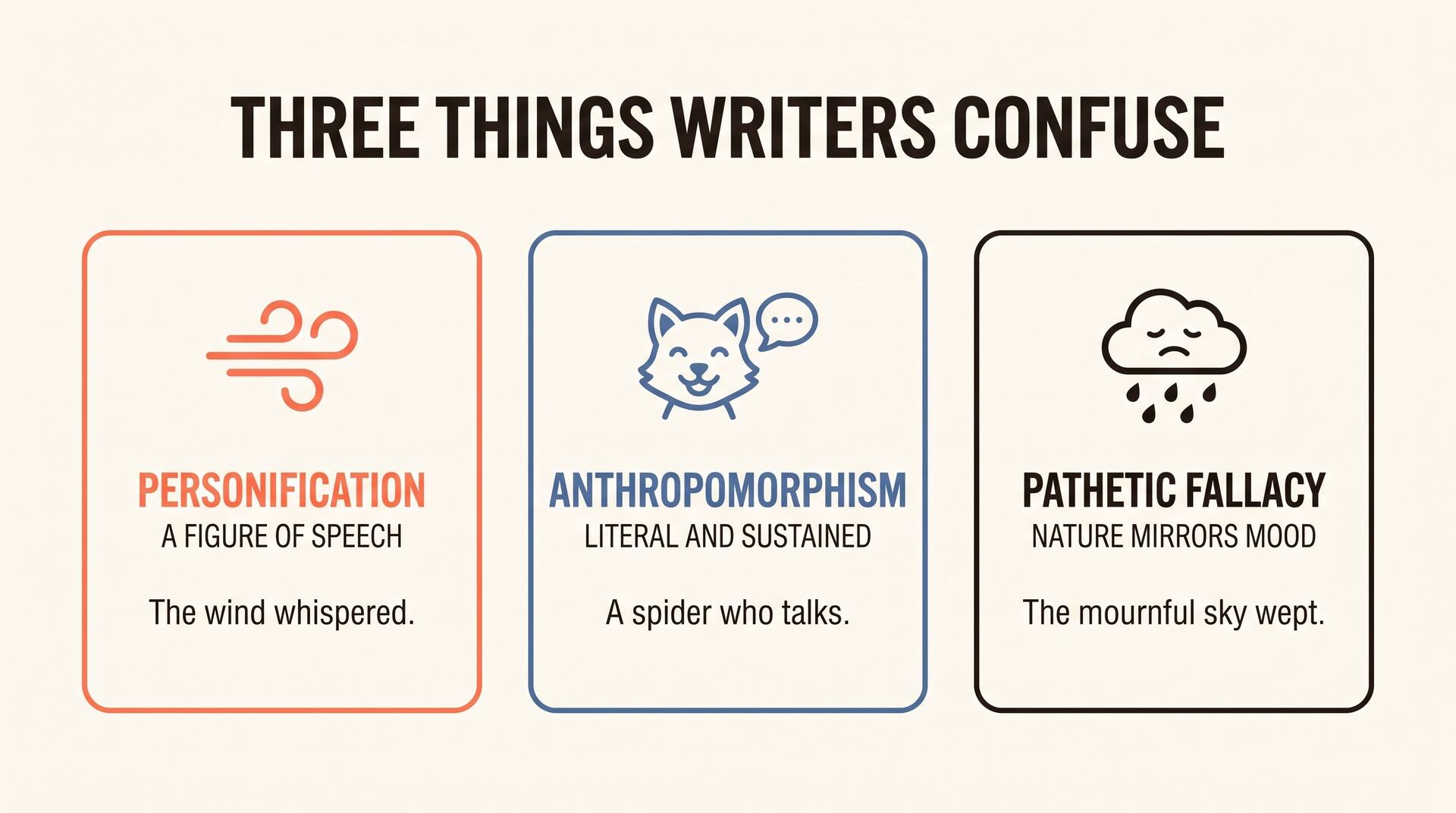
Most confusion about personification comes from two neighbours that look similar but do different jobs. Getting the distinction right is what separates a searcher who "kind of knows" the term from a writer who can use it on purpose.
Personification
A brief figure of speech — one verb or image. "The wind whispered." It doesn't claim the wind is really a person; it borrows a human action for a beat.
Anthropomorphism
Literal and sustained. A spider who genuinely talks, plans, and has a personality across a whole story — think of the animals in a fable — is anthropomorphism, not a passing figure of speech.
Pathetic fallacy
A narrower cousin: nature specifically mirroring a character's mood, like a storm breaking exactly as a marriage does. All pathetic fallacy is personification, but not the reverse.
Because it maps a human quality onto a non-human thing, personification is really a specialised kind of metaphor — the difference is that the comparison is always to a person, and it's usually so compact you barely notice the machinery.
Personification examples, sorted by where they come from
Seeing the device in four very different registers — from a Romantic poem to a text you sent this morning — is the fastest way to internalise it. Switch between the sources and read the short note under each on why it works.
Tossing their heads in sprightly dance.
William Wordsworth, "I Wandered Lonely as a Cloud" (1807)
The daffodils don't sway — they toss their heads and dance. Wordsworth hands the flowers a human joy, and that borrowed delight becomes the memory that later fills his "vacant" heart.
The grey-eyed morn smiles on the frowning night.
William Shakespeare, "Romeo and Juliet" (c. 1595)
Dawn and darkness become rival faces — one smiling, one frowning. In a single line Friar Laurence turns the sunrise into a small drama of optimism pushing back gloom.
Because I could not stop for Death — He kindly stopped for me.
Emily Dickinson (c. 1863)
Death arrives as a courteous gentleman caller, not a threat. The politeness is exactly what unsettles: personifying dread as good manners makes the whole carriage ride quietly terrifying.
Four ways personification goes wrong
The device fails in predictable ways. Watch for these before you reach for it a second time in the same paragraph.
Clashing images
"The sun smiled as the shadows strangled the alley." Two incompatible human postures collide and the reader pictures nothing. Give one object one coherent human stance at a time.
Personifying everything
If the door sighs, the lamp broods, and the floor groans in a single scene, none of it registers. Reserve personification for the beat that actually matters and let the rest stay literal.
Dead clichés
"Time flies," "the heavens wept," "opportunity knocks." These have been personified so often they now read as filler. Freshness is the entire point of the device — if you've heard it before, cut or twist it.
Wrong register
A whimsical "the teapot giggled" inside a tense thriller snaps the reader out of the scene. The mood of the personification has to match the mood of the moment.
When to use it — and when to skip it
Personification is a spice, not a base. Use it where it does a specific job; leave it out where clarity or tone matters more.
Reach for it to
- Set mood through setting — let a house "watch" or a road "wait" so the atmosphere does the emotional work.
- Compress emotion into one concrete image instead of a paragraph of telling.
- Give abstract forces — time, fate, the city, grief — a body the reader can picture.
- Control pacing: a single personified beat slows a scene down and asks the reader to linger.
Leave it out when
- The passage is expository or technical and needs to be unambiguous.
- The obvious pairing is a cliché and you can't find a fresh angle.
- It would puncture the tone you've carefully built.
- A plain, strong verb already does the job — don't dress up what's working.
Personification rarely works alone. It pairs naturally with concrete sensory imagery and, used sparingly, with hyperbole when a scene genuinely needs to feel larger than life.
How to write your own personification
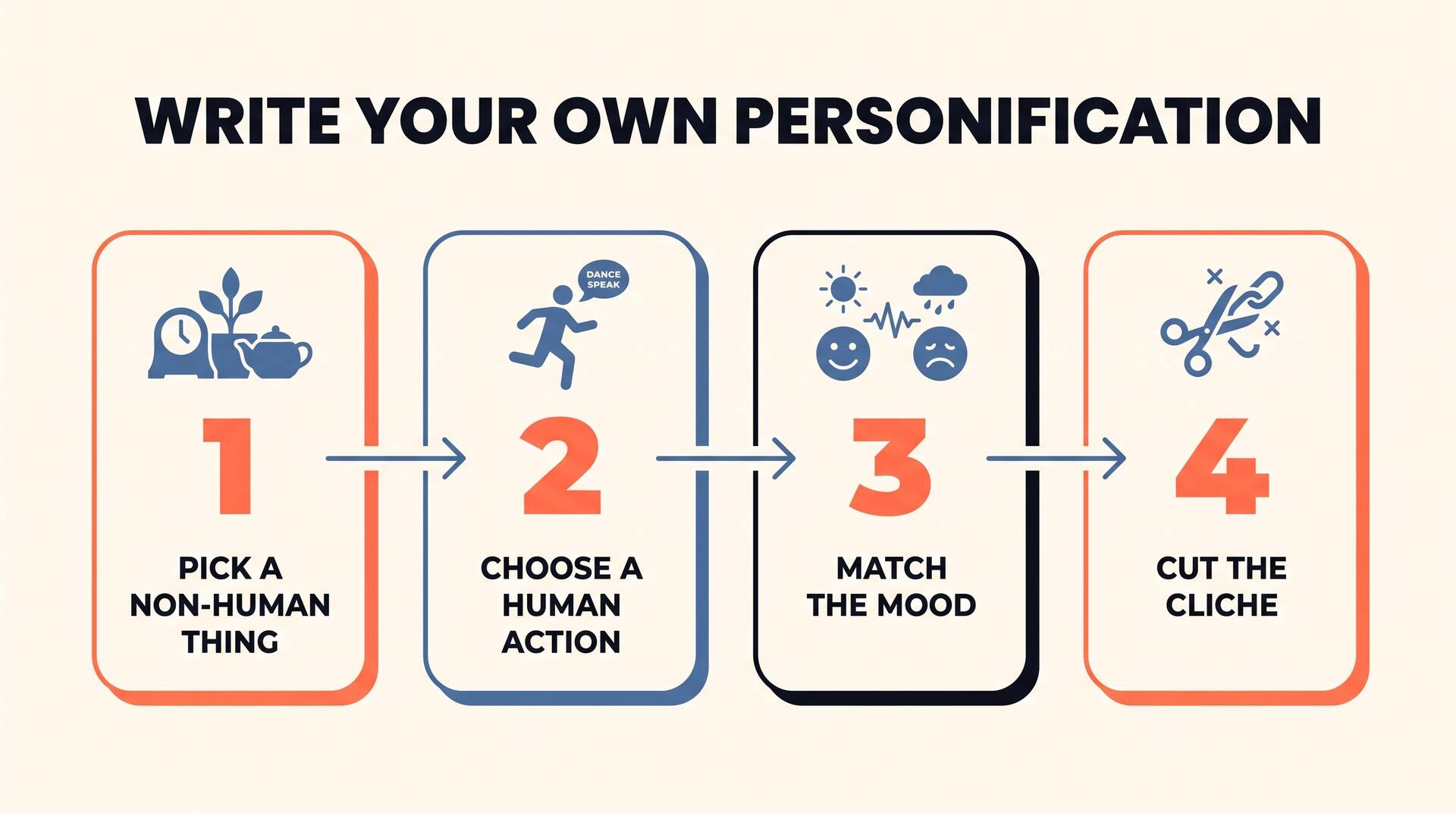
A reliable four-step move turns "I should add some description here" into a line that actually carries feeling.
Pick a non-human thing that already matters
Don't personify at random. Choose an object or force already in the scene — the clock, the weather, the empty chair — so the image reinforces what's happening.
Choose one human action or emotion
A single verb usually beats a whole clause. "The engine coughed" does more than "the engine made a spluttering sound as if it were sick."
Match the mood
The verb carries the scene's temperature. A door can "sigh" open in a tender moment or "shriek" open in a horror beat — same door, opposite feeling.
Cut the cliché
If you've heard the pairing before, twist it or drop it. "The wind howled" is dead; "the wind nosed under the door like a stray" is alive.
Staring at a blank descriptive passage? Our free scene builder can rough out the setting first, handing you concrete objects — a window, a stairwell, the weather — that are ready for a human verb.
Layer it into a real draft, in your own voice
Already have a chapter that reads flat? Open it in AIWriteBook and ask the built-in chapter chat to weave personification in where the scene needs life — it proposes each change as a diff you accept or reject line by line, so the voice stays yours. Save a writing style first and the AI keeps matching your tone instead of flattening it.
Personification FAQ
It's giving human traits — actions, feelings, or intentions — to something that isn't human, such as an object, an animal, an idea, or a force of nature, used as a brief figure of speech. "The leaves danced" is personification.
The takeaway
Personification is one of the cheapest ways to turn flat description into something a reader feels — but only when it's chosen, not sprinkled. Steal the technique from Wordsworth, Dickinson, and Sandburg; borrow nothing from the tired everyday clichés.
Master it alongside its cousins — simile and vivid imagery — and your descriptions stop reporting the world and start performing it. That's the same craft the rest of our guide to writing a book keeps building on, chapter by chapter.