

In this guide
Why rights matter more than the advance
Copyright arises the moment you write the work down. Copyright law then lets you divide it: the right to reproduce, distribute, translate, perform and adapt can each go to a different party, for a different territory, for a different time. Publishing contracts are, in practice, a list of which slices you hand over and on what terms.
The slices beyond the main edition are called subsidiary rights. For a traditionally published author they can be worth more than the book itself: a translation deal in a big market or a film option can outearn a modest advance. For a self-published author they are the unused inventory sitting in every finished manuscript. If you want the basics of ownership first, start with how to copyright a book.
The rights map
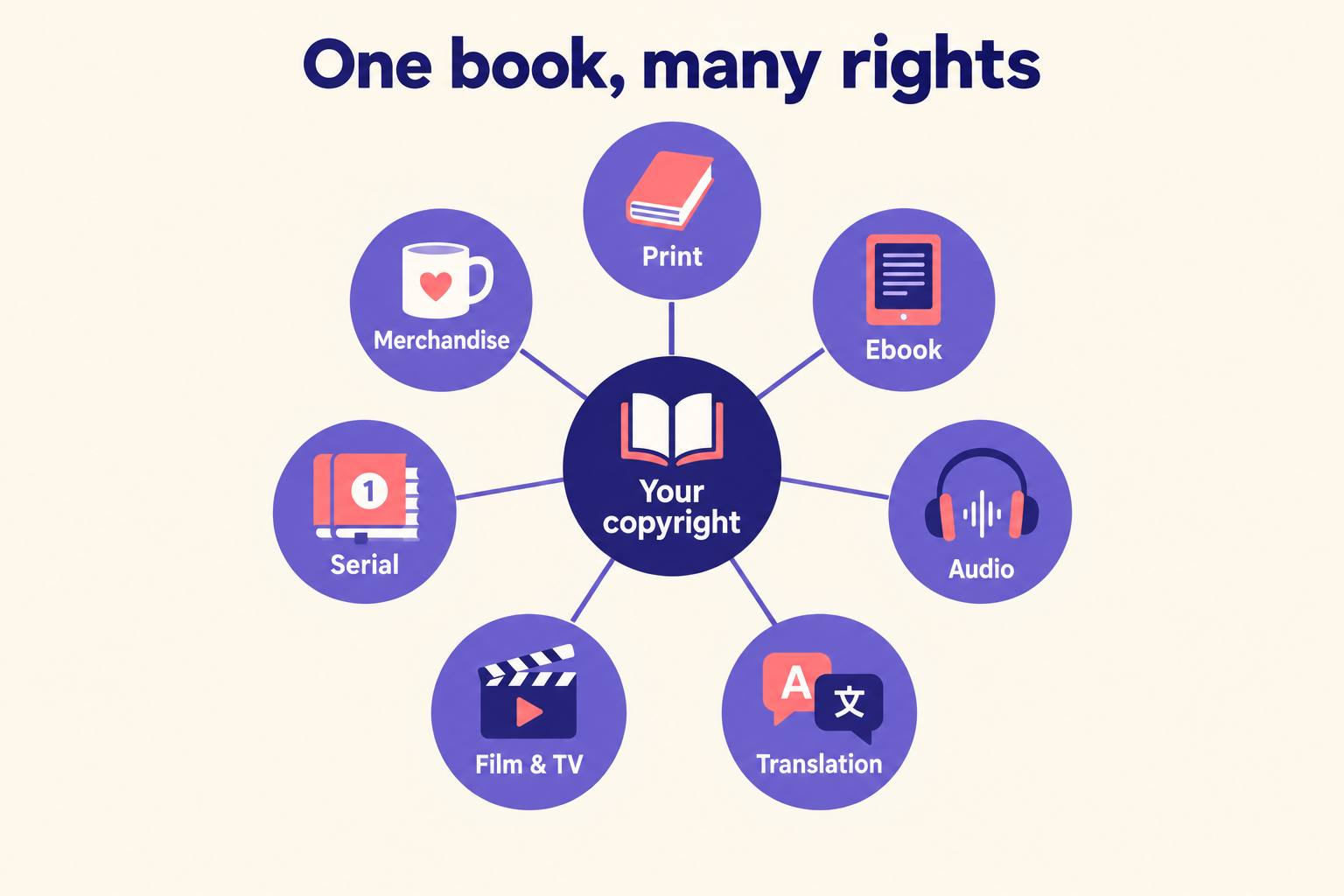
These are the rights authors deal with most often. Open any card for what it covers and how it usually works.
What it covers
Hardcover, paperback and large-print editions in a given language and territory.
How it usually works
The core of a traditional deal, often world English or a single territory. Self-publishers keep it and license print-on-demand distribution non-exclusively.
What KDP actually takes
Publishing on KDP does not transfer your rights to Amazon. You grant a non-exclusive license to sell the editions you upload and you keep everything else, which means you can sell the same book on other stores, record an audiobook, or sign a foreign deal at any time.
The exception is KDP Select. Enrolling an ebook gives Amazon digital exclusivity for 90-day terms, so you cannot sell that ebook elsewhere while enrolled. Print and audio are not affected. Our breakdown of KDP Select pros and cons covers when the trade is worth it.
Because self-publishing keeps the bundle intact, the real question becomes which rights you exploit yourself. Most indie authors exploit print and ebook only, and leave audio and translation untouched.
Run a rights audit on your book
Mark the status of each right for one of your books. The audit shows what you have not used yet.
5 unused rights in this book
Not earning yet: Audio, Translation, Film and TV, Serial, Merchandise
Audio and translation are usually the cheapest to unlock yourself. AIWriteBook's audiobook generator narrates a finished manuscript in the app, and book translation produces a full edition in 30+ languages that you can publish as your own foreign edition. To try a chapter first, use the free book translator.
AI training rights: the newest slice
Licensing a book to train AI models is now a real, separately negotiated right. In 2024 HarperCollins offered $5,000 per title, split evenly so the author and the publisher each received $2,500, to license some nonfiction backlist titles for AI training for three years, on an opt-in basis. In 2026 a US court gave final approval to a $1.5 billion class settlement over pirated books used to train an AI model, roughly $3,000 per work.
For you, this means two things. First, read new contracts for clauses that grant the publisher AI training or text and data mining rights, and treat them as a subsidiary right with its own terms, not boilerplate. Second, this is separate from using AI to help write your own book, which is a question of disclosure and authorship; our guides to whether you can legally write a book with AI and the KDP AI disclosure policy cover that side.
Common mistakes
- 1
Granting all rights in all formats worldwide
A publisher that only sells English print in one country has no reason to hold world translation and film rights. Grant what they will actively exploit.
- 2
No reversion clause
If the book goes out of print, rights should return to you. Define out of print by sales, not by the mere availability of a print-on-demand file.
- 3
Ignoring audio
Audio is a fast-growing format and often the first subsidiary right a self-published author can exploit cheaply.
- 4
Signing an option with no end date
Film and TV options should have a fixed term and a clear price to renew. An open-ended option freezes the right.
Unlock audio and translation rights yourself
Generate a narrated audiobook and translate your finished book into 30+ languages without leaving AIWriteBook.
Contract questions to ask before you sign
Copy this list into your notes and get a clear answer to each question in writing.
1. Which formats does this contract cover: print, ebook, audio?
2. Which territories and languages?
3. Which subsidiary rights are included, and what is my share of each?
4. Who controls translation and film rights, and can unused rights revert to me?
5. How is out of print defined, and when do rights revert?
6. Does the contract grant any AI training or text and data mining rights?
7. Is there a non-compete clause, and how broad is it?
8. How long is any film or TV option, and what is the renewal fee?
Book rights FAQ
They are the rights to use a book beyond its primary edition: translations, audio, film and TV, serialization, merchandise and other adaptations. Each can be licensed separately.
Yes. KDP takes a non-exclusive license to sell the editions you upload. KDP Select adds 90-day ebook exclusivity, but you still own the copyright and every other right.
Traditionally published authors usually leave it to their agent and co-agents abroad. Self-published authors can either pitch foreign publishers directly or publish their own translated editions.
The return of licensed rights to the author, usually when a book goes out of print or a publisher fails to exploit a right within a set period. A clear reversion clause is one of the most valuable lines in any contract.
Treat every book as a bundle
A finished manuscript is not one product. It is a print edition, an ebook, an audiobook, a dozen foreign editions and possibly an adaptation, each a separate right. Know which you have given away, which you are using, and which are waiting.
For everything about publishing your editions on Amazon, see our Amazon KDP guide.