


What a round character actually is
The term comes from E. M. Forster, who split fictional people into two kinds in his 1927 lecture series Aspects of the Novel. Flat characters, he said, can be summed up in one sentence and never depart from it. Round characters cannot — and the test he gave is still the sharpest anybody has written down.
The test of a round character is whether it is capable of surprising in a convincing way.
Note the two halves. Surprise alone is randomness. Convincing alone is predictability. Roundness lives in the collision.
That test does a lot of work. It rules out the character with a thick biography who behaves exactly as advertised on every page: flat, with a research folder attached. It also rules out the out-of-nowhere betrayal in chapter thirty, which fails the second half. Roundness is not how much you know about someone — it is how many directions they could plausibly move in right now.
In practice, a round character holds two things that do not comfortably fit: a stated value and a private appetite, a public competence and a hidden fear, a code and an exception to it. Readers sense the gap before they can name it, so when the character acts out of it, the moment reads as recognition rather than as a twist.
Round character definition
A character with enough internal contradiction that their behaviour cannot be predicted from a one-line summary, yet every surprising choice they make feels inevitable in hindsight.
Six round character examples
Read these for the mechanism rather than the plot: the contradiction that makes surprise possible, and the moment the surprise arrives and holds.
Elizabeth Bennet
Pride and Prejudice, Jane Austen
The contradiction
Her identity rests on reading people faster and better than anyone in the room — and she reads the two most important men in the book exactly backwards.
The convincing surprise
After Darcy's letter she turns that judgement on herself and concludes she has never known her own mind. Austen spends two hundred pages making the cleverness delightful, which is what makes the collapse land.
Severus Snape
Harry Potter, J. K. Rowling
The contradiction
He is petty and cruel to a schoolboy across seven books while quietly keeping that schoolboy alive, and he cannot stop doing either.
The convincing surprise
The memories in the final book do not contradict what we saw; they re-file it. The spite was real, the protection was real, and the reason for both had been visible in the shape of his Patronus all along.
Anna Karenina
Anna Karenina, Leo Tolstoy
The contradiction
She enters the novel as the woman who talks her sister-in-law into forgiving a husband's affair, then takes a lover and refuses every version of the compromise she recommended.
The convincing surprise
The real turn is not the affair, it is the jealousy. The woman whose gift was putting people at ease starts wounding Vronsky on purpose, and Tolstoy makes it read as fear rather than as a personality swap.
Jay Gatsby
The Great Gatsby, F. Scott Fitzgerald
The contradiction
A man of almost embarrassing sincerity who has built that sincerity a fraudulent name, a fraudulent history and a fraudulent fortune to stand on.
The convincing surprise
He throws the loudest parties on Long Island and does not drink at them. Nick keeps finding him apart from his own spectacle, sober and watching — which tells you the parties were never the point long before Gatsby says so.
Scout Finch
To Kill a Mockingbird, Harper Lee
The contradiction
A child raised on a doctrine of understanding other people who is, in the ordinary way of children, casually contemptuous of the neighbours she does not understand.
The convincing surprise
She breaks up a lynch mob at the jailhouse — not bravely, but by recognising a man in the crowd and asking after his legal troubles until he is too embarrassed to stay.
Amy Dunne
Gone Girl, Gillian Flynn
The contradiction
She has spent her life performing a likeable version of herself for her parents, her husband and eventually the police, and she despises every woman who does the same.
The convincing surprise
The midpoint reveals the diary as a fabrication. It works because that voice had been fractionally too charming throughout, so the reader feels flattered and conned at once.
Notice what none of them are: quirky. Not one is round because of a hobby, an accent, or a distinctive coat.
Round vs flat, dynamic vs static
The most common mix-up in character craft is treating round and dynamic as synonyms. Round versus flat measures complexity at a single moment. Dynamic versus static measures change across the book. They are independent, which gives four combinations — click a quadrant.
Complex from page one, and the complexity resolves into a different person by the last page. The protagonist slot in most fiction, and the hardest to write, because the change has to cost something.
Example
Ebenezer Scrooge in A Christmas Carol. Dickens gives him a sister, a first employer and a broken engagement before he gives him a conversion, which is why the conversion is not cheap.
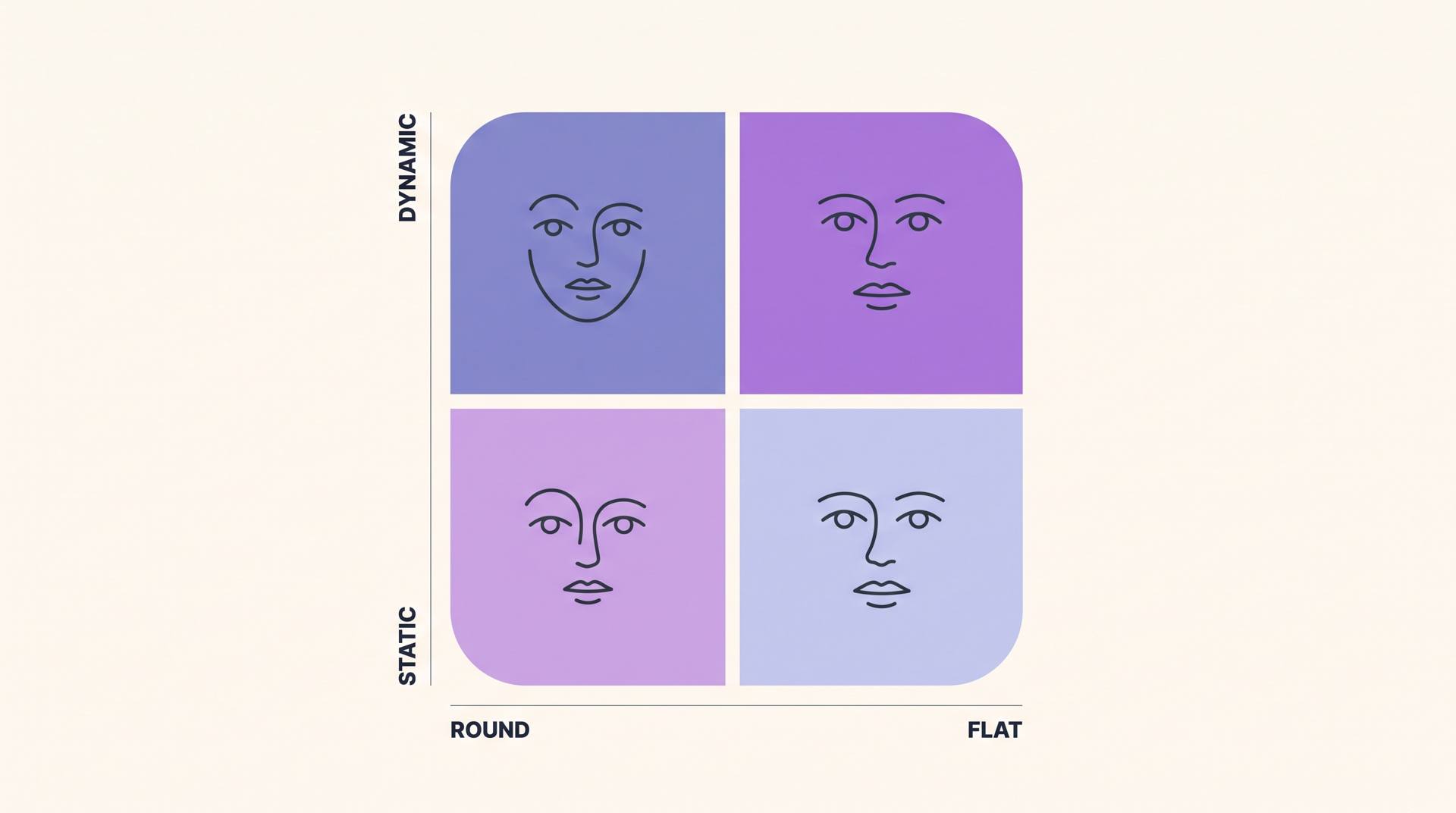
The practical upshot: when a beta reader says a character felt thin, ask which axis they mean. "Nothing happened to her" is a change problem. "She only ever does one thing" is a flatness problem. The fixes are opposites, and the wrong one adds a subplot to a character who needed a contradiction.
We take the change axis apart separately in the guide to dynamic character examples, and the single-trait side in flat character examples.
Rounding a flat character in four moves
Here is a character from nobody's novel: Sheriff Dale Mercer, who is gruff. That is the whole character, and it is the state ninety percent of secondary characters arrive in. Four moves fix it, and none of them requires a new scene.
Before
Mercer grunted and pushed the file across the desk. He had never been a talker.
Move
Give him one contradiction, not one quirk
Find something he does that the one-line summary cannot explain — not an eccentricity, a behaviour that argues with the surface. The gruff man who is secretly soft is a cliché. The gruff man who is organised about being soft is a person.
The diner tab under the register in Mercer's handwriting went back eleven years, and he had told Ruth twice, in writing, that it was a clerical matter and not to discuss it.
Move
Give him a private want that is not the plot's want
Round characters want something the story is not about. It gives every scene a second current, because he is pursuing his own agenda underneath yours.
Nineteen years in and what he wanted, precisely, was to lose. Not to resign — to be beaten, cleanly, by someone competent, so that leaving would be a thing that happened to him.
Move
Give the surface a history that explains it
Make the gruffness a consequence rather than a trait. One specific event, mentioned once, never explained again. The reader does the rest and enjoys doing it.
He had been a talker until the year he drove out to his brother's place with a warrant and came back with his brother in the cage.
Move
Make him choose something that costs him
This is the move that converts setup into roundness: put the contradiction and the private want on a collision course and force a decision. Forster's convincing surprise happens here or not at all.
So when the crowd came up the steps for the man in cell two, Mercer stood in the doorway with his hands empty and talked for forty minutes, and in doing it he won the election he had spent four years quietly trying to lose.
Four sentences of new material and Mercer can surprise you. He is still gruff — the one-line summary is still true — but it is no longer sufficient, and that is the entire definition.
Want to run the same four moves on a character of your own without staring at a blank field? Our free character creator takes a role and a premise and hands back a profile with motivation, conflict and arc already filled in — something to argue with rather than invent.
Three mistakes that fake roundness
Quirks stacked on a flat base
A limp, a catchphrase, a peculiar breakfast and a dead wife are four pieces of decoration on one unchanged trait. Decoration makes a character memorable; it does not make them unpredictable. Ask whether any quirk could produce a decision. If not, it is costume.
Backstory dumped instead of revealed
Roundness is demonstrated under pressure, not in a flashback chapter. Readers learn who somebody is from what they choose when choosing is expensive. Three pages of childhood produce a file, not a person. Spend the same three pages on one hard decision.
Rounding the entire cast
This is Forster's own warning and the one most writing advice skips. A novel where everyone contradicts themselves has no fixed points and reads as fog. Round your protagonist, your antagonist, and one or two who carry a theme; make everyone else crisply, deliberately flat — and if you need single traits to build them from, the character flaws list is the fastest place to shop.
Keeping a round character consistent across 40 chapters
Contradiction is easy to invent and hard to hold. The failure mode in a long draft is not a shallow character; it is a deep one who quietly flattens around chapter fourteen because you stopped remembering what she was hiding.
That is the job the Characters step in AIWriteBook's book creation flow does. Each character card carries its own Motivation, Internal Conflict, External Conflict, Stakes, Character Arc and Voice & Speaking Style — and Internal Conflict is literally the field the contradiction lives in. Those cards travel with the book: chapters are written against them, and you can open them as a Story Bible from the chapter editor sidebar, so the sheriff who wants to lose in chapter three still wants it in chapter thirty.
Fill a card in yourself, generate one from the book description, or hand an existing card back with Edit with AI when a character needs sharpening rather than replacing. When you move on to drafting, the chapter generator writes against those same records instead of re-inventing the cast each time.
For backstory frameworks and arc-building around those same fields, our character development guide goes further than this page does.
Questions writers actually ask
Round describes complexity at a single moment: the character holds contradictions and cannot be summed up in one line. Dynamic describes change across the book: the character ends with different beliefs than they started with. Sherlock Holmes is round and static. A minor henchman who switches sides is dynamic but flat. Most protagonists are both, which is why the terms get conflated.
Where to take this next
Round character examples stop being useful the moment they turn into a reading list. What the six above are worth to you is the mechanism. Elizabeth misjudges because she is proud of judging. Gatsby is sincere about something fake. Mercer wants to lose. Find the sentence that argues with itself, then write the scene that forces a choice between its halves.
If your cast is already assembled: run the four moves on your two most important secondary characters, check that move four genuinely costs them something, and leave everyone else flat on purpose.
For where character work sits in the rest of the process — premise, outline, drafting, revision — start from our complete guide to how to write a book. If characters are the specific thing you are stuck on today, go sideways instead into character arcs or foil characters.