

Where the method comes from
Randy Ingermanson is a physicist who writes novels, and the snowflake method reads like it. He published it on his site in the early 2000s as a free article, it spread through writing forums for a decade, and he eventually expanded it into a book, How to Write a Novel Using the Snowflake Method. The core article is still free, which is part of why the method is everywhere.
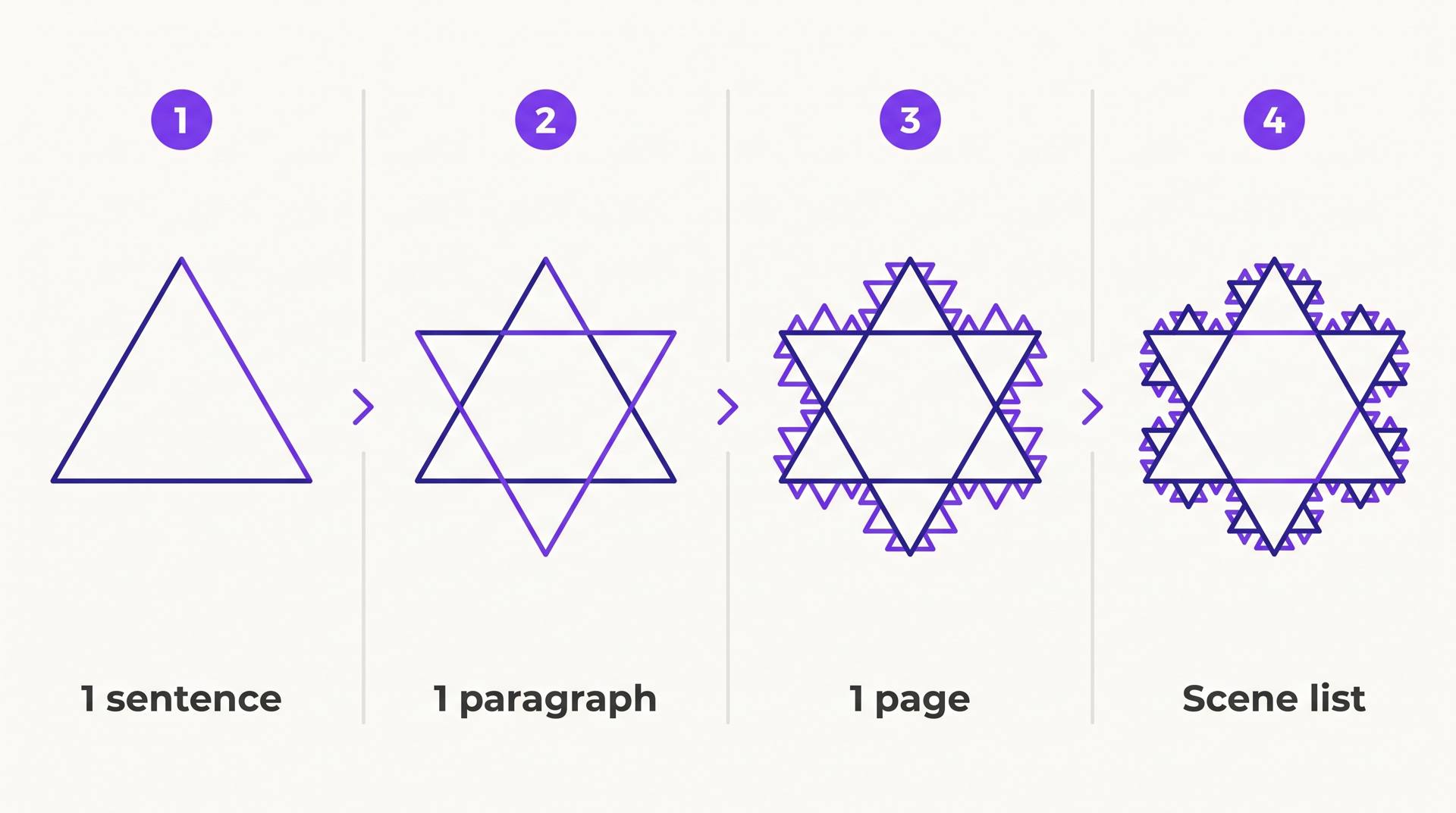
The name is borrowed from the Koch snowflake, a fractal you build by starting with a triangle and adding a smaller triangle to the middle of every edge, over and over. After one pass it is a star. After five it looks like frost on a window. Nothing is ever replaced — each pass only adds detail to what is already there.
That is the whole argument for the method. A novel written this way is never redesigned, only magnified. If the one-sentence summary is sound, the paragraph inherits it; if the paragraph is sound, the page inherits it. And when something is wrong, you find out while the story is still a sentence, when fixing it costs ten minutes instead of forty thousand words.
The ten steps
Ingermanson's sequence is fixed, and the order matters more than it looks — each step is fed by the one before it. Click through to see what each step actually produces, roughly how long it takes, and the thing that most often goes wrong.
One-sentence summary
What you produce
A single sentence of fifteen words or fewer that describes the whole novel.
Roughly how long
One hour, and it should take that long.
The tip that matters
Refer to characters by role, not by name. "A lighthouse keeper" tells a stranger something; "Ida" tells them nothing. If the sentence needs a proper noun to make sense, it is doing too much.
One premise, three steps, real text
Abstract instructions are easy to nod along to and hard to apply, so here is a premise nobody has written yet, run through the first three steps with the actual output rather than a description of it.
Step 1 — the sentence
A lighthouse keeper finds her missing sister's boat adrift and tells nobody.
Twelve words. No names, no setting, no theme. It has a protagonist, an event, and a choice — and the choice is the reason it is a novel and not an anecdote.
Step 2 — the paragraph
- 1
Setup: nine months after her sister vanished at sea, Ida keeps the light on an island that will be automated in the spring, and has stopped expecting anyone to explain what happened.
- 2
Disaster 1: a storm pushes her sister's dinghy onto the rocks below the light, dry inside and undamaged, and Ida drags it into the boathouse instead of radioing the coastguard.
- 3
Disaster 2: a marine investigator arrives to close the file, and the lie Ida told about the night of the disappearance — told once, to be kind — makes her the reason the file stays open.
- 4
Disaster 3: she finds her sister alive in a mainland town under another name, and learns the disappearance was staged to escape a debt Ida co-signed and never mentioned.
- 5
Ending: Ida testifies, loses the sister she spent nine months mourning, and stays on to work a light that no longer needs a keeper.
Notice what each disaster does to the protagonist's plan. After the first, she cannot keep grieving quietly. After the second, she cannot tell the truth without consequence. After the third, she cannot protect her sister and herself with the same decision. A complication makes life harder; a disaster makes the previous plan impossible. If your three sentences fail that test, you have three complications.
Step 3 — a character summary
Ida Halloran, 41, lighthouse keeper
- Storyline: covers up evidence of her sister's survival, then chooses the truth over her.
- Motivation: to be the one person who did not give up on Nora.
- Goal: keep the inquest closed and the boat unfound.
- Conflict: every act of loyalty to Nora is an act of obstruction against the investigator, and Ida is bad at lying.
- Epiphany: loyalty to a person who staged her own death is not loyalty, it is a second disappearance — her own.
That is roughly a quarter of the page Ingermanson asks for, and it is already enough to know what Ida does in a scene she has not been written into yet. That is the test for a step 3 summary: could you write her reaction to a knock on the door at 2am without inventing anything new?
Who this actually suits
The snowflake method is a plotter's instrument, and it makes no apology for it. If you are the kind of writer who wants the structural argument settled before the prose starts — who would rather discover a broken second act in a five-sentence paragraph than in chapter nineteen — it is probably the best-designed outlining system in general circulation. It is also unusually good for long, multi-thread books, because the expansion steps force every thread to justify its page count before it earns one.
If you write to find out what happens, it will feel like being asked to describe a meal you have not eaten. Discovery writers generally report the same thing: by step 6 the book feels finished, and the draft becomes transcription. There is no virtue in forcing it. The productive compromise is to run steps 1 to 3 — the sentence, the paragraph, the character summaries — and then start writing, treating the paragraph as a direction rather than a contract. You get a spine and a destination without pre-spending the discovery.
It is also worth knowing what the method does not give you. It is a structure generator, not a beat sheet: it tells you that three disasters must escalate, but not where in the word count they should land. If you want the percentages, the three-act beat map pairs with it well, and five-act structure gives a finer-grained version for books with a long middle. And if the snowflake's rigidity is the problem rather than the solution, our comparison of outlining methods walks through the alternatives — beat sheets, the index-card method, and reverse outlining — so you can pick one that fits how you actually work.
Writing is like driving at night in the fog.
The snowflake method is an argument with that sentence. Ingermanson's bet is that you can map the road in advance and still have something left to discover on it — and for most plotters, the bet pays.
Where writers get stuck
Three failure points account for nearly every abandoned snowflake outline, and all three are avoidable once you know their shape.
Step 2, the three disasters
This is the bottleneck, and most people sail past it without noticing. They write three things that go wrong — a betrayal, a storm, a missed train — and move on to step 3 feeling productive. But a disaster in Ingermanson's sense forces the protagonist to abandon a plan and adopt a worse one. The test is mechanical: state the protagonist's plan before each disaster and after it. If the plan is the same, the disaster is decoration, and no amount of expansion in steps 4 and 6 will give the book a middle.
Step 8, the spreadsheet trap
The scene list is the step that most resembles real work, which is exactly why it swallows weeks. Writers add columns — mood, weather, theme, colour coding, word-count targets by percentage — until the spreadsheet is a project of its own. Ingermanson's version is deliberately thin: who the POV character is, what happens, and how long it runs. If you are colour-coding emotional beats and the draft is not started, the spreadsheet is no longer serving the book.
Step 10, the one nobody reaches
The method is dangerously satisfying. Nine of its ten steps produce a visible artefact in a single sitting, with none of the exposure of writing actual prose, and that is a comfortable place to live. The correction is a calendar one: decide the date you start step 10 before you write step 1, and treat everything after it as revision material rather than a prerequisite. A four-page synopsis nobody turns into chapters is a very tidy way of not writing a novel.
One more, quieter failure: outlines that run on plot alone. Steps 3, 5 and 7 are all character steps, and skipping them because plot feels more urgent is the most common way a snowflake outline produces a structurally sound book nobody finishes reading. If those steps feel thin, how character arcs are built is the deeper version of what step 3 is asking for.
Running the snowflake inside AIWriteBook
If steps 1 through 8 look familiar to anyone who has used AIWriteBook, that is not a coincidence: the book creation flow is built on the same escalation. You give it a premise — the step 1 sentence, near enough — then work through characters, then an outline, then chapters, with each stage inheriting the one before it rather than starting fresh. The two useful differences are that expansion happens in seconds rather than over a week, and that the intermediate artefacts stay editable, so changing a character's motivation at step 3 and regenerating the outline is a normal thing to do rather than a week's rework.
In practice the mapping goes like this. The outline builder covers steps 2, 4 and 6 — it takes a premise and produces a chapter-by-chapter structure you can rearrange, split, or rewrite by hand; expanding a one-line chapter into a full scene breakdown is the snowflake expansion, compressed. The plot generator is the step 2 helper: give it your setup and it proposes escalating turns, which is genuinely useful when your three disasters keep coming out as three complications. Characters get their own records with motivation, goal and arc fields — step 3 and step 7, in the same place — and they carry through into every chapter the book writes.
You do not need an account to try the shape of it. The free outline generator takes a premise and returns a structured outline in about a minute, which is the fastest way to find out whether your step 1 sentence is actually a novel or an anecdote. If the outline that comes back is thin, the sentence was thin — and that is a much cheaper diagnosis than four pages of synopsis.
And if you want the operational version of all this rather than the theory, our walkthrough of building a novel outline with AI runs the same sequence end to end on a single book.
Free to start. No card needed.
Common questions
Add up the rough per-step times Ingermanson gives and steps 1 through 8 come to something like a month of part-time work: an hour each for the first two steps, an hour per character for step 3, an afternoon for step 4, and about a week each for steps 6, 7 and 8. The character work and the four-page synopsis are where the time actually goes. Writers who only run steps 1 to 3 before drafting can be writing prose the same weekend.
The part worth keeping
Strip the method back and one idea survives everything else: fix the story at the smallest size it can be fixed at. Whether you run all ten steps or three, the discipline of making a sentence work before a paragraph, and a paragraph before a page, is what stops a book from collapsing in its second half.
If you are early enough that structure is still an open question, our full guide to writing a book covers the decisions that sit around this one — premise, length, genre expectations, and getting the finished draft out the door.