

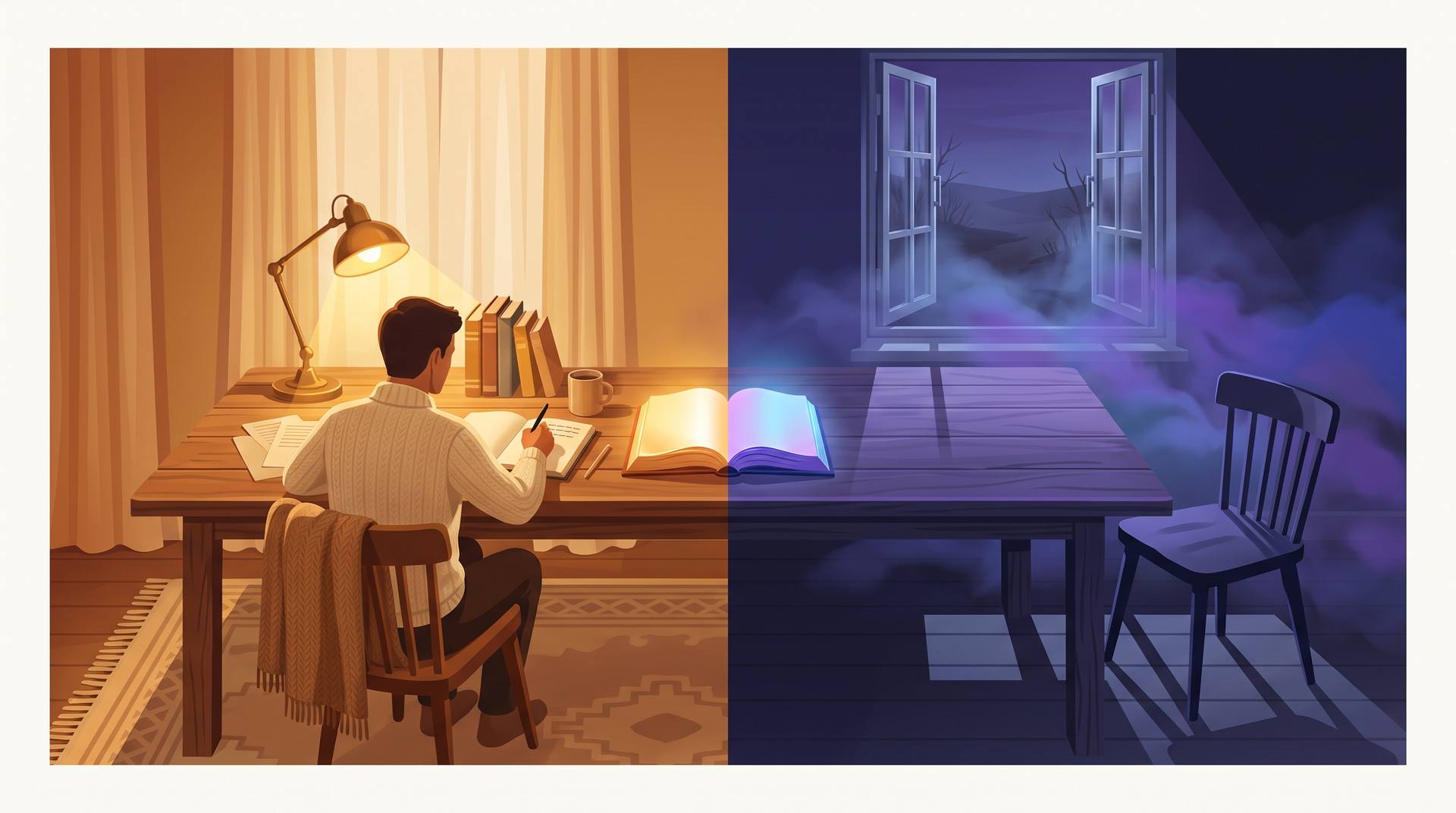
The difference, precisely
Tone is the writer's attitude toward the subject, carried in word choice. Mood is the emotional atmosphere the reader experiences, carried in setting, weather, sensory detail, and pacing.
The quickest way to keep them apart is to finish two sentences about the same paragraph. "The narrator sounds ___" gives you tone: wry, bitter, reverent, exhausted, fond. "Reading this makes me feel ___" gives you mood: uneasy, cozy, claustrophobic, hopeful. If your two answers are the same word, you have probably only diagnosed one of them.
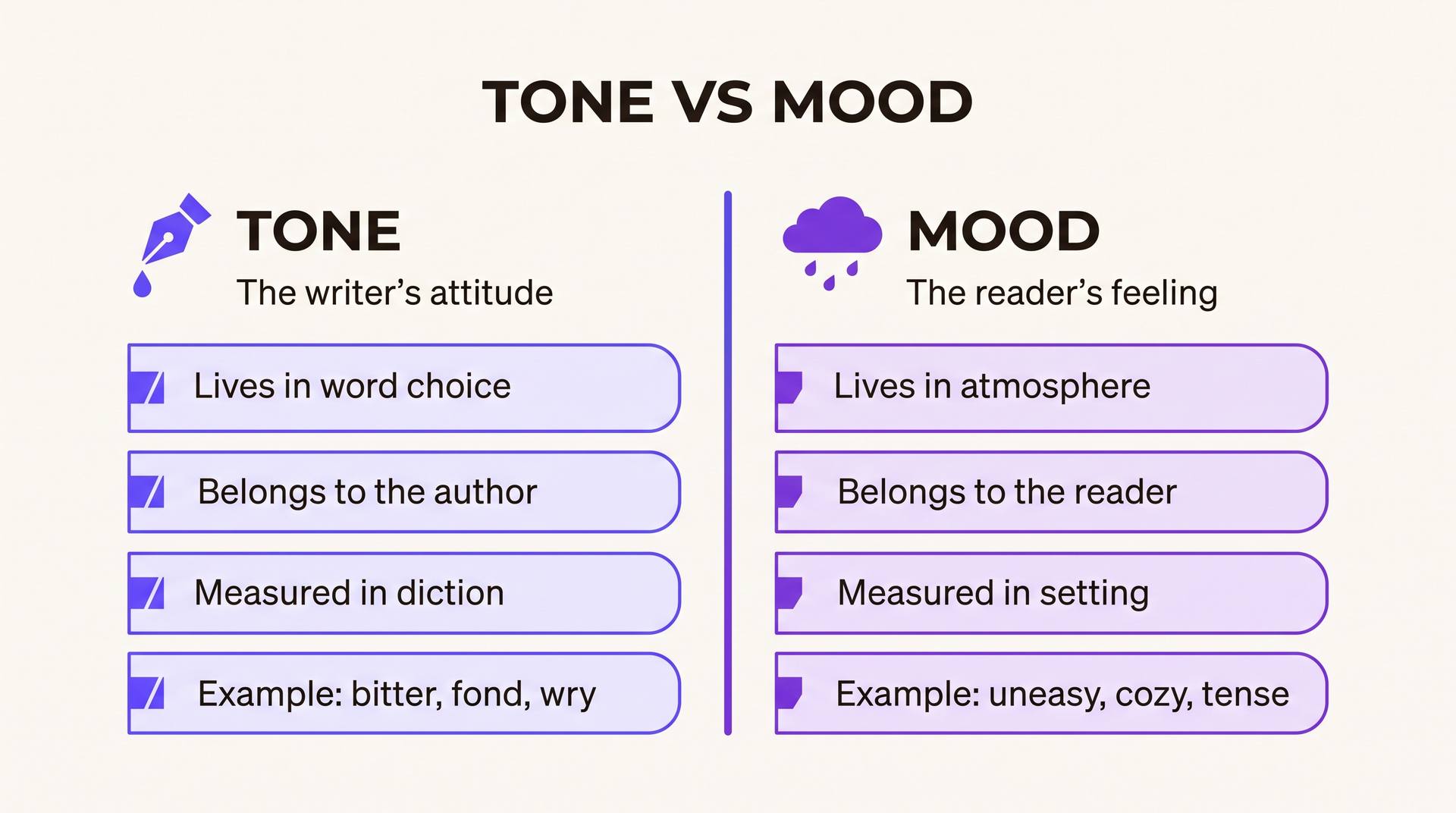
They are separate dials, and they do not have to point the same direction. A cheerful narrator describing a funeral produces a specific kind of horror precisely because tone and mood are pulling apart. Comic novels about war live in that gap. So does most effective dramatic irony.
Tone is also the more portable of the two. Mood usually needs a scene to live in, but tone travels in a single clause. Change "the house waited" to "the house sat there, doing nothing in particular" and nothing about the setting has moved, yet the narrator has visibly changed their mind about the house.
Three famous examples
The clearest way to see the two dials is to look at openings where one of them is doing almost all the work, and then at one where both are.
It is a truth universally acknowledged, that a single man in possession of a good fortune, must be in want of a wife.
Almost pure tone. There is no weather, no room, no sensory detail at all. The whole effect comes from diction: "universally acknowledged" is the language of settled fact applied to gossip, and the mismatch tells you exactly how amused the narrator is by the people she is about to describe.
During the whole of a dull, dark, and soundless day in the autumn of the year, when the clouds hung oppressively low in the heavens, I had been passing alone, on horseback, through a singularly dreary tract of country.
Almost pure mood. Poe stacks a light condition, a sound condition, a season, a cloud ceiling, and a landscape before anything happens. The narrator barely has an attitude yet; the reader already has a feeling.
It was a bright cold day in April, and the clocks were striking thirteen.
Both at once, in thirteen words. The mood is wrongness, produced entirely by a clock that counts past twelve. The tone is flat, reportorial calm, and it is the calm that makes the wrongness land, because the narrator does not think it is worth remarking on.
Notice what the Poe passage costs. Fifty words of atmosphere before a single event is a bargain a nineteenth-century reader was happy to make and a contemporary thriller reader is not. Mood is not free; it is paid for in pace. That is the real trade-off nobody mentions when they tell you to add more atmosphere.
Tone and mood in context
Both are built from the same raw material, so the practical skill is knowing which lever moves which dial. Here is one scene rendered three ways with no change to the plot facts: a character walks up a lane to a house at dusk.
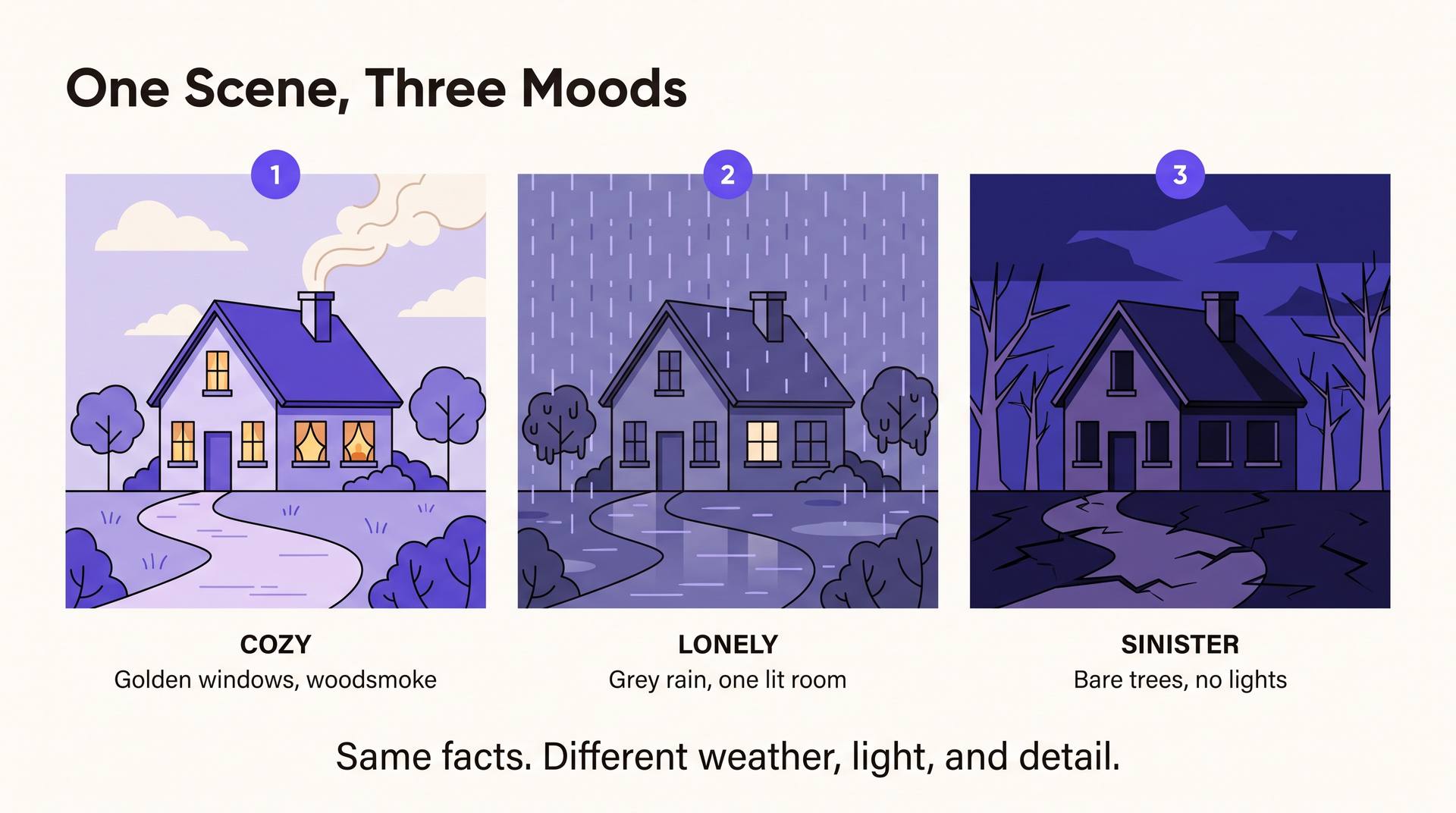
What moves each dial
- Diction
- Moves tone. "Squatted" and "nestled" describe the same house in the same position and disagree completely about it.
- Sensory selection
- Moves mood. You cannot list everything in a room, and whatever you choose to list becomes the room. Woodsmoke and lamplight build one house; damp brick and a dripping gutter build another.
- Sentence length
- Moves both. Short sentences read as urgency to the reader and as impatience from the narrator.
- Weather and light
- Moves mood almost exclusively, which is why it is overused. Rain is the cheapest atmosphere in fiction and the least distinctive.
- What the narrator notices
- Moves both, and it is the most underrated lever. Attention is characterisation. A narrator who notices the cracked step before the lit window has told you something about themselves and set the mood in the same clause.
If you want to feel the difference rather than read about it, our free AI scene builder takes a mood as an explicit input alongside the characters and the setting, so you can generate the same lane-and-house beat as cozy, then as ominous, and compare which words actually changed. It is a faster diagnostic than rewriting the paragraph three times by hand.
The exercise is worth doing once on a scene from your own draft. Most writers discover that their mood range is narrower than they thought, and that they reach for the same four sensory details in every atmospheric passage.
Five mistakes
Naming the mood instead of building it
"The room felt eerie" is a label, not an atmosphere. Mood is the reader's reaction, so you cannot assign it directly. This is the specific case where show, don't tell is not a stylistic preference but a mechanical requirement.
Letting tone drift between chapters
Drafts written over months carry the writer's real moods in them. A chapter written in a good week sounds fond about a character the rest of the book resents. Readers register this as inconsistent characterisation of the narrator, even though they rarely name it.
Matching mood to plot too tightly
If the weather is bad whenever the news is bad, the atmosphere stops informing and starts announcing. Deliberate mismatch is more interesting: a betrayal in bright sunshine, a reconciliation in fog.
Confusing mood with voice
Voice is the permanent identity of the narration. Tone shifts scene to scene inside a stable voice, and mood shifts faster still. A book with one mood from start to finish is monotonous, not consistent.
Buying atmosphere with adjectives
Three adjectives in front of a noun is a writer insisting on a feeling rather than producing one. Mood built from concrete nouns and verbs survives editing; mood built from modifiers does not. If you want more on the sensory side of this, the seven types of imagery covers which senses do the heaviest lifting.
When to push, when to leave it
Atmosphere is not a virtue in itself. It has a cost in pace and a genre-specific ceiling.
Push mood hard
Openings, thresholds, and any scene where the reader needs to be primed before information arrives. Horror and gothic fiction run on it. So does the quiet chapter after a catastrophe, where nothing happens and everything is felt.
Push tone hard
First-person narration, comedy, satire, and unreliable narrators. When the reader's interest is in who is telling the story rather than what happens next, tone is the plot.
Pull both back
Action beats, revelations, and dialogue exchanges that carry information. Atmosphere during a fight reads as the camera looking away. Let the scene move and put the mood work in the paragraph before and the paragraph after.
Leave it alone entirely
Procedural chapters and most non-fiction. A how-to chapter needs a consistent, trustworthy tone and essentially no mood at all. Atmosphere in a set of instructions is noise.
Genre sets the default. Cozy mystery and literary fiction tolerate long atmospheric passages; commercial thrillers and most romance do not, and their readers will skim. In dialogue-heavy genres the atmosphere generally has to be carried in the gaps between lines rather than in description, which is a separate skill covered in our guide to writing natural dialogue.
Getting AI to hold a tone
The standard complaint about AI-written fiction is that it sounds pleasant and means nothing, and that is a tone failure specifically. Generic models default to a warm, agreeable, slightly explanatory register regardless of what the scene needs. If you do not set the dial, the dial sits at neutral.
AIWriteBook makes tone an explicit input rather than something you hope for. When you set up a book you pick tones from a chip list, and you can pick several: bittersweet plus wry, or ominous plus tender. That selection is described in the app as the emotional atmosphere across the book, and it is a separate field from Writing Style, which governs how chapters are structured and paced. Two dials, set independently, exactly as they work on the page.
There is a third input that matters more than either: the optional Author Writing Style sample. Paste a few paragraphs of your own prose, or a plain description of the register you want, and it is carried through the draft. This is the difference between asking a model to write something bitter and showing it what your bitter sounds like.
For fixing tone in a chapter you have already written, the in-app chapter chat is the tool. You ask for the change in plain language, and the edit comes back as a diff you accept or reject line by line, so a tone pass does not quietly rewrite your plot. For a single stubborn paragraph, the free paraphrasing tool will rephrase it without you having to open the book.
Questions writers ask
Often, and that is fine. A grieving narrator describing a grey afternoon has a sad tone and a sad mood, and the scene works. The reason to keep the terms separate is that when a scene is not working, knowing which of the two is flat tells you whether to change the words or change the setting.
Yes, and it should. Tone tracks the narrator's evolving attitude, so a narrator who feels the same about their subject on the last page as the first has not been changed by the story. What should stay stable is voice.
Read it and note your physical reaction before you analyse anything. Tightness, ease, impatience, dread. Then go back and find which concrete details produced it. There are usually fewer than you expect, often two or three, and the rest of the passage is doing other work.
No. Theme is what the book is arguing; mood is how it feels minute to minute. A novel can maintain a warm mood while making a bleak argument, and the contrast is frequently the point.
The short version
Tone is what you think of the thing. Mood is what the reader feels while you describe it. Tone is edited at the level of the word, mood at the level of the detail you chose to include. When a scene reads flat, ask which dial is at zero before you rewrite anything, because the fixes are not interchangeable: a mood problem never gets solved by finding a better adjective.
Both are craft decisions you make early and then defend for eighty thousand words, which is the genuinely hard part. Our guide to writing a book covers where those decisions fit in the wider process, from outline through to publishing.