

Why action scenes confuse readers
A reader inside an action scene is answering three questions all the time, mostly without noticing. When all three answers are clear, the reader runs alongside the character. When one goes missing, they drop out of the story to reconstruct it, and that reconstruction feels like slowness, even in the fastest prose.
Where is everyone?
What does the viewpoint character want in the next ten seconds?
What is in the way?
Film answers the first question for free, because the camera shows the room. Prose has to build the room in the reader's head with words, and it has to do so before the action starts. There is no time to describe a staircase while someone is falling down it.
The ten-second test
Stop at any paragraph of your action scene. If you can't answer all three questions from the text alone, without your own knowledge of the plan, the reader can't either.
The core method: give every action scene a spine
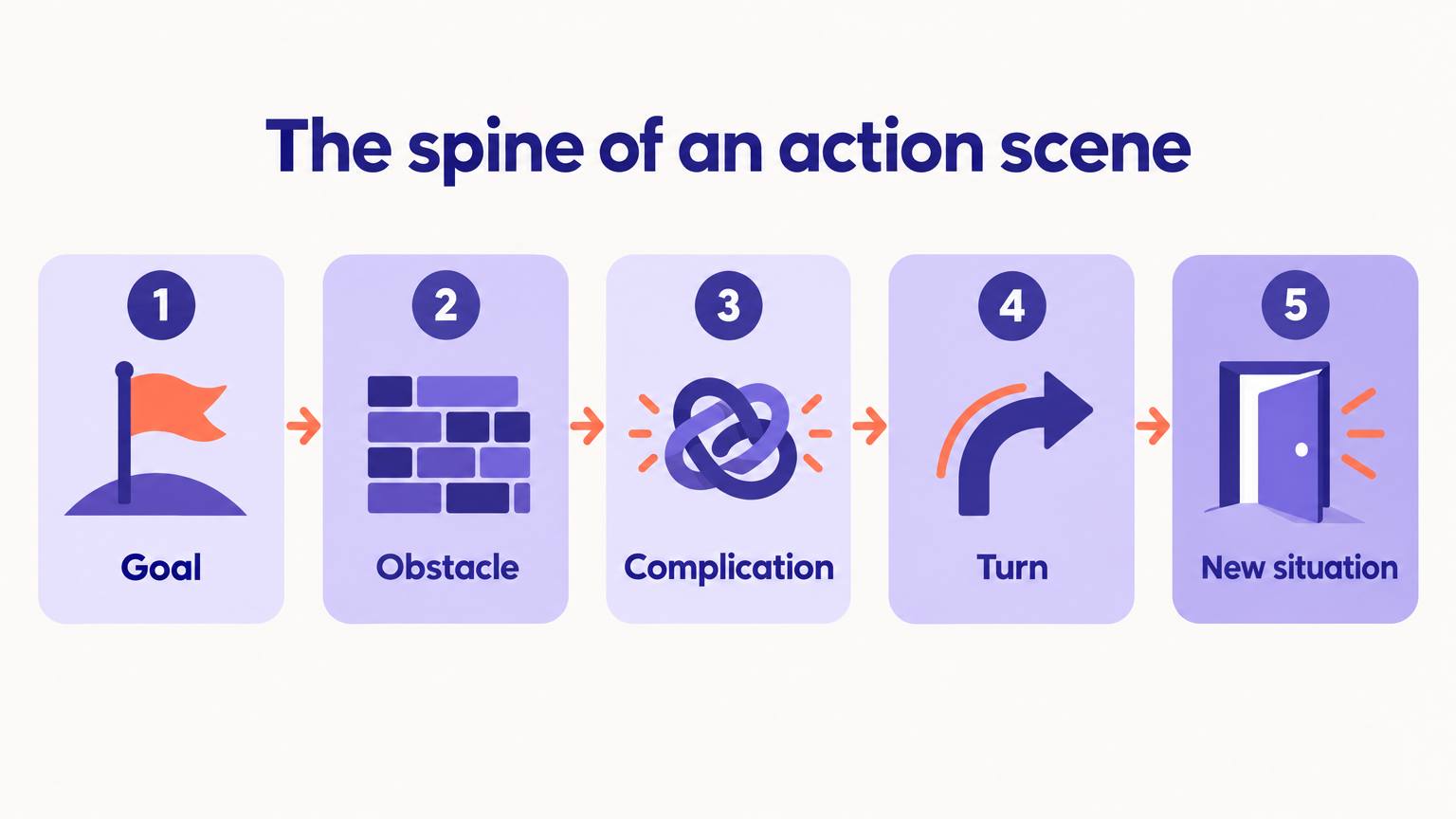
Action reads as noise when it is a list of things happening. It reads as story when it follows a spine, the same five moves at any scale, from a two-page escape to a forty-page heist.
- 1
- Goal. One concrete, visible objective. Reach the boat. Get the drive out of the server room. Not "survive".
- 2
- Obstacle. The specific thing in the way, shown before the character reaches it whenever possible.
- 3
- Complication. The plan breaks. Something the character didn't account for, or a forced choice between two bad options.
- 4
- Turn. The character does something that changes the situation, using what the scene has already shown.
- 5
- New situation. The scene ends with the character somewhere different, physically and in the plot. Escaped, but separated. Got the drive, but now they know who took it.
The turn is where most action scenes are won or lost. If the solution uses something the reader saw earlier, a fire escape mentioned on the first page or a forklift parked by the door, the turn feels inevitable and earned. If it uses something invented in the moment, it feels like the author stepped in. That is the action-scene version of Chekhov's gun.
Six steps, in order
Most of this happens before you write a line of prose.
- 1
Block the space
Draw the location, even badly. Mark the exits, the obstacles, anything that can break or be used, and where every character starts. Three to five fixed landmarks is the range most readers can hold; beyond that they stop tracking.
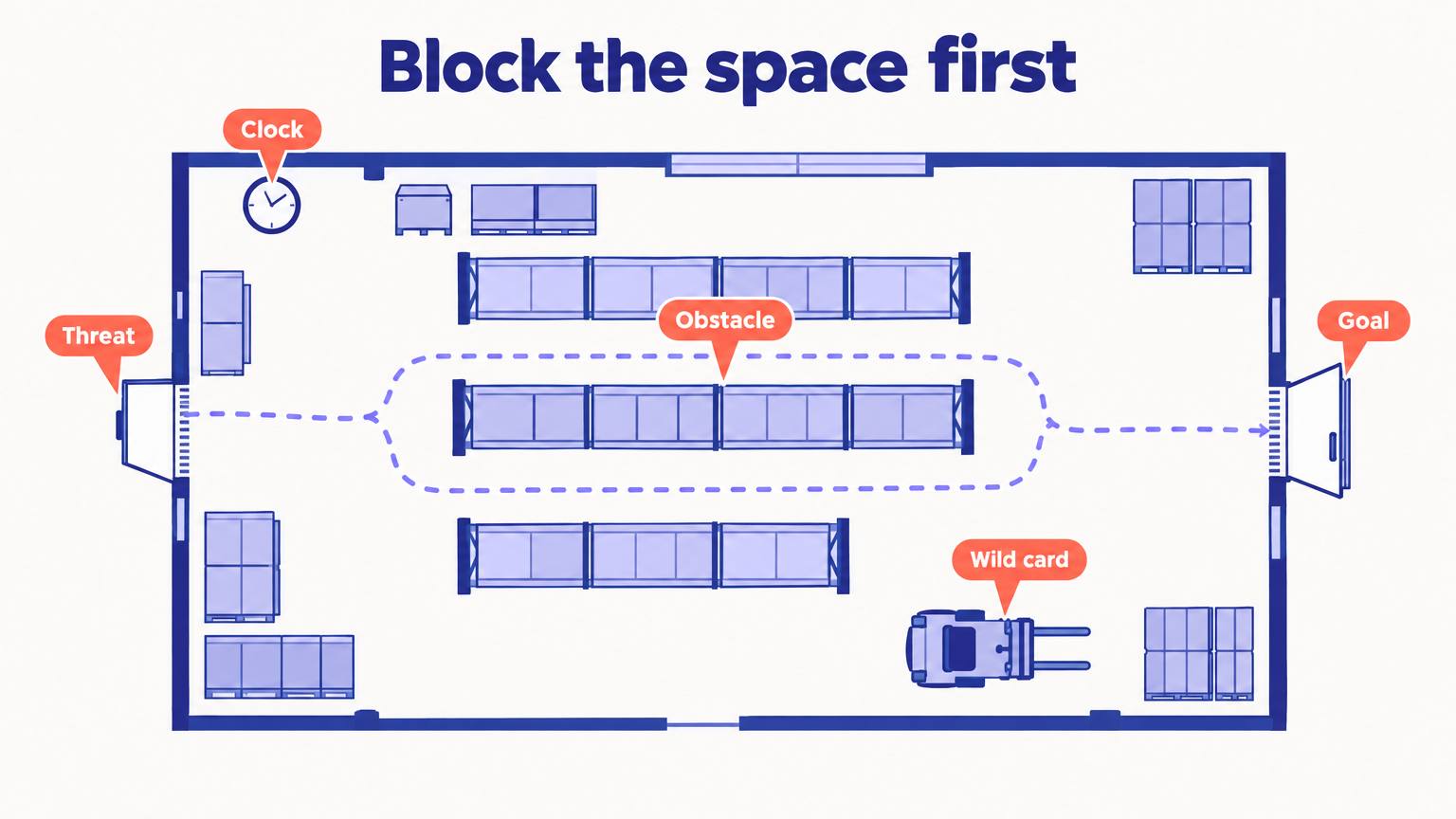
Five pins are enough. Everything the scene needs later is on the plan before the first footstep. - 2
Plant the landmarks early
Introduce those landmarks in a calm moment before the action: as the character walks in, sizes up the room, or waits. One sentence each. Once things move, you can refer to "the shelves" or "the loading bay" without stopping to explain.
- 3
Set the goal and the clock
Give the scene one goal and, where it fits, one deadline the reader can see. A clock does more for urgency than any sentence-level trick, because every paragraph spends some of it.
- 4
Pick one viewpoint and keep the camera in it
Action told from inside one body is easier to follow than action seen from above. The character can't see everything, and that helps: what they can't see becomes the threat.
Holding one viewpoint under pressure is a skill of its own; our guide to third person limited covers how to do it without slipping.
- 5
Draft the spine as beats
Write goal, obstacle, complication, turn and new situation as five one-line notes before any prose. Longer sequences repeat the obstacle and complication pair several times, each round worse than the last.
- 6
Write, then cut what the reader would supply
Draft loose, then delete every movement the reader would infer: standing up, turning around, opening an unlocked door. Keep the moves that change position or cost something.
Action beyond fights: what each kind of scene needs
The spine holds for every kind of action, but the clarity problem and the source of tension change from one type to the next. Pick a type.
The distance between them is the story
A chase is one number changing: the gap between pursuer and pursued. Every beat should widen or close it, and the reader should always have a rough sense of its size. Terrain is the other character. A chase through a market differs from one through a parking garage because of what each place offers to hide behind, climb or knock over.
Clarity trick
Report the gap in concrete terms after each turn: footsteps closer, a shout from one floor down, headlights two cars back.
Watch for
Chases that change direction for no reason. Every turn needs a cause the reader can see: a blocked street, a locked gate, a choice.
An escape scene, before and after
Here is a draft that is grammatically fine and nearly impossible to follow, then the same moment with the space blocked and the spine in place. It uses the warehouse from the floor plan above.
Before
Lena ran into the warehouse. Behind her, the men burst through the door. She ducked behind something and then ran to the left, past some boxes, toward where she thought the other exit might be. One of them shouted. She climbed up onto something and jumped across to the other side, then dropped down and kept running. The door was locked. She turned around. They were coming. She saw the forklift and had an idea.
After
Two ways out of the warehouse: the street door she had come in by, and the loading bay at the far end, its shutter half up. Between them, three rows of shelving and a forklift with the keys still in it. The street door banged open behind her. Lena went down the middle row, low, counting uprights. Seven. Eight. At the far end the shutter began to fall; someone had hit the switch, and it was already at waist height. She would not make it on foot. The forklift was ten steps to her right.
What changed
- The space is built in the first two sentences: two exits, three rows, one forklift. Everything after refers back to something already placed.
- The goal is concrete: the loading bay, not "where she thought the other exit might be".
- The complication is visible and timed. A falling shutter is a clock the reader can watch.
- The forklift is planted before she needs it, so the turn in the next paragraph will feel earned rather than convenient.
- "Something" and "the other side" are gone. Vague nouns are the fastest way to lose a reader in action.
Before: 75 words. After: 95. The second version is longer and reads faster, because the reader never has to stop and rebuild the room.
Common mistakes
Describing the space during the action
Stopping mid-chase to describe the architecture kills momentum and arrives too late to help. Move it to the calm before.
Vague nouns and directions
Something, somewhere, the other side, to the left. Left of what? Anchor every movement to a landmark the reader already has.
Action without a goal
If the character only reacts, the scene is a sequence of events rather than a story. Even running away needs a destination.
Solving the scene with something new
A sudden skill, a convenient tool, an ally out of nowhere. The turn should use what the scene already showed; when rescue comes from outside, it is a deus ex machina, and readers notice.
Every scene at full speed
A book of back-to-back set pieces flattens out, because action needs quiet around it to land. Our guide to pacing in fiction covers how to build that contrast across chapters.
The action scene card
Fill this in before drafting. If a line is blank, the scene isn't ready yet.
The AI-assisted shortcut
Blocking the space and choosing the turn are decisions only you can make, because they depend on what the rest of the book has set up. Where AI helps is the step either side of them: generating options before, and cutting after.
The free scene builder takes a setting, a goal and characters and lays out a scene you can mine for complications you hadn't considered. Inside AIWriteBook, the chapter generator drafts from the outline you write, so if your chapter outline already holds the spine, the draft follows your goal, obstacle and turn instead of inventing its own.
For revision, open the chapter in the editor and ask the chapter AI chat for one specific pass: replace every vague noun with a landmark from the opening paragraph, or cut the movements a reader would infer. Each change comes back as a diff you accept or reject, so the scene stays yours.
Clarity first, speed second
Readers forgive slow action they can follow and abandon fast action they can't. Build the space before the scene starts, give the character one visible goal, break the plan once, and solve it with something the reader already saw. Then cut every movement they would supply on their own.
Action scenes are one of many scene-level skills covered in our full how to write a book guide.