

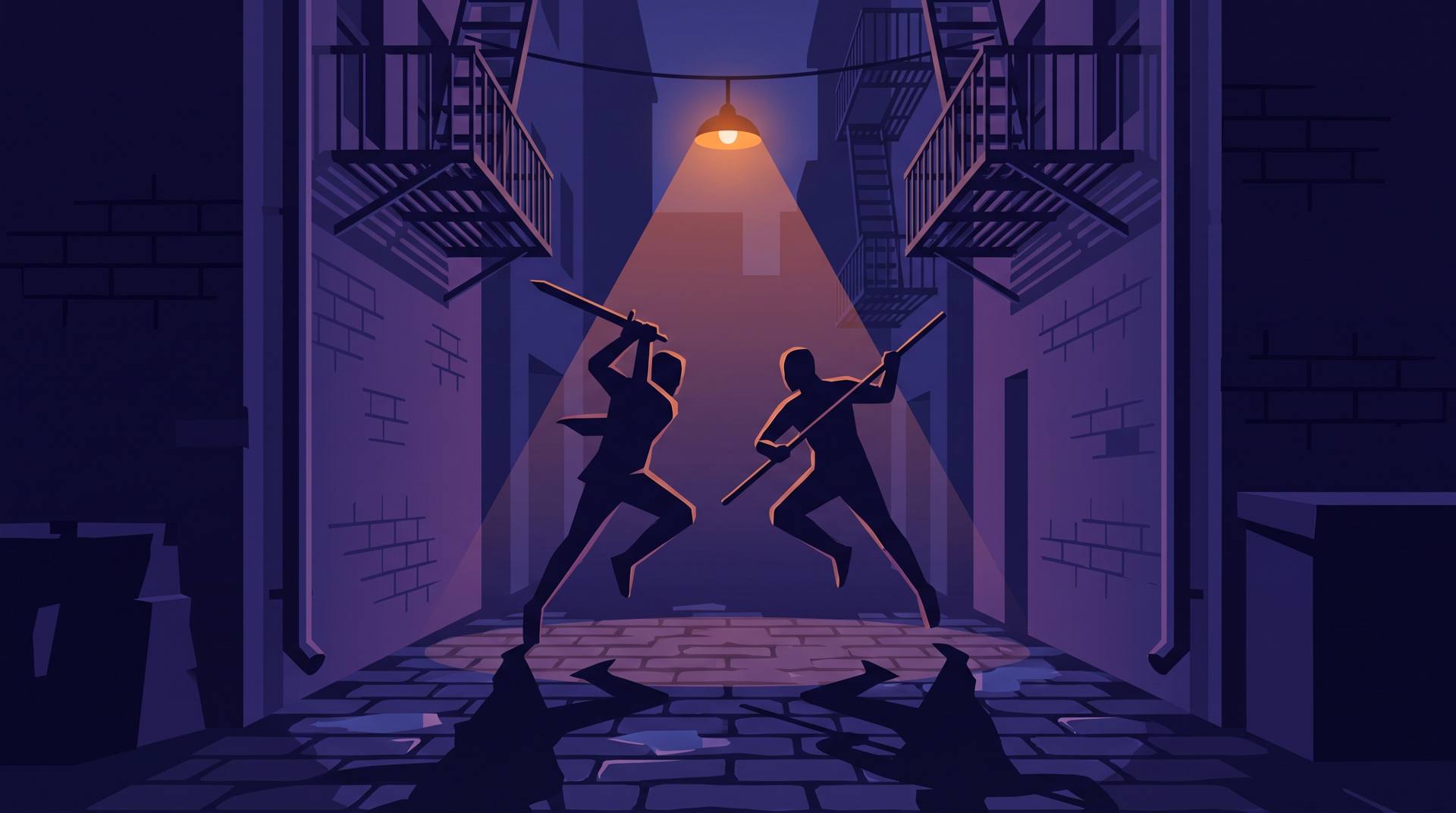
Why most fight scenes fail
A fight scene fails in one of two ways, and usually both at once. The reader loses the geography, or the reader loses the stakes.
Losing the geography means the reader cannot answer a simple question at any given moment: who is where, facing which way, holding what. The prose is grammatical and the verbs are violent, but the picture in the reader's head has gone grey, and they start scanning for the sentence that says who won.
Losing the stakes is quieter and more fatal. If the reader is confident the protagonist survives, and nothing except survival is on the table, every punch is a formality. A fight is tense only when something else is being decided — a friendship, a secret, whether this character is still who they thought they were.
Both failures are structural, not stylistic. You do not fix them by finding better verbs. You fix them by deciding what the fight is about before you choreograph a single blow, and by keeping one clear picture in front of the reader at all times.
The diagnostic
Read your fight aloud and stop at a random sentence. If you cannot immediately say who is standing, who is behind whom, and what the protagonist wants in the next two seconds, the geography has collapsed at or before that line.
The core framework: every exchange is three beats
Choreography sounds like a technical problem and gets treated like one — writers build move-by-move sequences and then wonder why the scene reads like assembly instructions. Stop thinking in moves and start thinking in exchanges. One exchange is three beats: intent, action, consequence.
Intent
What the POV character is trying to do, felt from inside. Not "he decided to punch." Closer to: the doorway is four steps behind the big man, and Marcus wants him out of it.
Action
The attempt itself, compressed. One movement, named plainly. This is the shortest of the three beats and the one writers over-write most.
Consequence
What it cost and what changed. A shifted position, a torn sleeve, a rib that will hurt tomorrow, an opening that wasn't there before. Consequence is where tension accumulates.
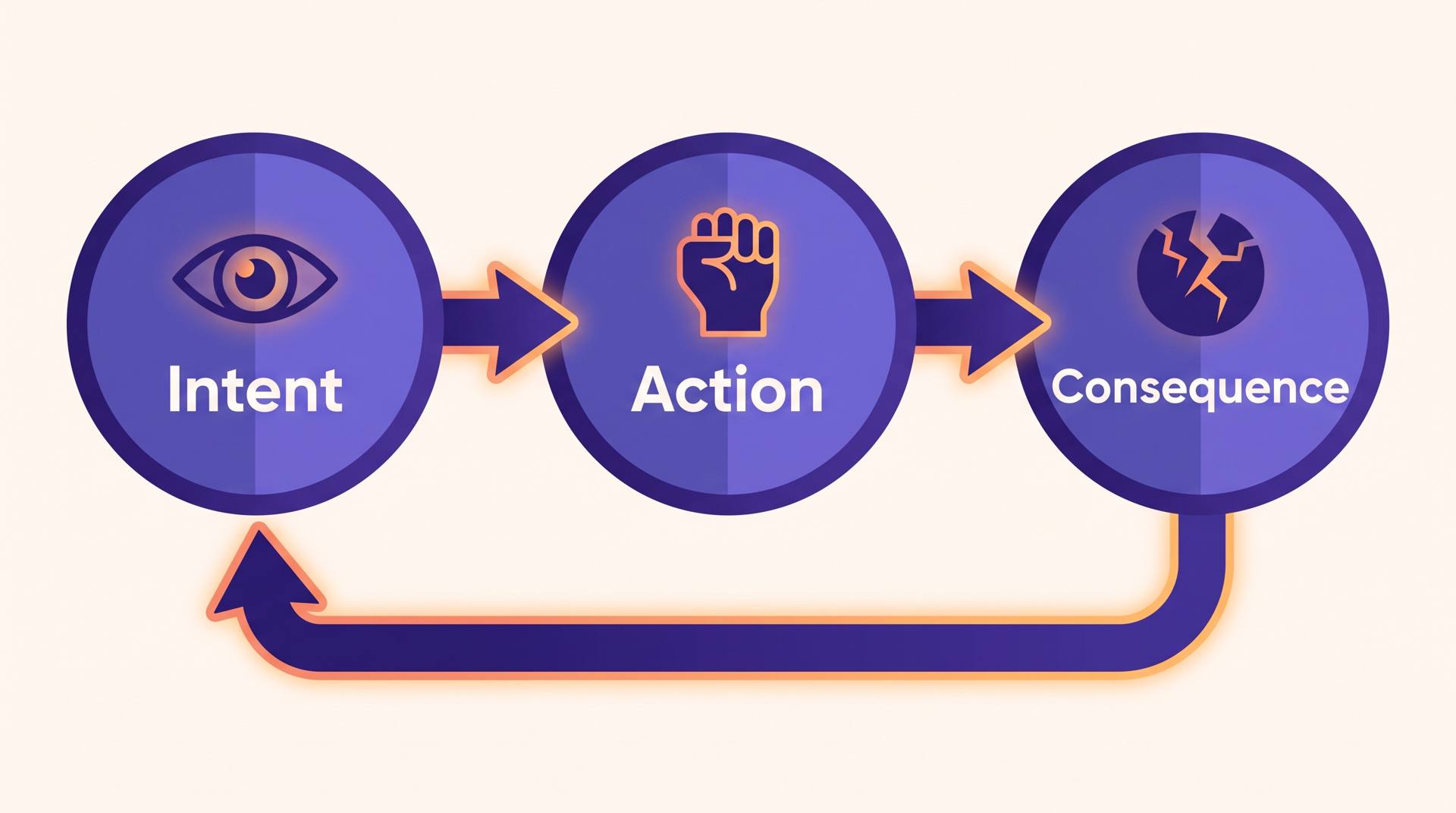
Run three or four of those exchanges and you have a fight. Run twelve and you have a transcript. The compression happens at the action beat: a reader will accept "he went in low" and fill in the rest, but they will not forgive four separate sentences on the block, the counter, the slip and the pivot.
Try to leave out the part that readers tend to skip.
In a fight, the part readers skip is almost always the middle of the choreography — the blocks, the counters, the footwork between the intent and the damage.
The one-clear-picture rule
Every sentence in a fight should leave exactly one image in the reader's head. The moment a sentence carries two — a movement and a memory, a blow and a piece of scenery — the picture blurs and the reader's grip on the space slips. Compound sentences belong in the lulls, not the clinch.
This is the one place where the show-don't-tell instinct can genuinely hurt you: a reader mid-fight needs a fast, flat verb far more than they need an evocative one.
The seven-step method
Work in this order. Most of it happens before you write prose, which is why fights drafted straight into the page so often need rebuilding from scratch.
- 1
Set the stakes before the first blow
Decide what is being decided. Write it as one sentence you never put in the book: "This fight determines whether Marcus can still call himself someone who doesn't start things." If you cannot write that sentence, the fight is decoration and probably belongs offstage.
- 2
Block the space
Sketch the room before the fight, not during it. Where are the exits, the obstacles, the things that break, the thing one of them will reach for at the worst moment? Give the reader the space in the calm paragraph before it starts, so you never stop mid-exchange to explain a table.
- 3
Choose the POV body
A fight is written from inside one body, and that body constrains everything: it cannot see behind itself, it feels pain on a delay, it loses track of time. Third person limited is the workhorse here because it welds the camera to one skull while still letting you name things the character wouldn't.
- 4
Choreograph in beats, not moves
Draft the fight as a numbered list of exchanges — intent, action, consequence — before writing a line of prose. Four to six exchanges carries most scenes. If your list runs past eight, the fight is doing a job that two shorter fights in different chapters would do better.
- 5
Vary sentence length to control pace
Sentence length is the reader's pulse. Short, subject-verb sentences in the clinch; longer, subordinate-clause sentences in the lulls when both fighters are circling or thinking. Do not write the whole fight in fragments — unbroken staccato flattens as fast as unbroken flow.
- 6
Land the injuries honestly
Bodies do not deplete evenly. A broken hand ends a puncher's fight. Adrenaline hides a stab wound for a minute and then doesn't. A concussion is confusion, not a nap. Pick two or three injuries, make them specific, and let them constrain every later scene.
- 7
End on a change
The last line of a fight should report a change of state, not a result. Not "he won." Something like: he is standing in a room he now has to explain. If nothing about the character or their situation is different at the end, cut the scene and write the consequence instead.
Step three deserves its own reading — third person limited explains how to hold a single body's perspective without slipping into head-hopping when the action speeds up.
Steps one and seven matter most when the fight is the book's turning point — our guide to building a climax that lands covers what a scene has to carry at that position in the story.
That seven-step order is the whole method. Everything below is demonstration.
A 120-word bar fight, rewritten
Here is a competent, publishable-looking paragraph that does almost everything wrong. Nothing in it is ungrammatical. It just isn't a fight.
Marcus threw a right hook at the bigger man. The bigger man blocked it with his left forearm and countered with a jab, which Marcus slipped. Marcus then threw a left uppercut, which connected with the man's chin. The man staggered backward two steps, regained his balance, and charged forward. Marcus sidestepped and brought his elbow down on the man's back. The man fell to one knee. Marcus kicked him in the ribs. The man grabbed Marcus's leg and pulled, and Marcus fell to the floor. They rolled across the floorboards, each trying to gain the upper hand. Finally Marcus got on top and punched the man twice in the face. The man stopped moving. Marcus stood up, breathing hard.
Marcus had until the bartender finished the phone call. Then police, then questions he had no answers for. He went in low. The big man's forearm caught him across the collarbone — a white bar of pain — and the beer-slick pine went out from under his feet. Floor. Table legs. A boot, very close. He got a fist into the man's shirt and dragged him down too, because down was where Marcus already was. Something broke against the man's jaw with a small dry sound, and it was his own knuckle. The man went slack. Marcus stood up with his right hand curled against his chest like a dead bird, and the phone was still off the hook behind the bar.
Before: 122 words. After: 119. Nearly identical length, roughly a third of the moves.
What actually changed
- Stakes arrive in the first sentence. The bartender's phone call is a clock, and the clock is not "will he win."
- The geography is one slick floor and one low angle. Every image after the fall sits at ground level, so the camera never gets lost.
- Eleven narrated moves became three exchanges. The blocks, slips and pivots the reader would have supplied anyway are gone.
- Sentence length does the pacing: three fragments at the fall, then a long sentence once the danger resolves.
- The injury is specific and inconvenient — he broke his own hand punching — and he does not notice until after.
- The last line reports a change of state, not a result — the phone is still off the hook, and Marcus is standing in a problem.
Rebuild one fight this week
Take the worst fight in your draft, rewrite it as four exchanges, and see how much of it you never needed.
Sentence rhythm is the pacing control
Readers do not experience pace as events per page. They experience it as effort per sentence. A short sentence ends quickly and drops them into the next one; a long sentence asks them to hold several things at once, which feels like time passing.
So the rhythm of a fight should map onto its physical shape. The lulls — circling, talking, deciding — get longer sentences with subordinate clauses, because that is where the reader is allowed to think. The clinch gets short declaratives. The aftermath slows down again, deliberately, because that is where the scene's meaning is collected.
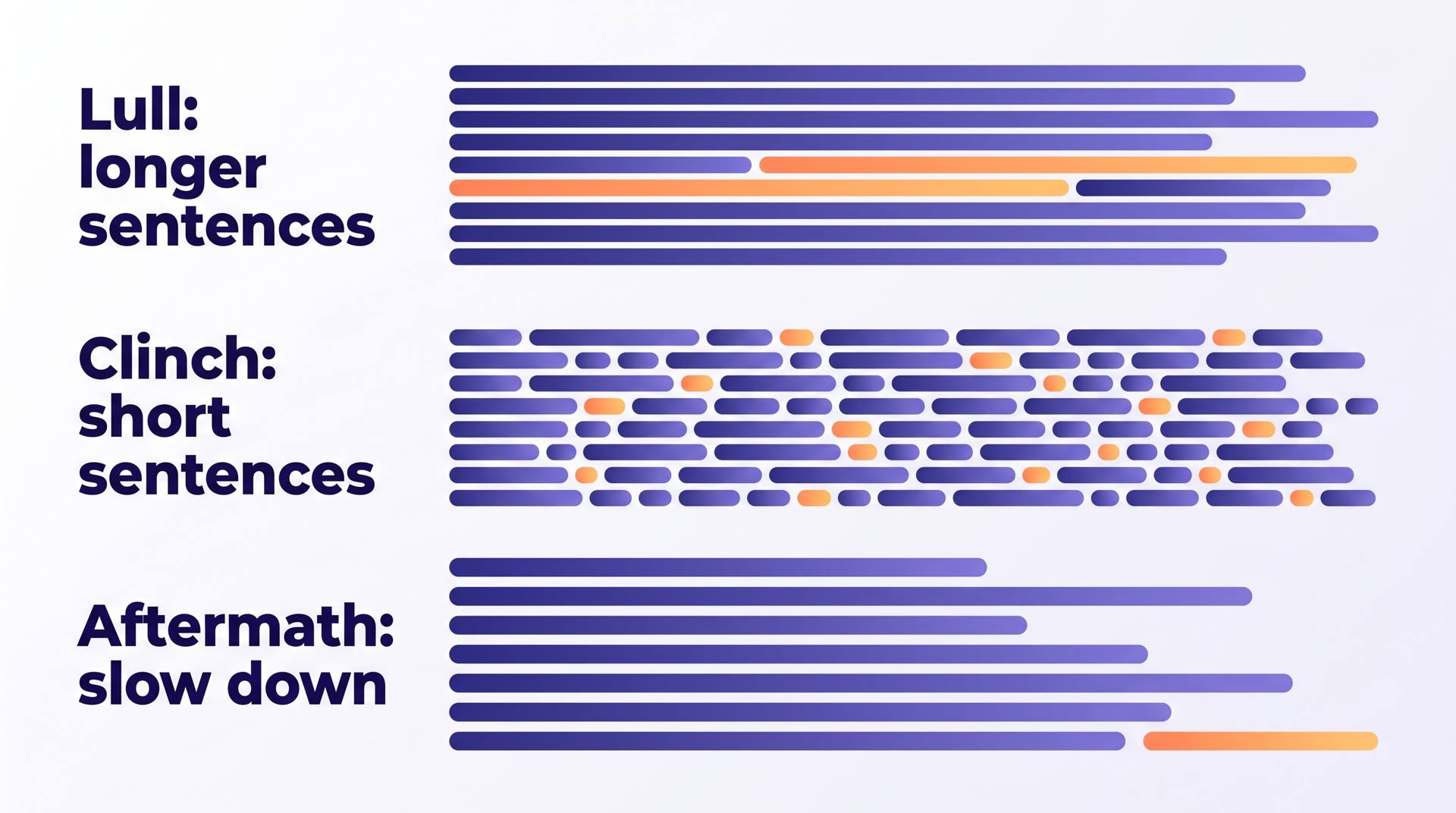
The mistake to watch for is writing the entire fight at clinch tempo. Forty consecutive fragments read as fast on paper and as flat in the head; without a lull the reader has nothing to measure the speed against.
Dialogue is the other rhythm control, and it is dangerous here — see our dialogue guide for why a line of speech mid-swing usually kills the tension it was meant to raise.
Genre-specific notes
The three-beat framework holds everywhere, but what the consequence beat is made of changes by genre. Pick your genre below.
Choose a genre
Magic needs a price, armour needs weight
In fantasy the consequence beat is where your magic system either becomes real or collapses. If a spell costs nothing — no fatigue, no blood, no borrowed years — the reader has no way to feel danger and the fight becomes a light show. Decide the cost before the scene and pay it visibly, mid-fight, at least once.
Armour is not a hit-point bar. Mail defeats a cut and does nothing about a mace; a helmet turns a killing blow into a concussion. Plate is far more mobile than films suggest, but the heat becomes the real enemy long before the enemy does.
For everything else that holds a fantasy fight together, see our fantasy novel guide. And the pacing mechanics around a thriller's set pieces are covered in our thriller writing guide.
Five mistakes that survive revision
These are the ones that get past self-editing, because none of them look like errors on the sentence level.
Blow-by-blow narration
Writing every movement because you can see it in your head. The reader does not need the block, the slip and the pivot; they need the intent and the damage. If a paragraph reads like a fight commentator, cut it in half and then cut it again.
Superhuman stamina
Real unarmed fights are brutally short, and even trained fighters are gassed after a few hard exchanges. A protagonist who fights for pages without a wrecked cardiovascular system reads as invulnerable, which is the same as reading as safe.
No aftermath
The scene ends when the other person falls, and the next chapter opens with everyone fine. Injuries that do not persist tell the reader that violence in this book has no weight, and they will read every future fight accordingly.
Dialogue mid-swing
Villains monologuing between punches drains tension faster than anything else on this list. People fighting say almost nothing — a name, a swear, a warning. Save the talking for the lull or the aftermath, where it lands harder anyway.
Symmetrical description
Giving both fighters equal, alternating coverage, as if the narration were a scoreboard. The POV character's attempts belong on the page from inside; the opponent's should mostly arrive as effects — a shape moving, a weight, a sudden change in the floor's angle.
The fight scene revision checklist
Ten checks to run on a finished draft. Tick them off here, or copy the list into whatever you revise in.
Doing this inside AIWriteBook
Fight scenes are the clearest case for editing rather than drafting. The intent and the stakes are yours; what usually needs work is compression, and compression is mechanical enough to hand off.
Apply it to your book
Inside the editor, the chapter AI chat lets you highlight the fight and ask for exactly one change — tighten the exchanges, cut the moves the reader would supply, shorten the sentences at the peak. It comes back as a diff with accept and reject on each change, so you keep the lines you fought for and take only the cuts that help. That per-change control is why it works on action: a wholesale rewrite loses the specific detail that made the scene yours.
If you are still at the blocking stage, the free scene builder is the faster way to lay out the space, the goal and the turn before any prose exists — it produces the beat outline that step four asks for.
And when the fight is one scene inside a chapter you are still building, the chapter generator writes to the outline you give it, so you can hand it the surrounding chapter and keep the fight hand-written.
The short version
Decide what the fight is about. Show the room first. Stay in one body. Build three or four exchanges of intent, action and consequence, compress the action beat harder than feels comfortable, let the sentences shorten at the peak, break something that stays broken, and end on a change rather than a result.
Everything else — the verbs, the weapon research, the genre texture — gets easier once the structure is right. If it still isn't landing, the problem is almost never the prose.
Fight scenes are one chapter-level skill among many; the full how to write a book guide covers where scenes like this sit inside a finished manuscript.