

In this guide
Why authors look past ACX now
Three changes in 2026 pushed a lot of indie authors to read the fine print again.
The royalty became a pool
Audible opened its new royalty model to every ACX creator on May 26, 2026. Rates went up, from 40% to 50% for exclusive titles and from 25% to 30% for non-exclusive ones, but the base changed. Instead of a cut of each sale, a listener's monthly plan value is split across the titles they listened to, weighted by each title's price, and your share is multiplied by your rate. A higher percentage of a pool is not the same as a higher payout, and nobody can tell you in advance which one you get.
The old model has an end date
Titles claimed after May 26 are enrolled in the new model automatically. Existing titles keep the legacy 40% and 25% only until the end of 2026, when Audible discontinues it. By then you either enroll or pull the title from Audible. Audible also sets the final price; you can suggest one.
Uploads must still be human-narrated
ACX's submission requirements say audiobooks must be narrated by a human unless otherwise authorized. Amazon's own AI route, Virtual Voice, is a KDP program that narrates your ebook with Amazon's voices. Audio you produced elsewhere with AI cannot go through a normal ACX upload.
None of this makes ACX bad. It makes it one option among several, and the others are now good enough that the decision deserves ten minutes. If you have never been through ACX itself, our ACX walkthrough for Audible covers the upload flow and the audio spec in detail.
The alternatives side by side
Terms as published or reported in October 2026. Every platform here can change its rates, so confirm on the platform's own pages on the day you sign.
| Platform | What you keep | Exclusive? | AI narration | Best for |
|---|---|---|---|---|
| ACX (Audible) | 50% exclusive or 30% non-exclusive of a pooled, listening-based value | Your choice; 90-day minimum before a one-time switch | Human narration only for uploads | Human-narrated titles that sell mostly on Audible |
| Voices by INaudio | 80% of net royalties; 100% on Spotify | No | Accepted | One upload to 30+ stores and libraries |
| Authors Republic | 80% of earned royalties | No | Accepted with disclosure | A second aggregator for channels INaudio skips |
| Spotify for Authors | Set by Spotify's author terms | No | Accepted with disclosure, including ElevenLabs voices | Authors whose readers already stream on Spotify |
| Kobo Writing Life | 45% of list price at $2.99 and up; 32% on subscription listens | No | Accepted; narrator listed as Synthesized Voice | Canada, Europe and Kobo Plus listeners |
| Google Play Books | Revenue share per your Partner Center agreement | No | Accepted; free auto-narration in beta | Your own files, or a free AI edition of an ebook already on Google Play |
| Apple digital narration | Apple Books wholesale terms | No; you keep the audiobook rights | Apple narrates it for you | English ebooks already on Apple Books, via Draft2Digital or PublishDrive |
| Direct via BookFunnel | Your price minus payment and delivery fees | No | Your call | Authors with an email list and a series |
Each platform in plain terms
Voices by INaudio (formerly Findaway Voices)
Findaway Voices became Findaway Voices by Spotify, and in August 2025 its original founders bought it back and relaunched it as an independent company, Voices by INaudio. The deal is simple: no upfront fee, non-exclusive, and you keep 80% of what the retailers pay it. On Spotify sales the distribution fee is waived, so the whole Spotify royalty is yours. One upload reaches Apple Books, Google Play, Kobo, Spotify, Chirp and library apps such as OverDrive and Hoopla. If you search for Findaway Voices today, this is where you end up.
Authors Republic
Authors Republic is the other big non-exclusive aggregator. It pays authors 80% of earned royalties and lists Audible, Apple, Spotify, Google Play, Hoopla and Libby among its channels. It is also one of the two routes into Chirp, BookBub's audiobook deal store. Disclose AI narration at upload and expect the occasional retailer to decline it. Some authors use INaudio for most stores and Authors Republic for a channel INaudio does not reach; just never send the same title to the same store twice.
Spotify for Authors
Spotify is now a real audiobook store, with listening hours included in Premium plans and an Audiobooks+ add-on for heavier listeners. It accepts disclosed AI narration, and named ElevenLabs voices specifically when it opened the door. In May 2026 it announced its own ElevenLabs-powered creation tool inside Spotify for Authors, launching as an invite-only, English-only beta in June. For most indies the cleanest route into Spotify is still an aggregator, and through INaudio that route costs no fee.
Kobo Writing Life audio
Kobo takes audiobooks directly through Kobo Writing Life, free and non-exclusive. The terms most authors work from: 45% of list price on purchases at $2.99 and above and 32% on paid subscription downloads. AI narration is allowed, but the narrator contributor must read Synthesized Voice, Female Synthesized Voice or Male Synthesized Voice. Kobo is strongest in Canada and parts of Europe, so it matters most for books with readers there. The ebook side of the same decision is in our KDP vs Kobo comparison.
Google Play Books (upload or auto-narration)
Google Play does two separate things. You can upload finished audio like any store. Or, if your ebook is already on Google Play, you can generate a free auto-narrated edition in its beta program, choose a voice and fix pronunciations. You can then download that audiobook as numbered MP3 files and sell it elsewhere, as long as it stays on sale on Google Play in those countries and the Google Play price is not higher than anywhere else.
Apple Books digital narration
Apple narrates eligible English ebooks for free through its preferred partners, Draft2Digital for independent authors and PublishDrive. The ebook has to be on Apple Books and you must own the audio rights. Apple's own page says the author keeps the audiobook rights and can produce and distribute other versions. You get no files to take elsewhere, so treat it as a free Apple-only edition, not a master copy.
Direct sales with BookFunnel
Selling direct means your own store (Shopify, Payhip or a WordPress shop) takes the payment and BookFunnel delivers the audio, either as a download or through its own listening app with chapters, bookmarks and speed control. You set the price, keep almost all of it, and learn who your listeners are. It pays off when you already have readers who open your emails, and it pairs well with a reader list on an AIWriteBook author page.
Pick your route
The routes split four ways: an aggregator, a store you upload to yourself, a store that narrates for you, and your own shop. Most wide authors use two or three at once.
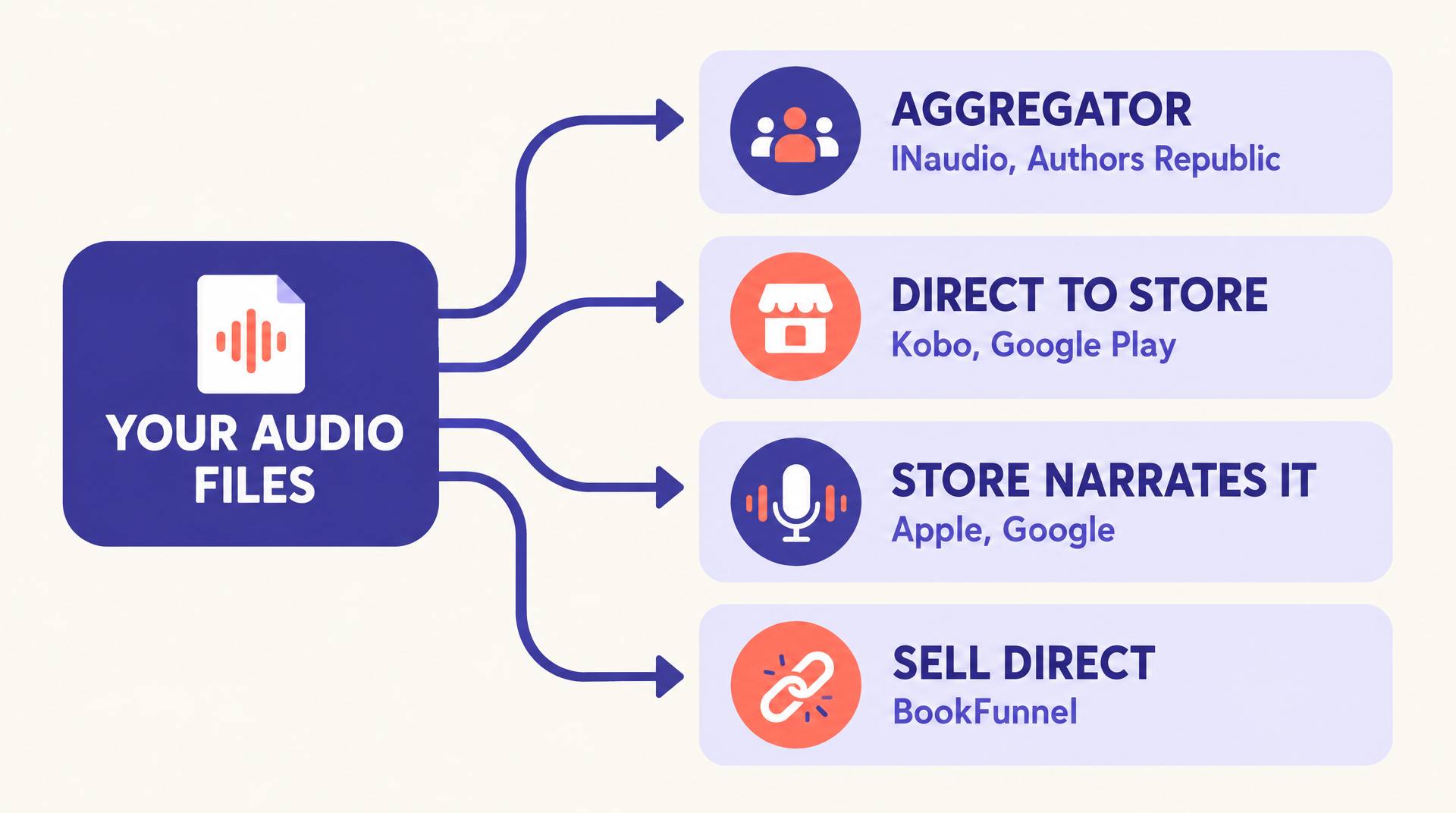
Then answer three questions. The finder below gives you a starting stack.
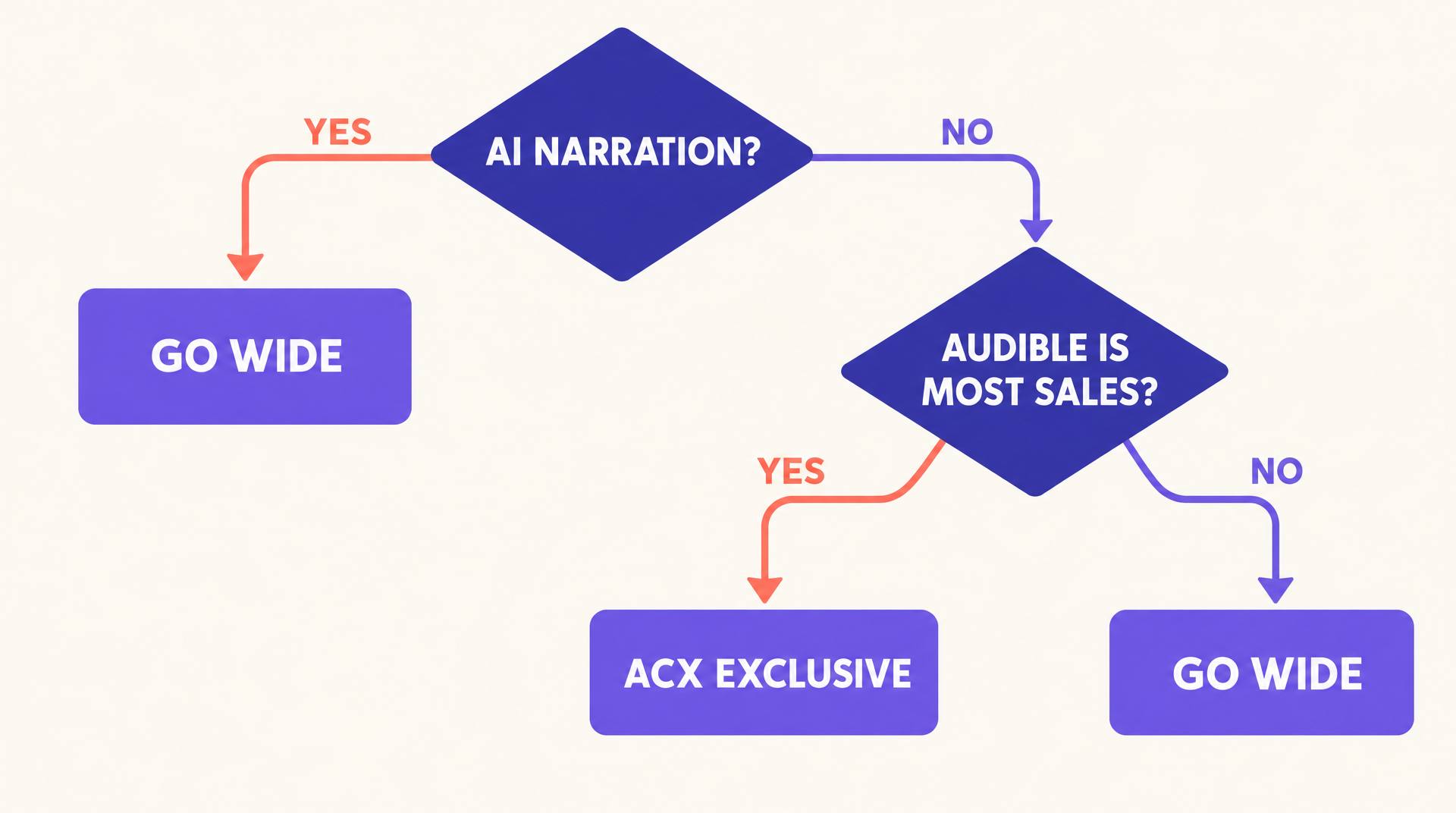
Is your narration AI-generated?
Does Audible or Kindle bring in most of your income today?
Do you have an email list of readers who buy from you?
Your starting stack
Answer all three to see a recommendation.
Going wide, step by step
Here is the order that avoids the most rework, assuming you already have mastered files.
1. Confirm you hold the audio rights
If a narrator worked on royalty share through ACX, that title is tied to ACX. Check any publishing contract for an audio clause too.
2. Pick one aggregator as your backbone
INaudio or Authors Republic, not both for the same store. Note which stores you plan to cover yourself and leave them unticked in the aggregator.
3. Prepare one clean set of files
Chapter MP3s, opening and closing credits, a retail sample, and a square cover of at least 2400 by 2400 pixels. Mastering to the ACX spec (RMS between -23 and -18 dB, peaks no higher than -3 dB) is the safe target, because every store on this list accepts it.
4. Write metadata once, reuse it everywhere
Same title, subtitle, series name and description in every store. Declare AI narration in the narrator field and the description where the store asks.
5. Add direct stores and direct sales
Kobo Writing Life and Google Play if you upload them yourself, then a BookFunnel delivery link on your own shop.
6. Price for the market, then promote
Keep prices consistent so no retailer price-matches you down. Once the title is on Chirp, it can be submitted for a Chirp deal, which works like a BookBub Featured Deal for audio.
Need the audio before you need the distributor?
Turn a book you wrote or imported into a narrated, mastered audiobook, chapter by chapter, and export the files the platforms above ask for.
Mistakes that cost royalties
Sending the same title to one store twice
INaudio and Authors Republic both deliver to Apple and Google. Two feeds of one audiobook create duplicate listings and tangled reports. Split stores between them deliberately.
Hiding the AI narration
Every platform that accepts AI narration asks you to disclose it. Leaving it out is the quickest way to have a title removed and an account flagged.
Assuming 50% beats 80%
50% of a pooled member value and 80% of a retailer's net payout are different bases. Compare what one listener is worth on each route, not the headline percentage.
Mistaking Google's auto-narration for a master
You can download it, but it must stay on sale on Google Play wherever you sell it, at a price no higher there than anywhere else. If you want files with no strings, produce your own.
Forgetting libraries
OverDrive and Hoopla reach listeners who never buy audiobooks at retail. Only the wide aggregators get you there, and ACX exclusive shuts that door.
The AI-assisted shortcut
Distribution is the easy half. The hard half is a finished, listenable recording, which used to mean weeks of work and a narrator invoice in the thousands.
The Audiobook Studio in AIWriteBook narrates the book straight from the chapters in your editor. You pick a narrator from 25 voices, the studio casts a separate voice for each character if you want one, and chapters render one at a time so you can listen as you go. A mispronounced name gets respelled and re-recorded on its own, without redoing the chapter.
Exports come out mastered to a retail target of -19 LUFS or a streaming target of -14 LUFS, at 128, 192 or 256 kbps: a merged MP3 with a chapter-markers file, a ZIP of numbered chapter MP3s for aggregators, or an M4B with chapters and cover art for direct sales. Every voice is an ElevenLabs voice, the kind Spotify explicitly accepts with disclosure. The audiobook generator feature page has full samples and credit costs.
Have a book on KDP already? Import the manuscript and you are a few steps from audio. Writing from scratch, the AI book writer gets you a draft first.
Copy-paste templates
Three snippets you will need when you list an AI-narrated edition. Edit the bracketed parts.
AI narration disclosure for the description
This audiobook is narrated by a synthetic voice. The text is the complete, unabridged [Book Title] by [Author Name].
Narrator contributor field (Kobo and most aggregators)
Narrator: Female Synthesized Voice
Launch email to your list for direct sales
Subject: [Book Title] is out in audio

The audiobook of [Book Title] is live, and you can get it straight from me for [price], the best price anywhere. It plays in the free BookFunnel app or downloads as MP3s. [link]

Thanks for reading, and now listening.
[Author Name]
Questions authors ask
Yes, under a new name. Findaway Voices became Findaway Voices by Spotify and, in August 2025, was bought back by its founders and relaunched as Voices by INaudio. Authors keep 80% of net royalties and the full royalty on Spotify sales.
Not through a standard ACX upload; ACX requires human narration unless otherwise authorized. Amazon's own Virtual Voice program narrates eligible KDP ebooks with Amazon's voices. Some aggregators deliver to Audible, but whether disclosed AI audio is accepted there depends on Audible's rules, so check with the aggregator first.
On headline numbers, direct sales come first, then the 80% aggregators such as INaudio and Authors Republic, with Spotify sales through INaudio at no fee. But the stores those aggregators reach pay them different amounts, so the real answer depends on where your listeners buy.
For DIY and pay-for-production titles that have been on sale at least 90 days, ACX allows a one-time switch between exclusive and non-exclusive through its support team. Royalty Share titles are not eligible.
Not usually. ACX, Kobo and the aggregators assign their own identifiers. An ISBN for the audio edition only matters if you want one identifier across every store, and it must be different from your ebook and print ISBNs.
The bottom line
ACX is still the biggest single audiobook store, and for a human-narrated book whose readers live on Audible, exclusive at 50% is a defensible choice. For everyone else, and for every AI-narrated edition, the better default in 2026 is wide: one aggregator as the backbone, Kobo and Google Play where they matter, and direct sales to the readers you already have.
Audio is one branch of the Amazon publishing path; our Amazon KDP guide maps the rest of it.