

Why the casting call matters more than the gear
Authors tend to obsess over bitrates and noise floors and then hire the first pleasant voice that answers. That is backwards. A technically imperfect file can be cleaned up in an afternoon; a narrator who reads your sardonic first-person detective like a nature documentary cannot be fixed at all. You are not buying audio. You are buying an interpretation of your book that will be the only version tens of thousands of listeners ever meet.
The practical consequence: spend your effort on the audition stage, not on the vetting-the-studio stage. Every serious platform already enforces a technical floor — ACX rejects files outside its RMS and noise-floor spec before a human ever listens. Nobody enforces a taste floor. That part is entirely yours.
A narrator who is wrong for your genre will still deliver a technically flawless file. The audition is the only place that mistake is cheap.
The five places narrators actually live
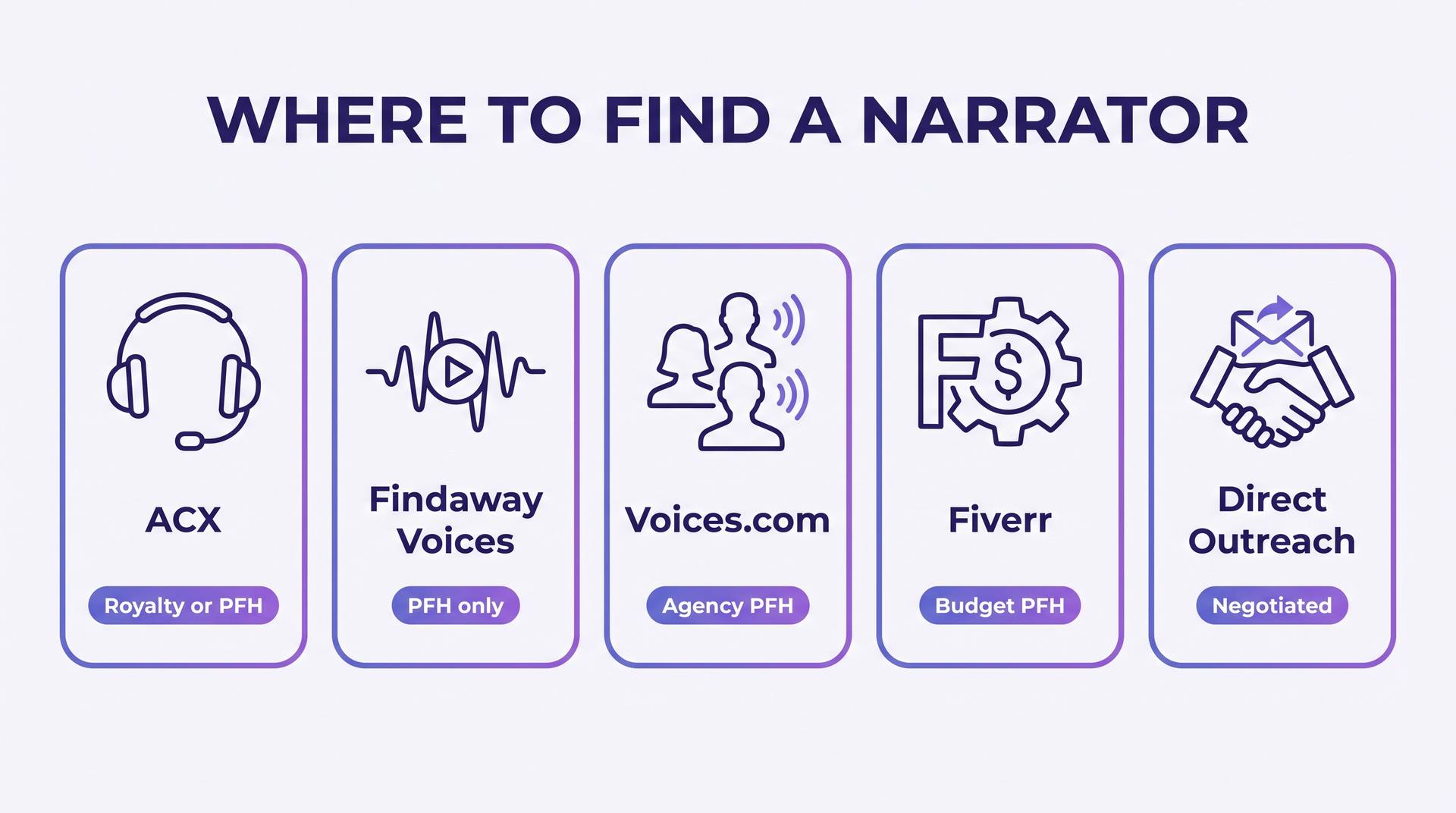
Ignore the listicles that name twenty marketplaces. In practice, indie authors hire from five channels, and each one shapes the deal you can get.
ACX
Amazon's audiobook exchange, and still the default for anyone publishing in the US, UK, Ireland, or Canada. You post a title, upload an audition script, and narrators submit reads against it. Its distinguishing feature is that it is the only major channel offering royalty share, so it is where cash-poor first-time authors go. Its distinguishing weakness is territory: if you are not in an eligible country, the door is shut.
Findaway Voices
Now part of Spotify's publishing stack, and the go-to for authors who want wide distribution rather than an Audible-first deal. There is no royalty-share option — you commission the narration at a per-finished-hour rate and keep 100% of the rights. Their casting team will shortlist voices for you if you describe the book, which is genuinely useful when you have no idea what your protagonist should sound like.
Voices.com
A general voiceover agency marketplace, not an audiobook specialist. You will meet commercial and e-learning talent alongside long-form narrators, at agency prices with an agency margin baked in. Worth using when your book needs an unusual accent or language that the audiobook-native pools do not cover.
Fiverr and Upwork
The budget floor, and the most variable quality in the set. Some excellent narrators keep a Fiverr listing as lead generation; a lot of listings are one person, one condenser mic, and one untreated bedroom. The tell is whether the seller can produce a full unedited chapter on request rather than a polished sixty-second showreel.
Direct outreach
The most underrated channel. Find three audiobooks in your subgenre that you admire, note the narrators, and email them. Most professional narrators list a contact address on their own site precisely because repeat direct work is more profitable for them than marketplace bidding. You skip the marketplace fee, and you start the conversation with proof you have actually listened to their work.
Whatever channel you use, listen to a full chapter before you shortlist anyone. A showreel is edited to hide exactly the things that ruin a nine-hour listen: breath handling, sentence-end pitch drop, and the wobble that appears in hour four.
Royalty share vs per finished hour
Narration is priced two ways, and picking wrong is the single most expensive decision in audiobook production.
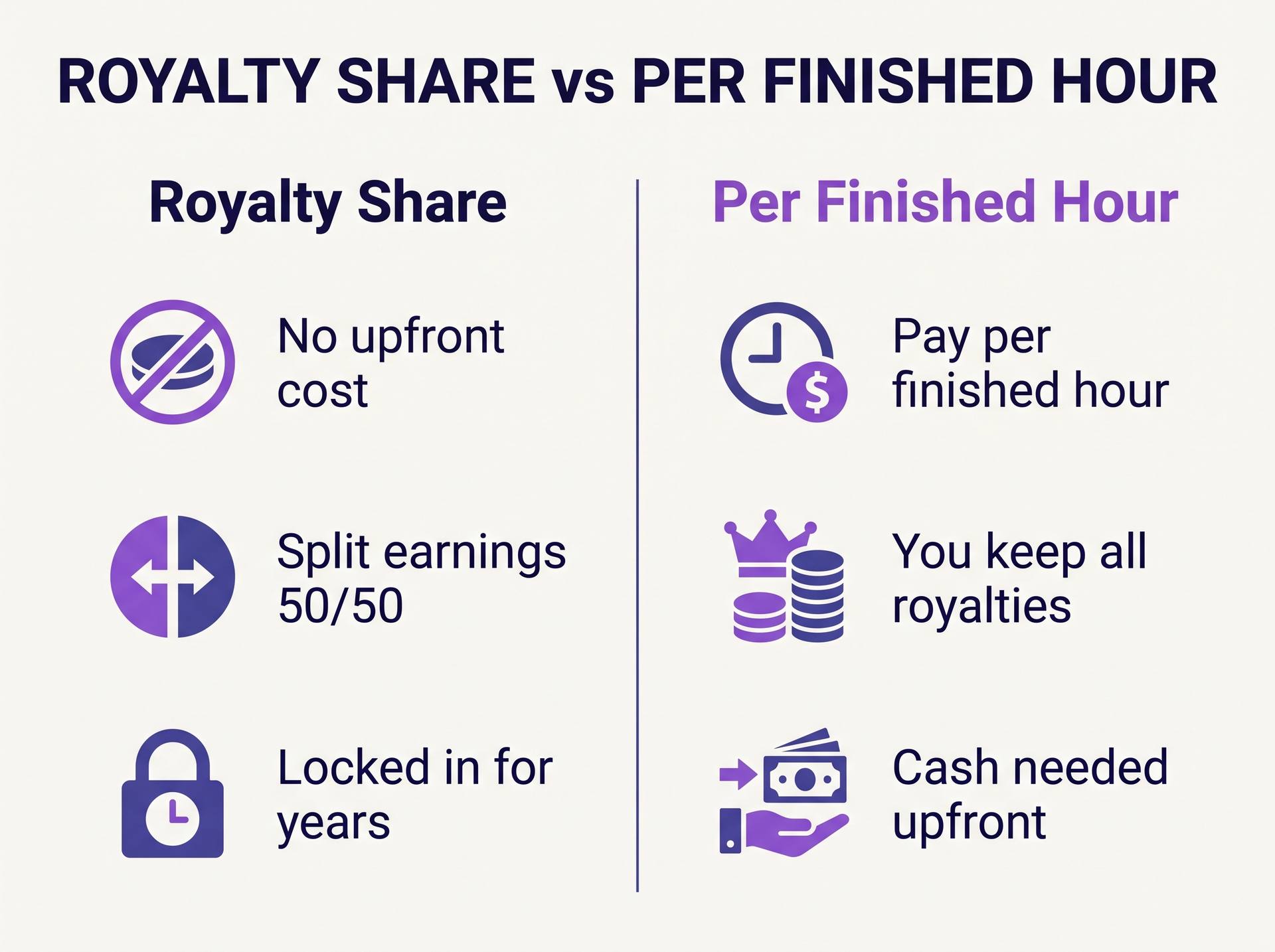
Per finished hour (PFH) means you pay for each hour of completed audio, not each hour the narrator worked — a distinction that matters, because producing one finished hour typically takes a narrator somewhere between three and six hours of studio and edit time. Rates for competent indie narration commonly sit in the low-to-mid hundreds of dollars per finished hour, and rise steeply for established Audible names. A 90,000-word novel runs roughly nine to ten finished hours, so the arithmetic is not subtle.
Royalty share means no upfront payment. The narrator produces the book in exchange for splitting your audiobook royalties — on ACX, evenly — for a fixed exclusivity term measured in years, not months. It is genuinely useful when you have no capital. It is also a bet: if the book sells well, you have paid many times the PFH rate, and you cannot buy your way out mid-term.
The blunt rule most experienced indies land on: royalty share for a first book with no audience, PFH the moment you have a series with measurable sales. If book one of your series already earns steady ebook royalties, you have the data to justify paying cash and keeping the whole audiobook upside.
The trap in royalty share
The exclusivity term is attached to the title, not to the narrator's performance. If the narration disappoints you six months in, you still cannot re-record and re-release until the term expires. Read the length of that term before you read anything else in the agreement.
A working step-by-step process
This is the sequence that keeps you from spending three weeks in auditions and still hiring on vibes.
- 1
Write the character brief first
Before you post anything, write four lines: narrator gender and rough age, accent, the emotional register of the book, and two published audiobooks whose narration you want to sit near. This brief is what you paste into every listing, and it filters more bad applicants than any other single thing you do.
- 2
Choose your channel and payment model
Decide PFH or royalty share before you post, and say so in the listing. Narrators self-select hard on this, and a listing that hedges attracts people who will renegotiate later.
- 3
Pick an audition script from the actual book
Never use a generic passage. Pull two to three minutes from your own manuscript that contains dialogue between at least two characters and one moment of emotional change.
- 4
Post, then wait a full week
Good narrators do not audition within an hour of a listing going live; they audition when they finish their current book. Judging after 48 hours means judging the least busy applicants.
- 5
Shortlist three, then request a paid sample
Take your top three and offer to pay for fifteen minutes of a real chapter. It is a small cost and it exposes everything a short audition hides — consistency, pronunciation of your invented names, and whether they can hold a character across scenes.
- 6
Agree the checkpoint before you sign
Standard practice is a first-fifteen-minutes checkpoint: the narrator records the opening fifteen minutes, you approve tone and pronunciation, and only then do they record the rest. Skipping this is how authors end up with nine unusable hours.
- 7
Review chapter by chapter, in one pass
Collect corrections in a single timestamped list per chapter rather than dribbling notes out over weeks. Narrators price re-records generously the first time and less generously the fifth.
Writing an audition script that filters
The passage you choose does most of the selection work. A monologue of pretty description tells you only that someone can read aloud. Here is what the passage needs to contain, and why.
Two speakers in conversation
This is the fastest test there is. A narrator who cannot make two characters audibly distinct without cartooning them will not survive an ensemble scene in chapter twelve.
One emotional turn
A moment where a character's mood shifts mid-scene. Plenty of readers have one gear; the turn is where you hear it.
Your hardest proper nouns
Drop in the invented place names and surnames that recur. You will immediately see who asked you how to pronounce them and who guessed.
A line of interiority
First-person thought, or close third. It reveals whether the narrator can drop volume and intimacy without dropping intelligibility.
A listing you can copy
Paste this into ACX, Findaway, or a cold email, swap the bracketed parts, and delete nothing else. It is short on purpose.
Title: [Book title], Book [n] of [series]
Genre: [genre], [word count] words, roughly [n] finished hours
Narrator: [gender], sounds [age range], [accent] accent
Tone: [two adjectives, e.g. dry and warm]
Reference narrations: [Audiobook 1], [Audiobook 2]
Payment: [PFH at $X] or [royalty share]
Audition: the attached passage, unedited, single take preferred
Note: the passage contains the names [Name 1] and [Name 2] — ask me how they are said, do not guess.
That last line is doing more work than it looks. The applicants who write back with a pronunciation question are almost always the ones who will read the whole book carefully.
How to judge the samples you get back
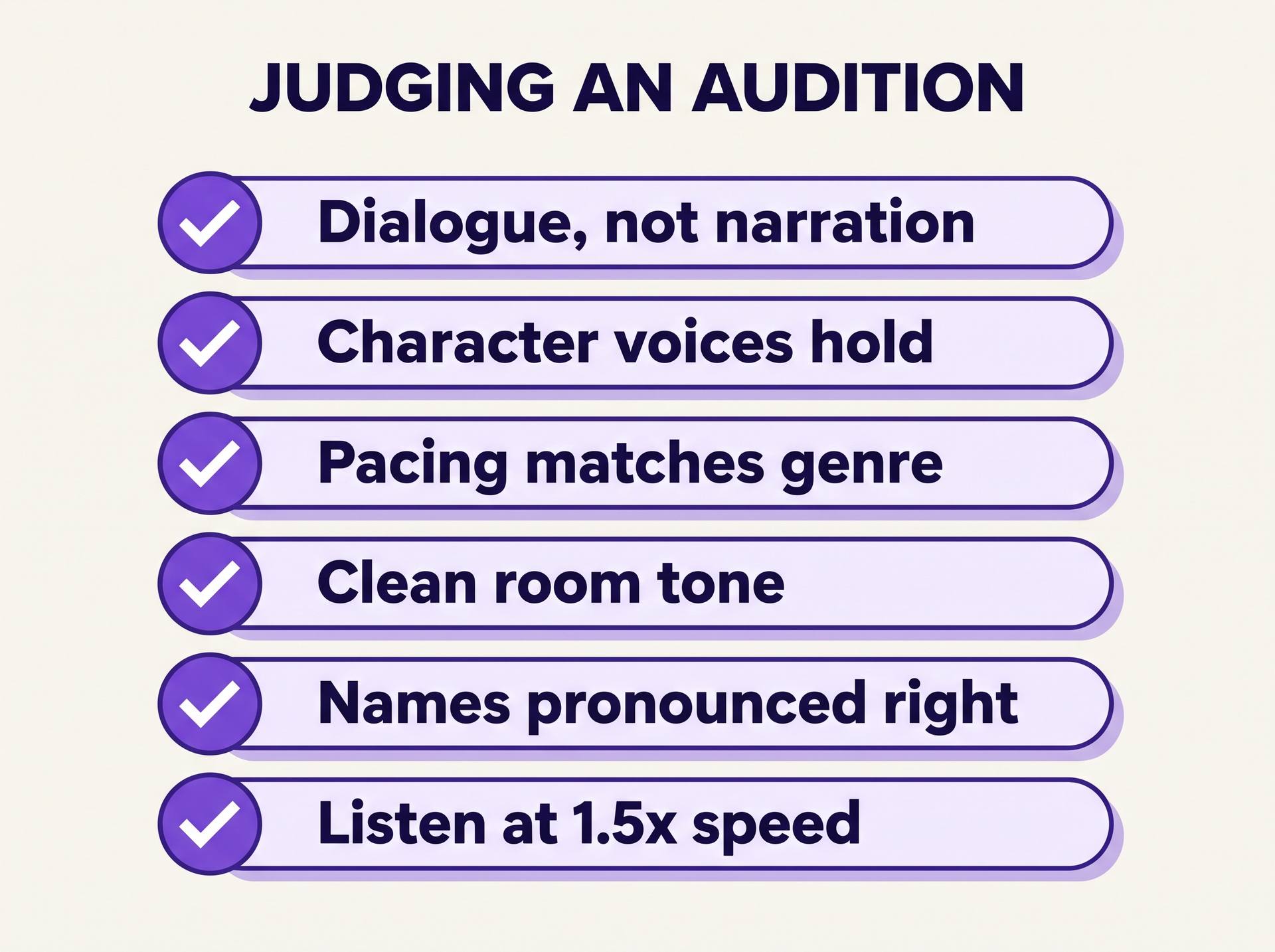
You will get somewhere between five and fifty auditions, most of them competent and forgettable. Use a fixed checklist so the last one you hear does not win by recency.
Listen to the dialogue first
Skip to the conversation and play only that. If the two characters blur, stop there — nothing later in the file will change your mind.
Play it at 1.5x
A large share of audiobook listeners run above normal speed. Narrators with mushy consonants or a rushed clip sound fine at 1x and fall apart at 1.5x. This one trick removes more candidates than any other.
Check the pacing against the genre
Thriller pacing in a cozy mystery reads as anxious; literary pacing in an action scene reads as bored. Compare against the reference narrations you named in your listing.
Listen to the silence
Turn the volume up during a pause. Hiss, hum, room echo, and a neighbour's dog are all things you will be living with for ten hours and paying to remove.
Ignore your own voice
The commonest casting error is picking the narrator who sounds most like the voice in your head. Your readers do not have that voice. Pick the one who serves the book.
Contracts, files, and the things people forget
The production part is straightforward once the casting is right. These are the clauses and details that cause the actual arguments.
Rights and term
Under PFH you should be commissioning a work-for-hire: you own the recording outright, worldwide, in perpetuity. Under royalty share you do not — you share, for a fixed term. Know which one you signed before you plan a boxset.
What a finished hour includes
Spell out that the rate covers narration, editing, mastering, proofing, and one round of corrections. Some quotes are narration only, and the edit gets billed separately at the end.
Retail sample and opening credits
Retailers want a short retail sample plus recorded opening and closing credits. Ask for them in the same session; getting a narrator back into the booth two months later costs a booking minimum.
Deliverables and file spec
One file per chapter, consistent naming, plus the raw masters. If you ever move retailers, or produce a second edition, the masters are what save you from re-recording.
A pronunciation sheet, sent in advance
Every invented name, place, and piece of jargon, with a plain-English phonetic spelling. Ten minutes of your time removes the single most common cause of paid re-records.
The AI narration route
Synthetic narration is no longer a novelty tier. It is now accepted across the major distribution channels, the neural voices handle breath and emphasis convincingly, and the cost difference against a commissioned human narrator is roughly the difference between a rounding error and a car payment. For non-fiction, for series where you need six books narrated consistently, and for any book whose audiobook sales you cannot yet forecast, it is a defensible first move.
It is also not a universal replacement. Character-driven literary fiction, comic timing, and heavy dialect work still favour a human performer, and some listeners in some genres will tell you so in reviews. Our honest read: use AI to find out whether your book has an audiobook audience at all, then commission a human narrator for the titles that prove they earn it.
If you want the mechanics — voice selection, directing emotional performance, quality control, and how the distribution platforms treat synthetic narration — we go deep on all of it in our complete guide to AI audiobook narration, and cover the retail side in the Audible publishing guide.
How AIWriteBook does it
If your book already lives in AIWriteBook, the audiobook is not a separate project. The AI Audiobook Studio takes a finished book from your library, casts a distinct voice for each character automatically, renders it chapter by chapter with emotion-aware delivery, and masters the result into files you can hand to a retailer. Because the chapter text in your editor is the script, there is no pasting, no re-upload, and no drift between the ebook and the audio edition.
The part authors tend to appreciate most is paragraph-level retouching: when one line lands wrong, you re-render that paragraph rather than the chapter. That is the workflow equivalent of a narrator pickup session, minus the booking minimum. You can also see the full feature on the audiobook generator page.
Five mistakes that cost real money
Hiring from a showreel
Showreels are the narrator's best ninety seconds, assembled from months of work. Insist on unedited audio from your own book.
Signing royalty share on a proven seller
If the ebook already earns, royalty share is the most expensive money you will ever borrow. Pay the PFH and keep the rights.
Skipping the fifteen-minute checkpoint
It exists so that a tone mismatch costs fifteen minutes of re-recording rather than nine hours of it. Nobody who has skipped it does so twice.
Sending corrections in dribs
Batch notes per chapter with timestamps. Scattered feedback burns goodwill and gets billed as extra rounds.
Casting for your own ear
You know the book too well to hear it fresh. Play your top two auditions to someone who reads your genre and has never read your manuscript.
Common questions
Narration is priced per finished hour of audio. Competent indie narrators commonly sit in the low-to-mid hundreds of dollars per finished hour, with established Audible names charging considerably more. A 90,000-word novel typically runs nine to ten finished hours, so a full production is usually a four-figure commitment. Royalty share removes the upfront cost entirely but splits your audiobook royalties for a multi-year exclusivity term.
For memoir, personal-brand non-fiction, and anything where readers are buying you specifically, self-narration can outperform a professional. For fiction, it usually does not: you need a treated room, several full days of stamina, consistent character voices across a nine-hour recording, and editing skills. Record a full chapter, listen at 1.5x, and be honest about the result before committing.
Yes, provided you own the rights to the audio you produced, which you do with AI narration. Many authors release an AI-narrated edition first, watch the sales, and commission a human narrator for the titles that clearly earn it. You will need to replace the audio files with the retailer and, in some catalogues, publish it as a new edition.
From posting a listing to a finished file, plan on six to twelve weeks with a human narrator: one to two weeks to audition and cast, a week for the opening checkpoint, three to six weeks of recording and editing depending on the narrator's queue, then a correction round and retailer review. AI narration compresses the production phase to hours, though your own proofing pass still takes real time.
Where to start
Do the cheap things first. Write the four-line character brief, choose the passage from your own book that contains dialogue and a turn, and decide honestly whether this title has the sales history to justify paying cash. Those three decisions determine almost everything about the quality of the auditions you receive, and none of them costs anything.
Then let the format follow the evidence. Produce a synthetic edition for a book with no track record, commission a human performer for the ones that have earned it, and keep the masters either way.
The audiobook is one of several editions of the same manuscript, and the ones that sell best tend to belong to authors whose ebook is already set up properly — which is what the rest of our Amazon KDP guide covers, from listing to launch.