


The definition
An anthology is a book-length compilation of separate works — short stories, poems, essays, or excerpts — usually by multiple authors, chosen and arranged by an editor around a shared theme, genre, period, or occasion.
The word comes from the Greek anthologia, a gathering of flowers. That image is a surprisingly precise description of the job: the individual blooms already exist, and the work is in the choosing and the arranging. An anthology editor is not primarily a writer. They are a curator who happens to work in prose.
Three things have to be true before a book earns the label. The pieces must be discrete — each one stands alone and could be read out of order. There must be more than one source, in the standard usage more than one author. And there must be a selecting intelligence behind it, someone who decided that these twenty pieces belong together and those other forty do not.
That third condition is the one self-publishers skip. A theme stated on the cover but not enforced in the selection produces the most common failure mode in indie anthologies: a book whose stories share a keyword but not a sensibility.
Anthology vs collection vs omnibus
These three words get used interchangeably in marketplace listings, and they are not interchangeable. Getting them wrong costs you at the worst possible moment — in the metadata a browsing reader uses to decide what they are buying.
Anthology
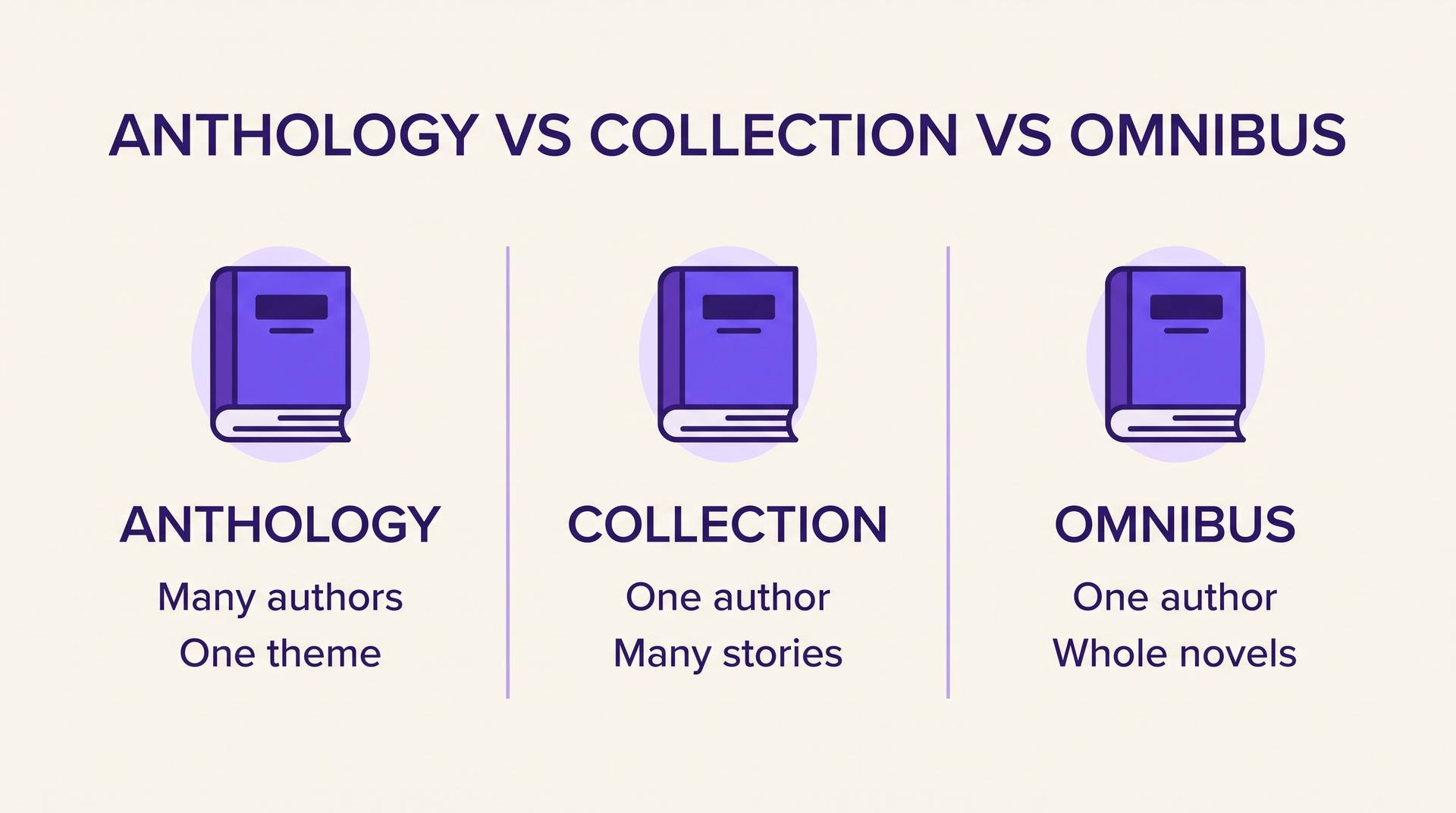
Many authors, one organising ideaMultiple contributors, short discrete pieces, an editor's name on the cover. A themed horror anthology, a Best American Short Stories volume, a charity collection of flash fiction.
Collection
One author, many piecesEverything in it comes from a single writer. Sold on the author's name and voice rather than on a theme, though a theme often emerges anyway. Calling a single-author book an anthology is the error editors notice fastest.
Omnibus
One author, whole works bound togetherComplete novels or novellas reprinted in one volume — usually a series boxed into a single spine. Nothing is excerpted and nothing is curated; it is a packaging decision, not an editorial one.
Two more terms sit nearby. A reader is an anthology assembled for teaching, with apparatus — headnotes, questions, a scholarly introduction. A miscellany deliberately abandons the unifying theme, which is the one thing an anthology is supposed to have.
How an anthology actually gets built
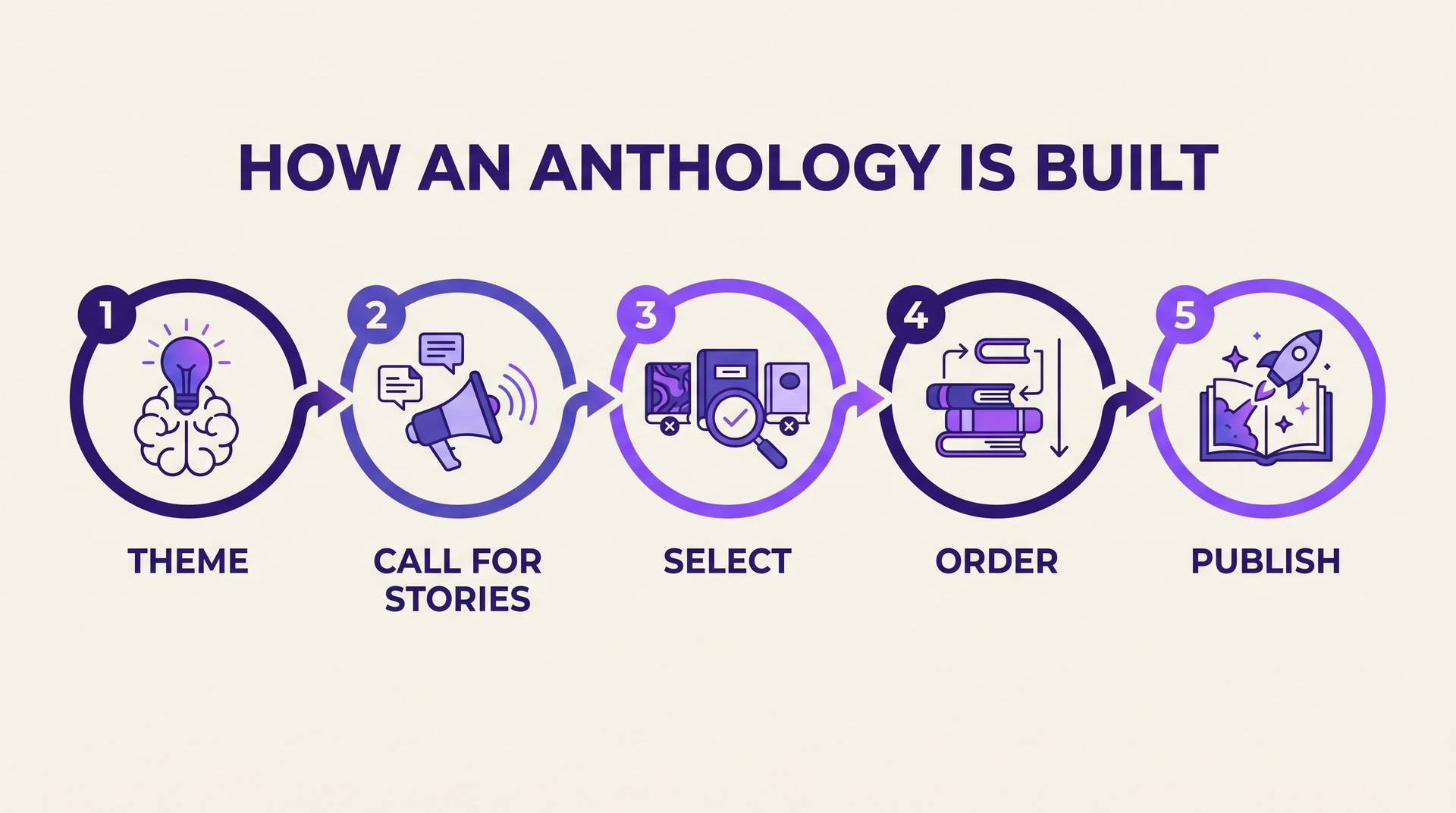
Editing an anthology is a project-management job with a taste problem in the middle of it. The five stages below are the same whether a New York house is paying for it or you are running it from a spreadsheet.
- 1
Fix the theme narrowly
"Ghost stories" is not a theme, it is a genre. "Ghost stories set in workplaces" is a theme — it is specific enough that a writer knows instantly whether they have something, and specific enough that a reader knows what they are buying. Narrow beats broad every time.
- 2
Write the call for submissions
State the word-count window, the payment, the rights you are asking for, the deadline, the reading period, and what you will not accept. Vagueness here produces a slush pile of things you cannot use and a reputation you cannot fix.
- 3
Select, and say no properly
Read blind if you can. Expect to reject most of what arrives, including good work that does not fit the theme — "good but wrong for this book" is the most common honest rejection and the one writers respect. Aim to fill your table of contents at roughly the halfway point of your reading, then spend the rest of the time upgrading.
- 4
Order the table of contents
This is where an anthology becomes a book rather than a queue. Lead with your strongest opener, close with the piece that leaves an aftertaste, and alternate tone, length, and point of view so no two similar stories sit back to back. A reader who hits three melancholy first-person stories in a row stops reading.
- 5
Front matter, back matter, publish
An anthology needs an editor's introduction explaining the selection principle, contributor biographies, and a copyright page that credits each piece to its author individually. Skipping the introduction wastes the only place you get to tell a reader why these pieces are together.
The ordering pass is the part first-time editors underrate. If you have ever sequenced a multi-book series, the instinct is the same, and our series planner is built for exactly that kind of running-order thinking — you can use it to map how the pieces escalate before you commit to a contents page.
Rights and contributor terms, in plain language
This is the section that turns a friendly project into a legal one, and the section most indie anthologies get wrong by being generous in the wrong direction — asking for far more rights than they need.
Ask for first rights, not all rights
The standard ask is first publication rights in a given language and territory, plus a non-exclusive right to keep the piece in print in that anthology. Demanding all rights, or exclusivity forever, is what gets a call for submissions blacklisted on writer forums.
Set an exclusivity window
Six to twelve months of exclusivity from publication is normal. After that the contributor is free to reprint their story elsewhere, usually with a line crediting your anthology as the first appearance.
Say what the payment is, including zero
Flat fee, royalty share, or contributor copies only — all three are legitimate, and all three must be stated up front. A royalty share needs a stated split, a stated accounting period, and a statement of who pays production costs first.
Copyright stays with each author
You hold copyright in the anthology as a compilation — the selection and arrangement. Each contributor keeps copyright in their own piece, and your copyright page should say so explicitly, story by story.
Get the copyright page right before you upload anything. We wrote a longer piece on how book copyright actually works, and if you want the page itself drafted, the copyright page generator produces one you can paste straight into your front matter.
Anthologies worth studying
Each of these solves the curation problem differently, which is why they are useful models rather than just famous titles.
Dangerous Visions, edited by Harlan Ellison (1967)
The most instructive anthology in genre history because the theme was not a subject at all — it was a permission. Ellison solicited stories that magazines of the day would not print, and wrote an introduction to every single one. The lesson: a theme can be an editorial stance rather than a topic.
The Norton Anthology of English Literature
The canonical teaching anthology, and a demonstration of how much power selection carries. Which writers appear, in what proportion, and with what headnotes has shaped what generations of students think English literature is. Curation is an argument, whether or not you intend it as one.
The Best American Short Stories, annual
A reprint anthology with a rotating guest editor, which turns the same book into a different book each year. If you plan a recurring anthology, this is the structural trick worth stealing: keep the frame constant and let the selecting sensibility change.
Themed charity and small-press anthologies
The form most indie writers will actually publish in or edit. They live or die on two things — a theme tight enough to make the book feel designed, and a contributor list broad enough that everyone brings their own readers to launch day.
Using the word correctly
Three sentences, three contexts. Copy the shape rather than the wording.
"My story 'Lantern Season' appeared in the anthology Quiet Hours, edited by R. Nkemdi (Fen Press, 2024)." Name the editor and the volume — the editor's name is the credential.
"An anthology of eighteen speculative stories about work, from writers in nine countries." Number, theme, and scope in one line. That is a subtitle a browsing reader can act on.
"The anthology is strongest in its second half, where Okafor's ordering lets the quieter pieces breathe." Note that the sentence credits the editor for something no individual author did — sequencing is the editor's contribution and it is fair to praise or criticise it.
Five mistakes that sink indie anthologies
Calling a single-author book an anthology
If every word is yours, it is a collection. Readers who bought expecting multiple voices leave the review that says so.
A theme so wide it is not a theme
"Stories about life" tells a submitting writer nothing and tells a buying reader less. If your theme cannot generate a rejection, it is not doing any work.
Publishing in submission order
The order stories arrived in is not an order. Sequence for contrast in tone and length, and put your best two pieces first and last.
Vague or absent contributor terms
No payment statement, no exclusivity window, no reversion date. This is how a project that everybody enjoyed becomes an argument eighteen months later.
No editor's introduction
You skipped the one page where you explain the selection principle, and the book now reads as arbitrary. An introduction of 600 words changes how the whole volume lands.
When an anthology is the wrong format
The form has real costs — coordination, rights admin, split royalties, a cover that has to sell an idea rather than a story. Skip it when:
- You want to build a readership for your own name. A single-author collection compounds; an anthology spreads attention across everyone in it.
- You have no theme yet, only a set of available pieces. The theme has to come first or the selection has nothing to push against.
- You cannot commit to the admin. Contracts, chasing edits, royalty statements — an anthology is roughly three months of coordination after the writing is finished.
- Your contributors will not promote it. An anthology's launch economics assume each contributor brings some audience; without that it sells worse than a solo title.
The honest alternative for most writers is a single-author collection with a strong internal theme. It reads like an anthology, keeps all the rights and royalties in one place, and needs no contracts.
Self-publishing an anthology on KDP
Amazon has no anthology-specific product type, so the format details are all in how you fill the fields.
Put the editor in the author field
List the editor as the primary contributor and add contributors in the Contributors section with the Author role. Only one account owns the listing, so agree in the contract whose KDP account publishes it.
One ISBN for the volume
The anthology gets a single ISBN as a compilation; individual stories do not get their own. Use a different ISBN for each format if you publish paperback and hardcover.
Watch KDP Select exclusivity
Enrolling the anthology in KDP Select requires the ebook to be exclusive to Amazon. Your contributor contract has to permit that, and it must not clash with any exclusivity a contributor granted elsewhere for the same piece.
Royalties are yours to split manually
Amazon pays the account holder, not the contributors. Whatever split you agreed, you distribute it yourself, so promise an accounting cadence you can actually keep. Simple accounting software makes that easier, with every royalty deposit and contributor payout logged in one place.
If ISBNs or the upload flow are new to you, we have step-by-step walkthroughs of getting an ISBN as a self-publisher and publishing on Amazon KDP. The cover matters more here than on a novel, because it has to sell an idea rather than a character — our guide to cover design covers what that changes. cover design
Where AIWriteBook fits into an anthology project
The stories in an anthology should come from your contributors. What AIWriteBook helps with is everything wrapped around them — the parts that stall a project after the writing is done.
Write the volume's front and back matter in the editor: the introduction that states your selection principle, contributor biographies, and the acknowledgements. Draft the theme description and subtitle you will put in your KDP listing. If some contributions arrive as documents, import them as drafts and edit them in place rather than rebuilding the book by hand. And if you are publishing your own single-author collection instead, the full chapter workflow writes and revises it with you, chapter by chapter, in your own style settings.
Two useful side doors: the title generator is good at producing anthology titles that carry a theme, and whole-book translation lets a themed anthology reach readers in other languages without re-typesetting the volume.
Questions writers ask
In loose usage yes, and publishers occasionally label single-author reprint volumes as anthologies. But the standard meaning involves multiple contributors, and readers use it that way. If the book is all yours, "collection" is both more accurate and more sellable, because it puts your name rather than a theme at the front.
Two layers. Each contributor keeps copyright in their own piece. The editor or publisher holds a separate compilation copyright covering the selection and arrangement — that is the only part of the book the editor created. Your copyright page should list both, with a per-story credit line.
Most themed fiction anthologies run 12 to 25 pieces at 3,000 to 6,000 words each, landing the book between 60,000 and 100,000 words. Fewer, longer pieces reads as a novella collection; more than about 30 short pieces starts to feel like a magazine issue.
It varies from professional per-word rates down to contributor copies only. What matters is that the terms are stated in the call for submissions before anyone writes anything. Unpaid anthologies are perfectly respectable when they say so up front and offer something real in exchange, such as royalty share or genuine promotion.
Mostly permanence and framing. A magazine issue is periodical, dated, and mixes fiction with other content. An anthology is a standalone book with an ISBN, meant to be bought and shelved on the strength of its theme rather than its date.
The one thing to take away
An anthology is not a container, it is an argument. The claim you are making is that these particular pieces, in this particular order, add up to something none of them manages alone. Every editorial decision — the narrowness of the theme, the story you reject even though it is good, the running order — is you defending that claim.
If you are working out where this sits in a larger publishing plan, the how to write a book guide walks through the surrounding decisions, from structure to front matter to getting the finished volume onto a store page.