


On this page
Why series work, for readers and for authors
Readers who finish a book they loved want more of the same world and the same people. A series turns that wish into a next purchase. Each new book also sells the earlier ones, because a new reader who finds book four often goes back to book one.
For self-published authors this compounding is the main reason series dominate genre fiction. Advertising the first book can pay off across the whole series, which is why many authors price the first book low and earn on the rest. Our ebook pricing strategy guide covers that series price ladder in detail.
Choose a structure before you write book one
Pick a structure to see how its arcs work and what it asks of you.
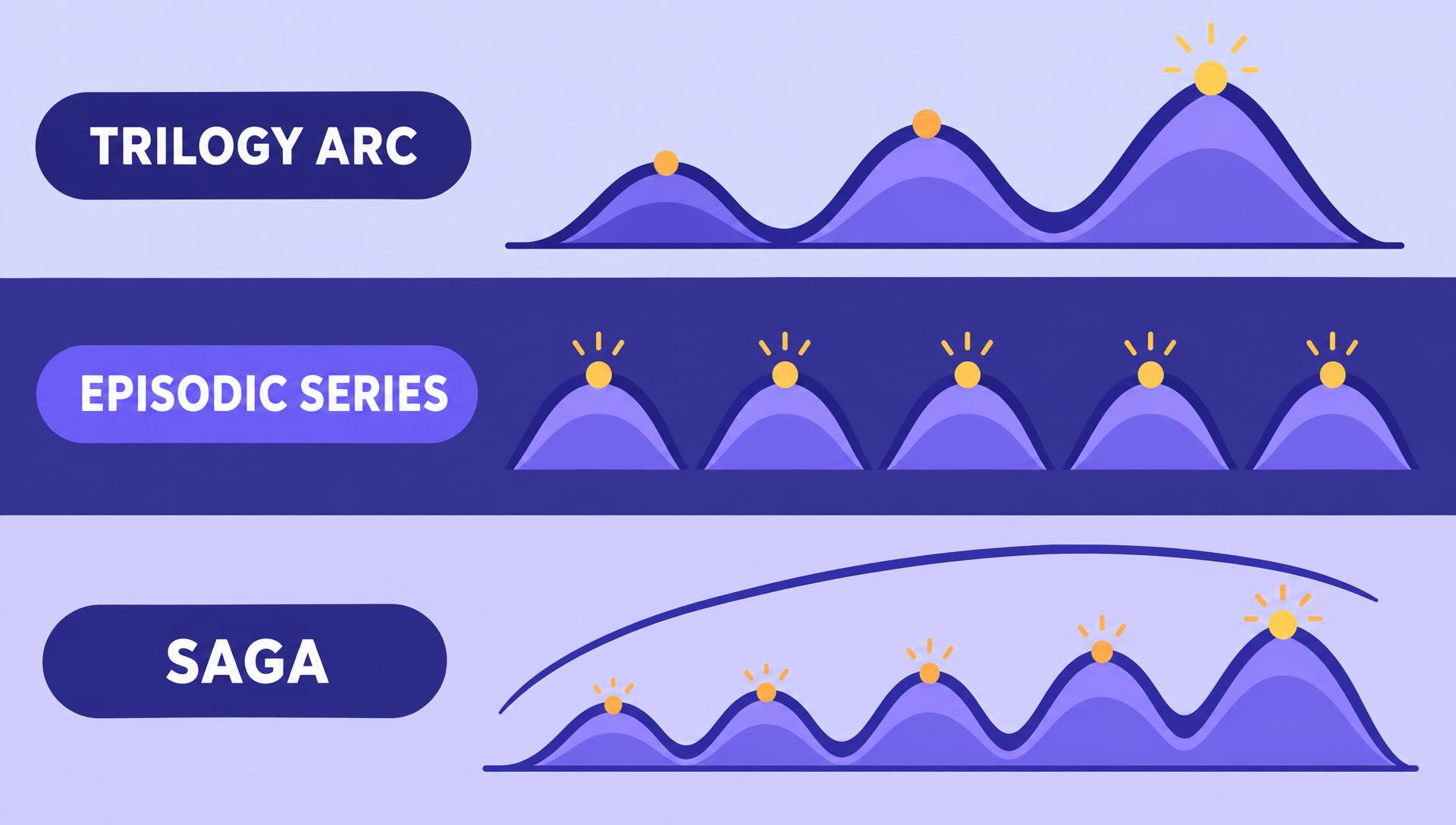
- Shape
- One large story told across a fixed number of books, each with its own climax, all building to a final resolution.
- Works best for
- Epic fantasy, science fiction, young adult, any story with a single overarching conflict.
- Main risk
- A weak middle book. Give book two its own goal and a turning point that changes the story's direction.
If you are writing a three-book story, our guide to how to write a trilogy goes deeper into the book-by-book structure.
Plan two levels of arcs
Every book in a series needs its own arc: a goal, rising conflict and a climax that resolves the book's main question. On top of that sits the series arc, a larger question that each book moves forward without answering until the end.
A practical method is to write one sentence for the series question and one sentence for each book's question, then check that each book answers its own question and changes the series question in some way. If a book does not change anything at the series level, it is filler, and readers notice.
You do not need every scene of later books planned before you publish book one. You do need the ending of the series, the major turns, and any secret you will reveal later, so you can plant it early.
Continuity: what to track and where
Readers of series remember details: eye colors, the name of a minor character's dog, what a spell costs. Contradictions break trust faster in a series than in a standalone, because fans reread.
- Characters: appearance, age, relationships, what each one knows and when they learned it
- World rules: magic, technology, politics, geography and their costs
- Timeline: dates, seasons, travel times and the order of events across books
- Open threads: promises, mysteries and setups that still need payoff
- Style: tense, point of view, chapter length and voice that readers expect
All of this lives in a series bible. Our step-by-step guide on how to write a series bible shows what to put in it and how to keep it current while you draft.
Character growth across books
In a single novel a character's arc completes. In a series, the lead's arc must stretch across books without stalling. Give the lead a flaw or wound big enough to last the series, and let each book resolve one layer of it while uncovering the next.
Secondary characters can carry full arcs inside single books, which keeps each installment satisfying even when the lead's change is slow. For patterns that work, see our character arc examples.
Do not reset characters between books. A detective who had a breakdown in book three should not be untouched in book four. Change is what makes readers feel that the series is going somewhere.
Ending each book: close the plot, open the series
The safest pattern is to resolve the book's main plot and leave a series-level question open, sometimes with a short hook in the final scene. Readers forgive an open thread; they rarely forgive a book that stops mid-plot.
A hard cliffhanger can work for a trilogy whose next book is already written or close to release. It is risky when the next book is years away. Our guide to writing a cliffhanger covers the difference between a hook and a cliffhanger in more detail.
Start book two with everything book one knows
Import up to five earlier books and AIWriteBook extracts the characters who still matter, the key details and a compressed outline, then uses them to plan and write the next book.
Release cadence
Many self-published series authors release books close together, because store algorithms and readers both reward momentum. Some write two or three books before publishing the first so they can release them a few weeks or months apart.
Whatever cadence you choose, plan it before launch: what goes in the back matter of each book, when the next preorder opens, and how readers on your list hear about it. Writing faster helps here, and our guide to writing 10,000 words a day with AI shows a realistic schedule for that.
Tools for series writers
The free series planner helps you sketch the series question, book-by-book arcs and release order in one place before you write.
Inside AIWriteBook, book series support lets you start a new book from earlier ones: import previous books as .docx files or pick them from your library, and the app builds characters, details and an outline summary that feed the next book's planning and chapters. The first series import is free. The character builder keeps profiles consistent across the series, and the chapter AI chat lets you check a draft against what came before.
Series writing FAQ
As many as the story needs. Trilogies suit a single overarching conflict; episodic series can run as long as readers keep buying. Decide whether your series is closed or open-ended before book one, because it changes how you plan the arcs.
Not necessarily, but having at least the series ending and major turns planned is important, and many authors write two or more books ahead to release them close together.
Episodic series are usually written so that each book stands alone. Trilogies and sagas often are not. Tell readers clearly in the description and on the cover which kind you are writing.
A reference document with every character, world rule, timeline event and open thread in the series, used to keep later books consistent with earlier ones.
Change something meaningful in every book, raise the series stakes gradually, and give each installment a new central problem rather than repeating the previous one.
Make the promise, then keep it
Decide the structure, write the series question and the ending, set up the bible, and give every book its own complete story. The rest is writing the books, one at a time, with the whole series in view.