


Pick your trilogy shape first
Most trilogy trouble starts with not deciding which kind you are writing. There are three common shapes, and each one puts the series question in a different place.
| Shape | How it works | Known example | Risk |
|---|---|---|---|
| One story in three volumes | A single plot split across three books. Each volume ends at a natural pause rather than a full resolution. | The Lord of the Rings, written as one novel and published in three parts | Readers of book one get no real ending. Hard to sell as a debut. |
| Closed books, open series | Each book has its own conflict and climax, while a larger conflict escalates underneath and resolves in book three. | The Hunger Games: the Games, the Quarter Quell, then the war | The series arc can feel bolted on if it is not seeded in book one. |
| Linked standalones | Three complete stories in one world, often with different leads, connected by setting, theme or a thread that pays off late. | Kristin Cashore's Graceling Realm books | Weaker pull from book to book. Readers may stop after one. |
For a first trilogy, and especially for self-publishing where readers judge book one alone, the middle shape is the safest. Every book delivers a payoff, and the series still earns its ending. The rest of this guide assumes that shape.
The two-arc framework
Think of a trilogy as two stories running at different speeds. The book arc rises and resolves inside each volume. The series arc rises slowly across all three and only peaks at the end of book three.
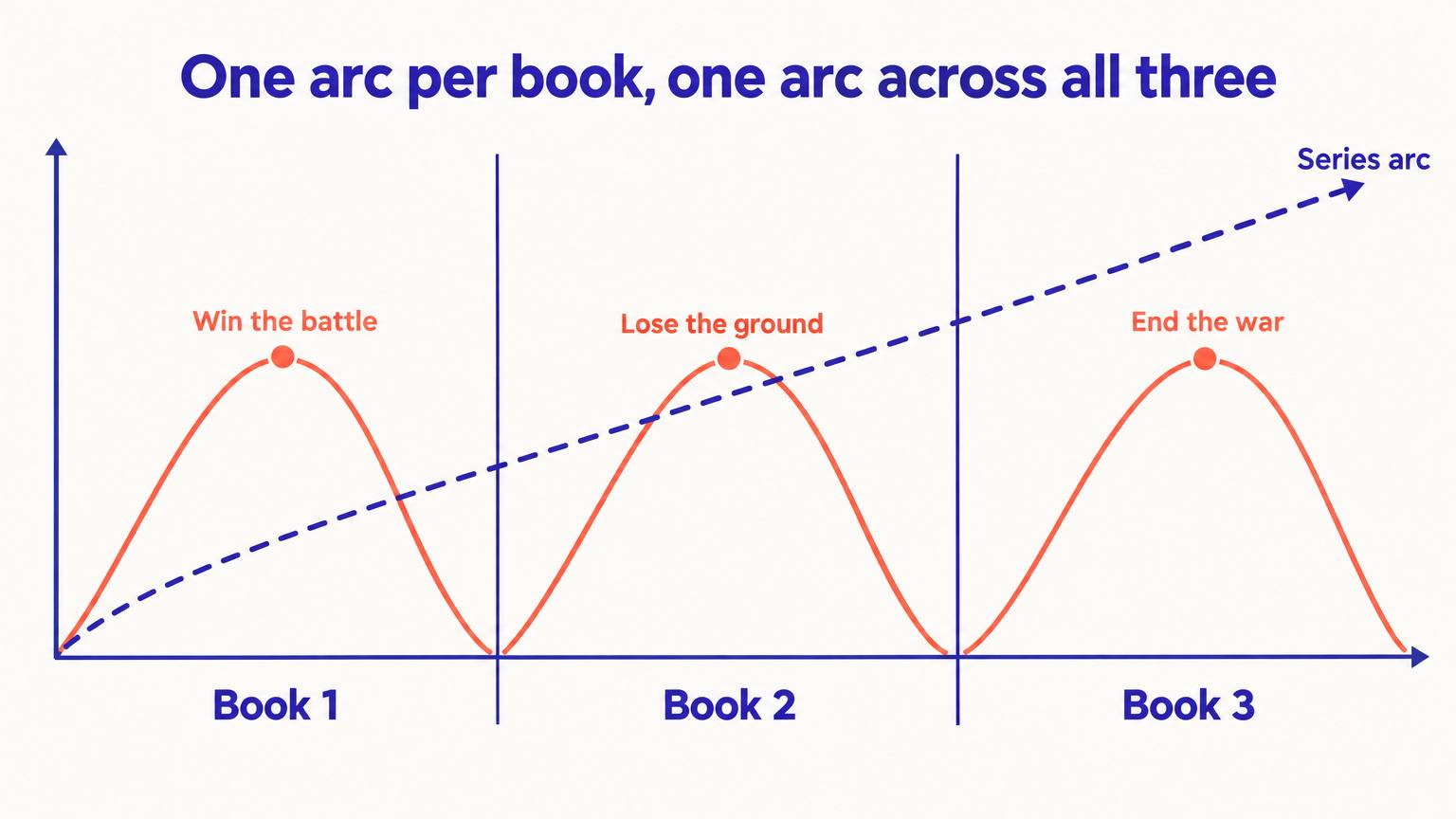
The trick is that each book's climax should move the series arc too, but not finish it. Book one wins a battle and reveals that the war is bigger than anyone thought. Book two loses ground and makes the cost personal. Book three ends the war and pays for it.
- Series question
- The one question only book three answers. Write it as a yes or no: will the heir take back the throne?
- Book question
- A smaller question each volume answers in full. Will she survive the trial? Will the alliance hold?
- The handoff
- What each book's answer reveals that makes the series question harder. This is what pulls a reader into the next book.
Plan a trilogy in six steps
This order works whether you outline every scene or discover the story as you draft. Plotters fill it in fully; pantsers fill steps one, two and five and leave the rest loose.
- 1
Write the ending of book three first
You do not need every scene, just the final image and the answer to the series question. Every setup in books one and two points at this.
- 2
Name the series question and three book questions
One sentence each. If a book question is just "what happens next", it is not a question yet.
- 3
Map the three climaxes
Decide what each climax resolves, what it costs and what it reveals. The second climax should be the lowest point for the hero, even if it is a tactical win.
- 4
Plant three seeds in book one
Pick at least three details that only pay off in book two or three: an object, a minor character, a rule of the world. Readers forgive slow reveals; they do not forgive answers that come from nowhere.
- 5
Plot each lead's arc across volumes
Where does the character start, where are they at the end of each book, and what do they believe at each point? More on this below.
- 6
Keep a series bible from day one
Names, ages, eye colors, who knows which secret, what the magic costs. A bible started after book one is already wrong. Our guide to building a series bible shows what to track.
Want a first draft of this plan to argue with? The free series planner turns a premise into a series bible, character arcs and a book-by-book outline you can then rework. For the scene level of each volume, see how to create a book outline.
Give every book its own climax
Readers finish a trilogy one book at a time, and each book is rated on its own. If book one ends on a cliffhanger with nothing resolved, the reviews will say so. Each volume needs a climax that answers its book question in full, plus a closing beat that opens the next.
Book 1
Climax must resolve
The immediate threat. The hero wins something real.
Leave open
Who was behind it, and why
Final beat
A reveal that reframes the win
Book 2
Climax must resolve
A major subplot, often a relationship or alliance
Leave open
The main conflict, now worse
Final beat
A loss or betrayal that forces book three
Book 3
Climax must resolve
The series question and every seed you planted
Leave open
Nothing that matters
Final beat
The new normal, and what it cost
A cliffhanger is fine as the last page, not as a substitute for a climax. If you want to end on one, read how to write a cliffhanger and make sure it opens a new question rather than withholding the answer to the old one.
The middle-book problem
Book two is where trilogies sag. It has no beginning to introduce and no ending to deliver, so it often turns into travel, training and waiting. Reviewers call it filler, and readthrough from book two to book three tends to show it.
The middle books people remember do the opposite. The Empire Strikes Back and Catching Fire both escalate, turn the hero's strengths against them and end with the heroes worse off than they started, with a much bigger question on the table. A good middle book is the darkest and most personal of the three.
Middle-book diagnostic
0 of 6Tick every statement that is true of your book two.
This book is in sag territory. Start with the climax: give book two its own question and a loss that matters.
If the draft still drags, it is usually a pacing problem rather than a plot one. Our guide to pacing in fiction covers cutting the travel and training chapters down to what changes the story.
Character arcs across three volumes
A trilogy lead changes too slowly for one book and too fast for a single climax. The arc that works best splits the change into three stages: the false belief pays off, the false belief starts to cost, and the character finally chooses the truth.
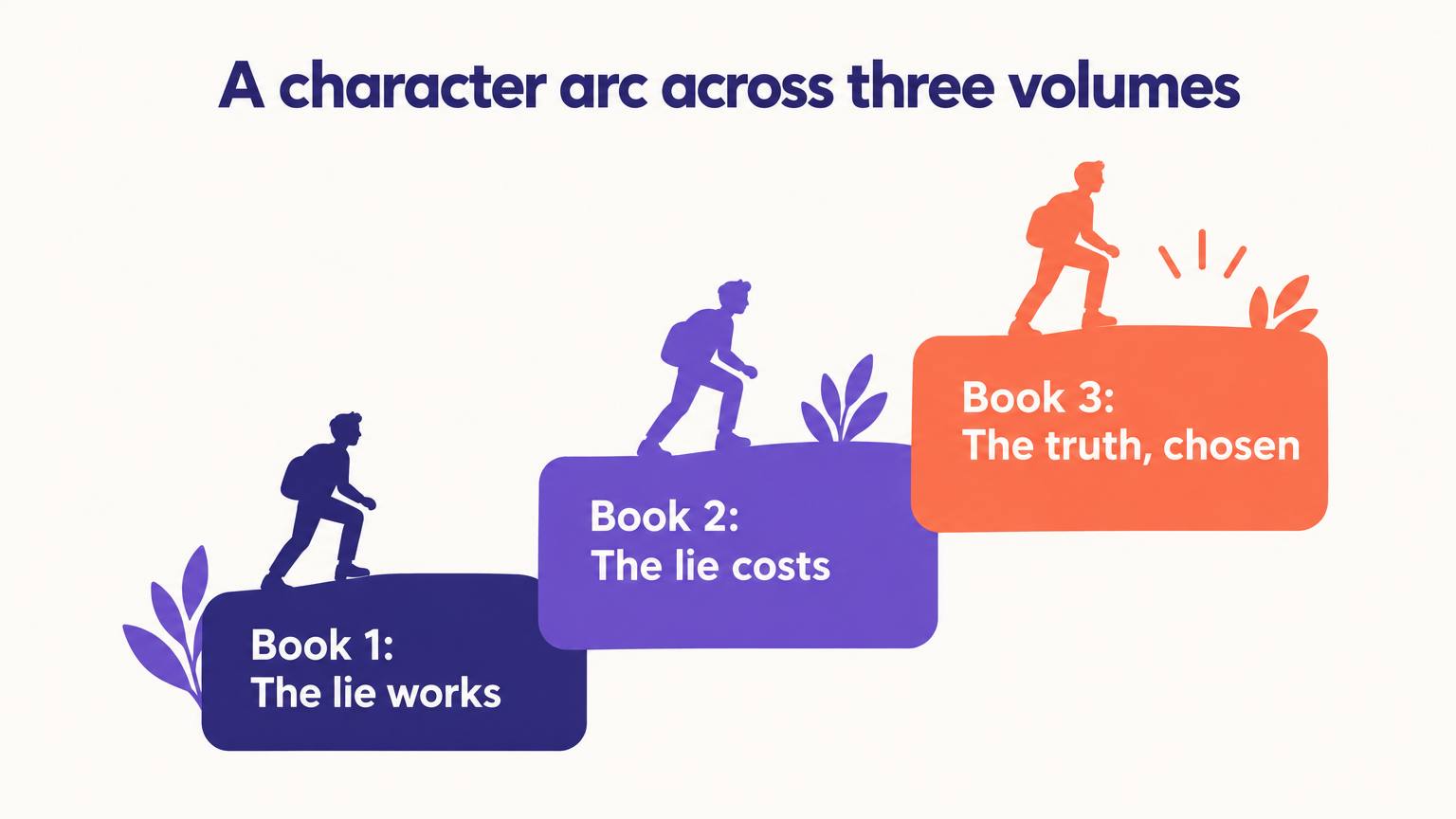
In book one the flaw helps. A suspicious hero survives because she trusts no one. In book two the same flaw costs her an ally. In book three she trusts someone at the moment it matters most, and the ending depends on it. Each book has its own change, and the three add up to one.
Supporting characters need arcs too, but shorter ones. Give at least one secondary character a full arc that resolves in book two, so the middle volume has an emotional payoff of its own. For more patterns, see these character arc examples, and if a lead still feels thin, run them through a character questionnaire before you plan their three stages.
Worked example: The Salt Crown
An invented trilogy, planned with the steps above, to show how the pieces connect.
Series question
Will Ilsa, a smuggler's daughter with a forgotten claim to the throne, free the salt coast from the tide-priests?
Book 1: Low Tide
- Book question
- Can Ilsa get her brother out of the priests' prison?
- Climax
- She breaks him out and burns the prison ledger.
- Handoff
- The ledger lists her own name. The priests have been hunting her since birth.
Book 2: The Drowned Court
- Book question
- Will the coastal lords back her claim?
- Climax
- They do, then her brother sells the alliance to the priests to save her life.
- Handoff
- She is now a queen with no army and a brother she cannot trust.
Book 3: High Water
- Book question
- Can she end the priests' rule without becoming them?
- Climax
- She floods the temple city, and gives up the crown to the council she once mocked.
- Handoff
- The coast is free. Ilsa goes back to the boats.
Notice the arc underneath: in book one Ilsa trusts only family, in book two family betrays her, in book three she trusts strangers with the crown. The plot and the character arc land on the same page.
Common trilogy mistakes
- 1Writing book one before deciding the ending of book three. You will spend book two retconning book one.
- 2Ending book one on an unresolved cliffhanger. First-book reviews punish it, and those reviews sell or sink the series.
- 3Resetting character growth at the start of each book so the hero can learn the same lesson again.
- 4Introducing the real villain in book three. If readers have never seen them, the final climax has no weight.
- 5Recapping book one for three chapters. Weave the essentials into action and trust returning readers.
- 6Letting continuity drift. A dead character reappears, a scar moves arms, a city changes names. Readers notice, and they say so in reviews.
The AI-assisted shortcut
The hard part of a trilogy is not writing book one, it is writing book two and three without losing track of what book one established. That is where AI tools help most, as long as they work from your actual text.
Start with the free series planner to rough out the two arcs, the three book questions and each lead's stages. It gives you something concrete to push against before you commit.
When you sit down to write book two, AIWriteBook's series support reads the books you have already written, from a file or straight from your library, and carries forward the characters at their latest state, the plot of each previous book and your voice on the page. The new book starts knowing who died, who lied and which threads you left open, instead of relying on a summary you wrote from memory. You can see how it works on the AI book series generator page.
Use it alongside your series bible, not instead of it. The bible holds your intentions for book three; the series import holds what books one and two actually say.
One-page trilogy template
Copy this into your notes and fill it in before drafting. If a line is hard to fill, that is the part of the plan that needs work.
SERIES QUESTION (yes or no):
FINAL IMAGE OF BOOK 3:

BOOK 1
  Book question:
  Climax resolves:
  Climax reveals (handoff):
  Lead believes at the end:

BOOK 2
  Book question:
  Climax resolves:
  What is lost:
  Lead believes at the end:

BOOK 3
  Book question:
  Climax resolves the series question by:
  Price paid:
  Lead's final choice:

SEEDS PLANTED IN BOOK 1 (pay off in 2 or 3):
  1.
  2.
  3.
Three books, one promise
A trilogy works when every book keeps its own promise and the three together keep a bigger one. Decide the shape, write the last page first, give each volume a real climax, make book two the darkest, and split your lead's change into three honest stages. Then keep a bible so book three still agrees with book one.