


In this guide
Why a series needs a bible
You write a series over years. Your readers read it over a week. That gap is the whole problem. By book four you have forgotten whether the mentor's scar was on the left hand or the right, but a reader who binged books one through three on Kindle Unlimited remembers, and they will tell you in a review.
The errors that hurt a series are rarely big plot holes. They are small drifts: a sister whose name gains a letter, a city that was three days' ride away and is now one, a magic rule bent once because the scene needed it. Each one is minor. Together they tell the reader you are not paying attention, and readers who feel that stop pre-ordering.
A novel series bible fixes this by moving memory out of your head and into a file you can search in seconds. It is also what lets you hand the series to an editor, a cover designer or an audiobook narrator without a three-hour briefing call.
The six parts of a series bible
Most templates online are either a single character sheet or a forty-page worldbuilding workbook. A working series bible sits in between. It has six parts, and each one answers a different question you will ask mid-draft.
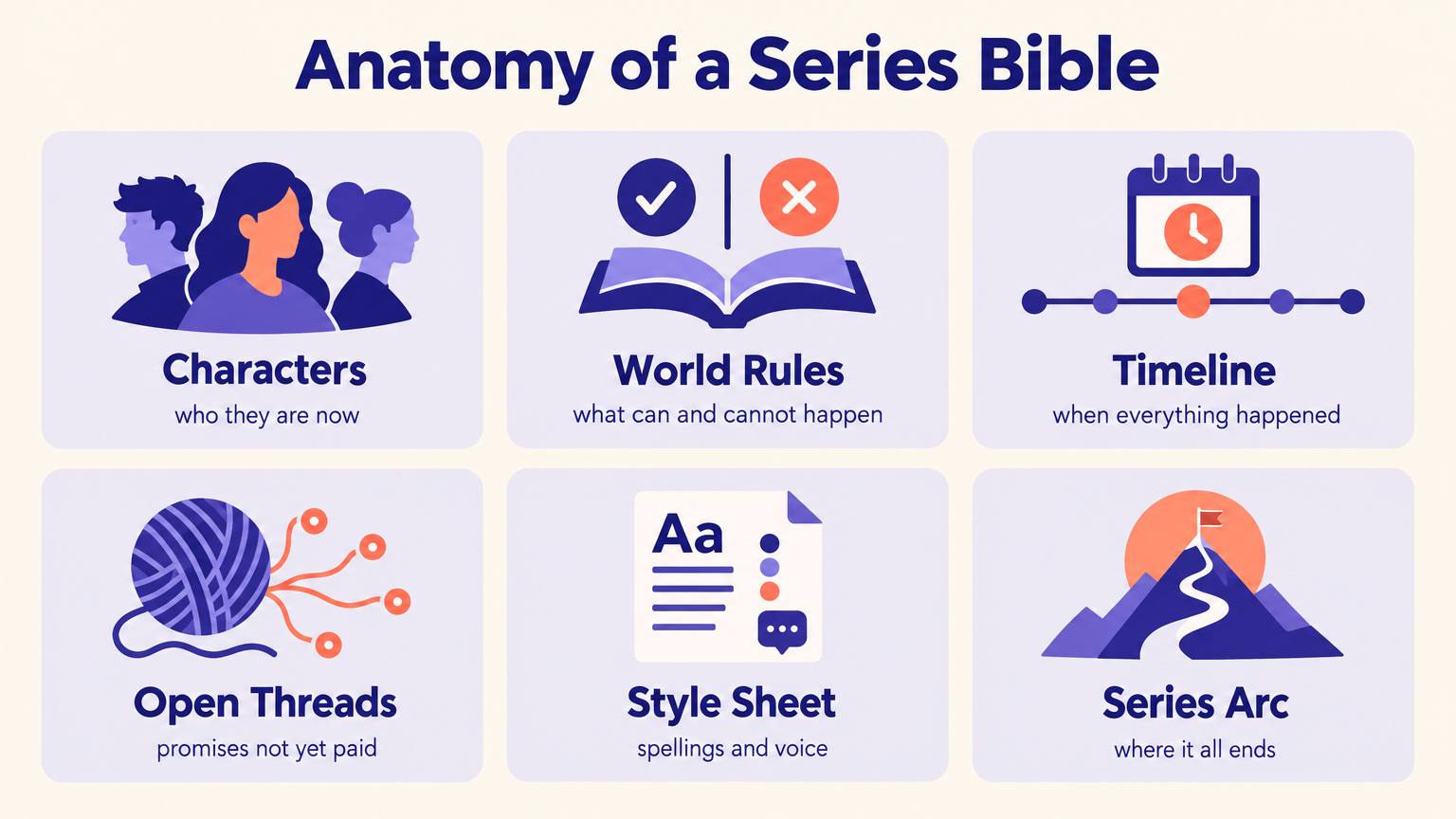
- Characters
- Who exists, what they look like, how they talk, and crucially what state they are in at the end of each book. Living, dead, injured, estranged, promoted.
- World rules
- Geography, travel times, politics, technology or magic, and the costs and limits of each. Write the limits down. Limits are what readers test.
- Timeline
- Dates or relative days for every major event, ages at each point, seasons. The timeline catches the pregnancy that lasts fourteen months.
- Open threads
- Every promise the books have made and not yet paid: a prophecy, an unexplained letter, a side character who walked off-page. Where it was planted, where it pays off.
- Style sheet
- Spellings, capitalization, invented words, pronunciation, POV and tense rules, recurring phrases. Your copyeditor will love you for it.
- Series arc
- The overall question the series answers, what each book contributes to it, and the ending you are steering toward even if it may change.
Build your series bible template
Pick your genre to add the fields that genre keeps tripping over, switch off any part you don't need, then copy the result into Google Docs, Notion, Scrivener or a plain text file.
Genre extras
Parts to include
Your template
SERIES BIBLE: [Series title]
Last updated: [date] | Current through: Book [n], chapter [n] | Tags: [C] canon, published  [P] planned

## CHARACTERS (one block per character)
- Name, plus every nickname, title and spelling used on the page:
- Role in the series and first appearance (book, chapter):
- Look: eyes, hair, height, scars, how they dress:
- Voice: speech habits, words they never use, accent:
- Core want and core fear:
- Relationships: who they love, owe, hate, lie to:
- State at end of each book: alive, injured, location, what they know:

## WORLD RULES
- Places: name, what it looks like, who runs it:
- Travel times between key places:
- Power: who holds it, how it is kept:
- Hard rules: what can never happen in this world:
- Money, food, technology level:

## TIMELINE
- Series start date or Day 0 anchor:
- Major events per book with date or day number:
- Character birthdays and ages per book:
- Backstory events referenced on the page:

## OPEN THREADS
- Promise or mystery:
- Planted in (book, chapter):
- Planned payoff (book):
- Paid in (book, chapter) or still open:

## STYLE SHEET
- Invented words with spelling and capitalization:
- Pronunciation guide for names (for narrators):
- POV and tense rules per book:
- Recurring phrases, oaths, chapter-heading format:

## SERIES ARC
- The series question in one sentence:
- What each book adds to the answer:
- The intended ending:
- Things that must stay true for the ending to work:
A series bible example: one character, three books
Here is the single most useful change you can make to a character entry. Most templates give each character a biography. A series needs a state for each book. This is an excerpt from the bible for an invented fantasy series, The Salt Wardens, for a secondary character named Oren Vale.
| Field | End of Book 1 | End of Book 2 | Book 3 plan [P] |
|---|---|---|---|
| Status | Harbor guard, loyal to the Warden | Deserted, hiding in the salt flats | Returns as a smuggler |
| Body | Left hand burned (B1 ch 9) | Burn scarred, two fingers stiff | Cannot draw a bow |
| Knows | Nothing about the tide-mark | Has seen the tide-mark on Mara's wrist (B2 ch 22) | Tells no one until ch 30 |
| Owes | Captain Ress, a life debt | Debt still unpaid | Pays it by betraying Ress |
Three habits show up in that small table. Every physical fact carries a chapter reference, so you can check it in thirty seconds instead of rereading a book. Published facts and plans are kept apart, because only the published version binds you; plans can change freely. And the knowledge row tracks who knows what, which is where most series continuity actually breaks. If you are still deciding how Oren grows across those books, our character development guide walks through arcs that span more than one book.
How to keep a series bible current
A bible written once and never touched is worse than none, because you will trust it. The fix is a small loop you run while drafting, not a big audit after.
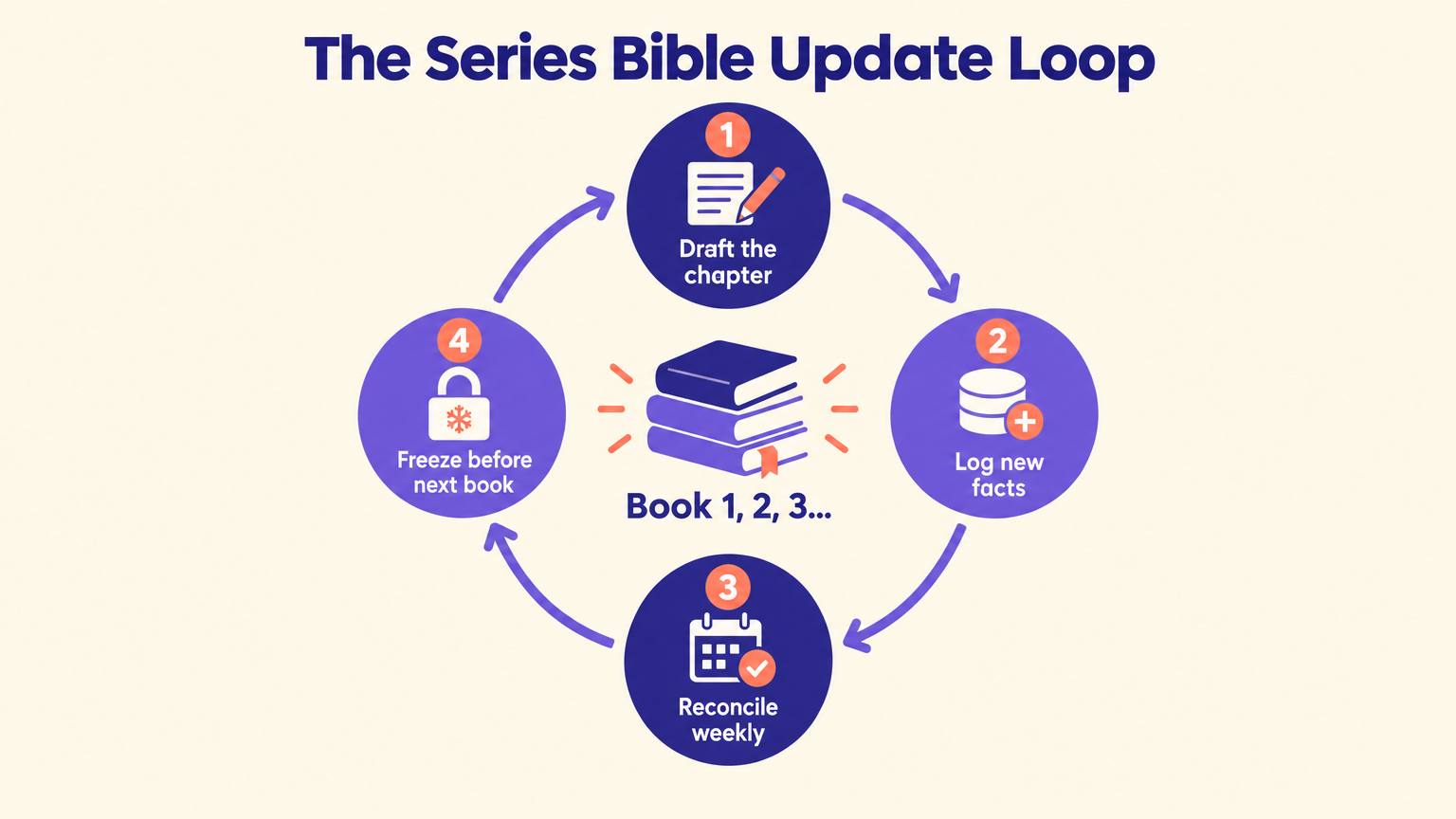
- 1
Draft without stopping
Don't break flow to update the bible mid-scene. Drop a marker like [BIBLE] in the margin wherever you invent a fact: a new name, a wound, a rule, a date.
- 2
Log new facts at session end
Spend five minutes at the end of each writing session searching for your markers and copying each new fact into the right part, with book and chapter.
- 3
Reconcile weekly
Once a week, reread the threads ledger and the character states. Close any thread you paid off, and flag any fact that conflicts with an earlier one.
- 4
Freeze before the next book
When a book is published, turn its plans into canon, add a new column for the next book, and read the whole bible once before you outline.
That final read is the step authors skip and regret. It takes an evening, and it is the only time you see the series as one object instead of a chapter at a time. It is also the right moment to plan the next installment's structure; our guide to writing a trilogy covers how to give book two and book three their own shape.
Writing book two or later?
Let your earlier books feed the next one
AIWriteBook reads your previous books and carries their characters, world and plot into the outline for the next one.
Common series bible mistakes
Writing the bible instead of the book
A sixty-page encyclopedia before chapter one is procrastination with tabs. Start with the parts you need for book one and let the bible grow from the page, not ahead of it.
Biographies instead of states
A paragraph of backstory does not tell you whether a character can climb stairs in book four. Track where each person stands at the end of each book.
Mixing canon with plans
If ideas and published facts sit side by side, you will eventually treat a discarded plan as fact. Tag every line as canon or planned.
No source references
A fact without a book and chapter reference can't be verified. When you and the bible disagree, the reference settles it.
Forgetting spelling and pronunciation
Invented names drift. Lock their spelling once, and add pronunciation before an audiobook, or two narrators will say the hero's name two ways.
One giant unsearchable file
If finding a fact takes longer than thirty seconds you will guess instead. Use clear headings, consistent labels and a tool with search.
The AI-assisted shortcut
Building a bible by hand for books you have already published means rereading all of them with a notepad. AIWriteBook's book series support does that reading for you. On a book's Series step you add up to five earlier books, either as Word files or from books already in your library. For each one it pulls out the story details, the characters that still matter with their most recent state, and a condensed plot outline, then merges them into one character list, one description and one outline that feed the writing of the next book.
Inside each book, the outline works as a per-chapter story bible: every chapter holds its events, locations, twists and character interactions, and the Story Bible sidebar keeps it open next to the editor while you write. Each character carries look, voice, motivation, conflicts, stakes and arc, the same fields the template above asks for. If your earlier books live in Word files, manuscript import brings them in with your text untouched and learns your writing style from them.
Planning a series from scratch? The free series planner sketches book-by-book arcs, the world builder drafts places and rules, and the character creator gives you a first pass at a cast you can then paste into your bible.
Series bible FAQ
A story bible covers one book. A series bible covers the whole run and adds what only matters across books: character states at the end of each installment, open threads that pay off later, and the series arc. Many authors keep one file with a column per book.
As long as the books need and no longer. For a three-book series it is often fifteen to thirty pages. The test is speed: you should find any fact in under thirty seconds.
Start with characters and open threads, since those break most often. Skim each published book for names, injuries, relationships and unanswered questions, and add chapter references as you go. Fill in world rules and the timeline as you hit them while drafting.
Anything with good search and headings: Google Docs, Notion, Scrivener's research folder, or a spreadsheet for the timeline and threads. The tool matters less than the update habit.
Yes. Send the style sheet to your copyeditor, the character looks to your cover designer and the pronunciation guide to your narrator. Strip the planned entries first if you don't want spoilers leaking.
Start small, keep it honest
A series bible doesn't need to be impressive. It needs to be correct and quick to search. Copy the template, fill in the characters and threads for the book you are writing now, and run the four-step loop. By book three you will trust it more than your memory, and your readers will feel the difference without ever knowing why.
For the rest of the craft, from first outline to finished draft, see our How to Write a Book guide.