


On this page
Writers spend a lot of energy on flaws and very little on strengths, on the theory that strengths are the easy part. Give the hero courage and a good heart, then go find something interesting to break.
That is backwards. A strength is what your character spends to get through the book, and it is the reason readers follow them through the bad decisions. A thin strength produces a protagonist who wins because the author needed them to. A precise one produces a protagonist whose victory feels earned and whose failures feel inevitable, because they come from the same place.
This page is the companion to our character flaws list. That one is about what a character pays. This one is about what they own, and how the thing they are proudest of becomes the thing that gets them in trouble.
Strength, virtue, skill: three different tools
These words get used interchangeably on character sheets, and the blur causes real problems in the draft. Each one does a different job.
| Term | What it is | Example | What the plot does with it |
|---|---|---|---|
| Strength | A disposition that helps the character under pressure | Patient | Tests it, overuses it, makes it backfire |
| Virtue | A strength the character holds as a moral value | Honest | Puts it on trial against something else they love |
| Skill | Something learned that can be taken away | Picks locks | Removes it at the worst moment |
The useful distinction: a skill can be lost, a strength can be misused, and a virtue can be betrayed. If you want a scene where the character loses something, take a skill. If you want a scene where the character becomes the problem, push a strength. If you want a scene that hurts, make two virtues collide.
The list: 84 character strengths in six families
Each strength is paired with the way it backfires, because that second line is what turns a virtue into a scene. Filter by family, or search for a word you already have in mind.
Showing 84 of 84 strengths
Honest
Moral strengthsHow it backfires
Tells the truth when silence would be kinder, or safer.
Loyal
Moral strengthsHow it backfires
Stands by a person or a cause long after it stopped deserving them.
Fair-minded
Moral strengthsHow it backfires
Holds enemies to the same rules, even when that means losing.
Principled
Moral strengthsHow it backfires
Refuses the one compromise that would have saved everyone.
Compassionate
Moral strengthsHow it backfires
Rescues the wrong person and drains the people who needed them.
Generous
Moral strengthsHow it backfires
Gives away what the group needed to get through the winter.
Forgiving
Moral strengthsHow it backfires
Lets the betrayer back in, and gets betrayed again.
Humble
Moral strengthsHow it backfires
Defers to worse judgment because speaking up feels like arrogance.
Just
Moral strengthsHow it backfires
Punishes by the book when mercy would have ended the feud.
Selfless
Moral strengthsHow it backfires
Erases their own needs until the resentment surfaces at the worst moment.
Trustworthy
Moral strengthsHow it backfires
Keeps a promise to someone who no longer deserves it kept.
Merciful
Moral strengthsHow it backfires
Spares the villain who returns for act three.
Devout
Moral strengthsHow it backfires
Reads every setback as a test and ignores the practical fix.
Accountable
Moral strengthsHow it backfires
Takes the blame for what was not theirs and gets sidelined for it.
Charming
Social strengthsHow it backfires
Talks around problems instead of solving them.
Empathetic
Social strengthsHow it backfires
Absorbs everyone's feelings and loses sight of the goal.
Diplomatic
Social strengthsHow it backfires
Smooths over a conflict that needed to happen.
Funny
Social strengthsHow it backfires
Jokes when someone needed them to be serious.
Warm
Social strengthsHow it backfires
Gets attached to the people the mission is going to cost.
Persuasive
Social strengthsHow it backfires
Talks others into risks they would never have taken alone.
Protective
Social strengthsHow it backfires
Lies to shield people and makes their decisions for them.
Good listener
Social strengthsHow it backfires
Hears everyone out and never says what they want.
Tactful
Social strengthsHow it backfires
Softens the warning until nobody hears it.
Inclusive
Social strengthsHow it backfires
Opens the circle to the person who is about to sabotage it.
Perceptive
Social strengthsHow it backfires
Reads people well enough to manipulate them, and is tempted to.
Supportive
Social strengthsHow it backfires
Enables a friend's worst habit in the name of standing by them.
Gracious
Social strengthsHow it backfires
Swallows an insult that should have been answered.
Easygoing
Social strengthsHow it backfires
Lets things slide until they cannot be fixed.
Clever
Intellectual strengthsHow it backfires
Outsmarts themselves on a problem that had a simple answer.
Curious
Intellectual strengthsHow it backfires
Opens the door everyone said to leave shut.
Observant
Intellectual strengthsHow it backfires
Spots the clue and misreads what it means.
Analytical
Intellectual strengthsHow it backfires
Freezes when the data runs out and a guess is required.
Creative
Intellectual strengthsHow it backfires
Improvises when the plan was fine.
Knowledgeable
Intellectual strengthsHow it backfires
Trusts the book over what is happening in front of them.
Strategic
Intellectual strengthsHow it backfires
Treats people as pieces and loses their trust.
Skeptical
Intellectual strengthsHow it backfires
Dismisses the one warning that was true.
Quick-witted
Intellectual strengthsHow it backfires
Says the clever thing that can never be taken back.
Resourceful
Intellectual strengthsHow it backfires
Takes on alone what needed help.
Rational
Intellectual strengthsHow it backfires
Discounts the emotional fact that decides the outcome.
Open-minded
Intellectual strengthsHow it backfires
Gets talked out of being right.
Meticulous
Intellectual strengthsHow it backfires
Burns the clock on the wrong thread.
Wise
Intellectual strengthsHow it backfires
Advises instead of acting and becomes a passenger in their own story.
Resilient
Inner strengthsHow it backfires
Keeps getting back up when they should be changing direction.
Patient
Inner strengthsHow it backfires
Waits past the last moment to act.
Calm under pressure
Inner strengthsHow it backfires
Reads as cold; nobody knows they are terrified.
Optimistic
Inner strengthsHow it backfires
Underestimates the threat until it is in the room.
Self-disciplined
Inner strengthsHow it backfires
Turns rigid, and punishes themselves and others for every slip.
Self-aware
Inner strengthsHow it backfires
Narrates their own flaws instead of changing them.
Hopeful
Inner strengthsHow it backfires
Waits for a rescue or a reunion that is not coming.
Independent
Inner strengthsHow it backfires
Refuses the help that would have saved them.
Content
Inner strengthsHow it backfires
Lacks the hunger to chase the goal at all.
Emotionally open
Inner strengthsHow it backfires
Says the true thing at exactly the wrong time.
Grateful
Inner strengthsHow it backfires
Will not leave a bad situation because it once saved them.
Steady
Inner strengthsHow it backfires
Cannot adapt when the ground shifts.
Passionate
Inner strengthsHow it backfires
Burns out, or burns the people beside them.
Tender-hearted
Inner strengthsHow it backfires
Breaks under cruelty that others shrug off.
Brave
Strengths of driveHow it backfires
Charges in without a plan.
Determined
Strengths of driveHow it backfires
Cannot quit even when quitting is the right call.
Decisive
Strengths of driveHow it backfires
Commits too fast on half the facts.
Ambitious
Strengths of driveHow it backfires
Climbs over people they will need later.
Hardworking
Strengths of driveHow it backfires
Neglects the people for the work.
Adventurous
Strengths of driveHow it backfires
Gets bored of the safe path and picks the dangerous one.
Bold
Strengths of driveHow it backfires
Says it in the room where it costs the most.
Competitive
Strengths of driveHow it backfires
Turns allies into rivals.
Reliable
Strengths of driveHow it backfires
Carries everyone's load and becomes the single point of failure.
Spontaneous
Strengths of driveHow it backfires
Breaks plans that other people were depending on.
Tenacious
Strengths of driveHow it backfires
Holds a grudge as tightly as a goal.
Energetic
Strengths of driveHow it backfires
Acts before anyone else has caught up, and leaves them behind.
Daring
Strengths of driveHow it backfires
Mistakes risk for virtue.
Proactive
Strengths of driveHow it backfires
Acts before understanding and makes the problem bigger.
Natural leader
Leadership and practical strengthsHow it backfires
Decides for people who wanted a say.
Responsible
Leadership and practical strengthsHow it backfires
Cannot delegate, and carries the guilt for every loss.
Organized
Leadership and practical strengthsHow it backfires
Breaks when the plan breaks.
Inspiring
Leadership and practical strengthsHow it backfires
Leads followers somewhere they should never have gone.
Nurturing mentor
Leadership and practical strengthsHow it backfires
Holds the student back to stay needed.
Commanding
Leadership and practical strengthsHow it backfires
Gets obedience instead of honesty.
Frugal
Leadership and practical strengthsHow it backfires
Under-funds the one thing that mattered.
Practical
Leadership and practical strengthsHow it backfires
Dismisses the dream that was the whole point.
Masterful at a craft
Leadership and practical strengthsHow it backfires
Defines themselves by the skill and collapses when it is taken.
Physically strong
Leadership and practical strengthsHow it backfires
Solves with force what needed a conversation.
Street-smart
Leadership and practical strengthsHow it backfires
Trusts nobody, including the ally who was real.
Cautious
Leadership and practical strengthsHow it backfires
Misses the window while checking the exits.
Prepared
Leadership and practical strengthsHow it backfires
Has a plan for everything except what actually happens.
Highly competent
Leadership and practical strengthsHow it backfires
Everyone else stops trying, and they end up alone at the top.
The shadow rule: every strength has a cost
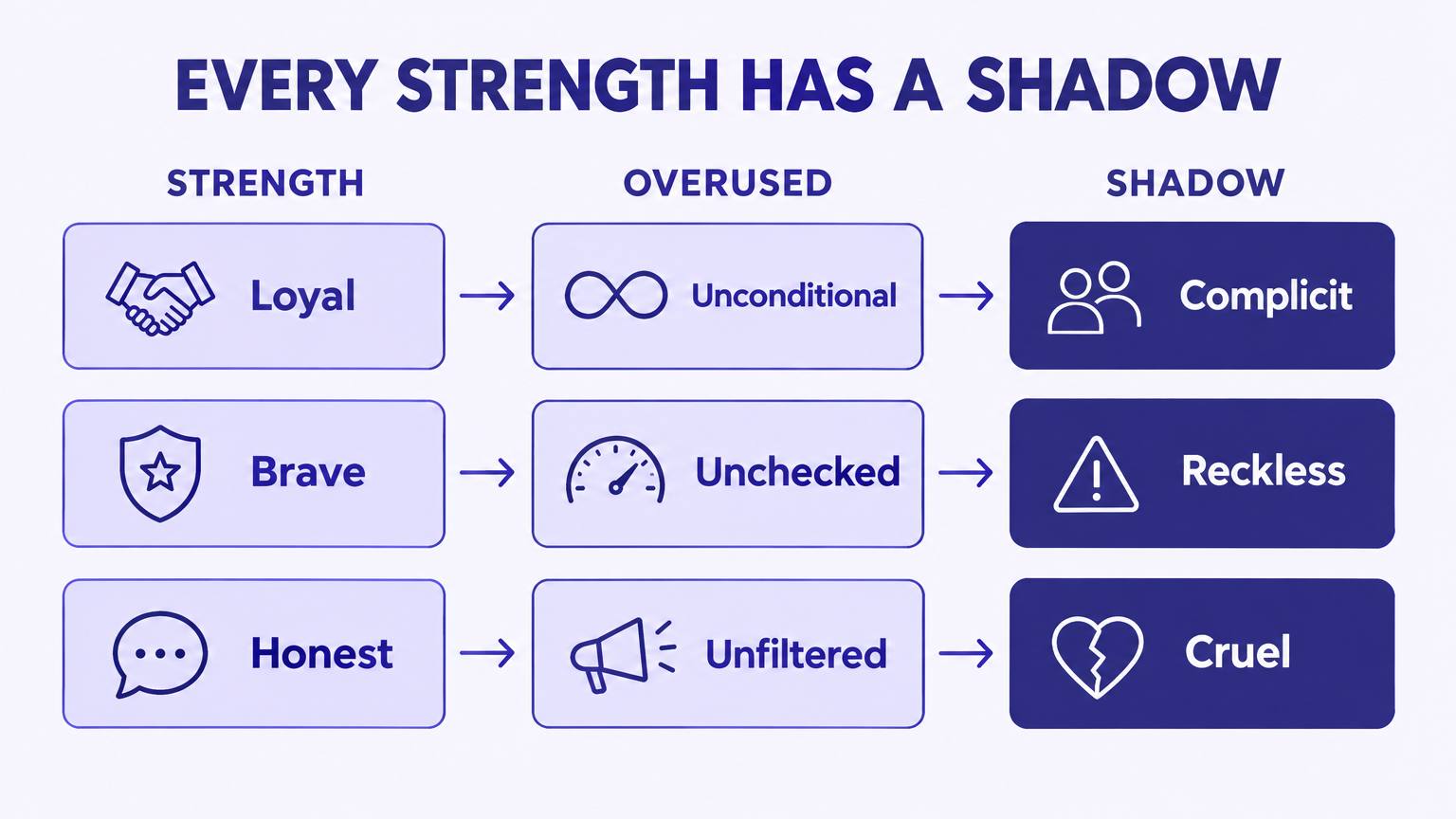
Look down the backfire column in the list above and you will notice a pattern. Almost none of the backfires are the opposite of the strength. Loyalty does not fail by turning into betrayal. It fails by staying loyal past the point where loyalty makes the character an accomplice.
That is the shadow rule. A strength goes wrong through excess, not reversal. The brave character does not become a coward; they become reckless. The honest one becomes cruel. Which means the shadow is always available, always one notch further along the same dial, and the plot only has to apply enough pressure to push the character there.
How to use it in three moves
- 1
Pick the strength the character would name if asked what they are good at. Their own word, not yours.
- 2
Turn the dial one notch past healthy and write down the shadow as an action, not an adjective. Not "reckless" but "goes into the building before backup arrives".
- 3
Build one scene in the middle of the book where that action is the obvious, admirable choice and still turns out to be the wrong one.
The strength the climax spends
Here is the job most strength lists never mention. The strength that wins the climax has to be set up early, and it has to have cost the character something before it saves them.
If a quiet character suddenly gives the rousing speech that turns the battle, the reader feels the author's hand. If we watched that same character talk a frightened child down from a ledge in chapter three, and then watched the same gift fail them badly in chapter twelve, the speech lands. It is the same principle as Chekhov's gun, applied to a person instead of a prop.
A simple schedule works for most novels: show the strength at low stakes in the first act, make it backfire in the middle, and let the character use it at the climax in a changed form, aimed at a different target or carried with the lesson the backfire taught. That change is the visible part of a character arc.
Strengths by role: protagonist, villain, sidekick
Which strengths you give matters less than how many and to whom. A few working rules:
Protagonist
One defining strength and one supporting one is plenty. The defining strength should be the thing the climax spends; the supporting one makes them pleasant company in the meantime. Two defining strengths split the arc and make the ending feel like a coin toss.
Villain
Give the antagonist a genuine strength the hero lacks, ideally one the reader admires against their will: discipline, foresight, loyalty to their own people. A villain with only flaws loses on page one. Our guide to writing a villain goes further.
Sidekick and foil
Give the secondary character the strength that exactly covers the protagonist's flaw. When the hero is impulsive, the friend is patient. That pairing generates arguments for free, and it is the cleanest way to build a foil character.
Pairing strengths with flaws: three patterns
A layered character is not one with a long list of traits. It is one where the strength and the flaw are wired to each other, so pulling on one moves the other. There are three reliable wirings.
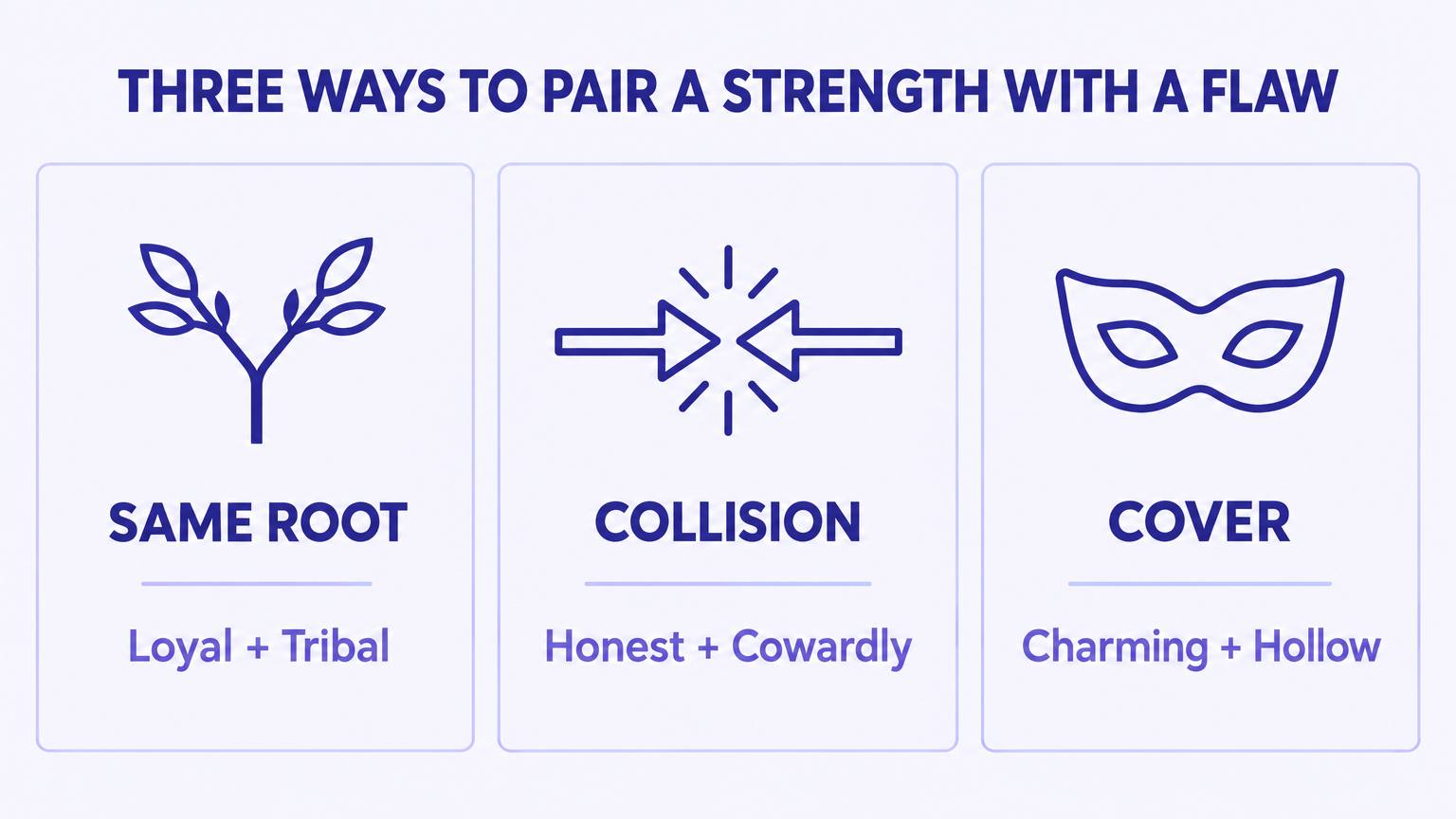
Same root
The strength and the flaw are the same trait seen from two sides. A loyal soldier is also tribal: kind to the unit, blind to the people outside it. Readers find this the most believable pairing, because it is how real people work.
Loyal + tribal, frugal + stingy, confident + arrogant
Collision
The strength and the flaw want opposite things, so every important scene forces a choice. A character who is honest but afraid of conflict knows the truth and cannot say it. This is the pairing that produces the most plot per page.
Honest + cowardly, brave + dependent, ambitious + loyal to a failing mentor
Cover
The strength exists to hide the flaw, from others and from the character. The charming one is charming because there is nothing underneath they want seen. This pairing is built for a reveal: the arc is the cover failing.
Charming + hollow, competent + terrified of failure, funny + grieving
Pick the pattern first, then shop. Use the list above for the strength and the character flaws list for the other half. If you want to check that the pair holds up under questioning, run the character through a character questionnaire and see whether both traits keep showing up in the answers.
Worked example: one strength, built all the way through
A ferry captain on a northern crossing, built with the method above.
- Defining strength
- Responsible. Thirty years, no lost passengers. It is the first thing she would tell you about herself.
- Shadow
- Cannot delegate. Checks every strap herself, and treats her first mate as a pair of hands rather than a second captain.
- Pairing
- Same root: responsible plus controlling. The pride and the problem are one trait.
- First act, low stakes
- She spots a badly secured car on the deck that her crew missed. The reader likes her for it.
- Middle, backfire
- In a storm she leaves the bridge to fix a problem below herself, and the first mate, never trusted with a call, freezes at the wheel.
- Climax, changed form
- The engine fails at the worst point of the crossing. She hands the bridge to the mate and goes below, and this time the responsibility is shared rather than hoarded.
Notice that her strength never disappears and never reverses. It changes target. That is what readers experience as growth.
Common mistakes with character strengths
01
The strength that never costs anything
If the character's kindness only ever makes things better, it is decoration. Audit it: find the scene where the strength made something worse. If there is none, write one.
02
Telling the strength instead of testing it
Other characters saying "she's the bravest person I know" proves nothing. Readers believe a strength after they watch it chosen at a price. This is show, don't tell at the level of character.
03
A strength for every occasion
The competent hero who is also funny, kind, strategic and physically gifted has no shadow left to explore and no reason to need anyone. Strip back to two strengths and give the rest to the cast.
04
A strength that solves the ending from nowhere
The quiet one gives the speech, the clumsy one makes the impossible shot. If the climax needs a strength, plant it in the first act, or the reader will feel the shortcut.
Keeping strengths consistent across a whole draft
Picking a strength takes ten minutes. Keeping it alive in chapter twenty-two, when you have forgotten that your captain would never leave the bridge without a reason, is the hard part.
In AIWriteBook every character has its own sheet with fields for personality, motivation, internal conflict, stakes and arc, and the chapter writer reads those fields before it drafts a scene. Write the strength into personality and its shadow into internal conflict, as a sentence the character would actually say, and the drafts keep both in play. You can rough out a cast in the free character creator first, and name them with the character name generator.
The schedule from the climax section belongs in the outline. The outline builder gives every chapter its own events, twists and character interactions, so the first-act proof, the mid-book backfire and the final spend each get a chapter of their own. And when a drafted scene lets the strength off too easily, ask the chapter AI chat to make the backfire cost more; the edit comes back as a diff you accept or reject change by change.
Give your characters strengths that cost something
Build the cast, wire each strength to its flaw in the character sheet, and draft chapters that remember both.
Character strengths FAQ
One defining strength that the climax depends on, and one or two supporting strengths that make them good company. More than that and the character stops needing other people, which drains tension from every relationship in the book.
A virtue is a strength the character holds as a moral commitment, like honesty or loyalty. All virtues are strengths, but not all strengths are virtues: patience and cleverness help a character without being moral positions. Virtues are useful because two of them can be set against each other.
Yes, and the best ones do. Discipline, loyalty to their own side, patience and intelligence make a villain dangerous and believable. A villain whose strength mirrors the hero's flaw is especially effective.
Put the character in a scene where using the strength costs them something, and let them choose to use it anyway. The cost is what convinces the reader; praise from other characters does not.
The short version
Choose the strength your character would name, push it one notch too far to find its shadow, wire it to a flaw with one of the three patterns, and schedule three moments for it: proof, backfire, spend. Do that and the strength stops being a label on a character sheet and starts being the reason the story goes where it goes.