

Why the order of passes matters
The most common self-editing mistake is polishing sentences in a chapter you later delete. Professional editing is staged for a reason: developmental editing first, then line editing, then copyediting, then proofreading. Each stage assumes the one above it is settled.
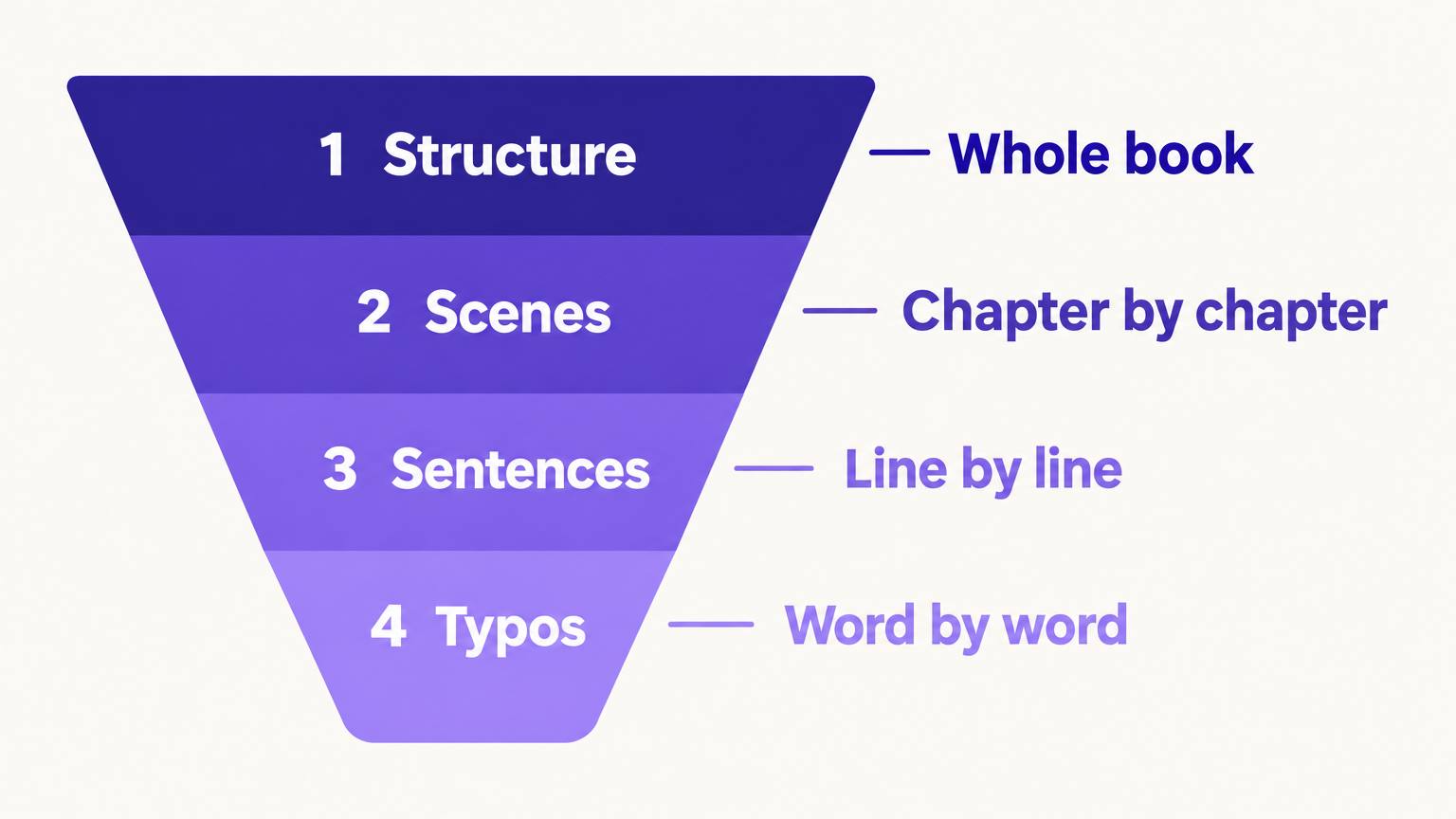
Think of it as a funnel. You start wide, reading the entire book for shape, and narrow down until you are looking at single words. Moving down the funnel is cheap. Moving back up, because you discover in the typo pass that chapter nine contradicts chapter three, is expensive.
If you want the broader landscape of editing types, tools and costs, the book editing guide covers it. This page is only about doing it yourself.
Before you start: get distance
Put the draft away for two to six weeks. You are trying to forget what you meant so you can see what you wrote. Work on something else in the meantime, even a short story.
Then change the format. Print it, export it to an e-reader, or switch to a different font and page size. A familiar layout lets your brain autocorrect; an unfamiliar one shows the bumps.
Finally, do one cold read without fixing anything. Keep a notebook beside you and write short notes with chapter numbers: 'ch 7 drags', 'why does Mara trust him here?', 'too many flashbacks in part two'. Those notes become your structural to-do list.
1Pass 1: Structure (developmental self-edit)
This pass works on the whole book. You are not touching sentences. You are asking whether the story or argument holds together, and moving, cutting or adding whole chapters if it does not.
A useful trick is a reverse outline: one line per chapter saying what happens and why it matters. If you cannot say why a chapter matters, it probably does not. Chapters that repeat the same emotional beat can usually be merged.
Questions for the structure pass
Fiction
- Does the protagonist want something specific by the end of chapter one?
- Does each act end with a change that makes going back impossible?
- Is the midpoint a real turn, or just more of the same?
- Does the climax depend on choices the protagonist made, not luck?
- Is every subplot resolved or deliberately left open?
Non-fiction
- Can you state the book's promise to the reader in one sentence?
- Does each chapter deliver one clear step toward that promise?
- Are chapters in the order a reader needs them, not the order you thought of them?
- Is every claim backed by an example, a source or your own experience?
- Does the ending tell the reader exactly what to do next?
If the structure is badly broken, it is often faster to re-outline and redraft a section than to patch it. Our guide on creating a book outline works for re-outlining an existing draft too.
2Pass 2: Scenes and chapters
Now go chapter by chapter. Each scene should have a goal, an obstacle and an outcome that changes something. Scenes where nothing changes are the ones readers skim.
Check where each chapter starts and ends. Many chapters start too early, with a character waking up or arriving, and end too late, after the interesting moment has passed. Try cutting the first and last paragraph of every chapter and see how many survive without them.
Scene-level checks
- Whose point of view is this scene, and is it consistent?
- What does the viewpoint character want in this scene?
- What gets in the way?
- How is the situation different at the end?
- Could this scene be cut without the reader missing anything?
Watch pacing across chapters, not just within them. Three slow reflective chapters in a row will lose readers even if each one is good. Our post on writing cliffhangers has practical chapter-ending patterns.
3Pass 3: Sentences (line edit)
This is the pass most people picture when they hear 'editing'. It is about rhythm, clarity and voice. Read aloud. Your ear catches what your eye skips: sentences that run out of breath, repeated words, dialogue nobody would say.
Work on the patterns that weaken prose most often: filter words (she saw, he felt, I noticed), stacked adverbs, vague nouns like 'thing' and 'stuff', and paragraphs where every sentence has the same length and shape.
A line edit, before and after
Before
She suddenly felt a really strong sense of fear as she slowly walked into the dark room and she noticed that the window was open.
After
The room was dark. Cold air from the open window touched her neck, and she stopped breathing.
The edit removes the filter words (felt, noticed), the intensifiers (suddenly, really, slowly) and shows the fear through a physical reaction instead of naming it.
This is also where an AI assistant can genuinely help, as long as you stay in charge. In AIWriteBook's chapter AI chat you can select a paragraph and ask for a tighter version or a different rhythm, and every suggestion appears as a diff you accept or reject line by line. Nothing changes in your manuscript unless you approve it. If you already have a finished draft, import the manuscript and edit it chapter by chapter.
4Pass 4: Typos and consistency (copyedit and proofread)
Last comes the mechanical layer: spelling, grammar, punctuation, and consistency. Consistency errors are the ones readers notice in reviews: a character's eyes change color, a town is spelled two ways, a timeline runs a week in four days.
Build a style sheet as you go. It is a simple list of every name, place, invented term, and choice you made (serial comma or not, 'OK' or 'okay', numbers as words or digits). Fiction writers can keep the same information in a series bible, which pays off again in book two.
Run an automated check, but do not trust it blindly. The free grammar checker or the built-in grammar and style check in each chapter flags errors with explanations; you decide which ones are real. Style choices like fragments in dialogue are not errors.
For the final proofread, change the format one more time and read slowly, ideally on paper or in the exact export your readers will see. Reading backwards, sentence by sentence, stops you following the story and makes typos jump out.
Self-editing checklist
Tick these off as you go. Your progress is saved in this browser.
When to get outside help
Self-editing has one hard limit: you cannot read your own book for the first time. You always know what you meant. That is why even very experienced writers use other readers.
The cheapest outside help is beta readers. Three to five readers from your target audience will tell you where they got bored, confused, or stopped believing. Our guide on finding beta readers covers where to find them and what to ask.
Hire a professional when the stakes justify it. A developmental editor is worth it if beta readers keep pointing at the same structural problem you cannot fix. A proofreader is worth it for any book you will sell, because typos in the first pages hurt reviews. Our guide on hiring a freelance editor explains rates and how to vet one.
| If this is your situation | Who to bring in |
|---|---|
| Readers say the middle drags or the ending falls flat | Developmental editor or critique partner |
| The story works but the prose feels clunky | Line editor |
| You are about to publish and want it clean | Copyeditor or proofreader |
| You want to know if it works for your audience | Beta readers |
Self-editing questions
Plan for at least four passes, one per level: structure, scenes, sentences and proofreading. Some writers need two structural passes before the rest. Stop when changes start making the book different rather than better.
Yes, many self-published authors do, especially with good beta readers. The minimum we recommend paying for is a proofread for any book you sell, because fresh eyes catch typos you have read past a dozen times.
Usually as long as the draft took, sometimes longer. The structure pass is slowest because it can mean rewriting chapters. The proofread is fastest but needs the most concentration.
Mostly no. Editing while drafting slows you down and often polishes scenes that get cut later. Leave notes and placeholders, finish the draft, then edit in order.
It helps most at the sentence and proofreading levels, where it can suggest tighter phrasing and flag errors. Keep the final decision yours: review every change instead of accepting a full rewrite, so the voice stays your own.
Edit big to small
Self-editing is a skill, and like drafting it gets faster with every book. Rest the draft, fix structure before sentences, keep a style sheet, read aloud, and bring in other readers before you publish.
For the full picture of editing types, costs and tools, continue with our Book Editing guide.