


What happened to NaNoWriMo
National Novel Writing Month began in July 1999, when Chris Baty and 21 friends in the San Francisco Bay Area tried to write a novel in a month. It moved to November the next year and grew into a nonprofit with more than 400,000 participants by 2022. Books that started as NaNo drafts include Water for Elephants, The Night Circus and Cinder.
At the end of March 2025 the organization announced it was closing. Its interim leadership pointed to money problems and a six-year decline in participation. Two public crises came before that: a 2023 to 2024 forum moderation scandal involving the safety of young members, and a September 2024 statement saying that categorically condemning AI had classist and ableist undertones. Authors including Maureen Johnson and Daniel José Older left its boards after that statement, and at least one sponsor withdrew.
What this means for you
There is no official NaNoWriMo site, word-count validator or winner certificate any more. The challenge itself, 50,000 words in November, is simply a goal anyone can set. Several companies and communities now host it, each with its own rules.
Where to write 50k in November 2026
These are the main hosts we could verify. Rules differ in ways that matter, especially on AI and on where your words must be typed.
| Event | Dates | Goal | What to know |
|---|---|---|---|
| Novel November (ProWritingAid) | Nov 1 to 30, with Preptober in October and editing help in December | 50,000 words | Free. The closest heir to the old format: dashboard, sprints, workshops, and tracking that works with Word, Scrivener and Google Docs. |
| Reedsy Novel Sprint | Nov 1 to 30 | 50,000 words | Free, with $5,000, $2,500 and $1,000 prizes plus agent meetings. Words must be typed in Reedsy Studio: no pasting, no AI-generated text, or you are disqualified. |
| Novel 90 (AutoCrit) | 90 days from October 1 | A finished draft | Free. A slower track for people who know 30 days is unrealistic this year. |
| NovelEmber (World Anvil) | Nov 1 to 30 | 50,000 by default, or your own | Free and honor-based. You set the target and claim your certificate at the end. Popular with fantasy writers who worldbuild there. |
| Order of the Written Word | Nov 1 to 30 | 30,000 words for novels in 2025 | A Discord community started by a former NaNoWriMo Municipal Liaison. Explicitly AI-free. |
| Your own challenge | Any 30 days | Whatever you pick | A spreadsheet, a friend who checks in, and the planner below. Nobody validates your count, so the only rule is honesty with yourself. |
Pick the event before you pick your tools. If you want Reedsy's prizes, you are writing in Reedsy Studio without AI for 30 days, and that decision comes first.
The numbers that decide it
- words a day for 30 days
- 1,667words a day for 30 days
- manuscript pages a day at 250 words a page
- ~7manuscript pages a day at 250 words a page
- a day at a steady 800 words an hour
- ~2 ha day at a steady 800 words an hour
- words in most adult novels
- 70k+words in most adult novels
The last number is the one people forget. 50,000 words is a short novel at best, and in most adult genres it is roughly two thirds of one. Treat November as the month you get most of the story onto the page, not the month you finish a book. Our breakdown of how many words a novel needs by genre shows how far past 50k your genre usually runs.
Measure your real speed before November instead of guessing. Write for 25 minutes on anything, then paste it into the free word counter. Double that number and you have your words per hour, which the planner below turns into minutes a day.
Daily word-count planner
Set your goal, your days off and a pacing style. The planner spreads the words across the days you will actually write, and it recalculates from any day if you fall behind.
The same target every writing day.
Behind already?
1,667 words per writing day
about 125 minutes a day at your speed
| Day | Date | Target | Running total |
|---|---|---|---|
| 1 | Sun, Nov 1 | 1,667 | 1,667 |
| 2 | Mon, Nov 2 | 1,666 | 3,333 |
| 3 | Tue, Nov 3 | 1,667 | 5,000 |
| 4 | Wed, Nov 4 | 1,667 | 6,667 |
| 5 | Thu, Nov 5 | 1,666 | 8,333 |
| 6 | Fri, Nov 6 | 1,667 | 10,000 |
| 7 | Sat, Nov 7 | 1,667 | 11,667 |
| 8 | Sun, Nov 8 | 1,666 | 13,333 |
| 9 | Mon, Nov 9 | 1,667 | 15,000 |
| 10 | Tue, Nov 10 | 1,667 | 16,667 |
| 11 | Wed, Nov 11 | 1,666 | 18,333 |
| 12 | Thu, Nov 12 | 1,667 | 20,000 |
| 13 | Fri, Nov 13 | 1,667 | 21,667 |
| 14 | Sat, Nov 14 | 1,666 | 23,333 |
| 15 | Sun, Nov 15 | 1,667 | 25,000 |
| 16 | Mon, Nov 16 | 1,667 | 26,667 |
| 17 | Tue, Nov 17 | 1,666 | 28,333 |
| 18 | Wed, Nov 18 | 1,667 | 30,000 |
| 19 | Thu, Nov 19 | 1,667 | 31,667 |
| 20 | Fri, Nov 20 | 1,666 | 33,333 |
| 21 | Sat, Nov 21 | 1,667 | 35,000 |
| 22 | Sun, Nov 22 | 1,667 | 36,667 |
| 23 | Mon, Nov 23 | 1,666 | 38,333 |
| 24 | Tue, Nov 24 | 1,667 | 40,000 |
| 25 | Wed, Nov 25 | 1,667 | 41,667 |
| 26 | Thu, Nov 26 | 1,666 | 43,333 |
| 27 | Fri, Nov 27 | 1,667 | 45,000 |
| 28 | Sat, Nov 28 | 1,667 | 46,667 |
| 29 | Sun, Nov 29 | 1,666 | 48,333 |
| 30 | Mon, Nov 30 | 1,667 | 50,000 |
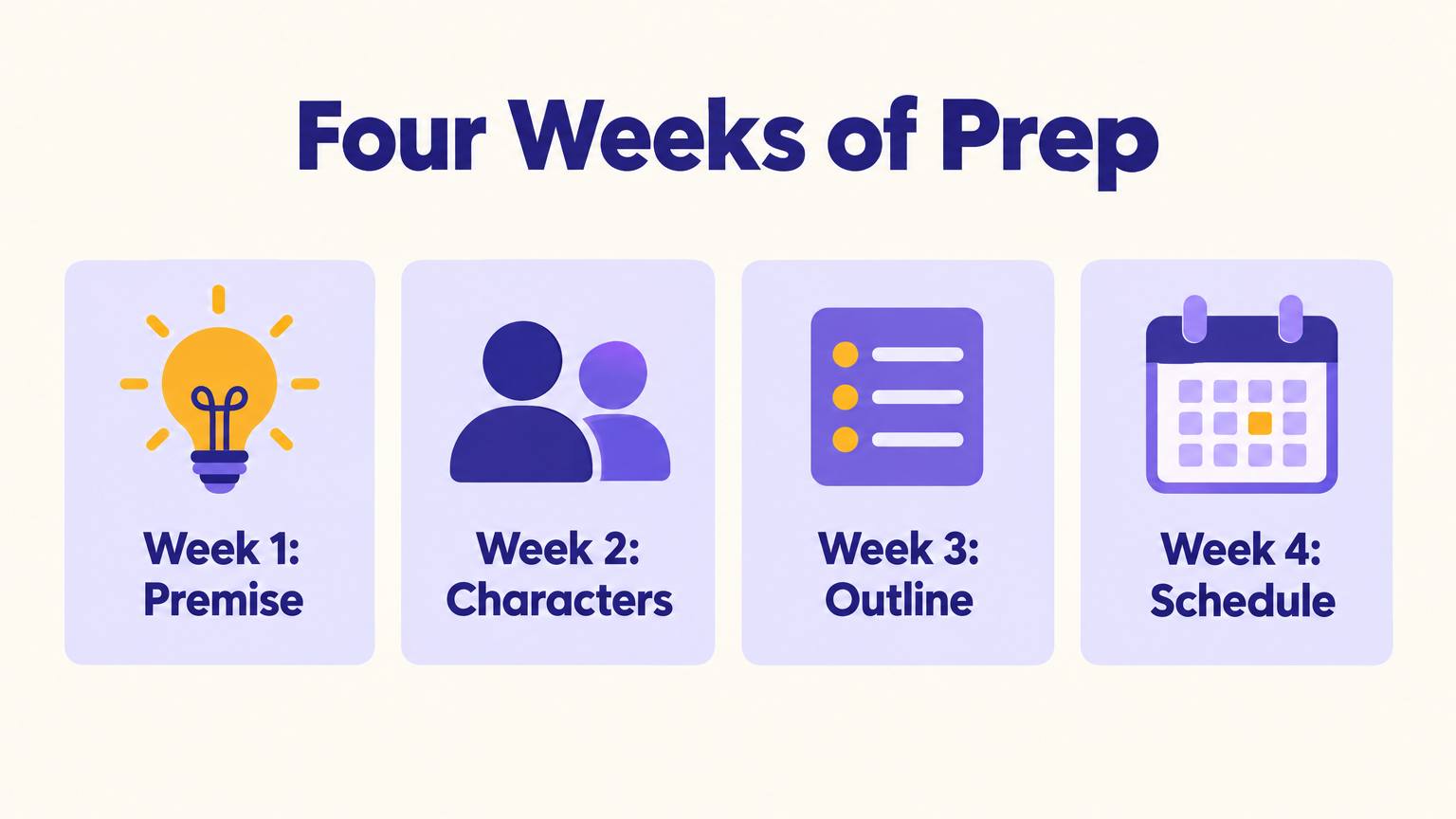
Preptober in four weeks
October prep is the difference between a hard November and a miserable one. Even committed discovery writers do better with a destination and a few signposts; our pantser vs plotter guide covers how much planning suits your temperament.
- 1
Week 1: Premise
Get the story into two sentences: who wants what, what stands in the way, what it costs to lose. If you have three ideas, spend a day drafting 500 words of each and keep the one you did not want to stop writing. The story starter tool is useful for pressure-testing a premise from different angles.
- 2
Week 2: Characters
Protagonist, antagonist and two or three supporting people, each with a want, a fear and a secret. Name everyone now, because renaming characters on day 14 costs you a sprint. The character name generator gives you genre-appropriate options in seconds.
- 3
Week 3: Outline
Aim for 20 to 30 scene or chapter lines, each one sentence long, with the midpoint and the ending pinned down. A beat sheet such as Save the Cat gives you the load-bearing moments; fill between them loosely.
- 4
Week 4: Schedule
Put writing sessions in your calendar like appointments, choose your days off, tell the people you live with, and set up the file or app you will write in. Run the planner above and write the targets on paper where you will see them.
If you want the outline and the cast in one place, AIWriteBook's outline builder generates a chapter-by-chapter story bible from your premise with events, locations, twists and a word-count target for each chapter. You edit every line, and those per-chapter targets double as your November checkpoints.
Pacing: where a missed day hurts
At the flat pace, the milestones are 11,669 words after the first week, 23,338 after the second and 35,007 after the third. The chart is simple. What it hides is that a missed day costs very different amounts depending on when you miss it.
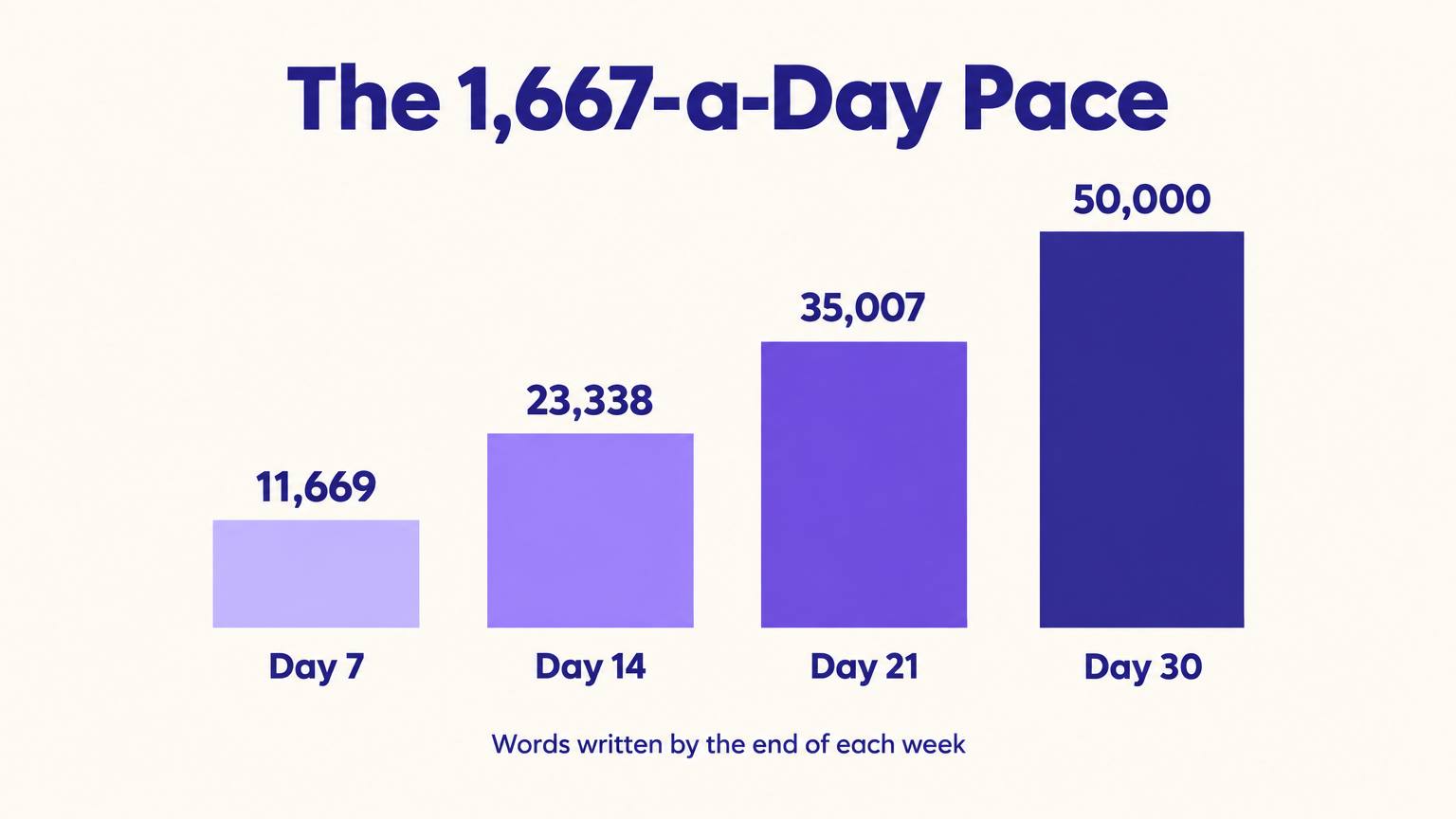
The same missed day, two different prices
Skip day 2 and the remaining 48,333 words spread over 28 days: 1,727 a day, 60 more than before.
Skip day 25 and the remaining 9,992 words must fit into 5 days: 1,999 a day, 332 more than before, at the point where you are most tired.
That is the whole case for front-loading. Words banked in the first week, while the novelty is still carrying you, are the cheapest words of the month. Many writers hit a wall in week two when the opening energy runs out and the middle has not taken shape yet, and many US writers lose days around Thanksgiving, which falls on November 26 this year. A cushion of 3,000 to 5,000 words by day 10 absorbs both.
Inside each day, sprints beat marathons. Three 25-minute sprints with a short break between them are easier to protect than a two-hour block, and they fit into a lunch break, a commute or the time before everyone else wakes up.
Three real schedules for November 2026
November 2026 starts on a Sunday, so it has 9 weekend days and 21 weekdays. Here is how that shapes three common lives.
The weekend writer
1,000 words on each of the 21 weekdays, which is one short sprint, then about 3,220 on each of the 9 weekend days. It works if your weekends are yours. It fails if one weekend disappears, so keep a Sunday in reserve.
The front-loader
2,500 words a day for the first 10 days makes 25,000, then 1,250 a day for the last 20. The second half feels almost relaxed, which is exactly when you need it to.
The commuter
Two 25-minute phone sprints on the train at about 650 words each, plus a 700-word session after dinner. With Sundays off, November 2026 leaves 25 writing days at 2,000 words each.
Mistakes that sink Wrimos
- 01
Editing while drafting
Rewriting yesterday's chapter feels productive and adds nothing to the count. Leave a note in brackets, such as [fix the timeline here], and move on.
- 02
Starting with no ending in mind
You can discover the route, but knowing roughly where you are headed keeps the middle from turning into 20,000 words of characters talking in kitchens.
- 03
Making up a deficit with sleep
Three nights of writing until 2am wreck the following week. Replan from today instead; the planner above exists for this.
- 04
Stopping when a scene is finished
A finished scene leaves you facing a blank page tomorrow. Stop mid-scene, when you know exactly what happens next.
- 05
Counting words you did not write
Pasted research, recycled old chapters or AI-generated prose inflate the number and teach you nothing about finishing. In Reedsy's sprint they also get you disqualified.
Where AI helps, and where it breaks the rules
The honest version: most November events exist to prove you can write a draft yourself. Reedsy bans AI-generated text outright and the Order of the Written Word is AI-free. So the useful question is not whether AI can produce 50,000 words, because it obviously can, but where it saves you time around the words that stay yours.
October: the plan
Brainstorming premises, stress-testing an outline, building character sheets, spotting a sagging middle before you are in it. None of this adds to your count, and all of it makes November faster.
November: getting unstuck
When a scene will not move, ask for five things that could go wrong next, pick one, close the tab and write it yourself. Tools such as the plot twist generator work well for this in two minutes.
December: the revision
This is where AI does its heaviest honest work, because the words already exist. Keep them yours and use the help to see the draft clearly.
For that December stage, AIWriteBook's manuscript import reads a Word .docx of up to 200,000 words, detects the chapters, lets you rename, split or reorder them, and never rewrites your text. It also learns your writing style from your prose. From there, chapter chat suggests revisions as a diff you accept or reject one change at a time, and if your November draft stopped at 50,000 words of a 90,000-word story, it can draft the missing chapters from your outline in your voice, which you then edit like any other draft.
If you run a private challenge and decide AI will draft some chapters, that is your call to make. Just count your own words separately so the number still means something.
The end-of-session note
The oldest trick in the book still works best: end each session knowing how the next one starts.
I always worked until I had something done and I always stopped when I knew what was going to happen next. That way I could be sure of going on the next day.
Paste this at the bottom of your manuscript and fill it in during the last two minutes of every session.
Today's words:
Running total:
Next scene starts with:
Who wants what in it:
One thing I know goes wrong:
Fix later (do not touch now):
Questions writers ask about November
No. The nonprofit announced its closure at the end of March 2025. The 50,000-words-in-November challenge continues through other hosts, including ProWritingAid's Novel November, Reedsy's Novel Sprint and World Anvil's NovelEmber, and through writers running it on their own.
1,667 words a day for 30 days. Take four days off across the month and it rises to about 1,923 a day on the remaining 26.
It depends on the event. Reedsy's Novel Sprint disqualifies AI-generated text and requires writing in Reedsy Studio, and the Order of the Written Word is AI-free. Using AI for planning before November and for revision afterwards is a different matter, and it is where AI helps most anyway.
Usually not. Most adult novels run 70,000 words or more, so treat 50,000 as most of a first draft and plan December and January for finishing and revising it.
Replan instead of cramming. Enter your current day and word count in the planner on this page to get a new daily target, and cut sleep last, not first.
The month is a tool, not a verdict
The organization is gone, but the method it popularized still works: a fixed deadline, a daily number, and permission to write badly for 30 days. Prep in October, bank words early, stop mid-scene, and keep AI on the planning and revision side of the line. Whatever you have on December 1 is more than you had on October 31.
When November ends and the real shaping starts, our How to Write a Book guide walks through revising, finishing and publishing the whole thing.