


Why fast works for nonfiction
A practical nonfiction book is usually 20,000 to 40,000 words. That is a lot less than most people think, and it is mostly material you already use. The risk is not a lack of ideas; it is a project that stays open for a year while the field moves on.
A fixed 30 days forces the decisions that drag on otherwise: who the reader is, what promise the book makes, which chapters earn a place. Once those are settled, the drafting is close to explaining your work, one chapter at a time.
The 30-day map
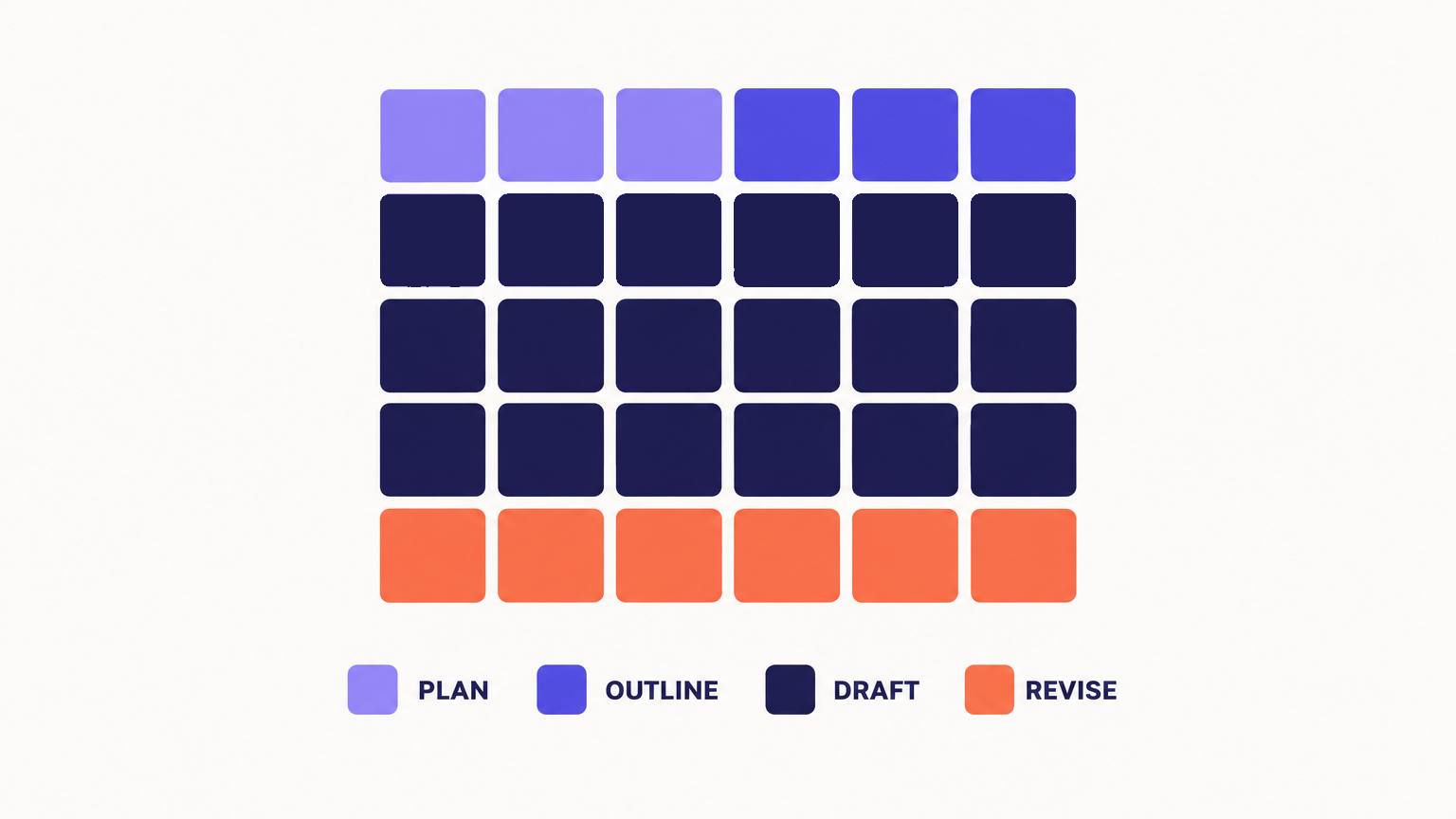
Four phases, each with one job. Click a phase to see the tasks and what you should have at the end of it.
Decide who the book is for and what it promises.
Tasks
- Write one sentence: this book helps [reader] go from [problem] to [result].
- List the questions clients ask you most; each strong one is a chapter candidate.
- Gather what you already have: talks, posts, slide decks, client notes, recordings.
Done when: A one-sentence promise, a reader description and a folder of source material.
Plan your daily word count
Set the length of the book and how often you can write. The planner spreads the words over the 18 drafting days.
13
Writing days in the draft phase
2,300
Words per writing day
3,000
Words per chapter
A solid pace. Plan two sessions on writing days, or draft from your talks and notes.
The chapter template
Every chapter of a practical book can follow the same shape. Using one template is what lets you draft a chapter in two or three sessions.
CHAPTER [N]: [Title that names the result]

OUTCOME: After this chapter the reader can [specific action].

1. OPENING (about 300 words)
   A real situation: a client, a mistake, a moment that shows the problem.

2. THE IDEA (about 600 words)
   The principle in plain words. Why the common approach fails.

3. THE METHOD (about 1,200 words)
   Step 1: ___
   Step 2: ___
   Step 3: ___
   One example per step, from your own work.

4. PROOF (about 400 words)
   A case, a number with its source, or a before-and-after.

5. EXERCISE (about 200 words)
   One task the reader can do today.

6. TAKEAWAYS AND BRIDGE (about 150 words)
   Three points to remember. One line that leads into the next chapter.

[CHECK] notes: ___
What slows a fast book down
01
Researching while drafting
Every stop to look something up costs the momentum of the session. Mark it [CHECK] and keep going.
02
Writing for everyone
A book for every reader has no clear chapter order. Write for the one reader in your promise sentence.
03
Editing yesterday's chapter
Rewriting before the draft is complete means some chapters get polished and others never get written.
04
Skipping the fact check
Speed is fine in the draft and never in the facts. Every number, quote and claim gets checked in the revise phase.
AI-assisted shortcut
Draft from your own material, not from a blank page
The slow part of a fast book is turning what you know into chapters. AIWriteBook's nonfiction book writer follows the same order as this method: basics and audience, details, structure, outline, then writing. In the details step you upload up to ten reference files, such as your slide decks, PDFs, transcripts and notes, and turn on citations so the draft points back to its sources.
The structure step offers book structures and chapter templates with learning outcomes, exercises and disclaimers, and the outline picks the most relevant pieces of your reference material for each chapter. A writing style built from 6 to 10 paragraphs of your own writing in the writing style builder keeps the draft sounding like you.
If your knowledge lives in talks, podcasts and videos, Expert Book builds the book from those sources plus a short voice interview about the gaps, in your voice, with nothing made up and the sources listed at the end. For days 25 to 30, the Book Editor gives you an editorial letter, line edits and a proofread.
Frequently asked questions
Can you really write a nonfiction book in 30 days?
A short practical book of 20,000 to 40,000 words, yes, if you already know the subject and you plan before you draft. Memoir, narrative nonfiction and research-heavy books usually need longer.
How many words a day do I need?
Divide the book length by your drafting days. A 30,000-word book over 18 drafting days is about 1,700 words a day; with five writing days a week it is closer to 2,300.
Does writing fast hurt quality?
Not when the speed comes from planning. The decisions about reader, promise and structure are made before drafting, and the revise phase is kept for structure, facts and sentences.
What should I do after the 30 days?
Send the revised manuscript to a professional editor or beta readers, then work on the title, subtitle, description and cover while the edit is underway.
Decide early, draft daily, check everything
The 30-day method works because each phase has one job. Three days to fix the reader and promise, three to build the outline, eighteen to draft at a steady pace and six to revise and verify.
For the bigger picture, read the nonfiction book writing guide and how to create a book outline. When you start drafting, first draft writing tips and writing 10,000 words a day with AI help with pace, and revision vs editing explains what to fix first. Before you publish, check your numbers with fact-checking statistics and verifying technical details.
Free tools help along the way: the outline generator for days 4 to 6, the word counter for the daily target, and the title generator and subtitle generator when the draft is done. Coaches and consultants will find more in AIWriteBook for self-help authors.
This is one route to a finished manuscript; our how to write a book guide covers the others.