

Short answer
Revision
Re-seeing the book. You change what happens, in what order, to whom, and why it matters. Whole scenes move, merge or disappear.
Editing
Fixing how it is told. The story stays put; you change words, sentences, rhythm, consistency and errors.
A quick test: if the change would alter the outline, it is revision. If the outline stays identical, it is editing.
Why the order matters more than the effort
Picture this. You finish a 90,000-word draft and spend two weekends making chapter four sing: every adverb weighed, every line of dialogue trimmed. Then a beta reader tells you the middle sags because chapters four and five do the same job. You merge them. Half of those two weekends is now in the trash folder.
That is the real cost of mixing the passes. Line work is slow and precise, and it only pays off on text that will survive. Revision decides what survives. So revision comes first, even though editing feels more productive because you can see the page getting cleaner.
There is a second, quieter cost. When you edit while revising, your attention keeps dropping to the sentence in front of you, and you stop seeing the book. Structural problems are only visible from a distance: a subplot that vanishes in act two, a villain who shows up too late, a midpoint that changes nothing. You cannot spot any of them with your nose against a comma.
Revision is a decision about the book. Editing is a service to the sentence. Make the decisions first.
Revision vs editing, side by side
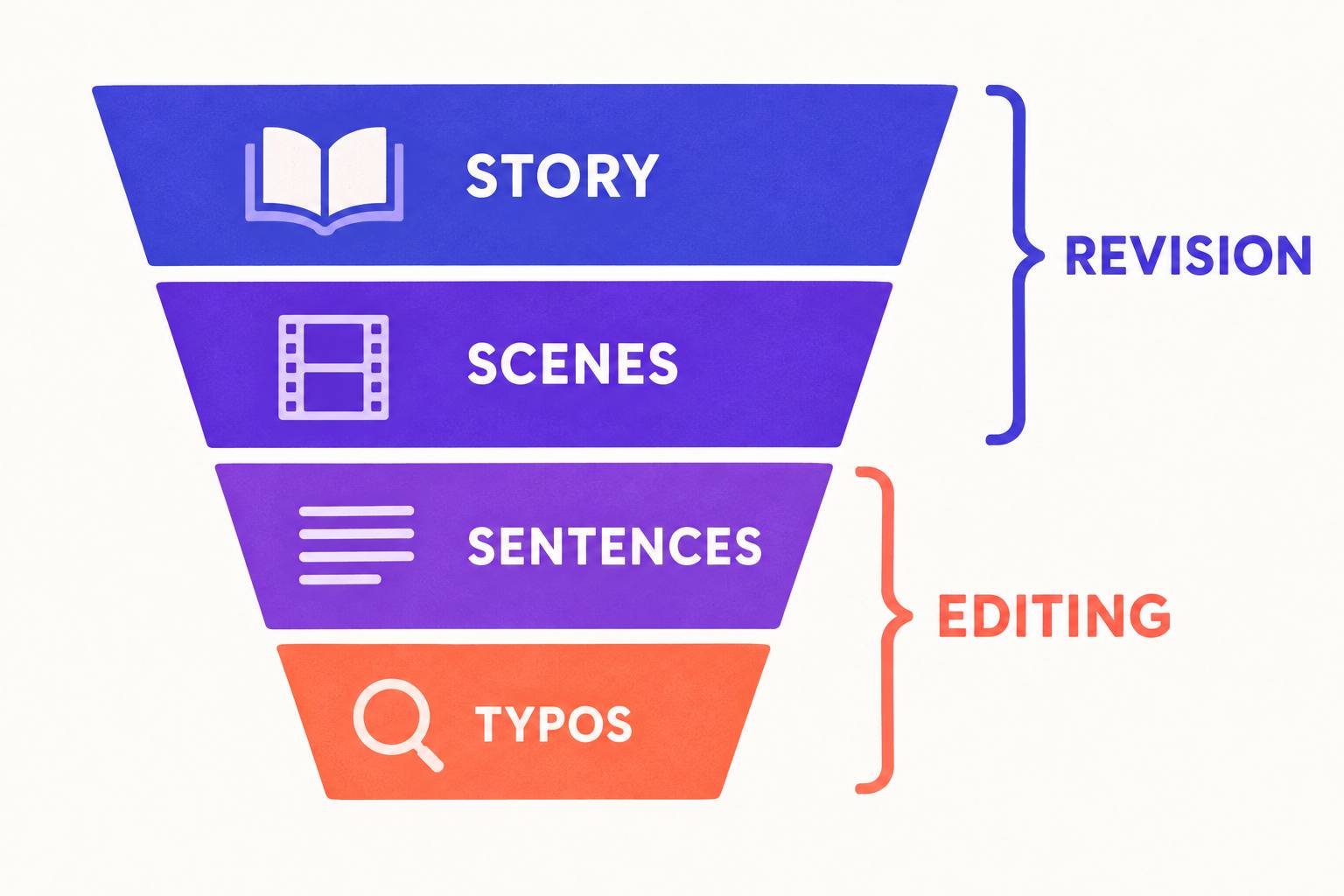
The two passes ask different questions, work on different units of text and need a different state of mind. The ladder below shows the zoom level of each one.
| Aspect | Revision | Editing |
|---|---|---|
| The question it asks | Does this story do what I want it to do? | Does this sentence say what I mean, cleanly? |
| Unit of work | The book, the act, the chapter, the scene | The paragraph, the sentence, the word |
| Typical changes | Cut a subplot, merge two characters, move the reveal, rewrite a scene from another POV | Tighten wording, fix repetition, smooth rhythm, correct grammar and typos |
| Best tools | Reverse outline, index cards, beta-reader notes, an editorial letter | Read-aloud, a style sheet, a grammar checker, line-by-line suggestions |
| Mindset | Ruthless and far away. Nothing is sacred. | Patient and close. Respect the voice. |
| Professional equivalent | Developmental edit, manuscript assessment | Line edit, copyedit, proofread |
| You are done when | Your reverse outline has no scene you can't justify | A read-aloud runs without a single stumble |
The confusing part is vocabulary. Publishing calls the big-picture pass a "developmental edit", so the word editing gets stretched over both jobs. Whatever you call them, they are still two jobs.
Quiz: revision or editing?
Eight real notes from a draft. Decide which pass each one belongs to. The pattern clicks fast once you try it.
1.The mentor character only appears in chapters 2 and 19.
2."Suddenly" appears 41 times in the manuscript.
3.The heroine never makes a choice; things just happen to her.
4.Her eyes are green in chapter 3 and hazel in chapter 12.
5.Chapters 7 and 8 both end with the same argument.
6.Long dialogue exchanges have no beats, so readers lose track of who speaks.
7.The twist lands at 90% of the book, after readers have already guessed it.
8.Every chapter opens with a weather description.
0 of 8 correct
The five-pass method for self-revising a novel
Each pass has one job and a clear exit. Resist the urge to fix lower-level problems early; note them in the margin and keep moving.
- 1
Rest, then read cold
Leave the draft alone for at least two weeks, longer if you can. Then read it fast, ideally in a format you didn't write it in, such as a PDF on a tablet. No fixing. Only short notes: "bored here", "why does she trust him?", "forgot about the brother".
Exit: a page of notes and a gut sense of the book's biggest problem.
- 2
Reverse outline and structural revision
Write one line per scene: what happens, and what changes because of it. Scenes where nothing changes are your first suspects. This is where you cut, merge, reorder and add. If index cards help you see it, use them; our guide to plotting with index cards works just as well backwards on a finished draft.
Exit: an outline in which every scene earns its place.
- 3
Scene revision
Now go scene by scene. Does each one open late and leave early? Is the POV right? Does the character want something on the page? Rewrite whole scenes here when needed. The pacing guide has a checklist for scenes that drag.
Exit: every scene works on its own and hands off to the next.
- 4
Line edit
Only now does the sentence get your full attention: rhythm, word choice, repetition, clarity, voice. Read dialogue aloud. Tighten. If your prose tends to bloat, the sibling guide on writing tighter prose gives you specific cuts to make.
Exit: you can read any page aloud without wincing.
- 5
Copyedit and proofread
The mechanical pass: spelling, punctuation, consistency of names and timelines, and typos introduced by all the earlier passes. Run a free grammar check on each chapter, and keep a style sheet so "OK" doesn't become "okay" halfway through.
Exit: a clean file ready for formatting.
How long should each pass take? There's no fixed ratio, but a useful warning sign: if you are still in pass two after a month, you may be rewriting the book rather than revising it. That's fine, just name it and plan it as a new draft.
One paragraph, two treatments
Same source text, given one revision note and one editing note. Notice that the edited version is better written, but the revised version is a different scene.
Draft
Mara walked into the kitchen and saw that her father was sitting at the table, which was unusual because he normally left for work very early in the morning. She felt really nervous. He told her that the bakery was going to be sold and that there was nothing she could do about it. She ran out of the house crying.
Edited (the story is unchanged)
Her father was at the kitchen table. At seven on a Tuesday, he should have been two hours into his shift. Mara's stomach dropped before he said a word. "We're selling the bakery," he said. "It's done." She was out the door before he could see her cry.
Same events, same order. Tighter, more concrete, better rhythm.
Revised (the story changes)
The buyer's card was propped against the sugar jar, where her father knew she would find it. Mara read it twice, then slid it into her apron pocket. He wasn't going to tell her. Fine. She would find out who the buyer was before he did.
The revision note was "Mara is passive; she only reacts." Now she acts, keeps a secret and sets up a new plot thread. The outline changed, so this is revision. It will still need its own line edit later.
Mistakes that cost weeks
- Polishing chapter one forever
- The opening gets revised twenty times because it's what you reread every session. Write a note, move on, and return to it last, when you know what the book actually sets up.
- Calling a proofread "revision"
- Fixing typos across the draft and declaring it revised skips the step where the story gets better. If nothing in your outline changed, you edited.
- Revising without a reverse outline
- Structural problems hide inside 300 pages of prose. On a one-page outline, a sagging middle or a missing subplot is obvious in a minute.
- Taking every beta note literally
- Readers are excellent at telling you where something is wrong and unreliable at telling you how to fix it. Treat their notes as symptoms; the diagnosis is your revision job. Our guide on finding beta readers covers what to ask them.
- Hiring the wrong editor first
- Paying for a copyedit on a draft that still needs structural work means paying twice. A developmental editor or a manuscript assessment belongs before the line work, not after. The editor hiring guide explains the differences.
- Line editing the voice out of the book
- Over-editing sands every sentence to the same neutral shape. Keep a few odd, rough lines that sound like you. Correct is not the same as good.
AI-assisted shortcut
Get both passes on one manuscript, in the right order
The hard part of self-revision is distance: you can't read your own book cold. That is exactly where an outside read helps, human or AI, as long as it gives you the big picture before the sentences.
The Book Editor in AIWriteBook is built around that order. The review pass reads the whole manuscript and writes an editorial letter with a chapter-by-chapter map: what each chapter is doing, where pacing drops, which threads go missing. That's your revision list. Then line edits and a proofread go chapter by chapter, each suggestion marked Objective or Optional, and nothing changes in your text until you accept it.
For the scene rewrites in between, the chapter AI chat lets you ask in plain words, for example "make Mara act on the news instead of running away", and shows the changes as a diff you accept or reject one by one. If your draft lives in Word, import the .docx and your text comes in unchanged, with chapters detected.
Free revision checklist (copy it)
Run the revision questions before you touch the editing ones. Paste it into your notes app or the front of your manuscript file.
REVISION (story level) - answer before editing
[ ] Can I state the book's central question in one sentence?
[ ] Does the protagonist make the choice that resolves the climax?
[ ] Reverse outline: does every scene change something?
[ ] Are any two scenes doing the same job? Merge or cut.
[ ] Is every subplot introduced by the 25% mark and paid off?
[ ] Does the midpoint change the protagonist's goal or strategy?
[ ] Is each POV choice the best one for that scene?
[ ] Does the opening promise what the ending delivers?

SCENE level
[ ] Each scene: who wants what, and what stops them?
[ ] Does it start late and end early?
[ ] Does it end on a change, a question or a turn?

EDITING (line level) - only after the above
[ ] Read dialogue aloud
[ ] Cut filler words and repeated tics
[ ] Vary sentence length in action scenes
[ ] Check names, ages, dates, eye colors against a style sheet
[ ] Proofread on a different screen or on paper
Revision vs editing: questions authors ask
Not quite. Rewriting means drafting text again from scratch, which can happen inside a revision when a scene needs it. Revision is the wider process of re-seeing the book and deciding what to change; some of those changes are cuts or moves that need no new text at all.
There's no standard number. Many authors do two or three structural passes before line editing, and fewer as they gain experience. A better test than counting drafts: stop revising when your reverse outline has no scene you can't defend.
You can fix an obvious typo while you revise, but don't line edit during revision. Every hour of polish on a scene that later gets cut is lost, and close reading stops you from seeing the structure.
It's the professional version of revision feedback. A developmental editor tells you what to change about the story; you do the revising. Line editing, copyediting and proofreading are the editing side.
Yes, do at least one structural pass first. Beta readers are most useful on a draft where you've already fixed what you can see, so their notes reveal what you can't.
The bottom line
Revision changes the book. Editing changes the sentences. Do them in that order, give each its own pass, and you stop paying for polish on pages that won't make the final cut.
When the revision is done and you are ready for the line-by-line work, the book editing guide walks you through every editing stage up to a publish-ready file.