

On this page
The market in one minute
Audiobooks have been the fastest-growing book format for more than a decade. The Audio Publishers Association has reported year-over-year US revenue growth for more than a decade, and US audiobook revenue now runs above $2 billion a year. Listeners skew younger than print readers, and many of them listen while commuting, exercising or doing chores, time that print and ebooks cannot reach.
10+ years
of consecutive US audiobook revenue growth reported by the APA
About 9,300
words per finished hour of audio, the figure ACX uses for estimates
6 to 11 hours
of audio for a typical 55,000 to 100,000-word novel
For an indie author the interesting part is not the size but the gap. Far fewer titles exist in audio than in ebook, so a book that competes with thousands of ebooks in its category may face a few hundred audiobooks. Genres with heavy readers, such as romance, thriller, fantasy and self-help, are where audio listeners concentrate.
AI narration vs human narration
Human narration is still the premium product. A skilled narrator performs characters, carries emotion and gives a series a recognizable voice, and listeners in fiction notice. Rates on ACX are usually quoted per finished hour; a 10-hour novel can cost a few thousand dollars before you sell a copy.
AI narration has become good enough for a large share of non-fiction and a growing share of fiction. It costs a small fraction of studio narration, finishes in hours instead of weeks, and lets you produce a whole backlist at once. Its weak spots are long emotional dialogue, unusual names and humor that depends on timing.
A practical rule: use AI narration for non-fiction, for testing whether a backlist title has an audio audience, and for languages you could never afford to cast. Hire a human for the flagship book of a fiction series whose audio sales already justify it. Our guide to AI audiobook narration covers voice choice and pronunciation fixes in detail.
Production options and what they cost you
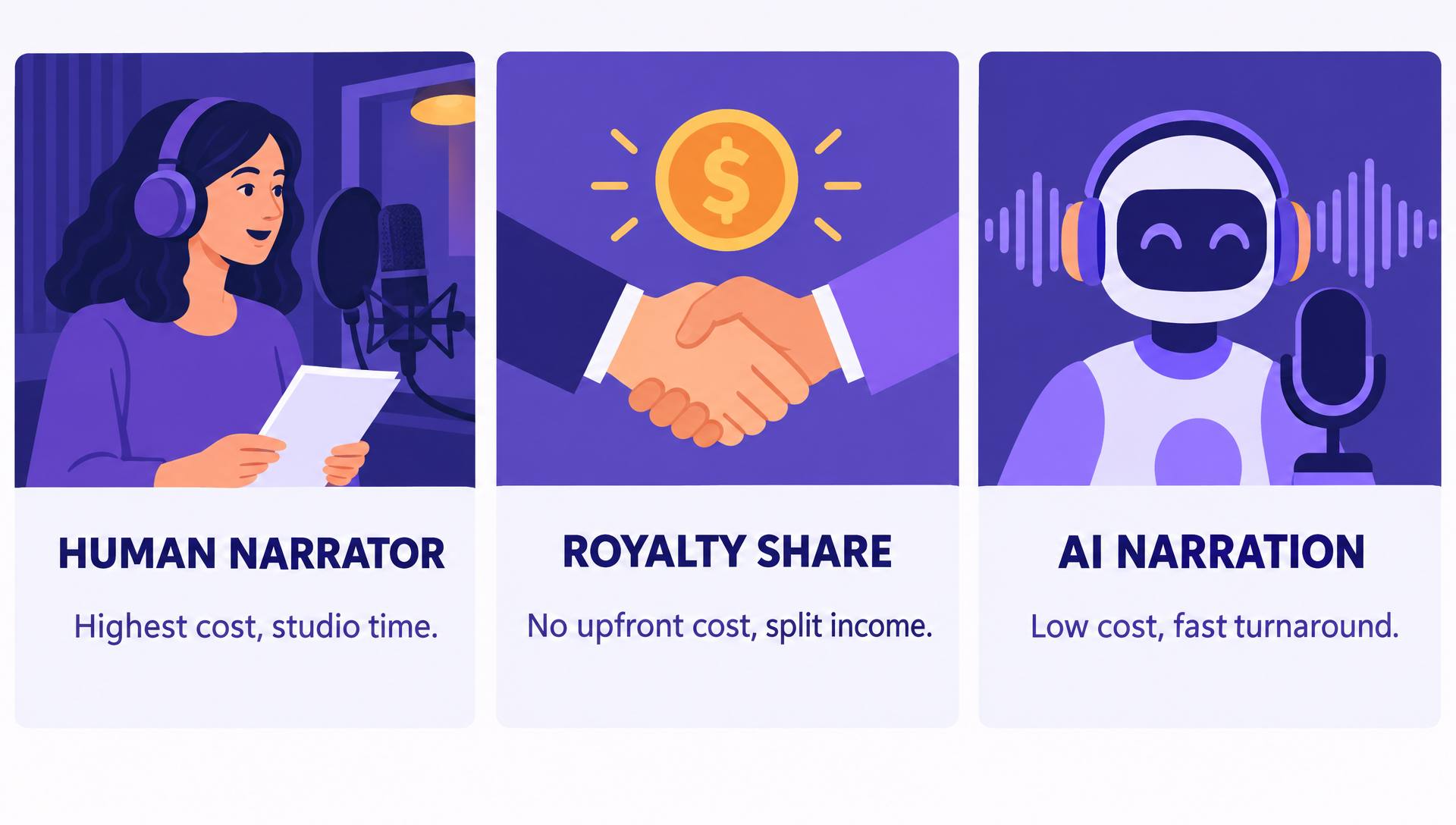
There are three ways to get a finished audiobook, and each shifts cost and risk differently.
| Path | Upfront cost | Time to finish | Best for |
|---|---|---|---|
| Pay a human narrator per finished hour | Highest, often thousands per title | 4 to 10 weeks | Fiction flagship titles with proven demand |
| Royalty share with a narrator | None | 4 to 12 weeks, if a narrator accepts | Authors with a sales track record narrators trust |
| AI narration | Low | Hours to days | Non-fiction, backlists, translations, tests |
AIWriteBook includes an audiobook generator that narrates a book you wrote or imported, chapter by chapter or as one merged file, so the manuscript and the audio stay in one place. To hear a sample on a short text before committing, try the free audiobook tool.
Distribution channels
Pick a channel to see who it reaches and what to watch for.
ACX (Audible, Amazon, iTunes)
The largest single audience. ACX's own platform expects human narration; AI voices reach Audible mainly through Amazon's Virtual Voice program for eligible KDP titles. Exclusive distribution pays a higher royalty than non-exclusive.
Store policies on AI narration change often. Read each store's current terms before you upload, and disclose AI narration wherever it is asked.
Royalty models, side by side
On ACX, exclusive distribution to Audible, Amazon and Apple pays 40% of retail, and non-exclusive pays 25%. Choosing a royalty share deal with a narrator splits that royalty between you, usually 50/50, for the length of the contract.
Wide distributors pay a share of what each store pays them, with the percentage depending on the store and the sale type (retail, subscription, library). Wide earns less per unit on Audible but reaches listeners Audible cannot.
The math that matters is cost recovery. A title that cost $3,000 to narrate needs hundreds of sales to break even. A title that cost a small fraction of that with AI breaks even on its first few dozen. This is why many authors now produce audio for their whole backlist with AI and reserve human narration for books that have earned it. For the Audible-specific steps, read our Audible publishing guide.
Your manuscript is already most of an audiobook
Write or import your book in AIWriteBook, then generate narrated chapters from the same manuscript you export to KDP.
ACX alternatives worth knowing
ACX is not the only door into audio, and for AI-narrated books it is often not the right one. The realistic alternatives are Findaway Voices by Spotify for wide retail and library distribution, Google Play Books and Kobo for direct sales, Amazon's Virtual Voice for eligible KDP ebooks, and selling direct from your own site or a store such as BookFunnel for listeners on your mailing list.
Each trades reach, royalty and control differently. Our comparison of ACX alternatives goes platform by platform, and how to find an audiobook narrator helps if you decide a human voice is worth it.
Audiobook readiness checklist
Tick what you already have. Anything unticked is the next thing to fix before you produce audio.
0 of 8 ready
Not sure who holds your audio rights? Start with publishing rights explained.
Audiobook FAQ
For a book that already sells as an ebook, usually yes, especially if production cost is low. Audio reaches listeners who rarely read, and fewer competing titles exist in audio than in ebook.
Not through ACX's standard upload, which expects human narration. Eligible KDP ebooks can reach Audible through Amazon's Virtual Voice program. Other stores such as Spotify, Google Play and Kobo accept AI-narrated titles under their own disclosure rules.
At roughly 9,300 words per finished hour, a 60,000-word book is about 6.5 hours. Length affects retail price on some stores, so check how your distributor sets prices.
Yes. Audiobook covers are square, typically 2400 x 2400 pixels, so adapt your ebook cover rather than cropping it.
Exclusive pays more per Audible sale; wide reaches Spotify, libraries and other stores. If your readers are mostly on Amazon, exclusive is simpler. If you already sell wide in ebook, wide audio usually fits better.
Where to start
Take your best-selling ebook, make sure the text works when heard, and produce it in audio with the cheapest method that meets your genre's quality bar. Measure its sales for three months, then decide whether the rest of the backlist follows and whether any title earns human narration.
Audio is one branch of publishing on Amazon; the Amazon KDP guide covers the ebook and print side.