

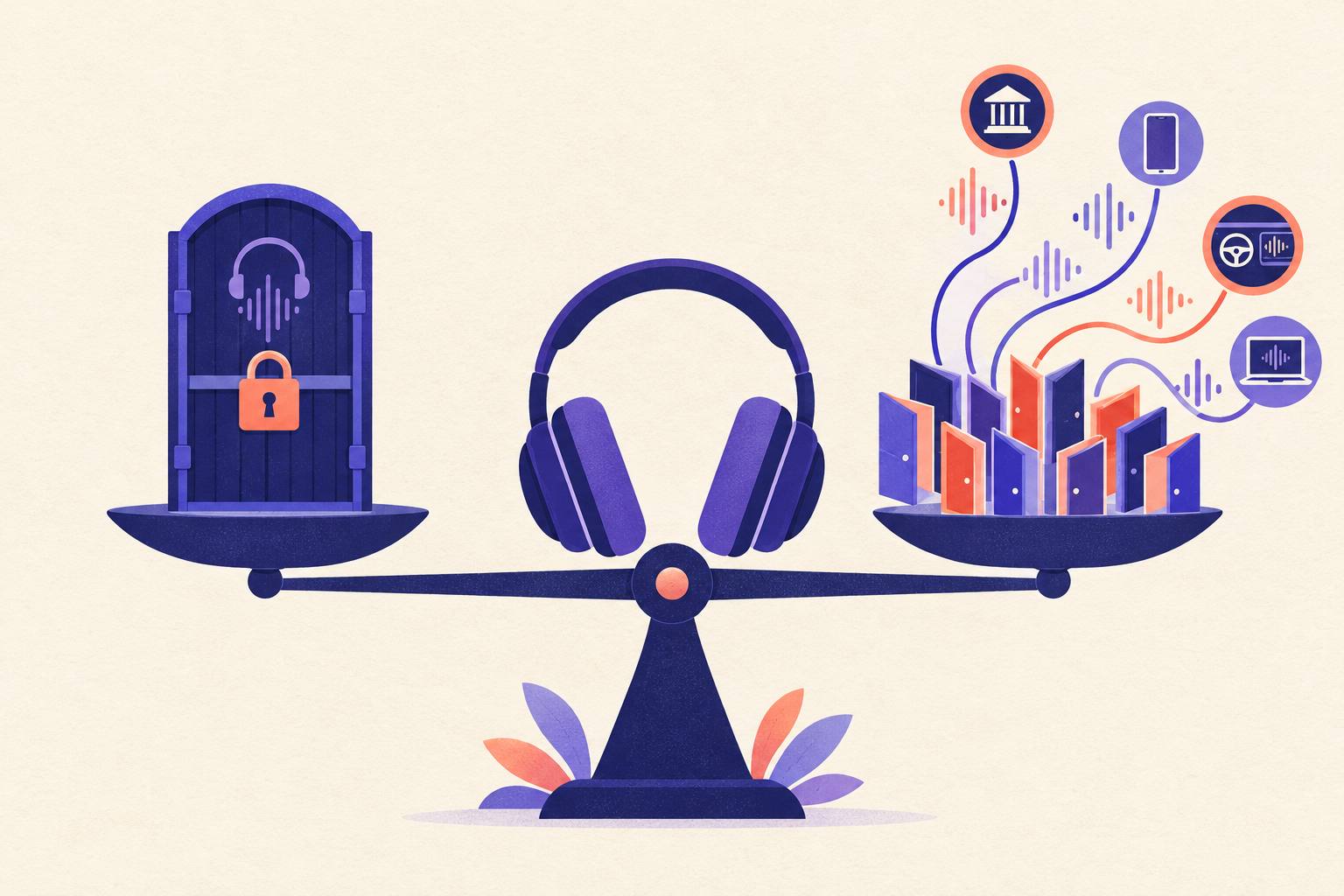
Which one, in one line each
ACX exclusive
Your narrator is on Royalty Share, or Audible, Amazon and Apple already bring you almost all of your audio buyers.
Voices by INaudio only
You paid for the narration, your readers are spread across stores and libraries, and you want to set your own price.
ACX non-exclusive plus Voices
You want ACX's direct Audible dashboard and promo codes, and every other store and library through Voices.
Head to head on the terms
Rates and rules as published on ACX's and INaudio's help pages in October 2026. Both companies change terms, so check their pages on the day you sign.
| Term | ACX | Voices by INaudio |
|---|---|---|
| What you keep | 50% exclusive or 30% non-exclusive, on cash sales and on Audible's member pool | 80% of what each store pays INaudio |
| What the store pays on | Net receipts on cash sales; member plan value split by listening on memberships | 40% to 50% of list price a la carte, 30% to 40% on subscriptions, 25% to 45% on revenue-share deals |
| Who sets the price | Audible; you can suggest a price | You set a retail price and a separate library price |
| Exclusivity | Your choice; exclusive gives Audible seven years of distribution rights | None |
| Where it sells | Audible, Amazon and Apple Books, in nine marketplaces | 30+ retailers, subscription apps, libraries and K-12 platforms, including Audible |
| Libraries | No | Yes: OverDrive, Hoopla, bibliotheca and others |
| Spotify | No | Through Spotify for Authors, which pays you directly with no INaudio fee |
| Finding a narrator | Built-in marketplace with auditions, pay per finished hour or Royalty Share | Distribution only; bring finished audio |
| AI narration | Human narration only unless authorized by ACX | Only unmodified packages from Google Play Books, ElevenLabs or Spoken Press, sent to the stores that accept them |
| Promo codes | US and UK | Scheduled price promotions at Apple, Barnes & Noble and Chirp |
Audible delivery through Voices needs the ebook to be live on Amazon, and Audible pays its distributors on its own terms rather than on your list price.
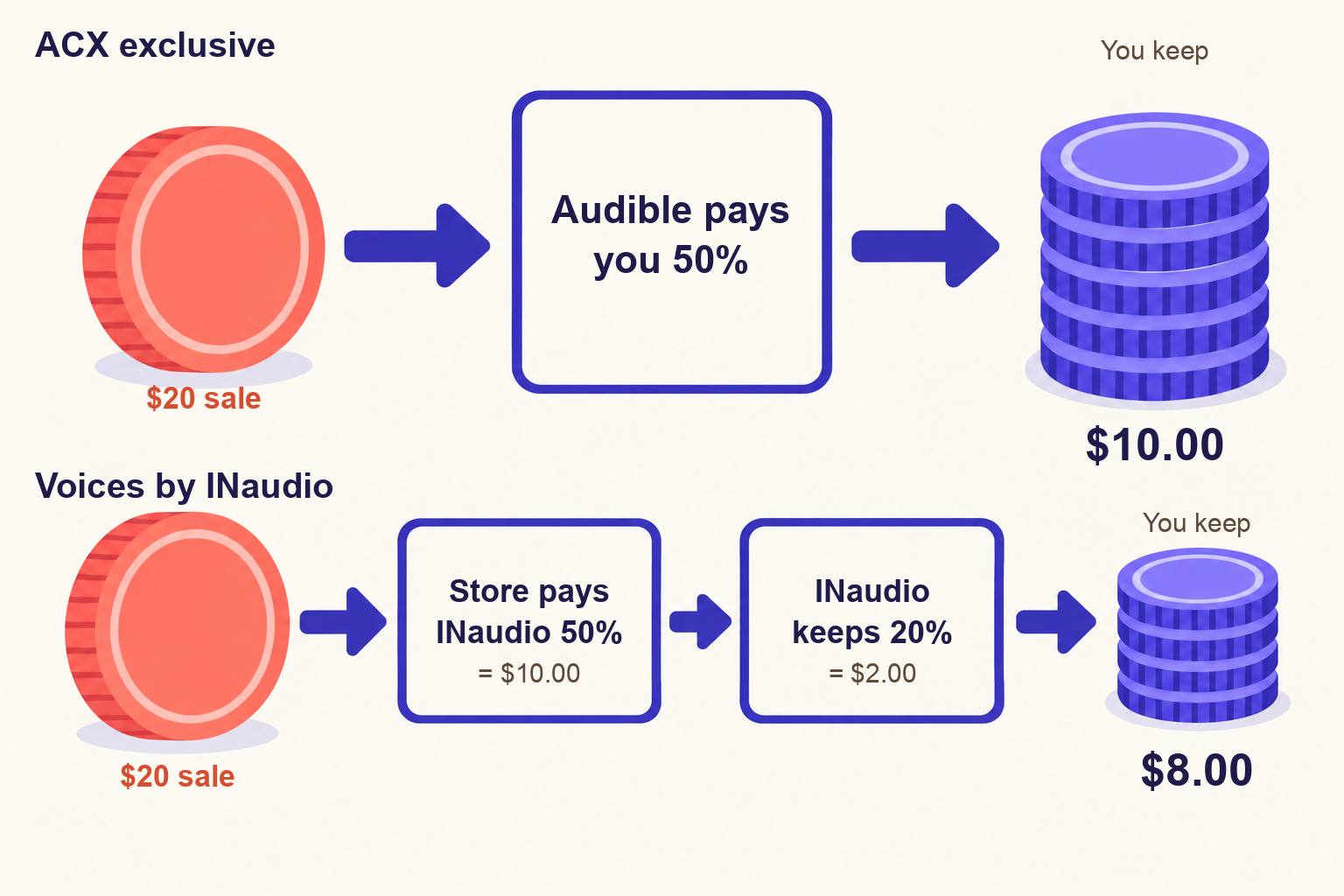
Where a $20 sale goes
Percentages on different bases are the reason this comparison confuses people. Here is one $20 cash sale, before any store-level deductions, on each route.
| Route | Math | You get |
|---|---|---|
| ACX exclusive, cash sale | 50% of $20 | $10.00 |
| Voices, store paying 50% of list | 80% of $10 | $8.00 |
| Voices, store paying 40% of list | 80% of $8 | $6.40 |
| ACX non-exclusive, cash sale | 30% of $20 | $6.00 |
| Voices, subscription paying 30% | 80% of $6 | $4.80 |
And the member pool?
Most Audible listening is paid with a membership, not cash. Under the new model, each member's monthly plan value, after taxes and fees, is split across the titles they listened to in proportion to each title's price, and you get your 50% or 30% of your slice. Say a member's plan value came to $12 that month. If your book was the only thing they listened to, exclusive pays you $6. If they also finished two other books at the same price, you get a third of that: $2. Nobody can tell you in advance which month you will have. That is why the cash-sale table above is the only part you can compare like for like.
If your ACX titles still sit on the legacy 40% and 25% rates, the legacy model ends at the close of 2026. Enrolled titles switch on the first of the next month.
Break-even calculator
The real question is not 50% against 80%. It is how many of your listeners you lose by staying exclusive, and how many of them would follow you to Audible anyway. Move the three sliders.
Per 100 buyers, cash sales
Going wide earns $35.00 more per 100 buyers at these settings.
Exclusive only wins if at least 32% of your other buyers would follow you to Audible.
Assumes ACX at 50% or 30% of list on cash sales and Voices at 80% of a 45% store rate, the middle of INaudio's published 40% to 50% a la carte range. Subscription and library income through Voices pays less per listen but adds listeners ACX cannot reach. Audible's member pool is left out because it cannot be predicted.
The number to remember: 64%
Run the formula and one threshold falls out of it. If Audible, Amazon and Apple already bring you about 64% or more of your audio buyers, exclusive beats wide on cash sales even when none of your other buyers would follow you. Below that, the answer turns on how loyal those other listeners are. Library patrons on Hoopla and Spotify listeners on Premium rarely follow, because they are not paying per book in the first place.
For the ebook and paperback side of the same math, use the free royalty calculator.
The Royalty Share lock
Royalty Share is the one thing ACX offers that Voices has no answer to, and the one thing that decides the question for you.
On a Royalty Share deal, the narrator works for free up front and takes half of your royalty instead. Under the new model that means 25% to you and 25% to the narrator on an exclusive title, for seven years. ACX requires every Royalty Share title to stay exclusive, because it is the only way ACX can guarantee the narrator gets paid. These titles cannot use the one-time switch to non-exclusive that DIY and pay-per-finished-hour titles can request after 90 days on sale.
So if your audiobook was made on Royalty Share, Voices is off the table for that edition until the deal ends or you buy the narrator out. If you are still choosing how to pay a narrator, that choice is also your distribution choice. Our guide to finding an audiobook narrator walks through Royalty Share against per-finished-hour rates in detail.
Royalty Share in four facts
- Your royalty is split 50/50 with one narrator or producer
- The narrator's share runs for seven years
- The title must be ACX exclusive for the whole time
- It cannot be switched to non-exclusive
Running both at once
The hybrid setup is where most wide authors land: ACX non-exclusive for Audible's own dashboard, Voices for everything else. It works only if the two never deliver to the same store.
- 1
Choose non-exclusive on ACX
At the distribution step, pick non-exclusive. If the title is already exclusive, it needs 90 days on sale before ACX support can switch it, and the switch can take a few weeks to take effect.
- 2
Upload the same files to Voices
One mastered set works for both. ACX's spec is the stricter one: MP3 at 192 kbps or higher, constant bit rate, 44.1 kHz, RMS between -23 and -18 dB, peaks below -3 dB, and no file longer than 120 minutes.
- 3
Untick Audible, Amazon and Apple in Voices
ACX already delivers to all three, including Apple Books, which surprises a lot of authors. Two feeds into one store create duplicate listings and messy reports.
- 4
Set two prices in Voices
One retail price and one library price. Library licences are priced higher than retail on purpose, so do not copy the same number into both.
- 5
Connect Spotify for Authors
Share the title to Spotify from Voices or upload it in Spotify for Authors. Spotify then pays you directly, with no INaudio cut on those listens.
- 6
Keep the metadata identical
Same title, subtitle, series name, author and narrator credit everywhere, so stores and listeners can link the editions. A clean store description helps more than people expect; the free blurb generator drafts one from your book in a minute.
Three authors, three answers
Composite cases built from the terms above, not real accounts.
Cozy mystery series, book four
Narrated on Royalty Share. Ebooks are in Kindle Unlimited and most readers already listen on Audible.
Royalty Share makes it exclusive anyway, and with a readership that already lives on Amazon the 64% line is well behind her. The narrator splits the 50%, so she earns 25% for seven years without paying a cent up front.
ACX exclusive
Personal finance guide
Paid a narrator per finished hour. Sells ebooks wide, has a podcast audience, gets library requests.
His listeners are spread across Spotify, Apple and libraries, and a library licence on OverDrive pays far more than one retail copy. ACX at 30% keeps the Audible dashboard; Voices covers the rest and Spotify pays him directly.
ACX non-exclusive plus Voices
Six-book backlist, never in audio
Wants to test which titles have an audio audience before spending on narrators.
A cheap AI edition is the test, and neither a standard ACX upload nor a Voices upload of plain audio files takes it. Kobo, Google Play and direct sales do. The two or three titles that sell get a human narrator and the ACX or Voices decision later.
Neither yet
Mistakes that cost royalties
Comparing 50% with 80% as if they were the same thing
One is a share of Audible's receipts or member pool, the other is a share of what a store pays INaudio. Compare dollars per buyer, as in the table above.
Letting Voices deliver to Apple while ACX does too
ACX non-exclusive titles still go to Apple Books. Untick Apple in Voices or you will have two listings fighting each other.
Signing Royalty Share without reading the lock
It is free up front and exclusive for seven years. That is a fine trade for an Audible-heavy series and a poor one for a book whose readers borrow from libraries.
Leaving old titles on the legacy rates
The legacy model ends with 2026. A title that is not enrolled by then stops earning on Audible.
Forgetting the library price
Voices asks for a separate library price. Libraries expect to pay more for a licence than a listener pays for a copy, and copying the retail price leaves money on the table.
Expecting Voices to find your narrator
The narrator marketplace did not come with the split from Spotify. On Voices you bring finished audio; ACX is still the place with built-in auditions.
Audiobook Studio
The AI-assisted shortcut
Distribution is a form you fill in once. The expensive part of an audiobook is the recording, and that is where AI changes the math for a lot of authors.
In AIWriteBook's Audiobook Studio you narrate a book straight from the chapters in your editor. Pick one of 25 voices, or give every character their own voice, render chapter by chapter and listen as you go. A mispronounced name gets respelled and re-recorded on its own line. Exports come out mastered at a retail (-19 LUFS) or streaming (-14 LUFS) target as a merged MP3 with chapter markers, a ZIP of numbered chapter MP3s, or an M4B with cover art.
Those files go straight to Kobo Writing Life, where AI narration is credited as a synthesized voice, to Google Play Books, and to your own store through a delivery service such as BookFunnel. That makes the backlist test in the third example above cheap, and the titles that prove themselves get the human narrator, the ACX contract and the Voices upload.
Already have the book on KDP? Import the manuscript and you are a few steps from audio. Hear a voice on your own paragraph first with the free audiobook tool.
Store map template
Fill this in before you upload anything, so no store gets two feeds. Copy it into your notes.
AUDIOBOOK STORE MAP: [Book Title]

Narration: [human, paid per finished hour / human, Royalty Share / AI]
ACX: [exclusive / non-exclusive / not used]

Store              Delivered by
Audible            [ACX / Voices]
Amazon             [ACX / Voices]
Apple Books        [ACX / Voices]
Spotify            Spotify for Authors
Google Play        [Voices / direct]
Kobo               [Voices / Kobo Writing Life]
Chirp              Voices
Libraries          Voices
Own store          [BookFunnel / none]

Retail price: [$]
Library price (Voices): [$]
Narrator credit, same everywhere: [Name or synthesized voice]
FAQ
Is Findaway Voices still the same as Findaway Voices by Spotify?
No. Since August 1, 2025, the distribution side is Voices by INaudio, an independent company run by Findaway's founders, and Spotify kept only Spotify for Authors for its own store. Existing Findaway accounts moved over to INaudio.
Which pays more, Findaway Voices or ACX?
Per cash sale, ACX exclusive pays more: $10 on a $20 sale against $6.40 to $8 through Voices. Wide distribution pays more when a large share of your listeners buy outside Audible, Amazon and Apple, especially in libraries. The calculator above shows where the line falls for your book.
Can I use ACX and Findaway Voices at the same time?
Yes, if the ACX title is non-exclusive and you untick Audible, Amazon and Apple Books in Voices. An exclusive or Royalty Share ACX title cannot be distributed anywhere else.
Does Findaway Voices take a cut of Spotify sales?
No. Spotify listening is handled by Spotify for Authors, which pays you directly. INaudio's 20% applies to the other stores and libraries it delivers to.
Can I switch from ACX exclusive to Voices later?
For DIY and pay-per-finished-hour titles, ACX support can switch the title to non-exclusive once after 90 days on sale. Royalty Share titles cannot be switched.
Do Voices by INaudio and ACX accept AI narration?
ACX requires human narration unless it has authorized otherwise. Voices accepts digital narration only as an unmodified package from Google Play Books, ElevenLabs or Spoken Press, and sends it only to stores that accept it. Kobo Writing Life and Google Play Books take AI-narrated files you upload yourself.
The verdict
ACX wins the headline: $10 on a $20 cash sale is more than any store pays through Voices. Voices wins the map: libraries, Spotify, Chirp and every store outside Amazon and Apple, at a price you set. Which matters more depends on one fact you can check today, the share of your readers who already buy on Amazon. If it is high, or your narrator is on Royalty Share, stay exclusive. If it is not, go non-exclusive and let Voices cover the rest.
If you have not been through the ACX side yet, our Audible publishing guide covers the upload, and the wider list of ACX alternatives covers Kobo, Google Play and direct sales in more depth.
Audio is one branch of publishing on Amazon; our Amazon KDP guide maps the rest.